eBook - ePub
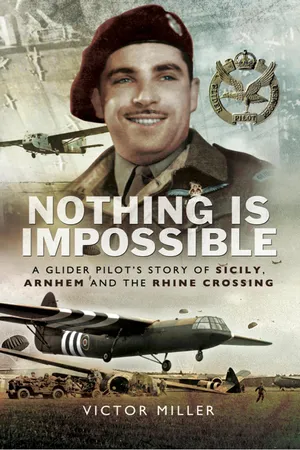
Nothing is Impossible
A Glider Pilot's Story of Sicily, Arnhem and the Rhine Crossing
- 408 pages
- English
- ePUB (mobile friendly)
- Available on iOS & Android
eBook - ePub
About this book
Battle is the severest test a man can be called upon to undergo; it can bring out the best in a man and the worst...The author of this book, Victor Miller, joined the Queen's Royal Regiment, at Guildford, upon the outbreak of the Second World War. He volunteered for the elite Glider Pilot Regiment upon its formation and passed, with above average marks, the RAF pilot training programme.From here, he was to take part in three of the most iconic airborne operations of the entire conflict. The invasion of Sicily, the Allies first attack in to Europe, where he was wounded and temporarily taken prisoner; Arnhem, where the 1st Airborne Division struck sixty-four miles behind enemy lines only to clash with two SS Armoured Panzer Divisions resulting in 80% losses in nine days; and the assault crossing of the Rhine, into Germany proper, with 'only' 30% losses.This remarkable story, jotted down shortly after each operation when the events were still vivid in the author's mind, is an astonishing record of skill, bravery, comradeship and resourcefulness which represents a fitting tribute to many fallen friends and colleagues. The book was published initially in 1994, before the author's death. This posthumous edition comes with brand new supplementary content, drawn together by the author's sons and family.
Information
Chapter 1
Early Army Life
Phase I – Stoughton Barracks Guildford
15th of January 1940 was my joining day in the Army; war had been declared on Germany three and a half months previous, and my papers had arrived about ten days before, directing me to report to Stoughton Barracks, Guildford, Surrey on the 15th of January.
I can well remember that day. It was cold and chilly, but I did not notice it that much. I left Thornton Heath Station at about 8.30 Hours and had to change at Clapham Junction Station for the Portsmouth train which had a halt at Guildford.
On reaching Clapham junction I found that I would have to wait about thirty minutes, so I wandered into the waiting room and dumped my haversack onto the floor. It was an old Army haversack and contained all my worldly possessions. As I glanced around the room, I noticed two other fellows sitting on the seats. Beside them were suitcases and packs, and some instinct told me that they were also bound for Stoughton Barracks. They seemed ready to enter into conversation so I asked them if they too were reporting to Guildford. They replied in the affirmative and from then on we entered into a lively conversation.
Our train rolled up and we entered a carriage. It was a pleasant run down through Esher, Cobham and Oxshott and as we entered Guildford we craned our necks in an endeavour to see our new home to be. Outside the station we found a number of other fellows who were waiting under the watchful eye of a sergeant in the Queen’s Royal Regiment, who seemed to spend most of his time cracking jokes.
Shortly afterwards, two Aldershot & District buses drew up beside us and we crowded into them. Ten minutes later we came up Stoughton Road and turned in through the gates of the Queen’s Royal Regiment barracks. As we passed by the old keep, and the iron gates shut behind us, jokes went around about us at last being imprisoned etc.
Our first step was to enter into the Guard Room and sit down where we could. Here we handed in all our particulars, i.e. number, name, etc. Up until now we had a national registration number, but now we were given our Army numbers (in my case No. 6093456).
After this long wait, we were shown our billets. Some were accommodated in the Old Stoughton Barracks themselves, whilst some of us were put into huts about 200 yards away. These huts proved very comfortable. Each one of the huts had a wireless set in each wing and we had folding spring beds with mattresses, sheets and four blankets.
Having explored our billets we were summoned by the sergeant who took us up to the Old Keep, which was apparently the store. Up the winding steps we went to the very top. From the slits in the side of the tower we had a magnificent outlook right across the town of Guildford two miles away and to the hills of the Hogs Back, the North Downs and St. Martha’s Chapel. To the north, pine trees rose in profusion and the air smelt keen and bracing.
We collected our rifles and bayonets (thickly coated in grease), our battle dress, overcoat, toilet requisites and under this heavy load we staggered back to our huts.
How comical some of the lads looked with their Army caps perched on their heads and clad in their civilian clothes. After this, we all adjourned to the N.A.A.F.I. Canteen and had tea and cakes.
No one slept well that night, the new surroundings and coarse sheets and blankets saw to that. We laughed and talked for some time before dropping off into fitful dozings. I eventually feel asleep at about 1 o’clock the next morning.
I awoke to the sound of the bugle, and for several moments could not fathom where I was and then it all came back to me in a rush. I was in the Army now! That bugle meant, ‘get out of bed’. Reveille was at 7.00 a.m., which was not so bad, no earlier in fact than I was used to in civilian life.
Most of us rolled out of bed sharp, but a few lingered. I made a dart for the ablutions; a really nice layout with porcelain bowls, hot and cold water, showers. A hot bathe and a cold shower soon brought one back to life. After this, was breakfast.
I was agreeably surprised with the menu, which I think consisted of porridge, marmalade or jam, followed by bacon, eggs and tomato. I must say, everyone seemed out to satisfy us. Mess orderlies hurried to and fro, and towards the end of the meal our Commanding Officer (Lt. Col. Pickering) came round asking ‘Any complaints’? Needless to say, there were none.
We did very little that day, except for an address by the CO in the gym. He spoke of the fine tradition of the Queen’s Royal Regiment, of its splendid achievements in the past and of its efforts in the last war, World War I.
Then soon after we got down to work and for weeks we pounded the barrack square, attended lectures and carried out, exercises. We were taught ways of field craft and carried out route marches, learned to draw maps and make out range cards. We learned to lay and aim, the best firing positions, and the use of cover.
The first few days in January 1941 were very cold and out on the parade ground the wind was biting. Sometimes my hands seemed too cold to hold a rifle. ‘Left right, left right, about turn, halt’! rang in our ears all day long, mixed in with the sergeant’s sarcastic remarks.
We were always well off in respect of non-commissioned officers (NCO’s), and our own Sargent was a really decent chap. Mind you, he could swear at us on parade, but off parade, you could not find a better man.
As January merged into February, the winds turned still colder and snow was indicated. We had become used to this sort of life now and when the snow did finally fall we were not so badly off. Almost before the snow reached a respectable depth, we were amongst it, snowballing for all our worth.
Shortly after the first fall of snow a great freeze set in and the parade ground was turned into ice like a sheet of glass, making parades impossible and our normal parade times were spent in the huts, listening to lectures and practicing loading positions, sight setting and several other things that could be carried out indoors.
Our huts were about 200 yards from the main barrack buildings down a slight slope and even the path here joining the two places was one slippery mess despite being composed of rough stones. One had to cling to the wall desperately when endeavoring to reach the barracks, and like everyone else, I found myself lying on my back.
This first snowfall of the year gradually thawed away, but shortly afterwards came a second and heavier fall. This snowfall came during the weekend and as usual a number of the recruits went home without passes on the Sunday. But they paid for it, for towards the evening a worse freeze than ever setin, bringing all road, and a great deal of rail traffic, to a halt; all those who had risked going home were caught out. Those living within 5 or 6 miles managed to walk back, suffering a great deal of hardship in doing so, but those who had traveled further afield—to London etc., were unlucky and failed to return that night. Of course the following morning the roll call showed all these absentees. Consequently, when they did turn-up, well, it was orders for them and a bit of being ‘Confined to Barracks’ by the CO
All this snow, together with dampness of our feet and wet clothes caused an epidemic of sore throats to arise and I was one of the first to catch this ailment. Every morning at 9 o’clock was the Sick Parade. For the next few days there was quite a crowd of us lining up outside the N.A.A.F.I.—our parading point.
After perhaps 30 minutes wait in a draughty corridor, one was taken into the Medical Inspection Room and stood in front of the Medical Officer, who would look at us with a calculating glance, ask us to open our mouths, peer down our throats and grunt. He would have a short word with the medical orderly, who would then lead us to another room where we would be given a glass of sweet tasting medicine.
The usual verdict was to take the medicine and then be fit for duty. That was my fate, so we were forced to tramp out of the gates, the cold air whistling down our throats and lungs as sore as hell, as we marched up Rydes Hill for a spot of field craft. There was very little we could do with all that snow on the ground, except make out target cards and take bearings. How thankful we were to get back to our billets and rest upon the beds, sucking throat tablets.
Our spirits rose, however, when it came to dinnertime and hot meals even though I experienced considerable difficulty swallowing food due to my sore throat.
Soon our initial training was passed, with plenty of physical training included in programmes for each day, from which I felt myself benefiting greatly. At first it seemed rather back-breaking, and our muscles ached for sometime after each bout of it, but later this effect wore off and I used to look forward to games of hockey, cricket etc.
Then shortly after the thawing of that severe January-February freeze the weather improved during March and April, and life became quite pleasant. The countryside around us discarded its bleak outlook and took on a gentler look as blossom and leaves started to come forth.
The sun shone forth from a cloudless blue sky for days on end, while the parade ground turned dry and dusty. How we sweated to the bellowing voice of our Sargent and the Sargent Major: ‘Quick march, left, right, left, right. About turn. Swing those arms! Ri-i-i-ight turn. Halt. Leave those caps alone, even if they are falling off your heads’.
We rather looked forward to our field training. It meant getting away from the barrack square for some hours. We would march off down to the common through dusty lanes and across the gorse-covered slopes of Broad Street Common and Rydes Hill. The air seemed heavy and every time we stopped along the way, our one desire was to lie down in the grass under the blazing sky and doze off; but under the steely eye of our sergeant, we dared not try it.
It always used to be a great relief to reach our allotted positions where we could lie down under cover and just watch for the supposedly approaching enemy. The first few minutes our sergeant would explain to us what our objective would be this time. He would direct us to positions that gave a good field of fire over the area, and then march off with the less lucky part of the platoon who were going to represent the enemy that afternoon. They would march to a place about 1000 yards away and try to advance and take our positions without being seen.
About once a week, usually on a Saturday morning, a route march would be carried out, commencing during the first few weeks with a distance of about 4 to 5 miles; which was increased in later weeks to about 12 to 15 miles. Sometimes these were carried out in ‘Field Service Marching Order’ and at other times in ‘Battle Order’.
From Saturday dinnertime, we were free for the remainder of the weekend. For those with special weekend passes proceeding away from Guildford was allowed. Those were issued at about the rate of one in every three weeks. For me, home was only 28 miles by road and 32 miles by rail, so I could be home in a short period of time when I had a pass. There were quite a number who went off home without a pass, just for the day. I did this two or three times. A bus left Guildford and went straight through to West Croydon just two miles from my home. This was the No. 408 (L.T.P.B.). There were too many ‘red caps’ (military police) in and around Guildford Station for one to get through, but for some reason or other they never paid any attention to the busses.
I had many a pleasant walk around Guildford and I often used to wander down through the town to the bridge over the River Wey and then take the towpath along the backs. Here I would laze for awhile and then proceed on to the foot of the hill that lead up the zigzag path to the summit, which gave a wide panoramic view to the south and ended at the ruins of St. Catherine’s Chapel. Below, one could watch the twisting path of the river and see the boaters upon it. Across the valley rose Pewley Downs and St. Martha’s Chapel, peering forth from her garment of foliage. Lying on the slopes of St. Catherine’s Hill, I would often fall into a deep slumber under the influence of the blazing sun.
Other times, I would walk up the High Street of Guildford to the Tunsgate and turn off up Pewley Hill on to Pewley Downs with its lovely views away to the north, west and south. From here I would follow the footpath across the downs to the foot of the hill that leads up to St. Martha’s Chapel, up through the beautifully wooded hills slopes until the spire came in sight. It was such a quaint church, hidden away miles from the nearest town, and over a mile from the nearest village. From the graveyard, one could get a magnificent view to the south, whilst on the right, the faint outlines of the Devil’s Punchbowl and Hindhead could be seen. The pine trees clustered around the base of the chapel gave it exceptional beauty that made me briefly forget the uniform that clad my body. As I gazed wistfully from the crest, I idly wondered if I would ever gaze out from this beautiful spot again, or how long it might be if I ever did. As the sun would sink behind the distant hills and the cool evening breeze set in, I would wander back to the barracks lost in thought until the sudden echoing of the bugle brought me back to reality once more.
Phase II.
After 14 or 15 weeks of training at the main barracks, we moved down to the Queen’s Camp about three-quarters miles from our now familiar hut homes. A footpath and a stretch of road connected these areas.
Queen’s Camp had only recently been completed and contained its own road complex. All the huts were built of wood. It must have been a good mile and a half around the perimeter. The huts were exactly the same as we had up at the old barracks. The only difference was that we now had to sleep on the floor instead of a bed, but we got used to it in time.
Down here at the camp we had more advance training, but also went over the old courses we had already taken, which we used to get rather bored with, but it was really to our advantage.
Our route marches became longer varying from 12 to 15 miles a day, lasting from 9.00 a.m. to about 3.00 p.m. Down the dusty lanes through Sutton Pitch, Worpelsdon, Woking, Jacobs Well and the district around Pirbright; these were my favorite routes and they were not too bad with regard to hills. The sight of the village inns would bring exclamations of longing from our throats, especially when some old yokel would be sitting outside in the shade sipping a large glass of beer or cider. More than once when we would halt near some house or cottage, the inhabitants would bring out some refreshments. Usually our officer or NCOs would turn a blind eye to these going on.
We did a number of cross-country runs and I think about the time we were ready to leave Guildford, we had reached our upper limit of health and fitness.
Whitsunday was drawing nigh, when we heard the first rumour that we were moving shortly and would be moving to a coastal town preliminary to embarking for (a) China, b) India, c) Africa and finally d) France. It was amazing how those rumours flashed around and about such wildly separated places.
New kit was issued to us and our old leather equipment was handed in with Bren Web replacing it. The day before the Whitsun holiday we were packing our kit bags and packs etc., polishing brass and blancoeing webbing.
Whitsunday turned out to be a beautiful day—such a brilliant blue sky studded here and there with white puffy clouds that drifted lazily. At 10.00 hours we had to take down our kit bags and stack them near the transport. Then we returned to our huts, donned our equipment and paraded outside in threes, ready for inspection, before moving off. We were in F.S.M.O. and having been standing at ease for about half an hour in the sun, we were feeling uncomfortable. After one hour of this, our shoulders were aching like mad with straps cutting down on our collarbones. Then our commander spoke, telling us we were not moving off that day after all, but would go tomorrow instead and that we could dismiss, return to our billets, and rid ourselves of our equipment. In one way we were glad, just for the sake of removing our packs from our shoulders, but in another way we were disappointed.
After dinner we went down and collected our kit bags from the pile and lugged them back to our billets. Then our officer called us together and told us that we would be moving off for sure tomorrow; and so we went to bed that night full of expectation.
The next day came bright and sunny and again by 10.00 hours we were paraded ready to move off. Soon after parading the word of command came: ‘Company, company, shun. Right turn. Quick march’ and we were off. For the last time we marched out through the gates of the barracks. Somehow I felt a little sorry at leaving this place that had been my home for so many months. But getting into our stride and with songs on our lips, the past was soon forgotten and a new future lay ahead—but exactly what?
The two and a half miles march towards Guildford Station seemed quite short and we marched along with swinging strides that soon brought us to High Street, where people gave us a cheer and a smile. Everybody was in good spirits and when we arrived at the station we found our train already waiting. After a few orders we were clambering onboard. We were not overcrowded and I managed to get myself a corner seat with a view out of a window.
A chocolate girl was on the platform and in a short space of time we had bought her out; this, together with our haversack rations, promised a good meal. It was delightfully cool in the carriage after the heat of the p...
Table of contents
- Cover
- Title Page
- Copyright
- Contents
- Preface
- Chapter 1: Early Army Life
- Chapter 2: Glider Training
- Chapter 3: North Africa
- Chapter 4: Sicily
- Chapter 5: Engagement
- Chapter 6: Capture
- Chapter 7: Return From Sicily
- Chapter 8: Return To England
- Chapter 9: Prelude To Arnhem
- Chapter 10: Arnhem
- Chapter 11: Landing At Arnhem
- Chapter 12: Oosterbeek
- Chapter 13: Three Days
- Chapter 14: The Shrinking Circle
- Chapter 15: The Sixth Day
- Chapter 16: The First Hope
- Chapter 17: How Much Longer?
- Chapter 18: Portents Of Doom
- Chapter 19: Retreat Across The Rhine
- Chapter 20: Out Of Arnhem
- Chapter 21: Nijmegen - And Home
- Chapter 22: Preparing For Wesel
- Chapter 23: To The Rhine
- Chapter 24: Landing Over The Rhine
- Chapter 25: On German Soil
- Chapter 26: Hamminkeln
- Chapter 27: Home Again
- Epilogue
- Afterword
- Post Script
- Appendix One
- Appendix Two
- Appendix Three
- Acknowledgements
Trusted by 375,005 students
Access to over 1.5 million titles for a fair monthly price.
Study more efficiently using our study tools.
Frequently asked questions
Yes, you can cancel anytime from the Subscription tab in your account settings on the Perlego website. Your subscription will stay active until the end of your current billing period. Learn how to cancel your subscription
No, books cannot be downloaded as external files, such as PDFs, for use outside of Perlego. However, you can download books within the Perlego app for offline reading on mobile or tablet. Learn how to download books offline
Perlego offers two plans: Essential and Complete
- Essential is ideal for learners and professionals who enjoy exploring a wide range of subjects. Access the Essential Library with 800,000+ trusted titles and best-sellers across business, personal growth, and the humanities. Includes unlimited reading time and Standard Read Aloud voice.
- Complete: Perfect for advanced learners and researchers needing full, unrestricted access. Unlock 1.5M+ books across hundreds of subjects, including academic and specialized titles. The Complete Plan also includes advanced features like Premium Read Aloud and Research Assistant.
We are an online textbook subscription service, where you can get access to an entire online library for less than the price of a single book per month. With over 1.5 million books across 990+ topics, we’ve got you covered! Learn about our mission
Look out for the read-aloud symbol on your next book to see if you can listen to it. The read-aloud tool reads text aloud for you, highlighting the text as it is being read. You can pause it, speed it up and slow it down. Learn more about Read Aloud
Yes! You can use the Perlego app on both iOS and Android devices to read anytime, anywhere — even offline. Perfect for commutes or when you’re on the go.
Please note we cannot support devices running on iOS 13 and Android 7 or earlier. Learn more about using the app
Please note we cannot support devices running on iOS 13 and Android 7 or earlier. Learn more about using the app
Yes, you can access Nothing is Impossible by Victor Miller in PDF and/or ePUB format, as well as other popular books in History & Military Biographies. We have over 1.5 million books available in our catalogue for you to explore.