- 20 pages
- English
- ePUB (mobile friendly)
- Available on iOS & Android
eBook - ePub
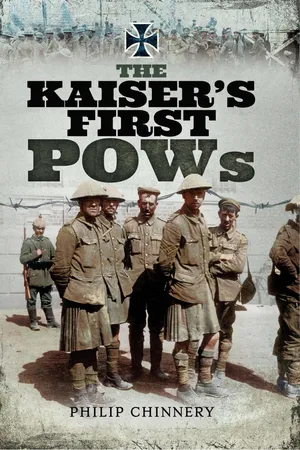
The Kaiser's First POWs
About this book
In 1915, the German government published a book entitled 1915 in an attempt to portray the Germans as a civilized people who were destined to win the war, who would treat their prisoners with care and compassion. The Kaisers First POWs is the first book to compare the official German view to the grim reality of captivity, as experienced by the prisoners.Dozens of original photos from 1915 tell the story as seen by German eyes. Compare them to the personal accounts from former prisoners who describe the reality of falling into the hands of the German Army and life as a prisoner of the Kaiser.By the end of the war, the Germans had taken approximately 2.8 million prisoners of war. This books describes the life and times of these prisoners and the manner in which the Germans dealt with the problems involved in accommodating them.
Information
Topic
HistoireSubtopic
Histoire de l'EuropeChapter 1
The Horrors of War
Although the German invasion of neutral Belgium horrified the world, it was an important part of the Schlieffen Plan, designed to avoid the French fortifications along the French-German border. The Germans were confident that they could defeat the French quickly, but the Belgian army put up a stiff resistance, slowing the German advance and allowing the British Expeditionary Force to join the fight. As the British Tommies embarked for the continent, the mighty British Empire began to stir and Canadians, Australians and Indians also began to prepare to join the war.
Although Britain did not maintain a large standing army like France and Germany, it was highly professional as the Germans discovered to their cost when they first met the 80,000-strong BEF at Mons, a small Belgian town, on 23 August 1914. The BEF formed up on the left flank of the French army and although outnumbered by about three to one, they managed to withstand the advance of the German First Army for forty-eight hours. They prevented the Germans from outflanking the French army, but when the Frenchmen began to retreat, the British had little alternative but to fall back too. British casualties were recorded at just over 1,600 but they had inflicted three times as many casualties on the Germans.
The two corps of the BEF retreated for two more days until the II Corps commander, General Horace Smith-Dorrien decided to stop and fight. Although he was disobeying the orders of General Sir John French, the BEF commander, his men were exhausted and in low spirits. On the morning of 26 August they reached Le Cateau and began to dig in. They were at a disadvantage from the start due to lack of cover on the open ground, with the Germans advancing from the higher ground to the north. The men and artillery of the BEF were badly exposed and the heavy German guns caused significant losses among the defenders. By the time the battle was over, 7,812 men had been lost and thousands more were captured. Although the German advance had been halted for a while, General French was livid that Smith-Dorrien had disobeyed his orders and he was eventually relieved of his position on health grounds.
One of the prisoners taken that day was 42-year-old Major Yate of the 2nd Battalion, King’s Own Yorkshire Light Infantry (KOYLI). He commanded one of the two companies that fought until all their officers had been killed or wounded and their ammunition was exhausted. Yate led his nineteen surviving infantrymen in a charge against the enemy and was taken prisoner. He was sent to Torgau prison camp, from where he escaped on 19 September. He was quickly apprehended by local workers who stopped him because of his unusual appearance and demanded to see inside his haversack. At this point he pulled out an open razor and cut his own throat rather than return to captivity. He was posthumously awarded the Victoria Cross on 2 August 1919.
The German army laid siege to the French forts at Maubeuge on 25 August 1914. Occupied by 47,000 French troops, the forts lay at the intersection of the Brussels and Liège railways that ran straight to Paris and were thus an important objective in the German Schlieffen Plan. On 29 August the Germans began a week-long bombardment of the forts and then attacked with 60,000 troops. On 7 September the defenders of the forts surrendered and 40,000 French prisoners were taken, along with several thousand allied stragglers who had sought refuge in the forts during the retreat.
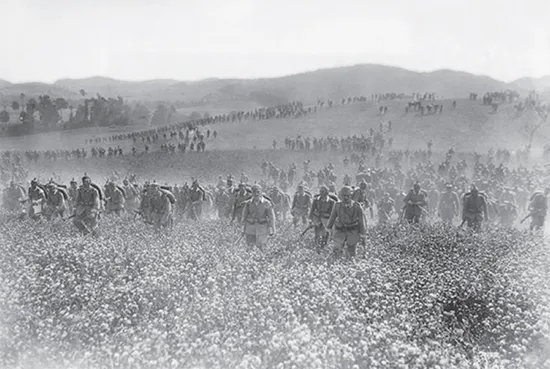
Regiments of German troops advance in open order across the fields of Belgium.
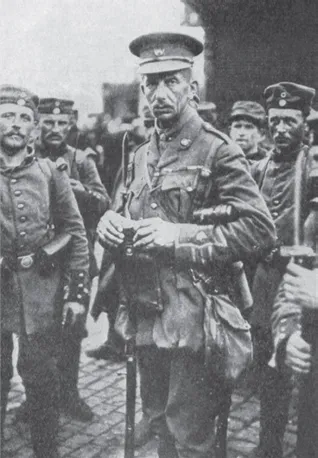
Major Yate of the 2nd Battalion, King’s Own Yorkshire Light Infantry was taken prisoner and imprisoned in Torgau camp from which he later escaped. When he was recaptured he took his own life and was posthumously awarded the Victoria Cross.
The retreat continued until 5 September 1914, when a French counter-attack from Paris began. Six French field armies and the BEF advanced along the River Marne and forced the German army to retreat north-west, leading to the First Battle of the Aisne and the ‘Race for the Sea’. Thereafter the conflict on the Western Front stagnated into trench warfare as both sides dug in for the duration.
Although trench warfare received most of the press during the war, the bloodiest phases were the short ‘war of movement’ at the beginning and the end of the war. The battles of August and September 1914 were responsible for nearly three-quarters of a million casualties. The French army suffered 330,000 casualties, including 80,000 dead, and the German casualties were almost as high at 300,000. The smaller British Expeditionary Force sustained around 30,000 casualties, nearly half its total strength.
A bullet struck Lieutenant Henderson in the head. It entered sideways between his eyebrows and came out beneath his temple. It broke all the bone along the forehead, ruined the sight of the right eye and paralysed his eyelids.
It was 8 November 1914 and he was fighting with his regiment, the Duke of Wellingtons, in front of Gheluvelt against a Prussian Guard regiment. They were 5 miles east of the Belgian town of Ypres and the Germans were determined to break through the British lines. His position was eventually overrun by the enemy who paused only to search through his pockets and steal everything of value. That night the temperature dropped down to freezing and he crawled into a dugout for shelter. He remained there for three long days, drifting in and out of consciousness.
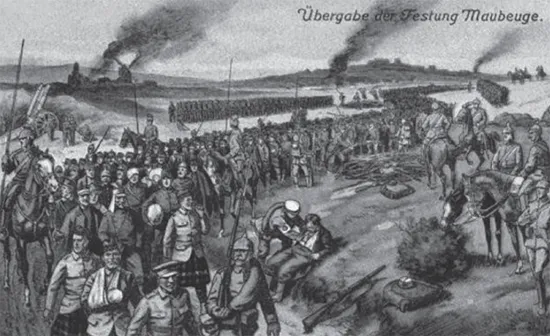
A German painting of British and French prisoners taken at the fall of the fortresses at Maubeuge.
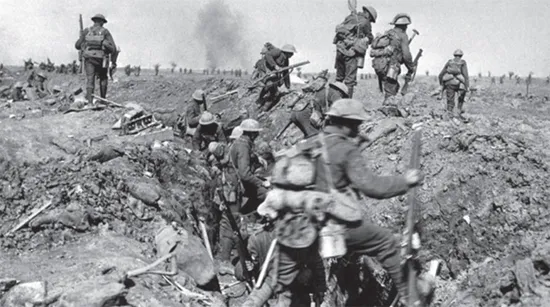
British troops leisurely advancing with full kit, apparently not under fire at this time.
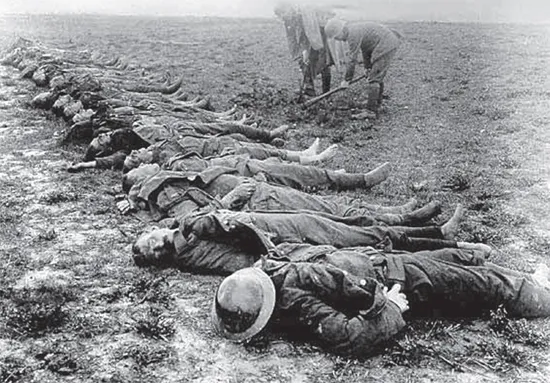
The horrors of war: British dead awaiting burial.
On the morning of 11 November a German infantryman discovered him and together with a comrade they lifted him out of the dugout and began to carry the wounded officer to the rear of the lines. They had not gone more than a kilometre when they met a German doctor. Henderson later recalled:
On seeing me he remarked ‘Ah, Englander!’ and held a revolver to my head whilst he cursed me in German. The only word I understood was ‘Swine-hund’ frequently repeated. Finally the sentry spoke to him, and after a heated discussion with him, he took me by the shoulder and gave me a kick, which sent me staggering down the road. The sentry picked me up and we went on to a cottage, where there was a second doctor, who bound my wound, gave me half a cup of water and sent me on. A little further down the road an unter-officer jumped off a wagon, followed me for a good mile jeering at me; having spat at me, he then left me.
Further down the road Henderson came upon a company of German soldiers having water served out to them. He asked their officer if he could have a drink, but he was ignored. One of the soldiers handed him his water bottle, whereupon the officer cursed him so loudly that the startled soldier snatched the bottle back and made himself scarce.
When Henderson finally reached the field hospital he met a dozen wounded men from his regiment. The German doctors re-dressed their wounds and they were directed to an open yard where they sat until nightfall. At dusk the rain began to fall and as the weary men were roused to their feet it began to pour down. The band of prisoners was surrounded by infantry and then a ring of lance-carrying cavalrymen – Uhlans, who used their horses to tread on the heels of the prisoners – to hurry them along. Despite their wounds, the prisoners were ordered to carry the Germans’ packs as they began a miserable march to their next destination. Three hours and 18 kilometres later they arrived at Tourcoing, where they were put into a theatre where they spent the night laying on some straw and shivering from the wet and cold.
The following day Henderson discovered just how cruel his captors could be to their wounded prisoners. In the morning they were marched to the local train station and while they were waiting Henderson lay down on the platform. A German officer appeared with his bulldog, which proceeded to lick Henderson’s face. The officer then kicked the dog while making derogatory remarks about the Englander to the German soldiers waiting nearby. Finally a train arrived and Henderson was put into a third-class compartment, where he lay down on the wooden floor. A fellow officer from his regiment, Lieutenant Bennett, was put into the same carriage. He gave Henderson his greatcoat and put his cap under his head to try to protect his head wound from the jolting of the train.
The journey was to take four days and on the way they stopped at Münster for food. There were some French officers on the train and the Germans took them away to a buffet for a good meal. However, Henderson and his fellow officer were told to sit with the French other ranks and eat their food out of tin basins. It was becoming clear that the British were to receive worse treatment than their French or Belgian allies. The French were allowed to purchase soda water at the station but the sentries refused the request from the British officers, stating ‘Nothing for the Englander’.
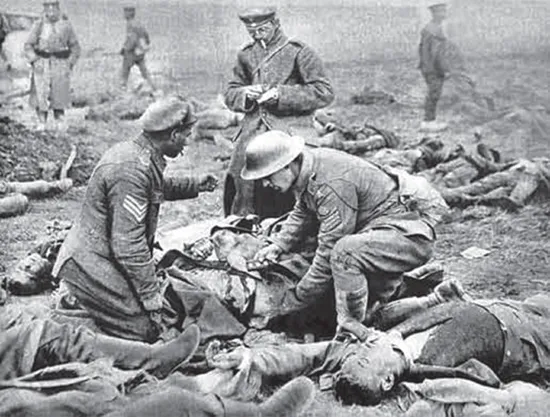
Captured British troops searching the dead for personal possessions.
At another station Henderson was taken to a Red Cross room where his casualty card was inspected by a doctor. The doctor said that it was too soon to re-dress his wound, gave him an aspirin and sent him back to his carriage.
On 14 November the train pulled into Osnabrück station in the north of Germany and the prisoners were marched off to the nearby prisoner-of-war camp in an old artillery barracks. On arrival they were ordered to turn out their pockets, whereupon Henderson handed over a pair of spectacles and a broken pencil. The German NCO indignantly asked for the rest of his possessions and refused to believe him when he said that they had already been taken from him when he was wounded. He had to remove his boots and puttees to prove that he was not hiding anything of value, and was then led to a room where the camp doctor worked for two or three days a week. The doctor simply put a fresh piece of bandage over the wound and told the sentry to escort the officer to a room that already housed ten Russian and two French officers.
The lack of treatment for Henderson’s wound was fast becoming critical. He could not sleep at all due to the effects of his injury and would lie awake all night listening to the hours strike and watching daylight arrive through the windows. A Russian who slept opposite him used to stand at the foot of his bed for ten minutes first thing every morning and last thing every night. When Henderson finally asked him why he did it, he replied: ‘Oh, when they brought you in here I was sure you were dying, and I came to see every day whether you would last the night out.’
By the end of the first week, the right side of Henderson’s face was turning green and blue and he could not bite into a piece of bread properly. It felt as if his gums were allowing his teeth to turn sideways. The German doctor was of no help, so Henderson turned to Dr Housey, a Belgian doctor who was also a prisoner. He looked at the wound and told Henderson that he had arrived just in time because he had gangrene. Fortunately Dr Housey was able to clean the wound two or three times a day using a syringe and hydrogen peroxide. For three months his right eyelid was closed and paralysed, but in January it starting quivering and within a couple of weeks he could open and shut it. However, he still could not see anything out of that eye.
The rations supplied by the Germans were totally inadequate for a wounded man: breakfast usually comprised acorn coffee and a small roll of bread (no sugar or butter); lunch was a watery soup with a small piece of meat or potato and sometimes rice; dinner was acorn coffee and another small roll. The Germans would not advance the officers any money to buy extra provisions, so for the time being they had to survive on basic prisoners’ rations.
Three more months passed and then one day Henderson was sent to see an oculist, who was the regimental doctor at a nearby barracks. He examined Henderson and then informed him that the optical nerve had been severed and he would not be able to see out of that eye again. Over the coming months a number of prisoner-of-war doctors took charge of Henderson, one of them informing him that if had been operated on earlier, his wound would have healed within two months. As it was, thirteen months later his wound had still not closed up properly and he was still removing splinters of bone from his shattered forehead with a pair of scissors.
Lieutenant R.V. Gracey was serving with the 14th Battalion, Royal Irish Rifles when he was wounded in the third German line by a hand grenade around 5 pm on 1 July 1916. This was north-west of Thiepval, on the road from Thiepval to Grandcourt. He was hit in both feet and legs, and spent the night lying in a hole on the battlefield waiting for help to arrive. In the morning he started to crawl towards a dead soldier nearby and tried to get his water bottle. However, a German sniper was watching and fired at him twice, forcing him back into the hole. The sniper must have seen that Gracey was wounded, as he could not let his feet touch the ground. The following morning the Germans came out and carried him back to their trenches in an oil sheet suspended from a pole. The occupants of the trenches were Saxons and they treated him well, giving him coffee and bread. One of them tried to bandage his wounds with field dressings. They were curious as to what he thought of the Zeppelin raids on London, which they thought had been a great success. Stretcher-bearers then carried him to a dugout and from it to the Grandcourt dressing station. On the way they stopped for a break in a village where Gracey was again given coffee.
At the dressing station orderlies brought water or coffee to both their own and the English wounded. Gracey’s wounds were dressed on 4 July, three days after he had been wounded. There were around 120 men lying on stretchers, roughly half British and half German. The German doctor on duty was very busy, but the German padre there was very kind to the wounded.
Two days later Gracey was carried by ambulance to the grounds of a château where mixed German and British wounded were placed on straw in the open and given some coffee. During the night it rained heavily and the German wounded were moved inside a large marquee. However, the British were left outside in the rain and most of them became wet through.
The next day Gracey was taken to St. Quentin and placed in a large room in a house along with a dozen other British officers. He would be there until 15 July. The food was sufficient to preserve life: coffee and bread in the morning; soup in the middle of the day; bread and tea without milk around 6 pm. The German nursing sisters were very kind and helped the bad cases to wash their hands and faces every morning. However, conditions were very bad with only two German doctors and four nurses to tend to the hundreds of British wounded in the house and a nearby church. The medical arrangements were totally inadequate and many men received no dressings for their wounds for a fortnight. Gracey was given two dressings by pointing out to the doctor the swellings in both groins and he was given an injection for tetanus around 8 July. Many of the men received no dressings at all within a fortnight. Although the Germans were willing, the medical arrangements were tragically inadequate.
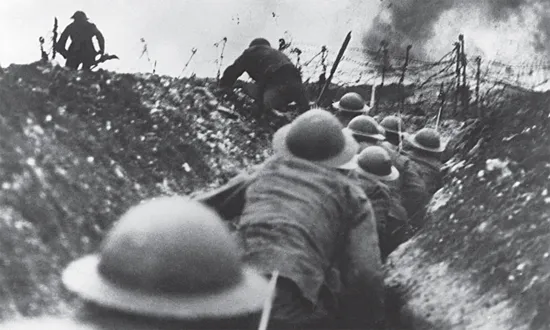
British troops about to go ‘over the top’ as shells burst ahead of them.
Despite the fact that they were all confined to bed in the officers’ room, the town commandant informed the German doctor that they were trying to communicate from the windows with the French civilians. As a result, all the windows were nailed shut and painted white up to the top; no fresh air was allowed, only via the door open to the staircase. As the weather was very hot they protested strongly against the accusation of the town commandant but the doctor said that he was powerless.
At St. Quentin they were interviewed individually by a very clever German who spoke English and French perfectly. The officers only gave their name, rank and regiment. At this time all notebooks etc. were collected for inspection. Fortunately Gracey had destroyed his maps and notebook soon after capture.
On 15 July Gracey was put on a hospital train from St. Quentin to Ohrdru...
Table of contents
- Cover
- Title
- Copyright
- Contents
- Introduction
- Chapter 1 The Horrors of War
- Chapter 2 Into the Bag: The First Prisoners
- Chapter 3 The Camps
- Chapter 4 All the Comforts of Home
- Chapter 5 The Jailers
- Chapter 6 Sanitary Arrangements and Care of the Sick
- Chapter 7 Arbeits Kommandos and Reprisals
- Chapter 8 Keeping Idle Hands Busy
- Chapter 9 Escape
- Chapter 10 Allied Prisoners of War
- Postscript
Trusted by 375,005 students
Access to over 1.5 million titles for a fair monthly price.
Study more efficiently using our study tools.
Frequently asked questions
Yes, you can cancel anytime from the Subscription tab in your account settings on the Perlego website. Your subscription will stay active until the end of your current billing period. Learn how to cancel your subscription
No, books cannot be downloaded as external files, such as PDFs, for use outside of Perlego. However, you can download books within the Perlego app for offline reading on mobile or tablet. Learn how to download books offline
Perlego offers two plans: Essential and Complete
- Essential is ideal for learners and professionals who enjoy exploring a wide range of subjects. Access the Essential Library with 800,000+ trusted titles and best-sellers across business, personal growth, and the humanities. Includes unlimited reading time and Standard Read Aloud voice.
- Complete: Perfect for advanced learners and researchers needing full, unrestricted access. Unlock 1.5M+ books across hundreds of subjects, including academic and specialized titles. The Complete Plan also includes advanced features like Premium Read Aloud and Research Assistant.
We are an online textbook subscription service, where you can get access to an entire online library for less than the price of a single book per month. With over 1.5 million books across 990+ topics, we’ve got you covered! Learn about our mission
Look out for the read-aloud symbol on your next book to see if you can listen to it. The read-aloud tool reads text aloud for you, highlighting the text as it is being read. You can pause it, speed it up and slow it down. Learn more about Read Aloud
Yes! You can use the Perlego app on both iOS and Android devices to read anytime, anywhere — even offline. Perfect for commutes or when you’re on the go.
Please note we cannot support devices running on iOS 13 and Android 7 or earlier. Learn more about using the app
Please note we cannot support devices running on iOS 13 and Android 7 or earlier. Learn more about using the app
Yes, you can access The Kaiser's First POWs by Philip D. Chinnery in PDF and/or ePUB format, as well as other popular books in Histoire & Histoire de l'Europe. We have over 1.5 million books available in our catalogue for you to explore.