- 160 pages
- English
- ePUB (mobile friendly)
- Available on iOS & Android
eBook - ePub
About this book
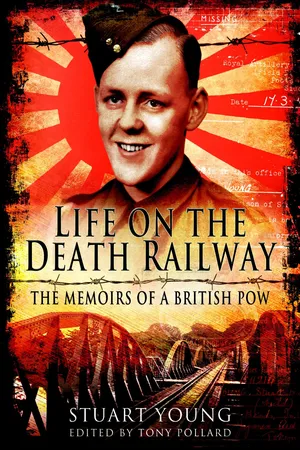
As a young man Stuart Young endured the horrors of the Japanese prisoner-of-war camps and survived. Later in life, in graphic detail, he recorded the experience the dreadful conditions, the brutal treatment, the sickness and starvation, the merciless routine of forced labour. Yet he also recorded the comradeship among the prisoners, their compassion and strength, and the pastimes and entertainments that helped them to come through an ordeal that is hard to imagine today. First he was held at the notorious Changi camp in Singapore Island, then in the camps in Thailand that accommodated POWs who were forced to work on the Death Railway. Perhaps the most revealing passages of his memoir recall the daily experience of captivity - the ceaseless battle to survive the backbreaking work, the cruelties of the guards and ever-present threat of disease. His account gives a harrowing insight into the daily reality of captivity and it shows why he was determined to document and make sense of what he and his fellow prisoners suffered.
Trusted by 375,005 students
Access to over 1.5 million titles for a fair monthly price.
Study more efficiently using our study tools.
Information
Chapter 1
The End and the Beginning
Suddenly I was awake, feeling cold and cramped. It was broad daylight, and the silence hung clammily over the stricken city.
Singapore was licking its wounds. The night had been long and hot. Spasmodic bursts of gunfire, punctuated with staccato small-arms fire, had filled the hours of darkness. The sound of screams and hoarse shouts in various tongues were evidence of the grim struggle. The sky had been made bright with the flames of burning buildings, the moans of the bereaved mingling with the crackle of blazing homes. Now all was still, but a hundred palls of smoke pinpointed where someone’s life had fallen into ruins.
I put my hand down to steady myself, and my fingers closed over a bottle, Cherry Brandy, filched from Shaw Brothers’ studio in the city, a few days previously. It was empty and I slung it carelessly into the hedge, where it joined others that had gone the same way.
It was eight o’clock on the morning of 15 February 1942, and still the expected Japanese final assault had not materialized. We lived another day. As we left the slit trench and walked down the hill for breakfast, I thought of the newspaper I had held in my hands a couple of days previously. For the past couple of years I had read newspaper reports of battles in France and on the Eastern front with a curious sense of detachment. The happenings were all taking place in another world and concerned me not at all. Now the same feeling was there as I read the final issue of the Singapore Times, with its report of the Japanese advance within four miles of Singapore city, till, with a curious sense of shock, realization broke that this time, it was real, and that this front line was not only four miles from Singapore, it was four miles from me. After two and a half years of playing at soldiers the war had finally caught up with me.
The cookhouse was a makeshift affair in the garden of one of those sprawling Chinese houses, and was crowded with members of RHQ (Regimental Headquarters), snatching a hasty meal while the going was good, for the lull surely wouldn’t last much longer. Half-cooked tinned bacon and beans and a cup of lukewarm tea swallowed, I picked up my rifle and made my way down to the Regimental Orderly Room, which was in the grounds of another Chinese house nearby. Who the Chinese owners were, we neither knew nor cared. This time tomorrow we would all probably be past caring.
The little house slept in the morning sun, green shutters closed tight over its sightless eyes. Of the family, there was no sign, Donald was seated at a table, tapping away at a portable typewriter, Dickie, the Transport Sergeant, head in a bucket, was sluicing away the dust of the previous night’s guard duty.
The 15-cwt truck, which served as mobile Orderly Room, was parked rear on to the house, beside the ugly bulk of an air-raid shelter,
I loosened the buckles of my equipment, and dropped my steel helmet on the table. Four soft thuds from over the hill were followed rapidly by the sound of four mortar shells landing nearby, and palls of smoke rose from the cookhouse area. Unthinkingly I stepped between the truck and the house wall. Like the proverbial ostrich, I imagined that what I couldn’t see, couldn’t see me – I was safe.
Donald cast a wary eye over the hill as more explosions followed, this time appreciably nearer.
‘Quick, the shelter,’ cried an unidentifiable voice, and I saw Dickie, ablutions abandoned, streaking for the entrance. I followed, and a blast of warm air picked me up and helped me inside, as someone landed on top of me. We heard no sound. I struggled to my feet and gazed outside.
It was nine thirty in the morning, and I had just seen my first – and my last – action in Singapore.
Cautiously we emerged to survey the damage. The last shell had scored a direct hit on the upper part of the house, bursting inside, and the green shutters hung drunkenly awry. The blast had blown back and ripped through the 15-cwt, which dripped petrol, oil and water from the shattered engine. Somewhere in a locker had been a few tins of baked beans, and a slow drip of reddish fluid made me shudder as I thought that a few seconds earlier, I had taken refuge behind the shattered wreck of a truck.
Of the family, there was neither sight nor sound, and I went in search of them. At the rear of the house was another shelter, twin to the one we had just left. I shouted at the door.
‘Hello. Anyone there?’
‘Hullo,’ came faintly from inside.
‘You all right?’
‘Yes, we all light.’
‘I’m afraid there isn’t much house left.’
‘Never mind. We all light.’
Thus I had my first introduction to the ubiquitous philosophy of ‘never mind’ that was to stay with us for the next four years, the non-committal shrug of the shoulders, the casual Tid apa that took care of everything. Tid apa, what does it matter? Tid apa, the adopted motto that followed us everywhere through Malaya and Siam.
I rejoined the others at the front of the house. They were just examining Gunner Bird, whose body it was that had landed so heavily on mine in the shelter. As he walked away, someone noticed that the seat of his shorts was missing, and further examination had shown that wherever it had gone, a hefty slice of his personal seat had gone with it. Persuaded, much against his will, to lie on his stomach, he was patched up to await evacuation to hospital where the hard-pressed medical orderlies could attend to him. When he finally departed, grinning and waving to us, neither he nor we knew that it would he the last we should see of him. We imagined later that he had been caught up in the infamous massacre of Alexandra Hospital.
‘Can’t stop,’ puffed the orderly as they picked him up. ‘They’ve copped one at the cookhouse, and another on the officers’ mess. They’re in a hell of a state up there.’
I doubled up the hill. Half an hour earlier this had been a pleasant garden where some fifty or so troops had been eating breakfast in the shade of a house built on piles in traditional native fashion. Now one house was in ruins, and a second half-demolished. Between the two, a figure in KD (khaki drill uniform) lay, arm pillowing his head as if asleep. Another, legs shattered, lay nearby convulsively moaning. In a waiting truck, screaming and wailing, a Chinese woman was taking the body of a child from the red-haired medical orderly. A white cloth covered its head, pinned securely all round.
‘Had to pin its head on,’ he said, ‘otherwise it would have bloody well dropped off.’
A loud wail broke out behind me. A fat man in the dress of an upper-class Chinese was pulling at his hair and crying aloud as he knelt down. In front of him, two figures, barely recognizable as women, lay feebly moaning, incapable of coherent sound.

‘Half an hour ago, a car bearing our envoys under cover of a white flag left Singapore to meet the Japanese Commander in Chief. It is expected that the ceasefire will operate from 20.30hrs. The HQ will be returning to Shaw Bros studio immediately.’
The Intelligence Officer finished speaking and we looked at each other in silence. Once again we had been ‘put in the picture’ as army parlance has it, and we didn’t much care for the picture that was painted. We completed the move back to our previous position, and I borrowed a truck to see if I could salvage any last items from the shattered MT 15-cwt. A listless, brooding silence covered the city. Even the low-flying spotter plane that had circled the area for the last few days, was absent. One of these planes had been continuously in the air during daylight hours, flying at fifty feet and shooting up anything that moved. One had been brought down by small-arms fire but, within ten minutes, another had taken its place, and we were once again taking to the monsoon drains at the sound of its approach. Now nothing disturbed the hot sultry afternoon heat.
The old Chinese was standing by the wreckage of his house when I arrived. Most of the dust and rubble and been swept up, and he indicated the wrecked truck.
‘You move,’ he enquired, ‘want to clear up.’
‘Plenty of time,’ I replied, ‘War all over. Clear up tomorrow.’
He stared blankly. ‘War no over.’
‘I’m afraid it is. All over, and the Japanese have won.’
As I left, bearing all that was worth saving, the Chinese was already fixing flags to the front of his house. Plain white flags with a red disc in the centre. I had never seen them before, but they soon became very familiar under the affectionate nickname of ‘fried eggs’. The news had spread fast, and the roads were filled with groups of impassive-faced natives, silently watching the end of an era, the last hours of European rule. On many of the buildings, the Japanese flag already hung limply in the still air, and many more were appearing by the minute. The ‘wily orientals’ had evidently backed the winner both ways, and the Union Jacks, no doubt, were at that moment being burnt, or carefully hidden away for some theoretical future use.
We slept that night in an abandoned house, near the studio. Sleep was not easy to woo, and we turned to a large HMV radiogram that stood in the corner of the room. It was in working order, and we played the comprehensive store of records for some time. One that fitted our mood was a ‘pop’ called ‘Wonders of the Wasteland’, but our concert was interrupted by the arrival of the RSM.
‘Turn the bloody thing off,’ he yelled. ‘This isn’t a bloody party. We’re prisoners of war now, and we haven’t anything to celebrate.’
We lay in the darkness talking in hushed tones.
Waves of tiredness swept over me. The sound of conversation ebbed and flowed. It sounded like waves surging up on some sandy beach. No, it was the sound of shells rushing by overhead. I drifted into uneasy slumber.
We awoke early on our first day of captivity. Breakfast was meagre, for we didn’t know how long our small stock of rations would have to last. We waited in the house for instructions. Despatch riders were still operating normally, and from them we heard of the scene in the city centre. In the past day or so, there had been a wholesale move to the dock area, by thousands of troops whose one thought was to get off the accursed island at all costs. Any craft that was seaworthy, and many that were not, had been pressed into service. This had been foreseen by the Japanese, who had ringed the approaches with naval craft to prevent any such attempts. Many were not heard of again, but a few lucky souls got through, and one such, an officer of our own Regiment, later wrote to his friends from Ceylon, the letter being received some eighteen months later when we began to receive mail. Others arrived back with us some days, or even weeks later, and one group of officers, after having reached Sumatra and struggling frantically over to the west coast a mile or so ahead of the advancing Japanese, obtained a boat and provisions and set sail for India. Weeks later they were within a few hundred miles of Ceylon, when they were sighted and picked up by a patrol boat. It was Japanese, and they were returned to Singapore, about two months after escaping.
For the majority, however, it was impossible. There was no longer any way of escape, and they drifted back into town in aimless groups. Military policemen were posted to discourage would-be escapees and, on Sunday and Monday, the streets were filled with mobs of frustrated would-be deserters, wandering aimlessly, looting sporadically here and there, totally unable to come to terms with reality. Or was it, rather, the rest of us who genuinely had never encompassed the idea of escape, who were out of touch with life?
The victorious Japanese were now all over the city, on cycles, on ‘borrowed’ motorbikes, in cars, or on foot. The majority of them had never before seen white men at close quarters and in bulk, and they, as much as we, were a little unsure. The atmosphere was one of watchful amiability. Any British soldier was likely to be peremptorily stopped and his watches, rings, fountain pens and other little trinkets removed for souvenirs or spoils of war, quite often the Jap being ready to leave his own in exchange. Our despatch rider on his Norton motorcycle, was stopped by a Jap, who rode triumphantly away, leaving his own rather decrepit sidecar machine in payment.
Conflicting reports of our immediate prospects were circulating. It was considered most likely the Japanese would concentrate us in Changi, but how and when was still in doubt. Whether we would be allowed to take our kit and whether equipment for cooking etc. would be transported, was also anyone’s guess.
In direct contravention of the terms of the capitulation, which stated that all arms and equipment would be handed over to the Japanese unharmed, the LAD (Light Aid Detachment) were busy putting as much of the transport as was not needed, out of action and there was much tyre slitting and wielding of hammers inside the engines, to while away the time. In a similar way, we all attended to our personal arms, burying the bolts, and scattering ammunition to the four winds. I came across the CO, the eternal cigarette drooping from his lips, and a glint of satisfaction in his eyes, as he tried to wrap a Bren gun round the trunk of a tree.
‘You know, these things are damn well made,’ he said, having done far more damage to the unoffending tree than to the gun. RSM Barr amused himself for hours. A shed in the studio grounds was literally stacked to the roof with cases of drink; grosses of bottles of Sandeman’s port, cherry brandy, gin, whisky, sherry, and all imaginable wines and spirits. It was more like a bonded warehouse. He personally smashed every bottle, and the yard was high with discarded crates and cartons, and smelling like a boozer’s delight,
‘There’ll be enough trouble as it is without those little yellow bastards getting hold of this and getting fighting drunk,’ quoth he as he did his little bit for the anti-war effort.
That night we got Radio Delhi on the radiogram. Among the news items we heard that Mr Churchill had ‘announced to a stunned and sorrowing nation’ the news of the fall of Singapore. We also heard of the escape of the Scharnhorst and Gneisenau from Brest. This latter cleared up a misapprehension, as in the absence of official news in the last few days, we had heard garbled accounts of a German invasion of the south coast of England, evidently started by the Channel incident.
Day two passed much as the previous one, except that in the afternoon, a Japanese NCO cycled into the compound, all smiles and brass teeth glinting in the sun. He dismounted and beamed expansively, showing more gold than Fort Knox. ‘Gasolino,’ he intoned pleasantly. We gazed at the RSM.
‘Give it to him,’ he said disinterestedly, ‘it’s his now, anyway.’ We handed over a four-gallon can and, bowing gallantly, he withdrew. After two days as a prisoner of the Japanese, I had at least seen one and now knew for certain that they existed.
So for day three, when we all assembled for the grand march to Changi, for this was indeed to be our place of concentration. As we stood in the boiling sun, a long straggle stretching into the distance, we were surrounded by smiling Chinese, who showed their apprehension for the future in their attempts to be helpful. We had an endless supply of hot sweet tea and little sticky cakes, which were produced from all the neighbouring, Rising Sun decorated, houses. We shifted from foot to foot, sat on our packs, and still the order to march was not given. After all our fears, adequate transport for the heavy equipment had been allowed by the authorities, and the heavily laden trucks had alr...
Table of contents
- Title Page
- Copyright Page
- Table of Contents
- Dedication
- Moon over Malaya
- Foreword
- Chapter 1 - The End and the Beginning
- Chapter 2 - The Wasted Years
- Chapter 3 - City of the Lion
- Chapter 4 - Changi
- Chapter 5 - River Valley Road
- Chapter 6 - The Mask Slips
- Chapter 7 - Welcome to Thailand
- Chapter 8 - Tonchan Takes Shape
- Chapter 9 - The Railway
- Chapter 10 - Lazy, Hazy Days of Summer
- Chapter 11 - Over the Hill
- Chapter 12 - Goodbye to Tonchan
- Chapter 13 - Tamuan
- Chapter 14 - Farewell to Up Country
- Chapter 15 - End of the Line
- Chapter 16 - Random Thoughts
- Reverie
- C Battalion (10 Bn) 1942 – 45
- Those Who Stayed Behind
- Glossary (Phonetic) for Aspiring Japanese PoWs
- Index
Frequently asked questions
Yes, you can cancel anytime from the Subscription tab in your account settings on the Perlego website. Your subscription will stay active until the end of your current billing period. Learn how to cancel your subscription
No, books cannot be downloaded as external files, such as PDFs, for use outside of Perlego. However, you can download books within the Perlego app for offline reading on mobile or tablet. Learn how to download books offline
Perlego offers two plans: Essential and Complete
- Essential is ideal for learners and professionals who enjoy exploring a wide range of subjects. Access the Essential Library with 800,000+ trusted titles and best-sellers across business, personal growth, and the humanities. Includes unlimited reading time and Standard Read Aloud voice.
- Complete: Perfect for advanced learners and researchers needing full, unrestricted access. Unlock 1.5M+ books across hundreds of subjects, including academic and specialized titles. The Complete Plan also includes advanced features like Premium Read Aloud and Research Assistant.
We are an online textbook subscription service, where you can get access to an entire online library for less than the price of a single book per month. With over 1.5 million books across 990+ topics, we’ve got you covered! Learn about our mission
Look out for the read-aloud symbol on your next book to see if you can listen to it. The read-aloud tool reads text aloud for you, highlighting the text as it is being read. You can pause it, speed it up and slow it down. Learn more about Read Aloud
Yes! You can use the Perlego app on both iOS and Android devices to read anytime, anywhere — even offline. Perfect for commutes or when you’re on the go.
Please note we cannot support devices running on iOS 13 and Android 7 or earlier. Learn more about using the app
Please note we cannot support devices running on iOS 13 and Android 7 or earlier. Learn more about using the app
Yes, you can access Life on the Death Railway by Stuart Young, Tony Pollard in PDF and/or ePUB format, as well as other popular books in History & Military Biographies. We have over 1.5 million books available in our catalogue for you to explore.