- 320 pages
- English
- ePUB (mobile friendly)
- Available on iOS & Android
eBook - ePub
About this book
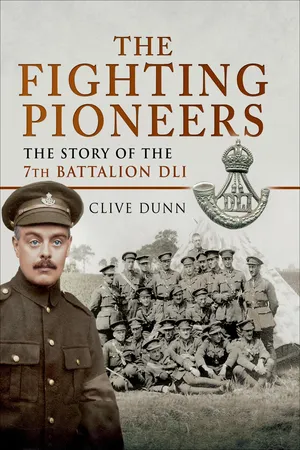
Story of the 7th Battalion Durham Light Infantry. With the creation of the Territorial Force in 1908 the battalion was re-designated as the 7th Battalion. It went to France in April 1915 with the rest of the Northumbrian Division seeing action almost immediately at the Second battle of Ypres. In November 1915 the battalion was picked to become the divisional pioneers. The 1/7 Battalion suffered 600 fatalities. In 1920 when the Territorial Army was reformed it was re-raised in its original role as infantry. The story concludes on 10 December 1936 when the 7th Battalion Durham Light Infantry became the 47th (Durham Light Infantry) A.A. Battalion R.E. (T.A.), whose personnel went on to serve in the Second World War.
Trusted by 375,005 students
Access to over 1.5 million titles for a fair monthly price.
Study more efficiently using our study tools.
Information
Chapter 1
The Beginning
Sunderland has had a long and proud affiliation with the volunteer movements, whose members gave their services to help defend the country. The history of Sunderland’s volunteers can be traced back to 1794, when the Loyal Sunderland Volunteers, or Sunderland Loyal Volunteers, were raised during the Revolutionary Wars, when the threat of invasion by France was real. Robert Hayton, a local wealthy coal fitter, raised the volunteers ‘for the purpose of manning and defending the batteries at the entrance of Sunderland harbour’. The unit was not officially recognized by the War Office until 1797. Prior to that date the gentlemen concerned hired the services of a regular sergeant to teach them the use of arms.
The Loyal Sunderland Volunteers consisted of three companies of 100 men each. The commanding officer, known as a major commandant, was Major Robert Hayton. He was assisted by two captains, one by the name of MacIntosh, a coal fitter, and the other called Bailey, a solicitor. In addition there was also Lieutenant Irvine and Lieutenant William Wilson. The headquarters of the Volunteers were at Mr Davison’s sail loft in West Wear Street, Sunderland. It is believed that parades took place in Villiers Street and drills on the Town Moor, with ranges at Hendon Beach.

Colours of the Sunderland Rifle Volunteers.
It was also in 1797 that colours were presented to the corps on 5 June by Mrs Russell, the wife of William Russell. These colours were returned to her in 1802, when the corps was disbanded because the Revolutionary Wars had come to an end with the Treaty of Amiens, and were stored in Brancepeth Castle. They were thought to be there in 1912, but it is not known where they are now.
As the corps was a volunteer formation, and was raised by local gentlemen and did not initially have official recognition, it had to raise its own funds for the purchase of gunpowder for musket practice, as well as other necessaries. A subscription list was opened, which had amongst its names some of the most prominent people of the town and county. The list was headed by no less than the Bishop of Durham, the Dean of Durham, the Edens and William Wilson, the wealthy owner of Brancepeth Castle, nephew of William Russell. The corps used to march to the tune of The swine cam jingling doon Pelton Lonin, the origins of which are unknown.
The Duke of York inspected the corps in 1795, when on a visit to the region, and expressed his appreciation of their military bearing to the commander of the Northern District.
In 1799, with invasion fever at its height, it was decided to have a grand field day with the corps being divided into two divisions, one landing on the beaches at Hendon, advancing inland, and the other moving to meet the threat and forcing them to retreat to their boats. The Volunteers had a great number of keelmen in the ranks, who wore blue pantaloons as opposed to white, who were usually kept apart from the rest. What happened on the day became known locally as the Battle of Hendon. The keelmen landed as planned and advanced and took up position, again according to plan. However, things started to go wrong when the ‘friendly forces’ advanced. Instead of falling back, as planned, they refused to budge and fired their muskets at close range at the advancing forces, leaving blue powder marks on their faces for the rest of their lives. Hand-to-hand fighting broke out, friends fighting friends. There were a number of serious casualties in the corps on this day, with Private James Sinclair losing an eye. The exercise, as it would be called today, ended when an armistice was agreed.
With the Treaty of Amiens bringing the Revolutionary Wars with France to a conclusion in 1802, the need for volunteer corps subsided. As a result, the Loyal Sunderland Volunteers were disbanded in July of that year following a parade at the Town Moor, where the commanding officer was presented with a silver cup. At about this time, in 1797, another corps, the Bishop Wearmouth Volunteers, was raised, organized by John Goodchild as captain and Robert Biss as lieutenant. Not much is known about this corps except that it too was disbanded in 1802 when peace was declared. Subsequently, Lieutenant Biss continued to serve with the Sunderland Volunteers in 1805.
Unfortunately the peace did not last long and by 1803 Great Britain and France were once again at war with each other. With the war came the renewed threat of invasion. The government was inundated with offers of volunteer service from all over the country to such an extent that it was hardly able to deal with them. County Durham alone raised seven corps of volunteer cavalry, ten of infantry and three of artillery.
One of these corps was the Sunderland Volunteer Infantry, raised in August 1803 under the lieutenant colonel commandantship of Sir Ralph Milbanke of Seaham Hall. This corps consisted of ten companies of sixty men each. The sum of £1,600 was raised by subscription from August to December 1803 to equip them, which was a huge sum in those days, especially considering the size of Sunderland. On Wednesday, 2 November 1803, Lady Milbanke presented new field colours to the corps. The headquarters were once again in Mr Davison’s sail loft in West Wear Street. On 25 August 1805, at a parade on the Town Moor, the commanding officer, Lieutenant Colonel Robinson of Hendon Lodge, read out a letter from Brigadier General Ker stating that they may be called upon to serve in other parts of the country. This also meant that the corps would have to be ready to move within an hour of being ordered to do so. The colonel then asked if any man objected, to which the corps responded with three cheers.
Drills took place at Lieutenant Colonel Robinson’s plantation, Hendon Lodge, during the summer months. In the winter, drills were conducted in the Seamen’s Hall, Church Street. For each drill attended, a private soldier received one shilling. With the threat of invasion receding, the need for the volunteer corps also diminished. They had been ready to fight; fortunately they had not been called upon to do so and in 1813 the Sunderland Rifle Volunteers were disbanded, many men joining the still extant 2nd Durham Militia, which itself wasn’t disbanded until 1818.
The colours that had been presented in 1803 were preserved by Lieutenant Colonel Robinson and remained in his family’s possession until his son, Septimus James Robinson, restored them to the corps in 1860. It is thought that they were used as decorations when the Duke of Wellington visited Sunderland in 1829.
In 1805, one curious incident involving the Sunderland Rifle Volunteers occurred when Colonel Milbanke placed sentries along the coast near the town. One of the positions guarded was known as the Paul Jones Battery, situated on a sandbank at the end of the old south pier. One night, Private Joseph Dunn, who was in Captain Bramwell’s Company, being by himself on duty at the battery, saw a black cat and mistakenly thought it was the Devil. He threw his musket to the ground and ran back to the town. The battery was known thereafter as the Black Cat Battery.
The Volunteer Force then seems to have been mothballed until it would be required again. The next crisis did not occur until 1859. Once again, people perceived the threat to come from France, which was now ruled by Napoleon III, the nephew of Napoleon Bonaparte. There was an initial rush to join what became the Rifle Volunteers. They saw themselves initially as clubs, and that is how they were regarded by the government at the time. To start with, the government did little more than sanction them and provide a small capitation grant for each man. Members of these clubs were of three types: effectives, who subscribed a sum per year and found their own uniform or were assisted from a general fund; honorary members, who subscribed more than the former and attended drills and parades whenever they could; and non-effectives, who merely subscribed towards the running of the corps.
The year 1860 saw the initiation of the volunteer movement and the formation of the Sunderland Rifle Volunteers, which consisted of 180 men divided into three companies. Like its predecessor corps, it was for home defence only. As in the Revolutionary and Napoleonic wars, a subscription was raised from the people of Sunderland. This time the amount raised was disappointing – £400 from a population of approximately 180,000, compared to £1,600 from 20,000 citizens fifty years previously – and various comments were passed. The corps was officially recognised on 6 March 1860, when it became the 3rd Durham (Sunderland) Rifle Volunteers.
In July 1860, Lord Adolphus Vane Tempest was appointed major commandant and in December 1862 he was promoted to lieutenant colonel, by which time a fourth company had been added to the corps. The headquarters were in a former warehouse near Gill Bridge Avenue. Range practices were again carried out at Hendon Beach and there was also a range at Fulwell Quarries. Initially the corps was issued with the muzzle-loading Enfield, but these were later replaced by the breach-loading Snider and Martini rifles.
The establishment of this corps was subsequently raised to 500 all ranks, comprising five companies, with five captains, five lieutenants and five ensigns, with an adjutant. As mentioned earlier, on 17 August 1860, the old colours of the 1803 Volunteers were returned to the corps by Septimus James Robinson, Esquire; they were presented to the corps by Lady Vane Tempest.
When the volunteer movement recommenced in 1860, commissions were by election within each particular corps. This proved to be a very unsatisfactory system, as it was possible for an officer to revert back to the ranks if not re-elected, which did happen on occasion. Later commissions were granted on the nomination of the Lord Lieutenant of the county. These first commissions in the Durham Rifle Volunteer Corps were published in The London Gazette of 1860, under the title ‘Commissions signed by the Lord Lieutenant of the County Palatine of Durham’.
A review of the northern volunteers took place in Edinburgh on 7 August 1860, with various corps from Scotland, Northumberland, Durham and Cumberland being represented. It took place on a grey and chilly day but this did not stop the crowds gathering to listen to the bands and watch the spectacle, uniforms being evident everywhere. The men from Sunderland mustered at Monkwearmouth Station at 4.30 am; there were members of the Artillery and 200 Rifles present. The volunteers joined other members of the brigade at Newcastle upon Tyne and proceeded then to Edinburgh, arriving at 2.30 pm, whence they marched to the review ground. Queen Victoria arrived at 4.00 pm and drove past the troops, who stood in silence at the salute. When the Queen reached the central dais the march past began. Leading were the Fife Mounted Volunteers, followed by the Artillery, then the Engineers, and finally the enormous mass of Rifles. The whole march past took an hour and a quarter. The end of the review was signalled by cheers and some of the Riflemen waved their caps on the end of their rifles, and when the royal carriage was leaving some broke ranks and surrounded it, cheering all the time. Queen Victoria expressed her admiration to the officer commanding the review on the steadiness and precision that characterized the large body of volunteers whose movements she had witnessed and that their appearance reflected highest credit both upon their officers and themselves. The men of the Durham Rifle Volunteers marched back to the railway station for their train home, arriving in Sunderland at 4.00 am the next day to be greeted by well-wishers.
The 3rd Durham Rifle Volunteers were represented by Captains T.E. Chapman, 3rd Company, T. Burn, 4th Company, and F.C. Huntley, 2nd Company, with Lieutenants J. Barron, 4th Company, A.W. Dixon, 2nd Company, C.T. Potts, 3rd Company, and T. Reed, 1st Company.
By 1864 the strength had risen to 604. It was also in this year that Lieutenant Colonel Vane Tempest died and Sir E.T. Gourley assumed command, with Henry Roberts, late 98th Regiment (later the North Staffordshire Regiment), as adjutant. A rather unique exchange of command took place over the coming years, for in 1870 Lieutenant Colonel Gourley resigned command of the corps to become the honorary colonel. He was replaced by Lieutenant Colonel W.B. Ferguson, who commanded until 1873, when he too resigned and handed over to Lieutenant Colonel Gourley, who had resigned as honorary colonel, the command of the unit having travelled in a full circle.
The number of troops in the new corps tended to decrease as time went by. At the presentation ceremony in the Victoria Hall on 23 January 1874, for the annual rifle competition, it was pointed out to those assembled that in the Revolutionary Wars the number of volunteers were 1,200, whereas there were only 374 effectives out of a population that was now five times its size.
Work on the new purpose-built drill hall at Livingstone Road had commenced in 1879, the money being raised by public subscription and a bazaar. The foundation stone was laid by Mr (later, Sir) James Laing and the building was completed in 1880. Changes to the Army were once again on the horizon and these took the form of the Cardwell Reforms.
Following the defeat of France during the Franco-Prussian War of 1870-71, people of England and their government set about a scheme for improving the defence of the realm. The task fell to Edward Cardwell, Minister for War. Amongst other things, he introduced the short service system whereby instead of a soldier enlisting for twenty years he would now sign on for seven with the colours and a further five with the Reserve. The Reserve would be called up in times of national emergencies to fill gaps in the Regular Army. The purchase of commissions was abolished under these reforms, a system that had in the past hindered the promotion of talented poorer officers. One of the greatest changes occurred in 1881, when the old numbering system of regiments was replaced by county affiliations. As a result, the 68th Light Infantry and 106th Light Infantry (formerly 2nd Bombay European Light Infantry) changed their names to the 1st and 2nd Durham Light Infantry battalions, respectively. The Volunteer Rifle Corps had over the past couple of years been reorganized into administrative battalions, with the exception of the Sunderland Corps, which remained the 3rd Durham Rifle Volunteer Corps.
However, the reforms gave these administrative battalions a real connection with the Durham Light Infantry: the 3rd Corps now became the 3rd Durham Rifle Volunteers. A further change occurred in 1887, when the 3rd Durham Rifle Volunteers became the 3rd Volunteer Battalion Durham Light Infantry.
The change to the new regimental system saw a move away from the club image to one of a more professional outlook. Annual camps started in the 1880s; it is believed that the first of these was at Morpeth. Other camps followed – at Brackenbury Moor, Appleby, Seaton Carew and Rothbury.
The first great challenge for the volunteers came in 1899, when the Second Boer War broke out in South Africa. The volunteers had originally joined to serve anywhere within the United Kingdom in the event of an...
Table of contents
- Cover
- Dedication
- Title Page
- Copyright
- Contents
- Preface
- Acknowledgements
- Chapter 1: The Beginning
- Chapter 2: The Early Years and the Outbreak of War
- Chapter 3: The Second Battle of Ypres
- Chapter 4: Summer 1915
- Chapter 5: Winter 1915 to Summer 1916
- Chapter 6: The Somme
- Chapter 7: The Battle of Arras
- Chapter 8: The Third Battle of Ypres and Spring 1918
- Chapter 9: 1918 and the Spring Offensive
- Chapter 10: Advance to Armistice
- Chapter 11: 2/7th Durham Light Infantry
- Chapter 12: Reformation to Disbandment
- Epilogue
- Awards
- Appendix One
- Appendix Two
- Appendix Three
- Appendix Four
- Appendix Five
- Bibliography
Frequently asked questions
Yes, you can cancel anytime from the Subscription tab in your account settings on the Perlego website. Your subscription will stay active until the end of your current billing period. Learn how to cancel your subscription
No, books cannot be downloaded as external files, such as PDFs, for use outside of Perlego. However, you can download books within the Perlego app for offline reading on mobile or tablet. Learn how to download books offline
Perlego offers two plans: Essential and Complete
- Essential is ideal for learners and professionals who enjoy exploring a wide range of subjects. Access the Essential Library with 800,000+ trusted titles and best-sellers across business, personal growth, and the humanities. Includes unlimited reading time and Standard Read Aloud voice.
- Complete: Perfect for advanced learners and researchers needing full, unrestricted access. Unlock 1.5M+ books across hundreds of subjects, including academic and specialized titles. The Complete Plan also includes advanced features like Premium Read Aloud and Research Assistant.
We are an online textbook subscription service, where you can get access to an entire online library for less than the price of a single book per month. With over 1.5 million books across 990+ topics, we’ve got you covered! Learn about our mission
Look out for the read-aloud symbol on your next book to see if you can listen to it. The read-aloud tool reads text aloud for you, highlighting the text as it is being read. You can pause it, speed it up and slow it down. Learn more about Read Aloud
Yes! You can use the Perlego app on both iOS and Android devices to read anytime, anywhere — even offline. Perfect for commutes or when you’re on the go.
Please note we cannot support devices running on iOS 13 and Android 7 or earlier. Learn more about using the app
Please note we cannot support devices running on iOS 13 and Android 7 or earlier. Learn more about using the app
Yes, you can access The Fighting Pioneers by Clive Dunn in PDF and/or ePUB format, as well as other popular books in History & Military Biographies. We have over 1.5 million books available in our catalogue for you to explore.