- 128 pages
- English
- ePUB (mobile friendly)
- Available on iOS & Android
eBook - ePub
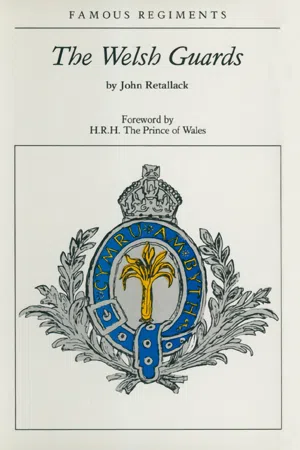
The Welsh Guards
About this book
Although the youngest of the Regiments in the Household Division, the Welsh Guards have established a reputation on both the battlefield, and on the parade ground, that is fully equal to the proud standards for which Guardsmen have long been famous. The Welsh Guards were formed in 1915, and they saw much hard fighting in both World Wars. Of the first thirty years of their existence, almost a third were spent at war and as a result tradition and regimental spirit were quickly forged. Such is the variety of a modern soldier's life that in the years since the Second World War, the Welsh Guards have been employed in sixteen different countrys, (in some of them two or three times) as diverse as texas and the snows of artic Norway. This swift account takes their story from the regiment's foundation in 1915, from their baptism of fire at loos, through another World War, and on to the tragic business of trying to preserve lives, and some sort of life, in the internecine bitterness of Northern Ireland.
CONTENTS
Foreword by HRH The Prince of Wales, Colonel, Welsh Guards | ||
List of Plates | ||
Prologue | ||
| 1 | Formation | |
| 2 | The Great War: A Bitter Struggle | |
Loos—1915 | ||
Winter 1915–16—the Ypres Salient | ||
The Somme 1916: Ginchy—Flers-Courcelette—Morval | ||
Winter 1916–17 | ||
Passchendaele 1917—Cambrai (Gouzeaucourt) | ||
Winter 1917–18: Arras, the Line—the German Offensive | ||
| 3 | The Great War: Advance to Victory | |
St Leger | ||
The Canal du Nord | ||
Pursuit: St Vaast—River Selle—Bavai | ||
Armistice | ||
Interlude: Between the Wars—1919–1939 | ||
| 4 | The Second World War: 1939–1943 | |
1940: 1st Battalion, Arras—Dunkirk | ||
1940: 2nd Battalion—Boulogne | ||
A Long Wait | ||
1943: 3rd Battalion, North Africa—Fondouk | ||
1943: 3rd Battalion, North Africa—Hammam Lif | ||
| 5 | The Second World War: 1944 | |
3rd Battalion: Italy—Cerasola | ||
3rd Battalion: Italy—Cassino | ||
3rd Battalion: Italy—Piccolo and Arce | ||
1st and 2nd Battalions: Return to France | ||
1st and 2nd Battalions: Normandy—the Battle of the Breakout | ||
1st and 2nd Battalions: the Race for Brussels | ||
3rd Battalion: Italy—Perugia and San Marco | ||
3rd Battalion: Italy—From Arezzo to the Gothic Line | ||
1st and 2nd Battalions: Belgium—the Road to Arnhem | ||
1st and 2nd Battalions: Holland—Operation Market Garden | ||
1st and 2nd Battalions: Winter in Belgium and Holland | ||
3rd Battalion: Winter in Italy | ||
| 6 | The Second World War: 1945 | |
1st and 2nd Battalions: the Reichswald Forest | ||
3rd Battalion: the Po and the Adige | ||
2nd Battalion: Germany—the Last Act | ||
Postscript | ||
| 7 | The Post-war Years | |
The First Ten Years: 1945–55 | ||
A New Epoch: 1956–65 | ||
The Savage Wars of Peace: 1965–76 | ||
Index | ||

BUCKINGHAM PALACE
Our regimental histories of both world wars are now out of print, and there is a need not only to bring them together in wieldy form, but to bring the story of the Welsh Guards up to the present time.
Much has happened since 1945 and nothing reflects the change in the state of world affairs more vividly than the variety which to-day’s ‘peace-time’ soldiering offers to the modern Guardsman compared to his father who served in the nineteen twenties and thirties. On training or on active service, the Regiment has done duty in the heat of the Radfan, in the Arctic Circle and from Texas to Chelsea Barracks.
In such a short book it is impossible to mention by name all those whose deeds have contributed to the high reputation of the Welsh Guards. But all good regiments are a team, and in a very real sense a family which extends beyond its battalions. I hope that this book will be of interest, not only to Welsh Guardsmen past and present, but to that wider family of parents, wives and all Welshmen who are proud of their Regiment of Foot Guards.

LIST OF PLATES
(following page 84)
1 Royal Warrant, dated 26 February 1915
2 First recruiting poster
3 Lieutenant-Colonel W. Murray-Threipland. From a book of cartoons of his brother officers, by Lieutenant P. A. L. Evans
4 Welsh Guardsmen asleep in a trench at Boyelles. This photograph was taken by Captain N. M. Harrop in 1918
5 Sergeant R. Bye, VC, being decorated by King George V
6 Dawn breaking over Dunkirk beaches during withdrawal, June 1940. By Sergeant C. Morrel
7 Lieutenant the Hon. Christopher Furness, VC
8 Portrait of Sergeant J. W. Isaacs, Master Cook of the 2nd Battalion, by Rex Whistler
9 Fondouk, a watercolour by Major L. F. Ellis after a sketch by Lieutenant O. N. M. H. Smyth
10 Cassino, by Major L. F. Ellis
11 The road to Brussels, by Sergeant C. Morrel
12 Winter in Holland, by Sergeant C. Morrel
13 Welsh Guardsman, 1945, by Augustus John, OM
14 Aden—the Radfan
15 Northern Ireland—Lance-Sergeant Somerset and Guardsman Bartlett and a patrol of the Drums Platoon
16 HRH The Prince of Wales, Colonel, Welsh Guards, from a portrait by Richard Foster
PROLOGUE
Wales has always been known for the patriotism and the fighting qualities of her people. Although defeated by the Romans at the battle of Anglesea in AD 61, their conquerors continued to treat them with respect and were compelled to keep a legion at Chester for the next 400 years to guard the Welsh Marches. They never really penetrated the valleys, any more than the Saxons and then the Normans who followed them.
The last of the independent Welsh princes, Llewellyn ap Griffith, died in 1281. He had fought and lost against Edward I. But it had taken that great soldier several years of ruthless campaigning to bring the last pockets of resistance under control. In 1301 he created his son, later Edward II, Prince of Wales. The twentieth of these princes to be appointed, also an Edward, was the first Colonel of the Welsh Guards from 1919 to 1936. The Colonel today is his great-nephew, and is descended from Henry Tudor, the first King of England of truly Welsh blood.
Although the Welsh Guards are a comparatively new regiment, their badge has an old and honourable tradition. It is said that Cadwallawn’s men had plucked leeks from a nearby field, as their distinguishing mark, before defeating the Saxons in a great battle in ad 633. Shakespeare, who had a feel for history, mentions it in Henry V. On the night before Agincourt, 1415, Fluellen says to the King: ‘Welshmen did good service in a garden where leeks did grow … and I do believe your Majesty takes no scorn to wear the leek upon Saint Tavy’s Day.’ To which the King replies, ‘I wear it for memorable honour; for I am Welsh, you know, good countryman.’
Welshmen have done much ‘good service’ to the Crown since the days of Edward I. But it was not until 27 September 1915, at the Battle of Loos, that the leek was once again proudly borne as the badge of the Welsh soldier.
1 FORMATION
The story of the Welsh Guards started, officially, on 26 February 1915, when a Royal Warrant, signed by King George V, authorized ‘The formation of a Welsh Regiment of Foot Guards, to be designated the “Welsh Guards”.’
Less officially the story had started on 6 February, when Field-Marshal Lord Kitchener, Secretary of State for War, sent for Major-General Sir Francis Lloyd, commanding the London District. There is surprisingly little formal record of the formation of the Welsh Guards, but General Lloyd made a note of this interview:
Lord Kitchener, very abruptly: ‘You have got to raise a regiment of Welsh Guards.’
Sir Francis Lloyd: ‘Sir, there are many difficulties in the way which I would like to point out first.’
Lord Kitchener, very rudely: ‘If you do not like to do it, someone else will.’
Sir Francis Lloyd: ‘Sir, when do you want them?’
Lord Kitchener: ‘Immediately.’
Sir Francis Lloyd: ‘Very well, Sir, they shall go on guard on St David’s Day.’
Of the three old regiments of Foot Guards—Grenadiers, Coldstream and Scots—only the Scots Guards had a national affiliation. But with the formation of the Irish Guards in 1900, the claim of Wales for a similar distinction became obvious, and began to be pressed. But the times were not ripe for any expansion of the army; however the outbreak of war in 1914 offered the opportunity.
Whether or not the inspiration was entirely Lord Kitchener’s, he certainly gave the push. But in fulfilling the aspirations of the Welsh people, he may have had further reasons. Kitchener was a great admirer of the Brigade of Guards, their training, discipline and professionalism, and he may already have had at the back of his mind the formation of the Guards Division, which he brought into being, equally abruptly five months later (a curt letter to the Commander-in-Chief in France, another curt interview with General Lloyd).
On 27 February, the day after the signing of the Royal Warrant, the new regiment began assembling at the White City. Two days later they mounted guard on Buckingham Palace on St David’s Day, as promised by Sir Francis Lloyd. This apparently miraculous speed is explained by the fact that the Commanding Officer, Lieutenant-Colonel W. Murray-Threipland, had been told by Kitchener to go ahead a few days before the announcement, without waiting for the official grindings of the War Office. Even so it was quick work; and on that first guard, officers and men still wore the badges of their previous regiments. The Captain of the Guard was the Commanding Officer himself.
Murray-Threipland proved to be an inspired choice to raise the new regiment. He was a Grenadier of great experience who had seen service in the Sudan and in the South African War. From the moment of his transfer, the Welsh Guards became the ruling passion of his life. Only the highest standards were acceptable; in return he gave his utmost. His second-in-command was Major The Hon. A. G. A. Hore-Ruthven, VC, later to become Regimental Lieutenant-Colonel, Colonel of the Regiment, and a distinguished Governor-General of Australia. He had staunch support from his adjutant, Captain G. C. D. Gordon, immaculate as any adjutant should be, and a team of first-class warrant officers, headed by R.S.M. Stevenson. Even so, the Commanding Officer had a difficult and delicate task.
In the first place, in any institution with a long and honourable history attended by much success, like the Brigade of Guards, there is always opposition to change, and it is not too much to say that the formation of the Welsh Guards had shocked a number of senior officers, both serving and retired. And if there was no active opposition, the performance of the new regiment would inevitably be regarded with a very critical eye. If they did well, it would be because they had had so many transfers from the old regiments; if they did not do well, then the critics would have been right in the first place. This was a difficulty which only time and success would overcome.
The second, and immediate, difficulty was the choice of officers, warrant officers and NCOs. In an established regiment officers and men are known and proved over a number of years. In this case they had to be taken on trust or very quickly judged. But the Commanding Officer’s discrimination was sure and rapid, and in six months he forged a regiment that was to be worthy of both Wales and the Brigade of Guards.
There was much else to be done. On 19 March the King approved the colours and sanctioned the title of Prince of Wales Company for the leading company of the 1st Battalion. Details regarding uniform were also settled. The leek was chosen for the cap-badge, and the plume for the bearskin was to be white-green-white, the Tudor colours. Regimental marches were also chosen: ‘The Rising of the Lark’ for the quick march and ‘Men of Harlech’ for the slow.
Recruitment went well; both direct recruitment from Wales and, following an appeal from the Major-General, himself a Welshman, transfers from other regiments of the Brigade of Guards. There were also transfers from the Army as a whole; both these last two sources provided valuable experience to the new regiment.
Much hard training was carried out, first at the White City among the swings and roundabouts of the now deserted fun-fair, and then at Sandown Park, Esher. As the time for the Battalion’s departure for France became nearer, a 2nd (Reserve) Battalion was formed to provide the 1st Battalion with trained reinforcements. It was also necessary to form a proper Regimental Headquarters. On the formation of the Regiment, Lieutenant-Colonel Murray-Threipland had doubled as Commanding Officer of the 1st Battalion and as Regimental Lieutenant-Colonel. On 16 June 1915 the latter appointment was taken over by Lord Harlech.
Their arrangements thus made, the new Regiment lay waiting and ready for whatever fate might bring them in war. For a short spell they carried out public duties in London, but two events were still needed to give recognition to their efforts so far. On 3 August they received their Colours from the King at a parade in the gardens of ...
Table of contents
- Cover
- Half Title
- Full Title
- Copyright Page
- Dedication
- Contents
Trusted by 375,005 students
Access to over 1.5 million titles for a fair monthly price.
Study more efficiently using our study tools.
Information
Publisher
Leo CooperYear
1981Topic
HistoryPrint ISBN
9780723227465
Subtopic
British HistoryeBook ISBN
9781473820692
Index
HistoryFrequently asked questions
Yes, you can cancel anytime from the Subscription tab in your account settings on the Perlego website. Your subscription will stay active until the end of your current billing period. Learn how to cancel your subscription
No, books cannot be downloaded as external files, such as PDFs, for use outside of Perlego. However, you can download books within the Perlego app for offline reading on mobile or tablet. Learn how to download books offline
Perlego offers two plans: Essential and Complete
- Essential is ideal for learners and professionals who enjoy exploring a wide range of subjects. Access the Essential Library with 800,000+ trusted titles and best-sellers across business, personal growth, and the humanities. Includes unlimited reading time and Standard Read Aloud voice.
- Complete: Perfect for advanced learners and researchers needing full, unrestricted access. Unlock 1.5M+ books across hundreds of subjects, including academic and specialized titles. The Complete Plan also includes advanced features like Premium Read Aloud and Research Assistant.
We are an online textbook subscription service, where you can get access to an entire online library for less than the price of a single book per month. With over 1.5 million books across 990+ topics, we’ve got you covered! Learn about our mission
Look out for the read-aloud symbol on your next book to see if you can listen to it. The read-aloud tool reads text aloud for you, highlighting the text as it is being read. You can pause it, speed it up and slow it down. Learn more about Read Aloud
Yes! You can use the Perlego app on both iOS and Android devices to read anytime, anywhere — even offline. Perfect for commutes or when you’re on the go.
Please note we cannot support devices running on iOS 13 and Android 7 or earlier. Learn more about using the app
Please note we cannot support devices running on iOS 13 and Android 7 or earlier. Learn more about using the app
Yes, you can access The Welsh Guards by John Retallack in PDF and/or ePUB format, as well as other popular books in History & British History. We have over 1.5 million books available in our catalogue for you to explore.