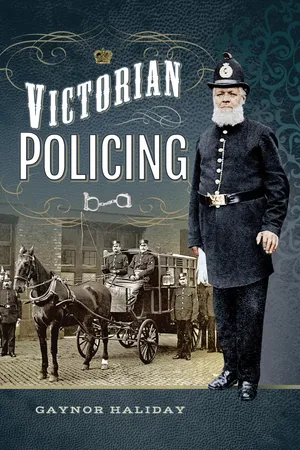
A cultural history of local law enforcement in Victorian England, from street patrolling and crime detection to corruption among the ranks.
Historian Gaynor Haliday became fascinated with the life of early police forces while researching her own great-great-grandfather; a well-regarded Victorian police constable in the West Yorkshire city of Bradford. Although a citation claimed his style of policing was merely to cuff the offender round the ear and send him home, press reports of the time painted a much grimmer picture of life on the beat in the Victorian streets.
In
Victorian Policing, Haliday draws on a variety of primary sources, from handwritten Watch Committee minutes to historical newspapers and police records. She reveals how and why various police forces were set up across the United Kingdom; the recruitment, training and expectations of the men, the issues and crimes they had to deal with, and the hostility they encountered from the people whose peace they were trying to keep.
- 192 pages
- English
- ePUB (mobile friendly)
- Available on iOS & Android
eBook - ePub
Victorian Policing
About this book
Information
Chapter 1
Laying the foundations
We sometimes imagine our ancestors living tough but peaceable lives – working hard in the fields, the worst disturbances being a few petty squabbles. A bucolic way of life where a police force was not required. But human nature has occasionally led some people to covet what others have – property, land, belongings, spouses – and for that reason policing in one form or another has always been necessary to try to keep the peace, deter the criminal fraternity and bring those who disobey the law to justice.
The concept of formal policing was introduced as early as 1285, when the Statute of Winchester instituted a system of watch and ward, putting in place a structure of watchmen, specifying the number of men, according to a town’s population, who were to keep watch from dusk to dawn. Their key duty was to arrest any passing strangers, hold them until morning and deliver suspicious characters to the sheriff to be dealt with. These watchmen were obliged to raise the hue and cry and pursue from town to town any stranger who resisted arrest until he was caught. All able-bodied men were to assist in the chase.
Apart from this, it was up to local residents to maintain a modicum of law and order. Under the statute every man between the ages of 15 and 60 was commanded to house equipment to keep the peace, according to the quantity of land and goods he possessed.
The richest were expected to keep a horse, lance, knife, iron helmet and a long coat of chain mail known as a hauberk, while the poorest carried just bows and arrows. Each man’s armoury was inspected twice a year by two high constables appointed for each hundred (a division of a county for military and judicial purposes). These high constables reported any defaults of the equipment or of the watchmen, as well as reporting those in country towns who lodged strangers, and any faults in the highway, to the assigned justices, who in turn reported the matter to the king.
Further to this, the Justices of the Peace Act in 1361 instilled the principle of a working partnership between justices and constables and, by appointing people to prosecute felonies and trespasses, established statutory powers for justices of the peace.
Later, parishes and townships each elected one or more unpaid parish constables annually, compulsory appointments often unpopular with the incumbents. Usually already following a trade or occupation, the parish constables’ roles included numerous and diverse functions such as collecting county and parish rates, finding transport for military forces, swearing the stocks were in good order and ready for use, and that people regularly attended church. Although their primary duty was to preserve the peace, parish constables had little or no value in crime prevention beyond that of any other able-bodied man, aside from their (often ornately decorated) staff of office. This staff was the only symbol of authority and a useful weapon of self-defence where necessary. The constables were, however, regarded as crown officers, having been required to take an oath of service to the crown on appointment.
This method of policing changed little over the centuries and a similar system was still in place in the late eighteenth and early nineteenth centuries.
As towns grew in population and prosperity, some authorities implemented a Local Improvement Act to establish more formal policing arrangements.
Each town’s commissioners were entrusted with managing that town’s affairs, each body aiming to address the specific needs of its local inhabitants. By petitioning Parliament, local commissioners could gain the power to levy rates, which funded highway works, lighting and sewerage schemes and a few paid police.
Birkenhead, against violent opposition to its application, received Royal Assent for a local act in June 1833. Its commissioners, now empowered to raise £8,000 (£888,000) through rates and tolls, as well as paving, lighting and cleansing the public streets, used the money to erect a market and establish a small separate police force.
Under the command of the Captain of the Night Watch, it employed three night watchmen plus a parish constable in charge of the lock-up. Dressed in a cape and a glazed hat and carrying a lantern, these watchmen toured the streets from 9pm until 6am armed only with a staff and a stick.
A few years earlier in 1825, with a population of about 20,000 – around six times that of Birkenhead – Rochdale’s police commissioners appointed thirteen men to patrol its streets at night, twelve as night watchmen and one as their captain.
In contrast, police commissioners in nearby Oldham appointed one constable in 1829, mainly responsible for rate collection and inspection of nuisances. Out of his £200 annual salary (£22,200), he had to pay the wages of two assistants known as beadles.
Although in London the ratio of police to population was higher, with around 450 constables and 4,500 night watchmen to keep the peace of almost a million-and-a-half people, that the men belonged to different (and unco-operative) organisations weakened what little power they had.
One issue common to all forces was the ineffectiveness of the night watchmen. The low pay probably only attracted those past hard work – the aged and infirm. Most were of little use for much other than lighting lamps and calling out the hours during the night.
Nodding off in their boxes at night, they were often a target for local youths who, for devilment, frequently overturned their boxes and ran off with their lanterns, leaving them stranded and unable to arrest anybody.
Although some people may have been kinder to the watchmen, perhaps slipping them a drop of rum to help them through the night, most regarded them with contempt, believing them to be corrupt and drunkards.
*
With the Industrial Revolution gathering pace, the rapid influx of workers into urban areas created more problems for the towns’ policing arrangements. Large gangs of labouring men, brought in to build railways, factories, warehouses, mills and housing, were corralled together in lodging houses. Naturally those who lodged, adrift from their families, needed entertainment at night, and this was generally in the form of drink and women. Pubs and beerhouses thrived in the manufacturing towns. In 1824, Warrington, with fewer than 15,000 residents, had eighty-one public houses within its town centre. Drunken brawls became the norm. Industrialists were unable to control large, unruly workforces, and it appeared lawlessness ruled in the expanding towns and cities.
Urban areas were not the only places experiencing a rapid deterioration in public behaviour. Frequent stock and produce fairs in country towns drew followers who robbed and pilfered, and large numbers of people on the move in search of work attracted criminal activity.
Poaching had long been a rural problem, but ease of travel on the new canals and railways changed it from being a crime carried out by a few local men into an organised major operation, with large gangs running vicious battles with gamekeepers. Rudimentary police forces struggled with the numbers.
In 1828, even though police in Cheshire managed to arrest a gang of fifteen poachers, two companies of infantry had to be called upon to provide a safe escort when a mob of hundreds of navvies made efforts to rescue the poachers as they were being transported to court at Chester Castle.
When mob disorders such as this descended into riots, leaving magistrates no alternative other than to summon military aid, it became ever clearer that the local and varied forms of policing were pretty ineffectual against the alarmingly rapid rise in crime.
A House of Commons committee investigating the problems of policing London in 1818, after a disturbing increase in the level of crime in London since the end of the Napoleonic Wars, concluded that something should be done, but uncertain whether a police force would be acceptable in a free country did little.
On his appointment as home secretary in 1822, Robert Peel, seeing this increase in crime as a threat to society’s stability, sought to establish a professionally organised, full-time police force under his control.
Progress was slow, but in 1828, after a further Commons inquiry, which reported in favour of a London police force, a bill was drafted. On 19 June 1829, Parliament finally approved Peel’s Metropolitan Police Bill.
It spelled out the need for a ‘more efficient System of Police in lieu of such Establishments of Nightly Watch and Nightly Police’:
Whereas Offences against Property have of late increased in and near the Metropolis; and the local Establishments of Nightly Watch and Nightly Police have been found inadequate to the Prevention and Detection of Crime, by reason of the frequent Unfitness of the individuals employed, the Insufficiency of their Number, the limited Sphere of their Authority, and their Want of Connection and Cooperation with each other.
As well as the detection and prevention of crime, it was envisaged that the visible presence of a uniformed and well-disciplined body of police would help to keep order on the capital’s streets.
Meanwhile, in provincial towns and cities and the countryside, policing continued as before, with more towns introducing small numbers of paid police constables and watchmen.
Against a rising tide of crime there was still hostility to the notion of paying for patrols of police, even where the magistrates (usually against the idea) seemed as though they might consider it.
In the same year as the establishment of the Metropolitan Police, magistrates in Cheshire obtained permission to establish a constabulary force through an Act of Parliament. A new position of special high constable was introduced for each hundred, with responsibility for any number of subordinates, depending on the size of the district.
Clearly they were looking for more structure to policing and a higher calibre person to fill the role. An advert for a special high constable for the Bucklow Hundred stated:
The officer shall be able-bodied, of sound constitution and under the age of 40 years, of good character for honesty, sobriety, fidelity and activity, and be able to read and write.1
There was opposition to the plan, though, from the Wirral justices, who deemed the only night patrols necessary were to protect wrecks off the coast, and such appointments should be paid for by Liverpool shipping merchants and underwriters. Even where evidence of lawlessness and the depraved habits of the population demonstrated the need for better policing, some magistrates believed it unnecessary to appoint anyone.
Nor were paid police appointments well received by the public. A letter to one newspaper referred to six paid constables as the ‘new gendarmes forcibly quartered in the district’. The correspondent thought them ‘a set of lazy vagabonds, harpies playing on the very vitals of the community’, and prayed ‘God defend us from all such spies and informers’.2
Signed petitions were another way the public could show their opposition to the police. One resentful (unpaid) parish constable collected many names on a petition. Unsurprisingly, nearly all the signatories were people who might be the subject of police control. Several had been charged or convicted of offences, one implicated in a murder. Others were publicans and beerhouse keepers.
With many areas still relying on unpaid or poorly paid constables and watchmen, and the crime rate continuing its upward trend, it was apparent the aversion to spending parish money on keeping order was hindering progress of the fight against crime.
The Lighting and Watching Act of 1833 allowed parish councils to levy a special rate to provide adequate numbers of day and night watchmen. Local people contributed to the cost of local policing, and that the Act was adopted in many places shows residents’ concerns about the problems they encountered were so great, they were prepared to pay to solve them.
Of course, there was criticism of the way money was spent. Bradford, who had established a Watching, Lighting and Improvement Act thirty years earlier, levied a further specific rate for lighting and watching.
Perhaps more concerned with the state of the streets than crime levels, one ratepayer called attention to the neglect of the commissioners under the Lighting and Watching Act in a letter to the editor of the Bradford Observer on 9 April 1834. The correspondent cited several nuisances not properly addressed by the ‘handsomely paid officer’ responsible for such matters. He was particularly aggrieved by the filthy streets, the wool bales allowed to stand outside warehouses and the number of carts and vehicles standing in crowded thoroughfares for hours on end ‘whilst their drivers caroused at public houses’.
Another correspondent (possibly the same ‘ratepayer’) in June of the same year complained about the flow of water in the brook running through Bradford being severely impeded by vast quantities of rubbish thrown into it and by waterwheels placed in it to obtain power. The stream was stagnant where it should have been most rapid and there was an easy solution to the problem if the surveyor (who he presumed to exist because there was a salary) would see to it that debris be cleared and the practice of throwing rubbish into the stream become a punishable offence.
In December 1834, the newspaper carried a report that a very strong muster of commissioners under Bradford’s Lighting and Watching Act had held a meeting to elect a successor to the ‘aged and increasingly infirm clerk’.
In recognition of his thirty-one years’ long service, the commissioners voted to award him 30 shillings (£166.50) before his successor (possibly a relative) ‘came handsomely forward’ to propose an annuity of 51 shillings (£283), which was received by the commissioners with unanimous applause.
A new post was created – collector and deputy treasurer – to collect rates, pay wages and bills, keep accounts and mark-up the rate books. An allowance of four percent of monies collected would be paid to the incumbent, a practised and honest accountant named Thomas Haigh.
Mr William Bakes became the new surveyor with the duty of seeing the watchmen on and off every day, superintending the scavengers, and detecting all nuisances and obstructions from carts, wheelbarrows, and such, at the weekly salary of 1 guinea (£116.50).
With fifty-eight commissioners and new appointments in place, the committee congratulated itself on the fair prospect of a faithful and vigilant discharge of their duties – and hoped to be spared ‘the unpleasant duty of further reproof’.
To further emphasise to ratepayers that they were doing their job, Bradford’s commissioners published the following announcement:
Watching and Lighting Act
The Commissioners under this Act are empowered from time to time to appoint such a number of Watchmen to be employed within the Limits of the Act for so long a time in the Night, under such Regulation and for such wages as they (the commissioners) shall think proper, and if any Watchman appointed as aforesaid should refuse or negl...
Table of contents
- Cover
- Title
- Copyright
- Contents
- Foreword
- Chapter 1. Laying the Foundations
- Chapter 2. Acts and Actions
- Chapter 3. Recruitment, Training and Progression
- Chapter 4. Police Terms, Conditions and Expectations
- Chapter 5. Seeing and Being Seen
- Chapter 6. Keeping Order in the Streets
- Chapter 7. Fighting Crime
- Chapter 8. The Dangers of Making an Arrest
- Chapter 9. Crowd-Control
- Chapter 10. Police Misdemeanours
- Chapter 11. Improving the Policeman’s Lot
- Chapter 12. Postscript
- Notes
- Appendices
- Bibliography
- Resources
- Plate section
Trusted by 375,005 students
Access to over 1.5 million titles for a fair monthly price.
Study more efficiently using our study tools.
Frequently asked questions
Yes, you can cancel anytime from the Subscription tab in your account settings on the Perlego website. Your subscription will stay active until the end of your current billing period. Learn how to cancel your subscription
No, books cannot be downloaded as external files, such as PDFs, for use outside of Perlego. However, you can download books within the Perlego app for offline reading on mobile or tablet. Learn how to download books offline
Perlego offers two plans: Essential and Complete
- Essential is ideal for learners and professionals who enjoy exploring a wide range of subjects. Access the Essential Library with 800,000+ trusted titles and best-sellers across business, personal growth, and the humanities. Includes unlimited reading time and Standard Read Aloud voice.
- Complete: Perfect for advanced learners and researchers needing full, unrestricted access. Unlock 1.5M+ books across hundreds of subjects, including academic and specialized titles. The Complete Plan also includes advanced features like Premium Read Aloud and Research Assistant.
We are an online textbook subscription service, where you can get access to an entire online library for less than the price of a single book per month. With over 1.5 million books across 990+ topics, we’ve got you covered! Learn about our mission
Look out for the read-aloud symbol on your next book to see if you can listen to it. The read-aloud tool reads text aloud for you, highlighting the text as it is being read. You can pause it, speed it up and slow it down. Learn more about Read Aloud
Yes! You can use the Perlego app on both iOS and Android devices to read anytime, anywhere — even offline. Perfect for commutes or when you’re on the go.
Please note we cannot support devices running on iOS 13 and Android 7 or earlier. Learn more about using the app
Please note we cannot support devices running on iOS 13 and Android 7 or earlier. Learn more about using the app
Yes, you can access Victorian Policing by Gaynor Haliday in PDF and/or ePUB format, as well as other popular books in History & Modern British History. We have over 1.5 million books available in our catalogue for you to explore.