eBook - ePub
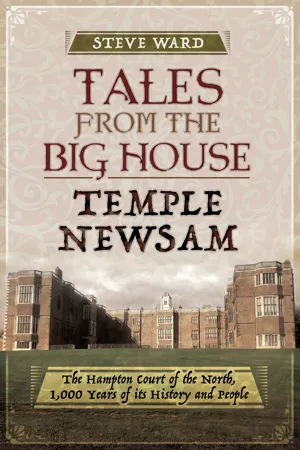
Tales from the Big House: Temple Newsam
The Hampton Court of the North, 1,000 Years of Its History and People
- 184 pages
- English
- ePUB (mobile friendly)
- Available on iOS & Android
eBook - ePub
Tales from the Big House: Temple Newsam
The Hampton Court of the North, 1,000 Years of Its History and People
About this book
Situated only 4 miles southeast of the bustling cosmopolitan city of Leeds lies a jewel in the crown of British stately homes. Set in 1,200 acres of rolling parkland and woods is Temple Newsam House, once described as the Hampton Court of the North.The estate has survived almost 900 years of history. Although first mentioned in the Domesday Book, it was the Knights Templar who gave the name to the land. The house that now stands on the site was begun in 1518 and has witnessed many events: the execution for treason of one of its owners; the birth of Lord Darnley, unlucky husband of Mary Queen of Scots; the Civil War rivalry of a family; the home of a flirtatious mistress of the Prince of Wales (later George IV); and the suffering of the First World War, when it was used as a convalescent home for wounded soldiers.The house and estate is now owned by the Leeds City Council and is open as a public park for all to enjoy. The house itself is part of Leeds Museums and Galleries and displays many different collections and exhibitions. On the estate is a working farm, known as Home Farm, which is the largest working rare breed center in the UK and is a popular attraction for many visitors.
Information
Chapter 1
A Monastic House
How Newsam achieved the title of ‘Temple’
Until William the Conqueror invaded Britain in 1066, the land that now comprises the Temple Newsam estate was known to have been controlled by Gluniar and Dunstan, Anglo-Saxon thanes. Before the time of the conquest, Dunstan’s name is associated with nine settlements in the current West Yorkshire, and Gluniar’s name with seventeen settlements in both the West and North Yorkshire areas; clearly they were important men. In 1085, William ordered a survey of England to be carried out. We know the results of this today as the Domesday Book. In a desire to know as much as he could about the land he had conquered, the Domesday Book was a complete inventory of Britain up to the river Tyne, and gave William power through knowledge. With all this documentation he was, as Simon Schama calls him, ‘the first database king’ (2000). The book was produced the following year, in 1086, and (Temple) Newsam makes it appearance as ‘Neuhusū’. The Tenant in Chief of that settlement was Ilbert de Lacy. The two brothers Walter and Ilbert de Lacy had travelled to England with William and both had subsequently been granted lands for their part in the conquest. Walter had lands in Herefordshire and Shropshire, and Ilbert had lands in Yorkshire and parts of what is now Lancashire.
At the time of the survey, Neuhusū was quite a small place with only ten households – eight villagers and two freemen. The settlement included four ploughlands, enough for three men’s plough teams to work on. There were also 3 acres of meadows and half a league of woodland. The tax assessment for Neuhusū was for eight geld units, where a geld was the amount of tax assessed per hide. A hide had been a nominal unit of land measurement equivalent to approximately 120 acres, but the true understanding of the hide unit has been lost in antiquity. Stenton (1971) explains: ‘Despite the 2 Tales from the Big House: Temple Newsam work of many great scholars, the hide of early English texts remains a term of elusive meaning.’
A hide appears to have been used more as a means of tax assessment rather than as a measurement of land as the nominal figure given was likely to have been different in different locations. With particular reference to the Domesday Book, Dr Sally Harvey, in her 1987 work Taxation and the Economy, suggests that a hide of land was worth £1, or land producing £1 worth of income be assessed at one hide. For Neuhusū to have a relatively small population, the tax assessment of eight geld units seems quite high, perhaps suggesting that the productivity of the land was good.
We have to thank the Crusades in the Holy Land for the addition of the word ‘Temple’ to Newsam. In the aftermath of the first Crusade in 1099, many pilgrims wished to travel to Jerusalem and other holy sites. This was still a dangerous land and many on pilgrimage lost their possessions and their lives at the hands of lawless thieves and murderers. To counter this, in 1119 a French knight, Hugues de Payens, proposed creating a monastic order of knights to protect these pilgrims. This was granted, and the newly formed Poor Fellow Soldiers of Christ and the Temple of Solomon were provided with a base on the site of the captured Al-Aqsa mosque in Jerusalem, believed to have been built on the site of the biblical Temple of Solomon. This small group of knights soon became known as the Order of the Knights Templar and many of us may be familiar with their uniform of a white tabard emblazoned with a red cross.
Feared by many for their ferocity in battle, the Order grew quickly, both in size and wealth. Within a decade of its creation, the Order was the most favoured charity in the Christian world and received many gifts and donations of money, land and business. Members took a vow of poverty and handed over their wealth and possessions to the Order, thereby swelling its coffers. Soon they were able to establish a successful network of commerce, dealing with monarchs, the aristocracy, and the Muslim world. Their fleet of ships in the Mediterranean Sea allowed swift and secure communications between Europe and the Holy Land. The Order strengthened its bases, and in 1139, Pope Innocent II issued a Papal Bull, Omne Datum Optimum, exempting the Templars from all local laws and making them answerable only to the Pope himself. This gave members of the Order free rite of passage across all borders and an exemption from paying taxes. The Templars rapidly developed into a very wealthy, powerful and influential body. From their fortified sites in the Holy Land they could provide shelter and safe passage for pilgrims. In addition to this they also acted as early private ‘bankers’. Pilgrims could leave their valuables with the Templars, who would issue a receipt in the form of a note of credit, very much like a modern-day money order. This meant that pilgrims were able to travel unencumbered by valuable goods and money. If they did need some of their funds they could present their credit note at the next Templar site. Of course, the Templars took a percentage of a pilgrim’s wealth in return for this service, again adding to their growing wealth.
Although particularly strong throughout continental Europe, the Templars gained a foothold in England. At the Order’s peak there were thought to be about sixty Templar sites within England, Scotland and Ireland. Each would have been controlled by a preceptor who had responsibility for any knights and brethren within the preceptory. There were in fact very few actual knights in the Order compared to lay brethren. The local preceptories would have been grouped together under a regional priory. According to the History of the County of York in the Victoria County History series (1974), in about 1155 the land around the area of Neuhusū, including the neighbouring settlements at Colton, Skelton and Whitkirk, was granted to the Knights Templar by William de Villiers and confirmed by the Baron of Pontefract, Henry de Lacy, ‘for the salvation of my soul’. Henry was grandson of Ilbert de Lacy, the first Tenant in Chief of Neuhusū. The land then became known as the Preceptory of Temple Newsam and hence the name remains today. Take a look at the index in a Leeds street atlas and you will find ten thoroughfares in the immediate area of Temple Newsam with the name Templar or Temple Newsam and thirty-nine other instances of the use of Temple as a street name.
The Preceptory of Temple Newsam was situated not where the present house stands – that is a much later building – but approximately half a mile to the south, near the river Aire. In 1185, it was listed as having sixteen carucates of land with a value of just under £10. The National Archives gives this an equivalent value of just under £5,500. A carucate of land was estimated as the area that a plough team of eight oxen could plough in a 4 Tales from the Big House: Temple Newsam season and is often referred to as a ploughland in the Domesday Book. So we can see that in the hundred years since the Domesday Book was produced, the area of the estate had doubled in size. A 1991 archaeological dig found evidence of a great barn, some 45 metres in length, and other farm buildings to the south of the present house. There were also stone pits that may have been used for tanning hides. Pre-1991 Ordnance Survey maps show this area being partly occupied by Temple Thorpe farm, very near junction 45 of the M1 motorway. Any other archaeological evidence was destroyed in the 1940s by opencast mining and it is thought that the Templar chapel lies under an industrial waste tip to the south. Although there is evidence of the farmstead belonging to the preceptory, the actual whereabouts of the Templar house is not known. One theory offered is that the twelfth-century foundations were incorporated into the building of the north wing of the current house. If this is so then it would mean that the original Templar house occupied the same imposing position that the current one does. There is some logic to this as the Templars maintained the church at Whitkirk, a short distance to the north, and a house situated between the farmstead to the south and the church to the north would have been convenient.
The main occupation of the Order seems to have been sheep farming, although other livestock was also kept. A 1311 survey, taken during the time of the suppression of the Order, showed that the preceptory held the following (P. Robinson, 1926): 44 plough oxen, 14 plough horses, 454 sheep, 335 wethers, and 247 lambs, all to a stock value of £95. In addition to this, the holdings included a chapel, kitchen, dormitories, hall, brewhouse, furnace, dairies and a grange.
With the farmstead being very near the river Aire, it is quite possible that this Templar community exported fleece and wool down the river to the Humber, where Cistercian monks had a community at Hull. They were indeed a wealthy community and were exempt from paying taxes. The Templars often indicated their tax-free status by placing their emblem of the splayed cross, adopted in 1146, upon many of their houses. There are two eighteenth-century cottages in nearby Whitkirk that display Templar crosses. Many older buildings in Leeds, before demolition and redevelopment took place, displayed such crosses and one can still be seen in the city today on a wall near the river at Lower Briggate. The Thorseby Society (officially the Historical Society for Leeds and District) have recorded that at one time there were nineteen such crosses on buildings in the city – ten alone on Templar Street and at least six on buildings in the Lower Headrow and Lady Lane area. Having a cross on their premises in Leeds gave particular exemption from the ‘Leeds Soke’. This permitted owners from having to use the King’s Mill in Swinegate to grind corn and therefore presumably exempting them from having to pay tax to the Crown.
The Templars were generally well supported by the monarchy during the twelfth and thirteenth centuries. Richard I, a great Crusader himself, had endorsed their land holdings in the country and given them immunity from pleas and suits. King John had major financial dealings with the Order and Henry III had entrusted some of his financial, diplomatic and military matters to the Templars. Henry also established a chantry in the Temple in London during his reign. Edward I, on his way north to confront the Scots, stopped at Temple Newsam and it is recorded that at least one former Knights Templar Master in Scotland fought on the side of the King at the Battle of Falkirk in 1298. Brian Le Jay died in the battle and has often been considered by many Scots as a traitor to the cause for independence. So reviled was he that it is said that the great Scottish novelist Sir Walter Scott, in his classic medieval story Ivanhoe, based his evil Knight Templar character Brian de Bois-Guilbert on that of the turncoat Brian Le Jay. In fact, Scott paints the Knights Templar in a bad light; they are both anti-Islamic and anti-Semitic.
In the novel, the Preceptory of Templestowe is central to the story. There was no preceptory of that name during the Templar period and it has been long thought that Templestowe was based upon Temple Newsam, although a small number of streets in Leeds have this name. Certainly, Scott placed the preceptory in the right area. When Isaac of York visits Templestowe to plead for his daughter Rebecca, the journey is said to be ‘but a day’s journey’. In reality, the distance between York and Temple Newsam is about 20 miles. Isaac also makes reference to other Jews in Tadcaster, halfway between York and Temple Newsam. The preceptory is described as being set in fair meadows and pastures and would fit well with what we know of the early Temple Newsam preceptory. Templestowe is well fortified, with armed guards at the main entrance, fronted by a drawbridge. Here Scott deviates 6 Tales from the Big House: Temple Newsam from fact, for there is no archaeological evidence that Temple Newsam was built in this way. However, given that many Templar establishments were bases for ‘warrior-monks’ and that Knights Templar would have regularly trained in combat skills, it is not impossible that Temple Newsam had some form of defensive works. Later in the book, before the trial by combat, reference is made to the tolling of the bell in the old church of St Michael’s, ‘situated in a hamlet at some distance from the preceptory’. This could well have been based upon the church at Whitkirk, which would have been such a hamlet just over a mile from Temple Newsam. Other towns and villages around Temple Newsam are mentioned and Scott surely must have had a model on which to base his Templestowe. What better than that of the real Temple Newsam preceptory?
It was towards the end of the thirteenth century that the Order began to come under pressure. With the defeat of the Templars in 1291 at the Siege of Acre, in the Holy Land, they lost their stronghold in the Kingdom of Jerusalem. They did manage to hold out at another fortress at Tartus for a few more years but when that finally fell in about 1302, their control of the Holy Land had gone. The power of the Order was beginning to wane. Philip IV of France was already in conflict with Pope Boniface VIII over the nonpayment of taxes to the Crown by clergy and other matters of allegiance. Phillip was ruthless enough to have a smear campaign levelled at the Pope. Boniface was seized by one of Phillip’s agents, and although later rescued, he unfortunately died. The new pope died within a year of taking office and, at Phillip’s subtle encouragement, a new French pope was elected, Pope Clement V. A compromise was reached between king and pope but while these ecclesiastical matters appeared to have been settled, Phillip still found himself in debt to the Templars. He was envious of their wealth and, being almost bankrupt himself, saw the Templars as an easy target. To add to his worries, with the loss of the Holy Land they were now without purpose and were a worrying military force; a force that he found potentially threatening. He quickly set about a campaign to discredit the Order and placed William de Nogaret, his chief agent in attacking Pope Boniface, in charge. De Nogaret rapidly drew up a total of 127 accusations against the Order. Barber (1978) breaks these down into seven groups as follows:
The denial of saints, the Virgin Mary and Jesus Christ as Saviour Idolatry
The denouncement of holy sacraments
The Grand Master hearing confession, even though he was not an ordained priest
Obscene practices at initiations Misusing donated funds
Secrecy of meetings, the breaking of which was punishable by death.
Phillip struck quickly. Historical legend has it that on Friday, 13 October 1307, all Templar houses in France were raided and members of the Order arrested and subsequently placed on trial. Many Templars were tortured to extract confessions and fifty-four were known to have been burned at the stake for heresy.
While Phillip was actively and harshly persecuting the Templars in France he encouraged his fellow kings in other countries to do the same. In England, King Edward II was not as keen to do so. From one of the earliest records in the Close Court Rolls of Edward II it is clear that Edward acted with a little more benevolence than Phillip:
For certain reasons it is ordained by the King and his council that, on Wednesday next after the feast of the Epiphany, all the brethren of the military order of the Temple in every county of England shall be attached by their bodies by the sheriffs and by certain men of the same counties, and that all their lands and tenements, goods and chattels, ecclesiastical and temporal, shall be taken into the King’s hands … and that the bodies of the Templars shall be guarded in a fitting place elsewhere than in their own places, but not in a hard and vile prison
(20 December 1307)
The Pope had clearly written to Edward upon the matter of the Templars, as indicted by a subsequent record a few days later:
To the Pope. Letter stating that the King fully understands the affairs connected with the Templars, upon which the Pope has written him, and that he will make as speedy execution thereof as possible.
(26 December 1307)
The Templars resident at the Preceptory of Temple Newsam were duly rounded up and sent to be held in York, and their lands were subsequently seized. Whilst Phillip had acted with the utmost speed against the Templars, Edward took a more cautious approach. By 1309, he had allowed the Inquisition to examine those arrested:
To the constable of York castle. Order to receive from...
Table of contents
- Cover
- Dedication
- Title
- Copyright
- Contents
- Acknowledgements
- Foreword
- Introduction
- Chapter 1 A Monastic House
- Chapter 2 A Troubled and Rebellious House
- Chapter 3 A Scottish House
- Chapter 4 A Dynastic House
- Chapter 5 A Landscaped House
- Chapter 6 A Scandalous House
- Chapter 7 A Hidden House
- Chapter 8 A Benevolent House
- Chapter 9 A Haunted House
- Chapter 10 A Caring House
- Chapter 11 A People’s House
- Select Bibliography
- Plate section
Trusted by 375,005 students
Access to over 1.5 million titles for a fair monthly price.
Study more efficiently using our study tools.
Frequently asked questions
Yes, you can cancel anytime from the Subscription tab in your account settings on the Perlego website. Your subscription will stay active until the end of your current billing period. Learn how to cancel your subscription
No, books cannot be downloaded as external files, such as PDFs, for use outside of Perlego. However, you can download books within the Perlego app for offline reading on mobile or tablet. Learn how to download books offline
Perlego offers two plans: Essential and Complete
- Essential is ideal for learners and professionals who enjoy exploring a wide range of subjects. Access the Essential Library with 800,000+ trusted titles and best-sellers across business, personal growth, and the humanities. Includes unlimited reading time and Standard Read Aloud voice.
- Complete: Perfect for advanced learners and researchers needing full, unrestricted access. Unlock 1.5M+ books across hundreds of subjects, including academic and specialized titles. The Complete Plan also includes advanced features like Premium Read Aloud and Research Assistant.
We are an online textbook subscription service, where you can get access to an entire online library for less than the price of a single book per month. With over 1.5 million books across 990+ topics, we’ve got you covered! Learn about our mission
Look out for the read-aloud symbol on your next book to see if you can listen to it. The read-aloud tool reads text aloud for you, highlighting the text as it is being read. You can pause it, speed it up and slow it down. Learn more about Read Aloud
Yes! You can use the Perlego app on both iOS and Android devices to read anytime, anywhere — even offline. Perfect for commutes or when you’re on the go.
Please note we cannot support devices running on iOS 13 and Android 7 or earlier. Learn more about using the app
Please note we cannot support devices running on iOS 13 and Android 7 or earlier. Learn more about using the app
Yes, you can access Tales from the Big House: Temple Newsam by Steve Ward in PDF and/or ePUB format, as well as other popular books in History & British History. We have over 1.5 million books available in our catalogue for you to explore.