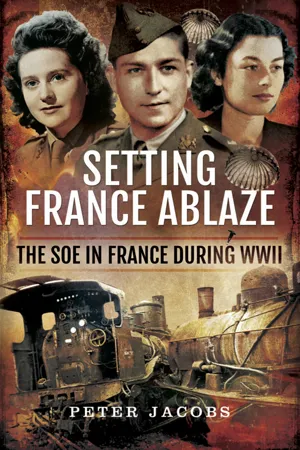
A history of the British intelligence group's operations in France during the Second World War.
During the summer of 1940, as Britain was fighting alone for its survival, the British Prime Minister, Winston Churchill, instructed the newly formed and clandestine Special Operations Executive to "set Europe ablaze." From that moment on the S.O.E. took its own war to Nazi-occupied Europe by conducting a mix of espionage, sabotage and reconnaissance missions, with its F Section dedicated to aiding the liberation of France. The risks and dangers of being associated with the S.O.E were obvious, and the consequences of being caught could only be imagined by those who volunteered. Yet the volunteers still came, from all walks of life, and each a specialist in their own field.
Amongst those recruited were Gus March-Phillipps, who led the Small Scale Raiding Force, Peter Churchill, who survived by convincing his captors he was related to the British Prime Minister, Tommy Yeo-Thomas, known to the Gestapo as the White Rabbit, and the legendary Newton "Twins" who waged their own private war against the Nazis simply to get personal revenge. As F Section grew in numbers, it turned to recruiting women and from its ranks came some of the bravest to have operated in occupied Europe. These included women such as Odette Sansom, Vera Leigh, Noor Inayat Khan, Violette Szabo and Nancy Wake. Then, as the Allies invaded Europe in 1944, the S.O.E. inserted small elite teams, known as Jedburghs, deep behind enemy lines to link up with the French resistance and to coordinate more widespread and overt acts of sabotage to prevent the German reinforcement of Normandy.
Peter Jacobs describes the extraordinary contribution to the Allied war effort made by the S.O.E. in France and tells the gripping story of the men and women who so bravely operated behind enemy lines, many of whom were betrayed and did not live to tell the tale. It pays tribute to the extreme courage and bravery of the individuals who did exactly what Churchill asked of them; they set France ablaze.
Praise for
Setting France Ablaze
"Overall this is a useful examination of SOE's operations in France, and a tribute to the courage of so many of the agents who attempted to carry out Churchill's instructions to 'set Europe ablaze." —History of War
"A very readable account of the SOE and what went on during the war, from the early days of setting up the operation. . . . This book is filled with the stories of agents being inserted into France from the early stages following the German invasion. . . . A very interesting, and thought-provoking account of SOE operatives, and also a way of remembering the many who never came home." —Military Modelling Online
- 240 pages
- English
- ePUB (mobile friendly)
- Available on iOS & Android
eBook - ePub
About this book
Information
Print ISBN
9781783463367
Subtopic
Military & Maritime HistoryChapter 1
SOE and France – The First Year
In fact, rather than fiction, it is rare for so many remarkable accounts of bravery and personal endurance, coupled with political fascination, double-dealing and betrayal, to be part of the same story. But that is the story of the Special Operations Executive, Britain’s most secret service of the Second World War that formed in 1940 after the fall of France. From that moment on its men and women bravely waged war in Nazi-occupied Europe until hostilities came to an end, and by the time the organization was wound up the SOE had enriched the nation’s history with heroic legends.
But the SOE was never a popular department in Whitehall. While its origins stem from intelligence departments and a series of papers and discussions during the last days of Neville Chamberlain’s term as Britain’s prime minister, it had seemingly been thrown together in something of a hurry by his successor, Winston Churchill, after just two months in office.
The SOE was born on 19 July 1940, just a month after France had surrendered, when Churchill drafted a brief memorandum for his War Cabinet tasking the new organization ‘to co-ordinate all action by way of subversion and sabotage against the enemy overseas’.1 Or, as Churchill would later put it to his rather peevish Minister of Economic Warfare, Hugh Dalton, who had been given political responsibility for the new organization, ‘to set Europe ablaze’.
Dalton, for one, believed that conducting war from within would be better achieved by civilians rather than professional soldiers, a view shared by many politicians. Churchill never fully disclosed why he did not entrust control over the SOE to the eagerly outstretched arms of the service chiefs, but he must have decided from the outset to keep a close personal eye on what was his own brainchild, and, as things would turn out, it was perhaps fortunate that the service chiefs did not own the SOE.
Churchill’s initial direction had been brief and very simple but in a later and fuller conversation he elaborated his directive. The SOE, he explained, was to be a secret organization to carry out two key tasks: to create and foster the spirit of resistance in Nazi-occupied countries; and, when appropriate, to establish a nucleus of trained men who would be able to assist in the liberation of those countries when the time came.2 The second task could probably best be achieved by committing, or at least instigating, acts of sabotage in-country. These acts were initially and deliberately intended to be small, risking reprisals by the Nazis if instigated too quickly.
While the direction had been clear, there was no blueprint to follow and there were no rules. The men and women of the SOE would simply have to make things up as they went along, and if the SOE was to be successful then secrecy would be the key.
As an organization, the SOE sat equally alongside Britain’s armed forces as a fourth service, although it would never be seen in Whitehall as truly a fourth armed service. The dominant figure in the organization was the executive director, a post briefly held by Sir Edward Spears and then, from the end of August 1940, Sir Frank Nelson. Nelson would later be replaced in 1942 by his deputy, Charles Hambro, who, the following year, would hand over, in turn, to his deputy, Major General Colin Gubbins, and it was Gubbins who would become the power behind the SOE during its key years of the Second World War.
The SOE initially made use of offices at a requisitioned hotel in Caxton Street but when accommodation became too cramped it set up its main headquarters in a greyish five-storey building at 64 Baker Street. For a long time its very existence remained unknown, even to high-ranking service officers. Those attached to the organization from other departments were discouraged from referring to it by its official name in private conversations; they tended to refer to the SOE as simply ‘The Org’ or ‘The Old Firm’ or ‘The Racket’. If the organization had to be referred to in official correspondence then the designation ‘Inter-Services Research Bureau’ was adopted to allay unwelcome curiosity.3
As its numbers grew, SOE spread its operations to other countries but, for a number of reasons, France always offered the best opportunities to foster sabotage and subversion. It was just across the Channel and so could be supplied and re-supplied with relative ease. There was no shortage of places where agents could be dropped or picked up and the terrain in many parts of the country, particularly the rolling hills and dense woodland, proved ideal for conducting guerrilla warfare. Furthermore, French-speaking agents could be found without too much difficulty and, once on the ground, it was hoped they would be able to merge into the local population with credibility and ease.
The main body for organizing French subversion was F Section (F standing for French), initially launched by Leslie Humphreys in the summer of 1940. F Section took up residence in Baker Street but, when the building became full, the various departments spilled out to neighbouring buildings.
The fall of France resulted in the resignation of the French government and it was left to a First World War hero, Marshal Philippe Pétain, to sign a humiliating armistice with Germany. Under its terms, France was essentially left with an unoccupied zone in the south of the country, to the south of the Loire and inland from the Atlantic coast, called the Zone Libre (free zone), and administered from the town of Vichy by the French premier, then Pierre Laval, while the Germans occupied and governed the northern zone, the Zone Occupée (occupied zone), from Paris.
This arrangement gave those in the south a certain feeling of independence and freedom but many ardent patriots owed their loyalty to Pétain. Consequently, there was initially no organized underground resistance, certainly nothing comparable to what there was in Poland at the time.4 Furthermore, the fact that the south was unoccupied did not mean the SOE would have freedom to operate in this region; far from it. The Vichy police and security service guarded its integrity but it did mean there were few Germans around, although operating in Vichy France would not be without its difficulties.
The legitimacy of Vichy France and Pétain’s leadership was immediately challenged by the exiled, and at that time little known, French officer, Brigadier General Charles de Gaulle. De Gaulle had served under French Prime Minister Paul Reynaud as the Under-Secretary for National Defence and War. He had unsuccessfully opposed surrender, advocating instead that the government should remove itself to North Africa and carry on the war as best it could from there.
From London, de Gaulle claimed to represent the legitimacy and continuity of the French nation. He set about building what became known as the Free French Forces from personnel outside France and used the BBC to broadcast his message to the French people at home to continue to resist Nazi occupation and to work against the Vichy regime.
But de Gaulle’s period of exile in Britain would never be without its problems. In his dealings with the British, and later the Americans, he would always insist on retaining full freedom of action on behalf of France and this would constantly put a strain on his dealings with the Allies. Churchill, for one, was often frustrated at de Gaulle’s patriotic egocentricity.
De Gaulle tried to insist that no SOE operations should be undertaken, either in Nazi-occupied France or the Vichy-controlled south, without his approval. But this was something the SOE was not prepared to do and so de Gaulle would continue to operate his own secret intelligence service in France and only consult the SOE if it was to his advantage to do so.
And so it was against this background that the SOE prepared to undertake operations in France, but it was still some way off being ready to fight a subversive war. The early weeks of its existence soon turned into months as discussions continued about what the SOE’s role should actually be. Even by the early winter of 1940, some four months after it had been set up, the SOE was still puling in its cradle.
This was not because of any lack of enthusiasm amongst those working hard to make sure the new organization would succeed, far from it, but is more a reflection on how that enthusiasm needed to be channelled during its early months. There was a determination to conduct operations as soon as possible but an early attempt to land two agents on French soil by a motor torpedo boat during October had proved unsuccessful, and an attempt to insert an agent near Morhaix during the following month, this time by air, also proved unsuccessful when the agent refused to jump.5
In this latter case, the agent was returned to his unit, as would always be the case in such circumstances, but this was the only recorded refusal to jump during the SOE’s operations.6 There was, however, some joy towards the end of the year when five agents were transported by a submarine provided by the Royal Navy to seize a French fishing vessel near the Ile de Groix, just off the Atlantic coast of France near Lorient, to observe procedures being used by enemy U-boats when entering and leaving the harbour.7
While the agents had succeeded in gathering intelligence and sailed the fishing boat back to Falmouth, this kind of mission was far from the type of subversive activity that the SOE had been intended to perform.
While F Section had been feeling its way, de Gaulle’s organization had been busy building in France and had now established an intelligence circuit under the quite brilliant and resourceful Gilbert Renault, codenamed ‘Colonel Rémy’. There were others, too, who responded to de Gaulle’s appeal. One was Pierre Brossolette, a gifted academic, who instead of pursuing an academic career had become a journalist in the years building up to the war and had used his newspaper columns to denounce both fascism and communism. He was also a popular voice on radio and his views on the rise to power of Adolf Hitler had led to him being blacklisted by the Nazis. Then, in 1939, he was fired from his radio station after publicly opposing the Munich Agreement while on air. After war broke out he joined the army but after the armistice the Vichy regime forbade him from teaching and so he and his wife ran a bookstore in Paris. It was not long before the bookstore became a hub of intelligence for French acts of resistance where documents such as factory plans, which could be used for bombings, were exchanged unnoticed.
It was not long before Brossolette was approached by his friend, Agnès Humbert, an art historian and ethnographer who had become outraged when the Nazis removed her books from her library and had granted German soldiers free entry into the museums at the Palais de Chaillot in Paris. She and a group of like-minded intellectual and academic colleagues had also heard de Gaulle’s broadcast and formed the Groupe du musée de l’Homme (translated as the group of the museum of man), which became acknowledged as being the first resistance group in occupied France.
It was early days of Nazi occupation but these pioneers soon built a highly diffuse underground network. Their action spread rapidly with the creation of a clandestine newsletter, Résistance, with editorials holding no illusions on Pétain and the Vichy government. With Brossolette producing the newsletter and co-ordinating contacts between more groups, he was taken on by Renault as the press and propaganda manager of what had become the most important information agency in France, the Confrérie Notre-Dame (Notre-Dame Brotherhood), amongst the first agencies of de Gaulle’s intelligence service, the Service de Renseignements (SR) and soon to become the Bureau Central de Renseignements et d’Action (BCRA), headed by the former French Army officer Major André Dewavrin (‘Colonel Passy’).8
The Gaullists were impatient for liberation of their country and anxious to commence operations against the Nazis but with few resources they would generally have to rely on the British, and specifically on the SOE, when it came to inserting and recovering their agents to and from France.
The SOE would have to accept the existence of de Gaulle but the fact was that by early 1941 the SOE had not achieved anything when it came to action against the enemy. Indeed, when the Air Ministry asked the SOE to disrupt specialist Luftwaffe bombers performing an early form of target marking for the nightly blitz against London from their airfield at Meucon in Brittany, the SOE had to turn to de Gaulle and Dewavrin to provide French parachutists as F Section had no one ready at the time.
The mission, given the codename SAVANNA, highlights the differences of opinion between the SOE and the RAF during the early months. It should have taken place in February 1941 but senior RAF commanders insisted that the agents be dropped in uniform, believing there to be a vast difference in ethics between the time-honoured operation of the dropping of a spy from the air and this entirely new scheme for dropping men whom the RAF considered assassins.9
By the time these differences of opinion had been sorted, the opportunity had passed; the moon period in February had waned and the weather during early March was poor. In the end, the mission commenced on the night of 15 March when five French soldiers parachuted from a converted RAF Whitley bomber into southern Brittany10. Rather than attempt to break into the airfield to destroy the bombers on the ground, the plan was to kill the crews instead. It was understood they were accommodated some distance away and travelled to and from the airfield by bus but, as it turned out, the intelligence was poor. The Luftwaffe crews travelled to and from the airfield in cars, with no more than two or three crew members in the same vehicle at the same time, and so the mission was abandoned.
Keen to ensure the trip was not entirely wasted, the leader, Captain Georges Bergé, dispersed the men to carry out various reconnaissance tasks. Bergé went to Paris and then on to Nevers and Bordeaux with another member of his team, a man called Forman, before they made their way in early April to a rendezvous point farther south on the Biscay coast near the town of les Sables d’Olonne where they joined a third member of the ...
Table of contents
- Cover
- Title Page
- Copyright
- Contents
- Acknowledgements
- Introduction
- Chapter 1: SOE and France – The First Year
- Chapter 2: First Agents
- Chapter 3: First Lysander
- Chapter 4: Worrying Times
- Chapter 5: A French Agent, an English Agent and a German Agent ‘La Chatte’
- Chapter 6: Establishing Circuits
- Chapter 7: The Twins
- Chapter 8: Women Enter the Fray
- Chapter 9: Colonel Henri
- Chapter 10: End of PROSPER
- Chapter 11: The Disastrous Double Lysander
- Chapter 12: Madeleine
- Chapter 13: The Man Called Gilbert – Agent, Double-Agent or Triple-Agent?
- Chapter 14: Bad Salesmen, Troublesome Farmers, Dangerous Musicians and Tinkers
- Chapter 15: Stationers, Stockbrokers, Marksmen and Scientists
- Chapter 16: The White Rabbit
- Chapter 17: Radio Games, Deception and Lies
- Chapter 18: An Economic Means of Achieving Strategic Success
- Chapter 19: Maximum Effort
- Chapter 20: Towards Liberation
- Chapter 21: Violette
- Chapter 22: To Victory
- Bibliography and References
Trusted by 375,005 students
Access to over 1.5 million titles for a fair monthly price.
Study more efficiently using our study tools.
Frequently asked questions
Yes, you can cancel anytime from the Subscription tab in your account settings on the Perlego website. Your subscription will stay active until the end of your current billing period. Learn how to cancel your subscription
No, books cannot be downloaded as external files, such as PDFs, for use outside of Perlego. However, you can download books within the Perlego app for offline reading on mobile or tablet. Learn how to download books offline
Perlego offers two plans: Essential and Complete
- Essential is ideal for learners and professionals who enjoy exploring a wide range of subjects. Access the Essential Library with 800,000+ trusted titles and best-sellers across business, personal growth, and the humanities. Includes unlimited reading time and Standard Read Aloud voice.
- Complete: Perfect for advanced learners and researchers needing full, unrestricted access. Unlock 1.5M+ books across hundreds of subjects, including academic and specialized titles. The Complete Plan also includes advanced features like Premium Read Aloud and Research Assistant.
We are an online textbook subscription service, where you can get access to an entire online library for less than the price of a single book per month. With over 1.5 million books across 990+ topics, we’ve got you covered! Learn about our mission
Look out for the read-aloud symbol on your next book to see if you can listen to it. The read-aloud tool reads text aloud for you, highlighting the text as it is being read. You can pause it, speed it up and slow it down. Learn more about Read Aloud
Yes! You can use the Perlego app on both iOS and Android devices to read anytime, anywhere — even offline. Perfect for commutes or when you’re on the go.
Please note we cannot support devices running on iOS 13 and Android 7 or earlier. Learn more about using the app
Please note we cannot support devices running on iOS 13 and Android 7 or earlier. Learn more about using the app
Yes, you can access Setting France Ablaze by Peter Jacobs in PDF and/or ePUB format. We have over 1.5 million books available in our catalogue for you to explore.