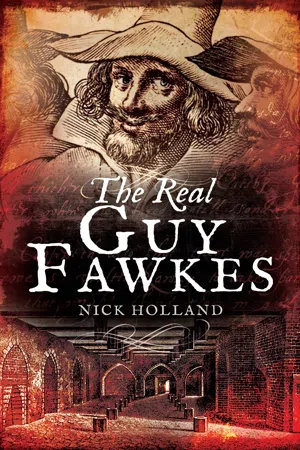
This biography looks behind the mask of the seventeenth-century rebel who became a controversial folk hero for his role in the infamous Gunpowder Plot.
Today, Guy Fawkes is an instantly recognizable symbol of violent rebellion across the globe. Some proudly dress in his image while others burn his effigy. But few people know the story of the man behind the legend. In
The Real Guy Fawkes, biographer Nick Holland explores his eventful life and the complicated, dangerous era in which he lived.
Born in York in 1570, Fawkes was raised Protestant, yet went on to plan mass murder for the Catholic cause. Prepared to risk everything and endanger countless lives, was he a freedom fighter, a treasonous fanatic, or merely a fool?
Holland offers a fresh take on Fawkes's early life, showing how he was radicalized into a Catholic mercenary and a key member of the 1605 Gunpowder Plot. Featuring beautiful illustrations, this accessible and engaging biography combines contemporary accounts with modern analysis to reveal new motivations behind his actions.
- 240 pages
- English
- ePUB (mobile friendly)
- Available on iOS & Android
eBook - ePub
The Real Guy Fawkes
About this book
Information
Chapter 1
By the Grace of God
Thy sight was never yet more precious to me;
Welcome, with all the affection of a mother,
That comfort can express from natural love:
Since thy birth-joy – a mother’s chiefest gladness
After sh’as undergone her curse of sorrows –
Thou wast not more dear to me, than this hour
Presents thee to my heart
Thomas Middleton, Women Beware Women
York is a beguiling city with a long history, one filled with conquest, bloody battles, and rebellion. Today it is a hive of activity, its charming streets full of tourists, students, families and workers, but if we look closely we can still catch glimpses of the Tudor city that Guy Fawkes grew up in.
By the late sixteenth century, the population of York stood at between ten and twelve thousand souls, a slight increase on the number living there a century earlier. With the population of England as a whole increasing substantially at this time, it could be expected that York would have grown more dramatically than that, as it was to do in later centuries building up to a figure of around two hundred thousand today, but in fact it was a city that had entered decline.
York had long been famous for its woollen trade, with the hills and dales surrounding it proving perfect sheep pastures, and the rivers Ouse and Foss that flow through the city being ideal conduits to carry produce in and out. In Tudor times, however, smaller scale wool trading centres began to gain popularity across Yorkshire and Lancashire. They were less cumbersome, with smaller overheads and offering cheaper prices.
Tudor York was also famous for its cathedral, the Minster. Then, as now, it dominated the heart of the city, but to many York dwellers by the mid-sixteenth century it had become a symbol of oppression rather than a source of pride. Even before its completion in 1472 it had been used as a centre of Catholic worship, with liturgies read in Latin that few of the congregation could understand, and an emphasis placed upon mysteries that had been passed down from generation to generation. In 1517, in a city over eight hundred miles away, an act took place that would change that for ever, and set in motion events that would lead to an attempt on the life of the King and all of England’s ruling class.
Tradition states that on 31 October 1517, a priest nailed a letter to the door of All Saints’ Church in Germany.1 The priest was Martin Luther and the letter became known as the ‘ninety-five theses’. In short, Luther was proclaiming his desire to see the Roman Catholic church reformed, and replaced by a new kind of worship that placed scripture at its centre rather than one person in the shape of the Pope.
This simple act proved a catalyst for what we call the Reformation, and the splitting of the church into Catholic and Protestant factions. The reformation was quickly championed by England’s king, Henry VIII, who proclaimed himself head of the church in England, and took steps to remove much of the power, and especially the riches, that the Catholic church in England had amassed.
This English reformation was entrusted by Henry to one official in particular: Thomas Cromwell.
Cromwell was a power-hungry man, and one who did not baulk when it came to cruelty, setting a trend that would be followed later by Queen Elizabeth’s chief courtiers such as Robert Cecil, who would become so important to Guy Fawkes’ story. By 1535 Cromwell, already Lord Privy Seal, was also made Vicar General by King Henry, and given the important job of driving the reformation onwards.
To Cromwell this meant one thing above all else: crushing the Catholics. In 1536 he published ‘An Act Extinguishing the Authority of the Bishop of Rome’, which was intended to end the ‘pretended power and usurped authority of the Bishop of Rome, by some called the Pope’.2 If Cromwell found the subjugation and conversion of Catholics in southern England easy, he encountered much greater resistance in northern England, a resistance that had its first outpouring in York in an event known as ‘The Pilgrimage of Grace.’
While there were staunchly Catholic areas in East Anglia, Wales and the Midlands, it was Yorkshire and Lancashire that clung most ferociously onto their previous beliefs. By 1536 many of the people of these counties had a litany of complaints against the reformation, against the destruction of their churches and monasteries, against the fines being imposed upon them, and particularly against the increasingly violent edicts of Thomas Cromwell.
After an earlier revolt in Louth, Lincolnshire, a wealthy lawyer called Sir Robert Aske, originally of London, raised a band of around ten thousand men and occupied the city of York. Under Aske’s rule, the Catholic way of life was restored, and priests, monks and nuns returned.
The Duke of Norfolk was sent by King Henry to meet and negotiate with the protesters, or pilgrims as they called themselves. Upon meeting them near Doncaster with his army of around five thousand, Norfolk was dismayed to find that Aske had around ten times that number of men, and that leading northern nobles including Sir Thomas Percy were backing the rebellion.
A peaceful settlement was made and the men were dispersed, but it’s unclear whether Norfolk had the authority to make the concessions that he promised. What is clear is that within two years the deal and any amnesty that came with it was broken. Aske was executed in York, hung from gallows at the top of the castellated Clifford’s tower before his lifeless body was suspended in chains from the wall.3 By 1538, 216 people associated with the uprising had also been killed.
In the decades which followed the Pilgrimage of Grace’s defeat, the new Protestant religion gained supremacy in York, officially at least. During the last years of Henry’s reign, under the auspices of Cromwell, and in the later reign of Henry’s daughter Elizabeth, acts of parliament encouraged their subjects to become good and loyal Protestants. Where the heart couldn’t be won over voluntarily, financial punishments were invoked so that people who chose not to attend Protestant church services, those who became known as recusants, were often worn down by fines and the confiscation of their land and property. The 1552 Second Act of Uniformity4 made it compulsory to attend official Church of England services, and from 1559 onwards a fine of twelve pence would be imposed on those who failed to attend. This fine would rise sharply in succeeding decades.
The reformation ensured that the Church of England became not only a spiritual movement, but also one that took an increasingly active role in legal administration, and therefore a money-making operation thanks to its system of fines and punishments. It was an ideal time to be an ecclesiastical lawyer, and one such man who served the city of York in the mid-sixteenth century was William Fawkes, a member of the Fawkes family of Farnley near Leeds.
William Fawkes had married well: his wife Ellen was from York’s prestigious Harrington family, and her father had served as the Sheriff of York for five years before becoming Mayor in 1536. It is an irony, therefore, that it was Mayor Harrington, the great-grandfather of Guy Fawkes, who received Sir Robert Aske’s demands at the start of the Pilgrimage of Grace, and who helped ensure its defeat.5
William Fawkes and other ecclesiastical lawyers were in even higher demand from 1561 onwards, as Queen Elizabeth I chose the city as headquarters for two major organisations: the Council of the North, and the Ecclesiastical Commission for the Northern Province.6 This served two purposes for the Queen: firstly it would attract more people to the city that had been losing population thanks to increased competition in the wool trade, secondly it would help to prop up the authority of the Church of England in York, a city that she and her courtiers knew still housed a significant number of people sympathetic to the old Roman faith.
While the first child of William and Ellen Fawkes, Thomas, became a wool trader, their second son Edward followed in his father’s footsteps by becoming a lawyer in York’s ecclesiastical court. Edward’s talents were soon recognised, and he became a proctor of the Ecclesiastical Court,7 and then an advocate in the Consistory Court of the Archbishop of York, based in Minster Yard next to the towering York Minster itself.
As an advocate in the Consistory Court, Edward Fawkes would play a major role in upholding church law, by which we mean the law of the Church of England. This would have involved him in civil matters, such as the settlement of debts or disputes between individuals, but it also placed him at the forefront of the battle against Catholics, and especially against recusants.
While never a wealthy man, Edward Fawkes did own land in several locations across York, and his job and background would have given him the undoubted status of a gentleman. With this status to his name it would have been expected that he’d marry a woman from a similarly respectable background, but instead, in 1567 or 1568, he married Edith Blake. Little is known of Edith’s early background, indeed some earlier commentators conjectured that her surname may have been Jackson based upon one of Guy’s confessions in the Tower of London.8 Her family were merchants from the Scotton area, around twenty miles to the east of York, and it seems that she was less well educated than her husband, as recordings of her signature show a less than assured hand. This may have led to the Fawkes family looking down on the union, and it may also be pertinent that when her brother-in-law Thomas died in 1578, he made provisions for Guy and other relatives but made no mention at all of Edith in his will.
If the Fawkes family felt that Edward had married beneath him, there is no reason to think that they didn’t enjoy a happy marriage. Indeed, it may have been a love marriage rather than one arranged for reasons of social standing as was common at the time. We know that Edith quickly became pregnant (and of course we could conjecture that this may have led to their marriage, rather than occurring afterwards). On 3 October 1568, Edith gave birth to a daughter who was named Anne. Unfortunately, tragedy soon struck and Anne was buried just seven weeks later.
As was traditional then, the name was passed on to their next daughter, who was born on 12 October 1572, and Anne Fawkes gained a sister Elizabeth on 27 May 1575. These were the younger sisters of the only son of Edward and Edith Fawkes: born on 13 April 1570, they named him Guy.
Guy’s exact date of birth is unrecorded, but we can estimate it with confidence because we know that he was baptised on 16 April at St. Michael-le-Belfrey church in York, and baptisms usually took place three days after a child was born.9
St. Michael-le-Belfrey is a large and beautiful church in its own right, although it is towered over by York Minster lying adjacent to it. It was the parish church for much of the centre of York, and so would have been the regular place of worship for many of its citizens, rather than the grander cathedral alongside it. The church hasn’t forgotten its infamous son, and a display on Guy’s life is today situated at the rear of the building, along with a copy of his entry of baptism.
Directly across from St. Michael-le-Belfrey, on High Petergate, is the Guy Fawkes Inn. It’s a charming place to eat and drink, and draws in many of York’s tourists partly thanks to its blue plaques stating that this was the spot on which Guy Fawkes was born, and the magnificent gunpowder plot mural across an outside wall.
While the Guy Fawkes Inn of today dates from a period after Guy’s life, it is a separate building to the rear of the inn that is of interest to Fawkes historians. This white coloured cottage bears the name of ‘Guy Fawkes Cottage’, and it has often been said that this was the building that saw him take his first breath on that April morning in 1570. The cottage is of the right age, and it seems likely that it’s the building referred to in a document of 8 July 1579, when Edith Fawkes signed for the continuation of a lease for a High Petergate building from Matthew Hutton, Dean of York Minster.
Is this then the actual birthplace of Guy Fawkes? Like much in Guy’s life, it is not certain, with two other spots in and around York claiming to be the place where he was born. The outlying district of Bishopthorpe has a long-standing tradition that Guy Fawkes was born there, in a house that no longer exists but which stood opposite St. Andrew’s church. The question has to be asked why Guy was baptised in the centre of York if he was born in Bishopthorpe? Nevertheless, I firmly believe that oral traditions that have lasted for centuries have to be respected – and they often contain some element of the truth even if they aren’t wholly truthful. Bishopthorpe was and is the traditional seat of the Archbishop of York, so it doesn’t stretch the imagination to conjecture that the village may also have attracted lawyers from the Archbishop’s court – such as Guy’s father, Edward Fawkes.
My opinion is that Guy may well have lived for a while in Bishopthorpe during his childhood, and he probably also lived for a time on the site of what is now the Guy Fawkes Inn. Historian Katherine Longley, however, argues convincingly that the true birthplace of Guy Fawkes was a house on Stonegate in York, a short walk from High Petergate, the Minster, and St. Michael-le-Belfrey,10 and that is what is now generally accepted.
Edward and Edith must have been overjoyed as they watched Guy grow up to be a strong and inquisitive boy, especially after the loss of their first child. Here was a boy who would grow into the man to carry the Fawkes name on into future generations. They might have dreamt that their son would follow his father and grandfather and become a lawyer. Unfortunately for them, the boy grew up to have other plans. The York that Guy came to know was very different to that of his parents’ generation, and Guy’s childhood and adolescence spent within its close, claustrophobic streets would change his life forever.
Guy’s York was a city full of paranoia and treachery, a city where people kept a close watch on their neighbours, and where husbands would be forced to betray their wives; a city where justice was becoming increasingly violent, increasingly arbitrary. It was a city where, even as a young boy advancing in years, you felt that you were being spied upon. You were being watched not only by your neighbours and playmates, but by the all-seeing eye of Queen Elizabeth herself.
Chapter 2
The Glorious Queen
Her berth was of the wombe of morning dew,
And her conception of the joyous Prime
Edmund Spenser, The Faerie Queene
Guy Fawkes’ life was full of turmoil and change, yet for all but his last two and a half years there was one constant: the rule of Queen Elizabeth, also known as the Virgin Queen, the Fairie Queen, or simply ...
Table of contents
- Cover
- Title
- Copyright
- Contents
- Acknowledgements
- Prologue
- Chapter 1. By the Grace of God
- Chapter 2. The Glorious Queen
- Chapter 3. A School for Sedition
- Chapter 4. Changed Forever
- Chapter 5. The Pearl of York
- Chapter 6. A Picturesque Scene
- Chapter 7. By Fire and Water, Thy Line Shall Come to an End
- Chapter 8. Spies, Secrets and Sundry other Places
- Chapter 9. A Man Highly Skilled in Matters of War
- Chapter 10. An Open Enemy, and an Enemy of their Beliefs
- Chapter 11. The Spanish Treason
- Chapter 12. A Gentleman of Good Family
- Chapter 13. Six Men in the Duck and Drake
- Chapter 14. This is the Gentleman
- Chapter 15. The Unknown Servant
- Chapter 16. An End to Tunnelling
- Chapter 17. God’s Lunatics
- Chapter 18. A Terrible Blow
- Chapter 19. A Traitor in the Brotherhood
- Chapter 20. A Very Tall and Desperate Fellow
- Chapter 21. The Devil of the Vault
- Chapter 22. By Steps, Proceeding to the Worst
- Chapter 23. A Prey for the Fowls of the Air
- Epilogue
- Notes
- Bibliography
- Plate section
Trusted by 375,005 students
Access to over 1.5 million titles for a fair monthly price.
Study more efficiently using our study tools.
Frequently asked questions
Yes, you can cancel anytime from the Subscription tab in your account settings on the Perlego website. Your subscription will stay active until the end of your current billing period. Learn how to cancel your subscription
No, books cannot be downloaded as external files, such as PDFs, for use outside of Perlego. However, you can download books within the Perlego app for offline reading on mobile or tablet. Learn how to download books offline
Perlego offers two plans: Essential and Complete
- Essential is ideal for learners and professionals who enjoy exploring a wide range of subjects. Access the Essential Library with 800,000+ trusted titles and best-sellers across business, personal growth, and the humanities. Includes unlimited reading time and Standard Read Aloud voice.
- Complete: Perfect for advanced learners and researchers needing full, unrestricted access. Unlock 1.5M+ books across hundreds of subjects, including academic and specialized titles. The Complete Plan also includes advanced features like Premium Read Aloud and Research Assistant.
We are an online textbook subscription service, where you can get access to an entire online library for less than the price of a single book per month. With over 1.5 million books across 990+ topics, we’ve got you covered! Learn about our mission
Look out for the read-aloud symbol on your next book to see if you can listen to it. The read-aloud tool reads text aloud for you, highlighting the text as it is being read. You can pause it, speed it up and slow it down. Learn more about Read Aloud
Yes! You can use the Perlego app on both iOS and Android devices to read anytime, anywhere — even offline. Perfect for commutes or when you’re on the go.
Please note we cannot support devices running on iOS 13 and Android 7 or earlier. Learn more about using the app
Please note we cannot support devices running on iOS 13 and Android 7 or earlier. Learn more about using the app
Yes, you can access The Real Guy Fawkes by Nick Holland in PDF and/or ePUB format, as well as other popular books in History & Historical Biographies. We have over 1.5 million books available in our catalogue for you to explore.