The definitive guide to the main theater of WWI—"maps of the battles . . . military strategy . . . extraordinary anecdotes . . . it's a triumph" (
Daily Mail).
Written by the author of the three previous bestselling Companions on Waterloo, Trafalgar and Gettysburg—now acclaimed as the definitive work of reference on each battle—
The Western Front Companion is not a mere chronological account of the fighting. Rather, it is an astonishingly comprehensive and forensic anatomy of how and why the armies fought, of their weapons, equipment and tactics, for over four long and bloody years on a battlefield that stretched from the Belgian coast to the Swiss frontier—a distance of 450 miles. Alongside the British Army, full coverage is given to Britain's allies—France, Belgium, Australia, New Zealand, Canada, South Africa, India and the United States—as well as the Germans.
The 350,000 words of text range over everything from the railways on the front to the medical corps and the chaplains. Like previous Companions, this book is equally distinguished by its magnificent visual resources—original and intricate maps and diagrams, over 200 resonant and remarkable archive images from the time (many rarely seen), and modern color photographs showing how historic battlefields look nowadays, and paying tribute to the magnificent and poignant cemeteries, monuments and ossuaries that mark the fallen for today's battlefield visitor.
Every reader, no matter how well informed already on the history of World War I, will learn something new from this extraordinary and exhaustive volume. No one interested in the true story and sheer sweep of the Great War on the Western Front can afford to be without it.
- 528 pages
- English
- ePUB (mobile friendly)
- Available on iOS & Android
eBook - ePub
The Western Front Companion
About this book
Information
Subtopic
History ReferenceIndex
History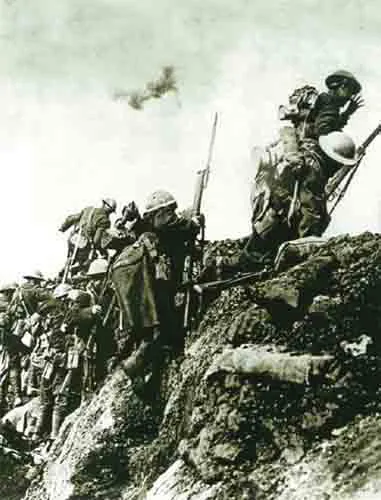
A company of Canadian soldiers going ‘over the top’ from a World War I trench. Note the shell bursts overhead.
Section One
A Western Front Timeline
Battles, even in these ages, are transacted by mechanisms;
men now even die, and kill one another, in an artificial manner.
men now even die, and kill one another, in an artificial manner.
Thomas Carlyle, The French Revolution, 1837
In May 1921 the Battles Nomenclature Committee published its report, and although this Companion has not specifically followed the phases of the war set out by the committee, it may be useful to enumerate their conclusions in order to help the reader understand the sequence (or phasing) of major events that occurred during the four years of continuous fighting on the Western Front.
Phase 1 The German invasion in 1914.
Phase 2 Trench warfare, 1914-1916.
Phase 3 The Allied offensive in 1916 (the Battles of the Somme and the French defence of Verdun).
Phase 4 The German retreat and the Allied advance to the Hindenburg Line.
Phase 5 The Allied offensives of 1917 (Arras, Vimy, Chemin des Dames, Third Ypres (Passchendaele), Cambrai.
Phase 6 The German offensive, spring 1918.
Phase 7 The Allied advance to victory, August-November 1918.
Before describing in detail how the war on the Western Front was fought, a look in outline at the critical events and battles that took place year by year will help in putting the later, more detailed, accounts of smaller-scale actions into context. The timeline is in the form of a year-by-year diary of events, illustrated by maps showing the battles fought and the line of the Western Front at the end of each year. More detailed maps with accompanying notes explain two or three of the more important battles fought during each year.
1914
Never in the history of warfare had so large a concentration of military forces assembled in Europe. In round numbers, the Germans initially deployed 1.5 million; the French had over 1 million, with 3 million reservists on call; the Austrians and Russians each had 1.25 million on their frontiers; and by the end of the year 1 million volunteers in the UK had come forward to serve. By Christmas, as an unofficial truce was celebrated on parts of the Western Front, the expectation of a short, sharp war of manoeuvre had evaporated. The Kaiser had told departing troops, ‘You will be home before the leaves have fallen from the trees.’ In Britain the urgency of the patriotic rush to volunteer was due to the prevailing view that the great adventure would ‘be all over by Christmas’.
Only Lord Kitchener, the British war minister, warned the Cabinet that the war would not be short – he anticipated it would last three years. The first weeks of fighting in the west were clashes of encounter and movement (the Battles of the Frontiers), which saw the Allies forced to retreat in the face of a massive German onslaught. This opening phase of the war was what both sides had planned for – a type of war their commanders understood and for which their armies were trained. However, Moltke’s variation of the Schlieffen Plan had, by the end of 1914, failed to provide the decisive, overwhelming and speedy victory envisaged by the Germans. Worried by reports of Russian advances into East Prussia, Moltke had weakened the all-powerful right wing by detaching troops to the Eastern Front and had failed to appreciate how the blazing heat of summer, continuous forced marching over extensive distances, combat and heavy losses, coupled with immense logistical problems, would exhaust his armies before any decisive victory could be achieved.
When General Alexander von Kluck, commanding the German First Army on the extreme right wing, had been forced to turn his tired troops south-east and march north of Paris instead of swinging south of it, he exposed his own right to a flank attack from Paris by the French governor, General Joseph-Simon Gallieni. General Joffre, the French commander-in-chief, ordered the French Sixth, Fifth and Ninth Armies (under Generals Michel-Joseph Maunoury, Louis Franchet d’Espèrey and Foch), together with the BEF (Field Marshal Sir John French), to counter-attack across the River Marne. This resulted in the so-called ‘Miracle of the Marne’, which saw the entire German advance halted and pushed back as far as the River Aisne. Here the Germans stabilized the line and both sides started to dig. At this stage Lieutenant General Erich von Falkenhayn replaced a demoralized Moltke as chief of the German General Staff.
Declarations of War 1914
Every year from 1914 to 1918 at least five declarations of war were made, many by tiny countries like Haiti and Honduras, both of which declared only a few months before the Armistice. In 1914 they were:
28 July | Austria on Serbia |
1 August | Germany on Russia |
3 August | Germany on France |
4 August | Germany on Belgium UK on Germany |
5 August | Montenegro on Austria-Hungary |
6 August | Austria-Hungary on Russia Serbia on Germany |
8 August | Montenegro on Germany |
12 August | France on Austria-Hungary UK on Austria-Hungary |
23 August | Japan on Germany |
25 August | Japan on Austria-I lungary |
28 August | Austria-Hungary on Belgium |
2 November | Russia on Turkey Serbia on Turkey |
5 November | UK on Turkey France on Turkey |
The First British Rifle Shot of the War
On 22 August 1914 C Squadron of the 4th Dragoon Guards were part of the cavalry screen advancing ahead of the BEF and about to take part in the first action by British soldiers on the continent of Europe since Waterloo ninety-nine years earlier. Suddenly, over the crest of a hill, a body of lance-carrying German Uhlan cavalry appeared.
The squadron commander, Major Tom Bridges, gave permission for Captain Hornby with the 1st Troop to make a mounted charge. In the resulting melee, the British swords proved far more effective than the Germans’ unwieldy lances. The Germans scattered and the 1st Troop, supported by the 4th, careered off in pursuit for about a mile before the Germans rallied and tu...
Table of contents
- Cover
- Title
- Copyright
- Contents
- Author’s Note
- Acknowledgements
- Key to Symbols
- Introduction: Why the World Went to War
- Section One: A Western Front Timeline
- Section Two: The Western Front Armies
- Section Three: Commanders and Staff
- Section Four: Infantry and Their Weapons
- Section Five: Artillery
- Section Six: Cavalry
- Section Seven: Engineers
- Section Eight: Supply and Transport
- Section Nine: Medical, Chaplains, Veterinary
- Section Ten: Tanks
- Section Eleven: Aviation
- Section Twelve: Trench Warfare
- Section Thirteen: Cambrai
- Epilogue
- Bibliography
Trusted by 375,005 students
Access to over 1.5 million titles for a fair monthly price.
Study more efficiently using our study tools.
Frequently asked questions
Yes, you can cancel anytime from the Subscription tab in your account settings on the Perlego website. Your subscription will stay active until the end of your current billing period. Learn how to cancel your subscription
No, books cannot be downloaded as external files, such as PDFs, for use outside of Perlego. However, you can download books within the Perlego app for offline reading on mobile or tablet. Learn how to download books offline
Perlego offers two plans: Essential and Complete
- Essential is ideal for learners and professionals who enjoy exploring a wide range of subjects. Access the Essential Library with 800,000+ trusted titles and best-sellers across business, personal growth, and the humanities. Includes unlimited reading time and Standard Read Aloud voice.
- Complete: Perfect for advanced learners and researchers needing full, unrestricted access. Unlock 1.5M+ books across hundreds of subjects, including academic and specialized titles. The Complete Plan also includes advanced features like Premium Read Aloud and Research Assistant.
We are an online textbook subscription service, where you can get access to an entire online library for less than the price of a single book per month. With over 1.5 million books across 990+ topics, we’ve got you covered! Learn about our mission
Look out for the read-aloud symbol on your next book to see if you can listen to it. The read-aloud tool reads text aloud for you, highlighting the text as it is being read. You can pause it, speed it up and slow it down. Learn more about Read Aloud
Yes! You can use the Perlego app on both iOS and Android devices to read anytime, anywhere — even offline. Perfect for commutes or when you’re on the go.
Please note we cannot support devices running on iOS 13 and Android 7 or earlier. Learn more about using the app
Please note we cannot support devices running on iOS 13 and Android 7 or earlier. Learn more about using the app
Yes, you can access The Western Front Companion by Mark Adkin in PDF and/or ePUB format, as well as other popular books in History & History Reference. We have over 1.5 million books available in our catalogue for you to explore.