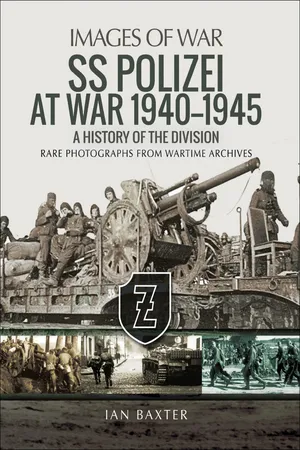
- 144 pages
- English
- ePUB (mobile friendly)
- Available on iOS & Android
eBook - ePub
About this book
Formed in 1939 SS-Polizei Division were not considered initially as an SS fighting force, and this status was reflected in the quality of the equipment they were issued. Following operations in France, Greece and then Russia, it was not until 1942 the division was transferred to the Waffen-SS, and eventually upgraded to a Panzergrenadier division, the 4th SS-Polizei-Panzergrenadier Division.The book describes how the SS-Polizei Division fought across the Low Countries, the Eastern Front, before deploying to the Balkans and Greece where it committed numerous atrocities. During the last days of the War it was assigned to Army Detachment Steiner defending Berlin where many soldiers fought to the death.This book is a unique glimpse into one of the most infamous fighting machines in World War Two and a great addition to any reader interested Waffen-SS history.
Information
Chapter One
Origins
Even before the Germans attacked Poland in September 1939, Himmler wanted to create a third division that was not technically SS, unlike the LSSAH, SS-VT units (later Das Reich) and unofficially the Totenkopfverbände (Death’s Head). This new division would be formed from ordinary policemen, or Ordnungspolizei. From its conception it was planned to be part of the military arm of Himmler’s growing empire which would be capable of fighting alongside both Wehrmacht and SS-VT troops and still police the local area with force. The Polizei division, although not titled as a division at that time, was created at the end of the Polish campaign in early October 1939. Some 15,000 members of the Ordnungspolizei were drafted into units of the artillery and signals units that were transferred from the Wehrmacht. During its creation these men were not recruited as SS troops, but as policemen and wearing regular army uniforms.
Generalleutnant der Polizei Karl Pfeffer-Wildenbruch was appointed the Polizei’s first commander, and with it was also commissioned as an SS-Gruppenführer. His task was to equip and train the police unit to become a fully-fledged fighting machine. However, it was poorly funded, with resources going to the new SS units like the LSSAH and SS-VT. It was a poor-grade unit and lacked the physical and ideological qualities of the original armed SS formations. There was also resentment within the ranks, as many of the men were middle-aged and had not wanted to be taken away from their chosen professions as policemen to act as soldiers. Nonetheless, they began its training in the Black Forest and was sent on internal security duties in Poland.
The new recruits, although not yet imbued with the same enthusiasm as their SS counterparts, still trained and undertook their service in relatively good spirits. Wearing their field grey uniforms, bearing police instead of the SS insignia, the men trained with equipment that mainly consisted of captured Czech weapons.
Military training was often laborious for the trainers as many of the recruits had no combat experience or military knowledge. Some also proved to be ‘gun shy’, or simply had no aptitude, despite patient encouragement. However, once familiar with their weapons they were taught infantry assault techniques, with emphasis on ferocity and speed in attack. The recruits soon learnt this was key to obtaining an enemy position quickly and efficiently and minimising casualties.
Ideologically, the teachings in the Polizei were kept to a minimum. It was unlike that of the SS order where trainers reinforced each recruit with Germanic virtues, producing men who believed in their destiny as missionaries of a new Aryan order to rule the world with an iron fist. Here in the ranks of the Polizei, the men were taught to fight and stay alive. They were told that they were fighting to make their country strong and fulfilling their personal oath to their Führer.
During the first part of 1940, the SS continued to expand. In March, the SST-VT officially became the Waffen-SS (Weapon-SS), comprising the reinforced LSSAH (Leibstandarte SS Adolf Hitler), now at regimental strength, the newly formed SS Totenkopf Division, and the Polizei Division. The SS-VT had been formed during the closing days of the Polish campaign by amalgamating the three SS-VT truppen together as Deutschland, Germania and Der Führer. This formation would later become the infamous Das Reich division, and take centre stage replacing the Polizei division as the third SS division in the Waffen-SS. Polizei would become the fourth.
The men of the Leibstandarte would continue to receive nothing but the best equipment and hardware, while the Polizei, which was not really expected to take an active role in future fighting, would make do being supplied with obsolescent horse-drawn weapons. The Polizei were not even given priority over the regular Heer. Equipment for the formation was often extremely slow to come through, and wrangling over the distribution of weapons was a constant problem.
Even as preparations were made for war against the West, there were already acute shortages of guns due to the drastic expansion of the Wehrmacht and their need to be ready for action. If the SS divisions were to function properly they needed their own integral artillery battalions. Moreover, these units needed to be motorized and would require large numbers of vehicles to tow guns and move troops quickly to forward areas of the battlefield.
In spite of shortages, the SS were to take part in operations against the West. Both the Leibstandarte and SS-VT were already bloodied from Poland, and were thus suited for front-line tasks. However, the Totenkopf and the Polizei divisions were untried in battle, and consequently did not inspire confidence in the Heer units who would have to fight alongside them. Both divisions were ordered into reserve and were to play initially no active role in the campaign.
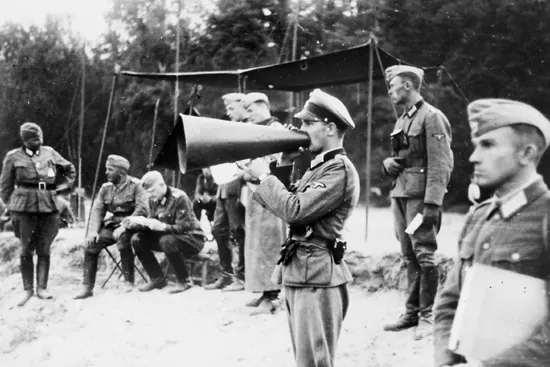
A Polizei officer gives out his orders during a training exercise. Although formed under the authority of Reichsführer Heinrich Himmler, the Polizei was not technically SS at this early period of the war. Prevented by the army from recruiting soldiers from the general population, Himmler did however have a source of manpower in the police, which he controlled, and the division was made up from members of the Ordnungspolizei, the Police force.
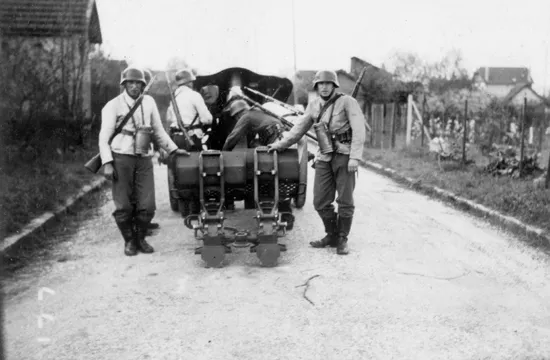
Two 10.5cm howitzer crew members prepare to hitch the gun to its limber during a training exercise. Note their gas mask canisters slung around to their front so they can easily sit in the limber.
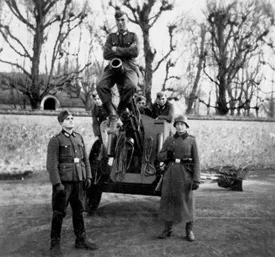
A photograph taken of a 10.5cm howitzer at a training barracks in 1939. Note on the left sleeve of the soldier straddling the cannon is the infamous SS eagle. In the foreground the man on the left is an NCO and is identifiable by the braid loop at the base of his shoulder straps.
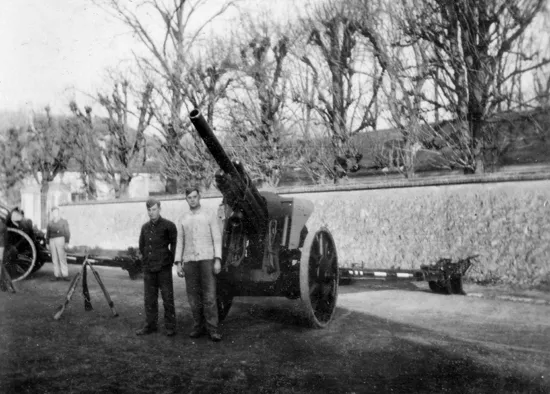
A second photograph taken at the same training barracks of a 10.5cm howitzer.
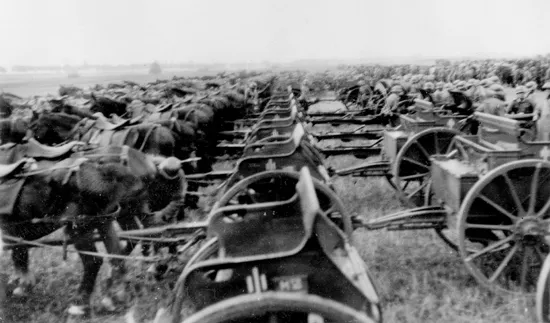
What appears to be a photograph of a complete artillery Abteilung lined up during a training exercise. In the foreground is a caisson attached to a limber. The guns are the 7.5cm FK16 nA.
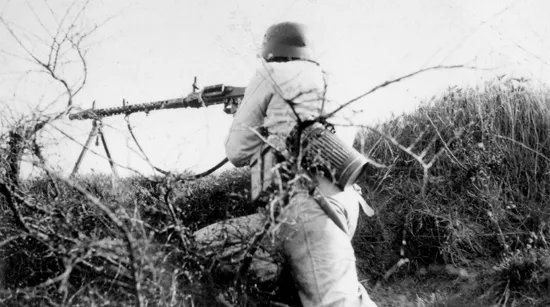
A candidate wearing a white denim work uniform during a training exercise, armed with the MG34 machine gun on a bipod. Each artillery battery was assigned two MG34 machine squads to protect its position against both aerial and ground attack.
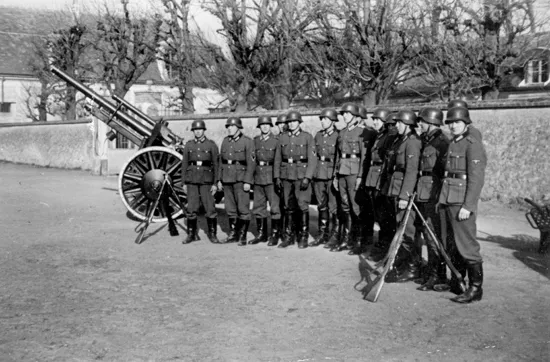
An artillery regiment with their pristine looking 10.5cm howitzer at their training barracks during what appears to be a ceremonial occasion.
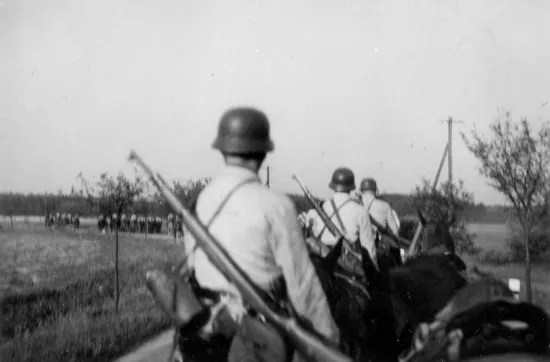
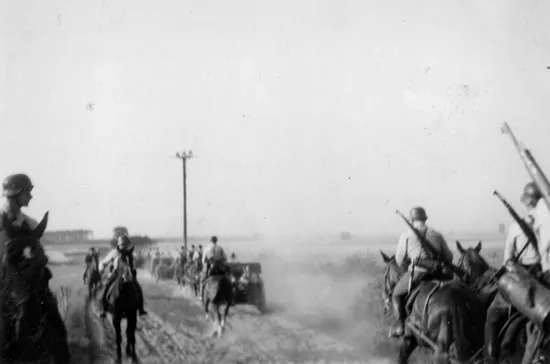
Two photographs taken in sequence showing SS-Artillerie-Regiment 4 during manoeuvres in the early spring of 1940. Wearing their white training garments these artillerymen are put through their paces simulating on-the-march towing their artillery and equipment. Even in 1940 the German army’s main mode of transport was still animal draught.
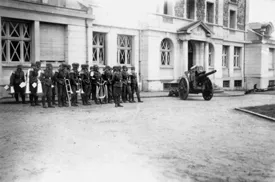
What appears to be some kind of ceremony at a training camp in 1940 complete with military band and 10.5cm le.FH 18 light field howitzer. Generally all German infantry divisions had organic field artillery regiments. These comprised batteries that contained the 10.5cm, which was the most popular artillery piece in the German arsenal during the early war period.
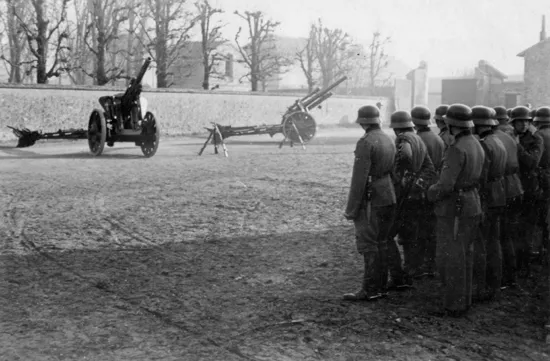
Polizei troops belonging to an SS-Artillerie-Regiment during a parade ceremony in early 1940. Two 10.5cm le.FH 18 light field howitzers are placed at right angles with a group of stacked Karabiner 98K bolt-action rifles positioned between them. The 10.5cm was the standard field howitzer used by both the Polizei, SS, and regular army during this early war period.
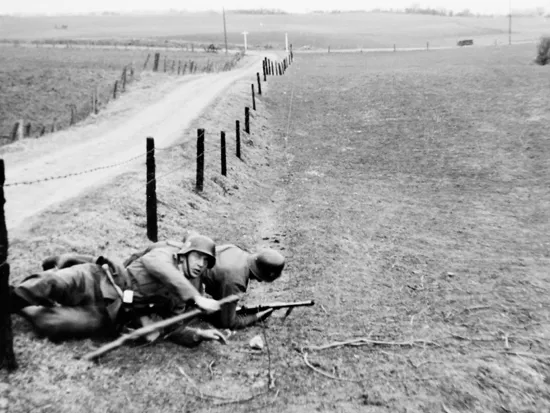
Two Polizei troops are seen during a training exercise. One nearest the photographer is armed with the standard German Karabiner 98K bolt-action rifle, while his troop leader is armed with the MP38/40. Instead of SS equipment the Polizei were often equipped with old and captured hardware. The troops too where considerably older than other SS men, and they lacked poor training.
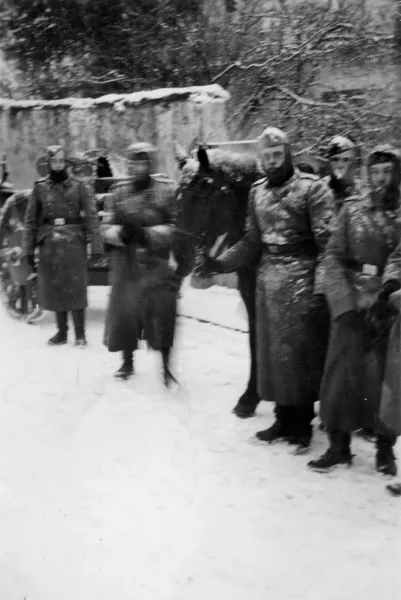
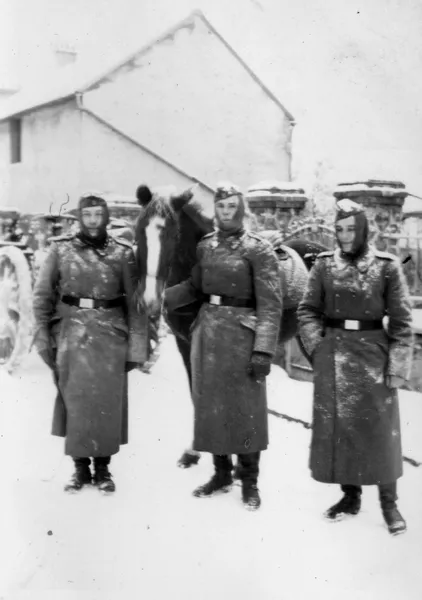
Two photographs taken in sequence on manoeuvres during the early winter of 1940; men of SS-Artillerie-Regiment 4 are seen in the snow. Clad in the standard army great coat wearing head scarf and Wehrmacht M1938 field caps, but displaying the early style front metal cap skull button and branch-coloured soutache, the...
Table of contents
- Cover
- Title
- Copyright
- Contents
- About the Author
- Introduction
- Chapter One: Origins
- Chapter Two: Western Front (1940)
- Chapter Three: Holding the Line (1941)
- Chapter Four: Bitter Fighting (1942)
- Chapter Five: Greece and the Eastern Front (1943–45)
- Appendix: Organizational History
Trusted by 375,005 students
Access to over 1.5 million titles for a fair monthly price.
Study more efficiently using our study tools.
Frequently asked questions
Yes, you can cancel anytime from the Subscription tab in your account settings on the Perlego website. Your subscription will stay active until the end of your current billing period. Learn how to cancel your subscription
No, books cannot be downloaded as external files, such as PDFs, for use outside of Perlego. However, you can download books within the Perlego app for offline reading on mobile or tablet. Learn how to download books offline
Perlego offers two plans: Essential and Complete
- Essential is ideal for learners and professionals who enjoy exploring a wide range of subjects. Access the Essential Library with 800,000+ trusted titles and best-sellers across business, personal growth, and the humanities. Includes unlimited reading time and Standard Read Aloud voice.
- Complete: Perfect for advanced learners and researchers needing full, unrestricted access. Unlock 1.5M+ books across hundreds of subjects, including academic and specialized titles. The Complete Plan also includes advanced features like Premium Read Aloud and Research Assistant.
We are an online textbook subscription service, where you can get access to an entire online library for less than the price of a single book per month. With over 1.5 million books across 990+ topics, we’ve got you covered! Learn about our mission
Look out for the read-aloud symbol on your next book to see if you can listen to it. The read-aloud tool reads text aloud for you, highlighting the text as it is being read. You can pause it, speed it up and slow it down. Learn more about Read Aloud
Yes! You can use the Perlego app on both iOS and Android devices to read anytime, anywhere — even offline. Perfect for commutes or when you’re on the go.
Please note we cannot support devices running on iOS 13 and Android 7 or earlier. Learn more about using the app
Please note we cannot support devices running on iOS 13 and Android 7 or earlier. Learn more about using the app
Yes, you can access SS Polizei at War, 1940–1945 by Ian Baxter in PDF and/or ePUB format, as well as other popular books in History & Military & Maritime History. We have over 1.5 million books available in our catalogue for you to explore.