- 182 pages
- English
- ePUB (mobile friendly)
- Available on iOS & Android
eBook - ePub
About this book
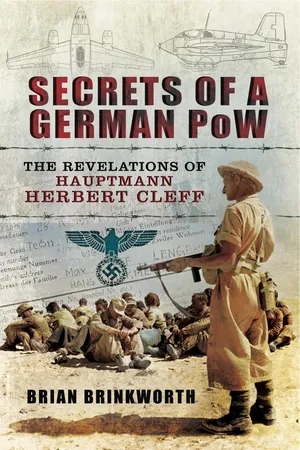
This is the extraordinary story of Hauptmann Herbert Cleff, who was captured in Egypt during the Allied advance from El Alamein in November 1942. He was thought to have had some administrative function in the Panzer corps, but not all was as it seemed.It was found that he had expert knowledge about tanks, and was interrogated both in the Western Desert Theatre and after transfer to the UK, following assessments that he might prove useful to the Allied war effort. He began to reveal tantalizing glimpses of advanced scientific and engineering projects back in Germany, including the development of a secret new fuel, and progress with submarines, jet-powered aircraft, faster-thansound flight and long-range offensive missiles. The truth of Cleff's revelations could not be fully verified at the time, but some were accepted by key experts, which led to the start of a Most Secret project for a British high-speed research aircraft. Eventually, he decided to collaborate fully with his captors, with a view to bringing the war to an earlier end, though always insisting that the object was to destroy the Nazi regime, to the advantage of Germany in the long run. He was released into civilian life in 1943, to undertake work for the Ministry of Supply. Information gathered in Germany after the War now allows comparisons to be made by which the veracity of Cleff's claims can be assessed. Some firm conclusions are reached, but the motivation for his actions remains elusive. This highly original account is sure to appeal to anyone interested in fresh and diverting contributions to the unfolding history of the Second World War.
Trusted by 375,005 students
Access to over 1.5 million titles for a fair monthly price.
Study more efficiently using our study tools.
Information
Subtopic
World War IIIndex
HistoryChapter One
M 164
1.1 Capture
By the beginning of November 1942, British and Commonwealth forces of the 8th Army in Egypt had fought a costly advance westward along the Mediterranean coast from El Alamein. The opposing German and Italian forces, depleted in men and materials and short of fuel, were preparing to make a withdrawal into Libya. But, directed by an order from Hitler to hold their position, they suffered further losses without being able to halt the advance. The tanks of the 21st Panzer Division were severely mauled. On 4 November, their commander, General Wilhelm Ritter von Thoma, was captured in the field and on 6 November, the Headquarters of the Panzer Armee near El Dab’a were overrun. Amongst those taken prisoner there was Herbert Cleff, in Panzer field uniform, with the rank of Captain. Although at first tagged only by a bland Prisoner-of-War reference number, he soon came to the attention of senior intelligence officers, which would lead to his transfer to Britain, with altogether remarkable consequences.
Cleff held the title of Technischer Kriegsverwaltungsrat, initially translated (roughly) to be Technical Staff Administrative Officer. Someone holding a post of that description might not normally have attracted much interest. The reference to administration in the title could have indicated that Cleff acted in some executive capacity, perhaps in the equivalent of the Adjutant’s office. But he had stated that he had arrived in Libya recently by being flown ‘directly from Stalingrad’, where some of the fiercest fighting on the German Eastern Front was raging, so it was perhaps thought that he might have some inside knowledge of that. He was taken to the Middle East branch of the Combined Services Detailed Interrogation Centre (CSDIC, ME) in Cairo, now with the reference number M164, to see whether any useful information might be obtained from him. This would take place routinely by the usual methods of British interrogation, keeping it at a conversational level with people of similar rank, including, in the terms of the first report issued about him, by ‘the Interrogating Officer becoming his pupil pro.tem., an almost infallible trick with intelligent Germans’. Information was gained there also by the use of ‘stool-pigeons’, disillusioned prisoners who had agreed to talk with newcomers and report back what had been learned from them.
At first, Cleff refused to give any details of his work, deflecting questions firmly though politely. But in contrast, he had been forthcoming about his personal history and the theatres in which he had served, from which a picture began to emerge. His first involvement with the military had been as a civilian engineer in the Army’s weapons development organisation. In this capacity he had accompanied the German forces during the invasion of Poland, but in November 1939 he was called up into the Army, despite a low medical category, said to be due to ‘poor physique, weak eyesight and rheumatic heart trouble’. After perfunctory military training (chiefly in saluting), during 1940 he accompanied Rommel’s Ghost Division of tanks in the western advance through Holland and Belgium and subsequent operations in France. He was promoted to the rank of Captain, in the ‘silverfish’ division (in full dress, as shown in Fig 1, his jacket would have had silver rather than the usual pink piping of the Panzer uniform). It was learnt from him later that the award of the Iron Cross, of which he is wearing the ribbon at the second button-hole, had been for his work in the French campaign. At some point he was lucky not to have been killed in a tank, when a shell penetrated the armour close to his head. He appears to be wearing the cross itself on his breast pocket, which would indicate that his award was raised to First Class at some point.
From June 1941, he had taken part in the Russian ‘Eastern Campaign’, at first under General Heinz Guderian in Army Group Centre. His report of having crossed the River Bug in an amphibious tank, and mention of actions at Bialystok, Brest-Litovsk, Minsk, Smolensk and the Moscow area, were consistent with his having been with the 2nd Panzer Group. At some point he had been detached to operations in Yugoslavia. He said that latterly he had been involved in the south-eastward advance of Army Group South through the Ukraine, with Feodosiya and Sevastopol in the Crimea being mentioned, and then via Kharkov and Rostov to Stalingrad. These somewhat erratic movements were however typical of the hasty redeployment of German resources over great distances at this stage of the Russian campaign. He might not have known at that point how hugely fortunate he was to have been directed out of the Stalingrad sector. Very soon afterwards, this was to be termed the ‘Cauldron’, in which the German 6th Army was irretrievably confined after being encircled by Soviet forces from 22 November. What followed there was a conflict regarded as the most bloody in the history of warfare, with total casualties on all sides variously estimated to be up to two million. The remnant of the German army was finally overcome with its commander, Field Marshall Friedrich von Paulus, amongst those taken prisoner.
Although having reported the outline of his personal experiences with more than usual detail, Cleff had still been refusing to answer direct questions about his work. But during the informal conversations he began to voice his opinions about things such as the relative merits of the tanks fielded by the Axis and Allied powers. The level of detail in these comments showed that, far from being involved in routine administration, he was in fact an expert in tank engineering. Once this had become clear, he was more forthcoming. His role had been to observe and record the effectiveness of design features of tanks under battle conditions in different theatres of operation. Although he had acted as a civilian in government service before the war, after the formal declaration of hostilities he had been called up, despite being medically unfit. There is no evidence of any intention that he should engage in fighting; instead this formal absorption into the army was perhaps necessary in order to ensure that, if he were captured, being in uniform he would be protected under the provisions of the Geneva Convention from the risk of being executed as a spy. It could also have been hoped that the vagueness of the title allocated to him might deflect interest away from his real occupation.
There is already more than a suggestion here that his capabilities had been well regarded in the German Army. In Egypt, his task was to be an observer of technical aspects of operating tanks in desert conditions, in the course of which he claimed to have visited all the German tank units in the North African Theatre, and to have had frequent interviews with the commander of the Afrika Korps, Field Marshal Erwin Rommel.
1.2 Army interrogation 1
There is a sense here that Cleff wanted his experience and knowledge of his field to be respected by his interrogators. Even with someone not overtly boastful, this carries a risk. Concerning technical matters, he seemed careful to refer only to things that he might reasonably expect to be already known, but the extent of that could never be certain. And so, amongst things of little consequence, hints were obtained that might have been useful when taken in conjunction with information from others. A measure of the interest in Cleff is that, over the next three months, seventeen verbatim accounts of his interrogations in Cairo were recorded in the ‘S.R.’ series of documents. They were summarised in two CSDIC reports, Army 1361 and 1836, totalling nine foolscap pages, which showed the wide scope of his remarks about aspects of tank engineering
Some of these were expressions of Cleff’s own opinions about the process of tank design. Ideally, he thought, this would be a systematic procedure, in which all aspects of the requirements for a fighting vehicle in foreseeable circumstances were first established. Next, early layouts of machines to meet these requirements would be realised in one or more trial designs, and experimental prototypes would be built and field tested, which would often reveal factors which had not been anticipated. Only then could the detailed design and preparation for manufacture begin. There should be an opportunity to follow this process in peacetime, but often it had not been managed well. In war, it was now overtaken by the urgency to respond to technical developments by the opposing forces. He recognised that through haste, mistakes had been made by all the present combatants – German, British, American and Russian (he was more generally dismissive of Italian and French tanks, making few references to those). Concerning hull design, he instanced the early American medium tanks, which had a heavy gun mounted towards one side of the hull, as well as a turret with a lighter one. Their high profile had made them vulnerable in action, and the interior layout was uncomfortable for the crew and hindered them in their tasks. What is today called the ergonomics had not been sufficiently considered. This lesson had been learnt for the design of the American M4 Sherman tank, which Cleff considered to be the best all-round tank in the Theatre at the time.
British tanks had been hampered by the decision to use engines that were already in existence for other purposes, particularly those originally designed for aircraft. These were not sufficiently robust to withstand the severe and incessant jolting experienced in tank operations. British tanks had been sent as aid to the USSR, but many had been found abandoned in the Russian Theatre, not knocked out, but immobilised due to engine and other mechanical failures, arising from the unforeseen severity of conditions when operating in difficult terrain and a testing climate. He considered that the 12-cylinder Maybach engine gave a better overall performance than any used in British tanks. This was despite his acknowledging that the materials and workmanship seen in British engines were better, especially in those engines produced by Rolls-Royce.
The Russians had an excellent tank in the T-34, with a 76.2mm gun that he called ‘marvellous’, one of the most effective then in existence. But when it was first introduced, the commander had been expected to operate the gun, as well as manage the tank as a fighting vehicle, navigate, maintain radio communication and so on. A larger turret had subsequently been introduced, to provide space for the inclusion of a gunner. The Russian heavy tank KV-2 had a 650hp engine, with a novel compressed-air starter, but this had been more troublesome than the German inertia starter, having to be pumped up by hand to 150 atm and being subject to seizure due to condensation in cold weather. Contrary to claims, he had observed that Russian tanks were no easier to start in hard winter conditions than the German ones.
Concerning a matter that was to arise later, Cleff asserted that much more attention was required to the drive train of tanks. In all British and American tanks, (such as the Lee and Grant in British terminology), the gearbox was difficult to manipulate. The Variorex gearbox was intended to reduce the physical strain on the driver in gear-changing, but he had reported that it was proving too delicate for desert use. The rear drive in British tanks was awkward to repair, and although they often had better ground clearance, their suspension was not as good as that fitted to German tanks. There had been national preferences for these – British and Russian tanks had often used the Christie arrangement, with horizontal coil springs acting through bell-cranks to react to the vertical motion of the bogies, whilst German tanks had used leaf-springs. But at this time, the suspension of the Mk III and IV tanks was about to be changed to torsion-bar springing, with trailing arms carrying a stub axle, which Cleff thought would become the preferred method for the future. The most suitable bogie arrangement was the Christie wheel, with its better air cooling. A compromise had to be made over wheel sizes. Larger wheels were desirable for covering difficult terrain, but smaller ones provided more points on the ground where large forces could be transmitted. This was important for traction, for stability on soft and loose surfaces and when firing the gun. For the ‘tyres’, the German artificial elastomer Buna was more hard-wearing than natural rubber. Steering systems in British, American and German tanks were equally good.
Although much of what was said might seem to be generalities, there was still interest in how they were seen from a German point of view. Summarising his opinions of the British tanks that he had observed in action, Cleff rated the Cromwell as a ‘very good all-round tank’ and the Churchill ‘good, but rather clumsy’, but considered that the angles of the armour of the earlier cruiser tanks had been misconceived, and from some directions were likely to deflect shells towards, rather than away from other parts of the hull.
He said that riveting had been found to be unsatisfactory as a means of repair, as it was impossible to effect good joints when sheets had been distorted by battle damage. But the German welding equipment available in Africa was not capable of dealing with anything other than minor repairs, so that damaged tanks that could only be repaired with proper workshop facilities had to be abandoned. Repair was made more difficult by the heat generated by welding affecting the hardening of external plating and armour, which was heat-treated throughout its thickness in manufacture. British practice was to harden a surface layer only. Although initial penetration by projectiles was resisted better by the harder face of the British product, the through-hardened German armour was better overall
German armour contained no nickel (for them already a scarce strategic metal). Analysis of the materials of construction of captured tanks did not accurately reveal the composition and treatment. It had been found that the French had developed a material for armour that was thinner and lighter than their own, but they had been unable to reproduce it. He gave no details, beyond saying that it was believed to be costly and to require raw materials that were no longer accessible. Use of light alloys such as duralumin might be considered in the future.
Questioned about spaced armour, which had been noted on some German Mark III and IV tanks in the North African Theatre, Cleff said that this was still something of an experiment. It had been found that interposing sandbags between an inner steel layer and an outer one of armour plate offered greater overall resistance to penetration. Although suggesting an analogy of it being safer to drive into a tree than a lamp-post, Cleff would not say whether this meant that fibrous materials were best for the filling, or anything about other materials that were being considered.
Cleff was told that another PoW had spoken of a smoke-laying tank that could travel at 60kph (38mph), driven by an engine with a speed of 20,000rpm. He had not seen this tank, but claimed to have heard of it, and he assumed that it was unarmed, so as to lay protective smoke screens quickly under covering fire. He considered that there would be a trend to smaller, lighter engines, with high rpm, probably simpler (eg two-stroke types), supercharged and using aviation fuel. There were similar trends in submarine propulsion. He had driven in a car that had an 800cc three-cylinder two-stroke engine, having great power and economy. He gave the impression that a radius of action for tanks as much as 250km (160 miles) might already have been realised in trials.
Supplying fuel and lubricants was a continual problem in tank operations. Cleff considered that oil usage would be high in British tanks, particularly for desert conditions, due to inadequate filtration. They had no counterpart to the German multi-plate filter, where the element was continually being squeezed clear of impurities by connection to one of the driver’s control pedals. He was confident that Germany could supply all its needs for fuel, oil and lubricants by synthetic means from a feedstock derived from brown coal (lignite). He knew of the plant of STW (South German Fuel Works) at Breux, which drew its supply from coal mined in the district.
Military Intelligence was especially eager to learn about additions to the German arsenal that had not yet appeared in the Western Desert Theatre. Little had been known about the Mk V tank, but Cleff reported that in appearance it was the same as the Mk III. It was fitted with an armoured tower that was continued through the interior of the hull and supported on the floor. The commander and gun-layer sat within the tower, protected by its extra shielding. The ammunition for the 75mm gun was kept there, and it had an automatic loading device that rotated with the turret and dispensed with the need for a loader. He referred to this arrangement also in connection with a new tank gun of 88mm bore. It was said to be based on a mobile one of 75mm used by parachute troops, and to have a much reduced recoil. This too was to have automatic loading. But he would not clarify seemingly incompatible statements that the cartridges for the ammunition were somehow loaded separately from the shells. A new shape of cartridge, though with the same quantity of propellant, apparently allowed ammunition to be stored more compactly, enabling more to be carried.
Information had been received from various sources about the Mark VI ‘Tiger’ tank, the latest addition to the German arsenal. It was known to have been deployed first in August 1942, but none had yet appeared in the Western Desert Theatre. Cleff thought that some had been despatched, but perhaps had been sunk in transit by the increasingly rigorous blockade of the Mediterranean coast maintained by the Allies. He was reluctant to give specific details about it, perhaps through knowing that interrogators from the locality had not seen one yet, beyond saying that it was a medium tank of less than 30 tons, long and low in build, to present a small head-on target, but in width it could ‘go through where any previous German tanks could go’. He claimed that various models of the Mark VI had been tested in battle within the last four to five months. They had knocked out any tanks used by the Russians, including British and American ones that had been supplied to them in aid. At one point, while talking of the Mark VI tank, he had referred to the new 88mm gun, but when questioned would not confirm that it was intended for the Mark VI tank. Tested on the southern steppes, the Mk VI had successfully negotiated sand and sandstorm conditions much more trying than he had seen in Africa.
Specific questions had been sent to the Centre by the 8th Army, one of which was to discover German views about tank actions at night, which necessity had required the British to undertake, albeit with limited success. Cleff turned such questions aside smoothly, on the grounds that he was not required to have any knowledge of strategic matters.
1.3 Disposal
When the two summary reports concerning Cleff and interpretations of these were read at Military Intelligence (MI 10) in London, there was uncertainty about the reliability of some of his statements, but recognition that he was potentially an important source of useful information. This might include more experiences from his service in the Eastern Theatre; for example, he had already mentioned that the Russians had made extensive use of a mine with an outer casing of wood that contained no metal parts. German mine-detectors had not located a single mine of this type, and they had caused many casualties. Further, in one of his comments there had been an echo of Hitler’s assurance to the German people that ‘secret weapons’ were being developed, that would be decisive in the war. This was a very active area for the intelligence services at that time, as they struggled to make sense of a multitude of scraps of information that reached them from many sources. Cleff claimed to know some details of what he called ‘a new weapon more terrible and more powerful than any hitherto used’, which made him ‘shudder at the thought that it could ever be applied’. Beyond denying that this might involve chemical or biological agents, he asserted that he would never reveal what he knew about it. He thought however, that the weapon would not be deployed unless the British began...
Table of contents
- Cover
- Dedication
- Title Page
- Copyright
- Contents
- List of Illustrations
- Author’s Preface
- Chapter 1: M 164
- Chapter 2: Latimer House
- Chapter 3: Reaction Propulsion
- Chapter 4: The Enquiry Opens Out
- Chapter 5: A Transformation
- Chapter 6: On the Ground and in the Air
- Chapter 7: Turmoil on all Fronts
- Chapter 8: War and Peace
- Chapter 9: The Reckoning 1: The New Fuel
- Chapter 10: The Reckoning 2: Projectiles and Aircraft
- Chapter 11: Post-war Life
- Chapter 12: The Benefit of the Doubt
- Chapter 13: The Enigma of Herbert Peter Cleff
- Acknowledgments
Frequently asked questions
Yes, you can cancel anytime from the Subscription tab in your account settings on the Perlego website. Your subscription will stay active until the end of your current billing period. Learn how to cancel your subscription
No, books cannot be downloaded as external files, such as PDFs, for use outside of Perlego. However, you can download books within the Perlego app for offline reading on mobile or tablet. Learn how to download books offline
Perlego offers two plans: Essential and Complete
- Essential is ideal for learners and professionals who enjoy exploring a wide range of subjects. Access the Essential Library with 800,000+ trusted titles and best-sellers across business, personal growth, and the humanities. Includes unlimited reading time and Standard Read Aloud voice.
- Complete: Perfect for advanced learners and researchers needing full, unrestricted access. Unlock 1.5M+ books across hundreds of subjects, including academic and specialized titles. The Complete Plan also includes advanced features like Premium Read Aloud and Research Assistant.
We are an online textbook subscription service, where you can get access to an entire online library for less than the price of a single book per month. With over 1.5 million books across 990+ topics, we’ve got you covered! Learn about our mission
Look out for the read-aloud symbol on your next book to see if you can listen to it. The read-aloud tool reads text aloud for you, highlighting the text as it is being read. You can pause it, speed it up and slow it down. Learn more about Read Aloud
Yes! You can use the Perlego app on both iOS and Android devices to read anytime, anywhere — even offline. Perfect for commutes or when you’re on the go.
Please note we cannot support devices running on iOS 13 and Android 7 or earlier. Learn more about using the app
Please note we cannot support devices running on iOS 13 and Android 7 or earlier. Learn more about using the app
Yes, you can access Secrets of a German POW by Brian Brinkworth in PDF and/or ePUB format, as well as other popular books in History & World War II. We have over 1.5 million books available in our catalogue for you to explore.