"An amazing tribute to the people who designed, built and flew it—a comprehensive history of one of the most beautiful aircraft ever manufactured."—
Books Monthly
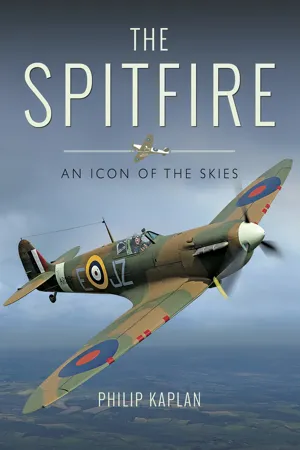
The magnificent Vickers Supermarine Spitfire, together with its able partner the Hawker Hurricane, saved Britain from Nazi invasion in the summer of 1940 and irrevocably changed the course of the Second World War. This book from Philip Kaplan celebrates one of history's most important weapons in a glorious new light. A British national icon, the Spitfire is the best-known symbol of the war years for generations of Britons. From the deep, haunting growl of its Rolls-Royce engine, to the elegant style of its elliptical wing, it is perhaps the most famous and revered combat airplane ever built.
Kaplan investigates just what it is that fuels the Spitfire's compelling mystique. During wartime, it held an unrivaled reputation amongst Allied and Axis airmen. Today, it continues to hold aviation enthusiasts in thrall. Kaplan highlights the immeasurable contributions of Spitfire designers Reginald J. Mitchell and Joseph Smith, test pilots Jeffrey Quill, Mutt Summers and Alex Henshaw, and ace Spitfire pilots including Al Deere, Sailor Malan and Pierre Clostermann. All added to the legend of this lovely, but deadly, little fighter.
"Can be considered a 'Potted History' of the Spitfire and its military and civilian service, with particular emphasis being placed on the restoration of AR213. On that basis it will probably appeal to Spitfire aficionados in particular and to aviation and war-bird enthusiasts in general."—
NZ Crown Mines
- 232 pages
- English
- ePUB (mobile friendly)
- Available on iOS & Android
eBook - ePub
About this book
Information
REBORN

Personal Plane Services’Tony Bianchi: “When the matter of doing the first complete restoration of AR213 came up, I had already discussed with the owners, the fact that the aeroplane was showing some signs of needing attention. I knew that they would want to go for a pristine, 1940 standard and would want the aeroplane done exactly as it was in its day. We had agreed that the way to proceed with the restoration was to get the aeroplane absolutely 100% to that standard. Before we even started putting estimates in for what it would cost to do it, we pretty much had it in mind that it had to be done that way; there really was no other way of doing it.
“ We were then doing aeroplanes for Kermit Weeks and he is another perfectionist. His aeroplanes had to look and smell exactly as they would have done in their day, or as best as we know it would have done. Kermit was really the first guy to do aeroplanes that way. So, we were already doing restorations of that kind; no one else in the UK really was. In some cases, they were taking all the original equipment out, including radios, armament, instrumentation, gun sights, and a lot of unique Vickers-Supermarine fittings and throwing it all away. Some people were trying to put that stuff back in their aeroplanes, but didn’t have it. We were going around rescuing the stuff that people were throwing away on the rubbish tips. We were doing some restorations for other clients who just wanted masses of radios and modern equipment in them, changing this and that. We were doing our best with Kermit to acquire aeroplanes and turn them back to the way they were. I said to him, ‘Look, the right way to do these things is to do them exactly the way they did in their day’. In response, his inference was ‘I agree. If it doesn’t cost any more, why not do it the correct way?’, and these were some pretty expensive things. As an example, he wanted to make some hood runners for his Grumman Duck.They were a kind of a figure-of-eight and needed folding on a press brake and he couldn’t get anyone to do them. Kermit is a very clever and competent engineer himself; he can design things and he knows how to make things work. He’ll just spend his time doing things properly and he got a lot of good machinery when he was down in Miami. He has a fantastic machine shop having bought all kinds of machines from various airlines that had gone bust, so he could make pretty much everything and he wanted to make these hood runners. However, they were about twelve feet long and he eventually found that there was a company in Miami, a machine tool supply shop, doing a very expensive press brake, and he bought it to make two hood runners, on the basis that he was going to use it again.That’s what a perfectionist he is. In the case of his Tempest V, I said to him, ‘This is the way they made these bits on the Tempest’ and he’d say, ‘Do it. Make it as they did.’
“There are short-cuts you can do on these aeroplanes. Nobody had ever rebuilt a Tempest V because there are only two in the world, his and the one in the Hendon Museum and we had to borrow parts off the Hendon Museum aeroplane, from the bulkhead forward, and make everything. For the cowlings, it took us over two years to make the jigs before we ever cut any metal for them. It was a huge job of work, but Kermit being Kermit, it had to be done the way they did it in its day. And the Tempest is a highly complex aeroplane—far more complex than the Spitfire. Every piece of aluminium is heat-treated on an aeroplane like that, so even the cowlings are not just ordinary pieces of material. They go straight into an oven and get heat-treated.You’ve got to work the metal first, then heat-treat it, then cure all the problems of changing shape once you’ve heat-treated it. We got into some quite high-quality manufacturing philosophy within the company, so, doing a Spitfire to the sort of ultimate level of restoration and quality was not a problem.The problem lay in making it look like it hadn’t been done … like it was a fresh aeroplane that’s been on a squadron for ten hours and it’s got a little bit of patina in it and is just aging down gently.That’s the philosophy I’ve tried to put onto the aeroplane. We did that with a lot of Kermit’s stuff. Some of the aeroplanes, of course, when he’d used them for a hundred hours over a period of five years, they’d start to look knocked around the edges like a squadron aeroplane.Tony Bird is excellent at doing that; he knows how to age things nicely. He’ll make something and make it look like it’s fifty years old as he’s doing it.

PRECEDING SPREAD: AR213 OVER OXFORDSHIRE; THIS PAGE: IMAGES OF AR213 DURING RESTORATION.
“We look at other people’s Spitfires, other people’s restorations, and they miss detail and passion.They are either incredibly ‘brand new and polished looking’, or they’ve gone halfway to the way we do it, but have missed something out. I look at it and think ‘that doesn’t look like a squadron aeroplane; that doesn’t look like an aeroplane that’s come from the factory. It looks like something that somebody has rebuilt who doesn’t know what an aeroplane should look like.’ Even the sort of ’30s aeroplanes that we have done for Kermit, we had to get them looking and smelling right. One of the dangers that goes with it, you can do it to too much of a degree and ten years down the road the aeroplane looks like it needs restoring again because you’ve almost gone too far with it. It’s largely cosmetic but no matter what, it has to be properly airworthy.
“We have compromised ourselves in some cases by going the way they did it in World War One and the post-World War One era, doing the paint finishes that they did and we’d have damaged fabric now. Of course, because they are natural materials, not man-made, they suffer from ultra violet light damage, and the UV light is worse now than it used to be.You cover the control surfaces in Irish linen and once you’ve got it all doped you then put acres of silver paint on it to reflect the UV light. In the case of Kermit’s World War One aeroplanes, we did exactly what they did in that war. We mixed aluminium powder with the paint so you’d get a slight glistening effect, and that’s why some people thought they were glossy.You hand-painted everything on.They were all hand-painted. Nobody sprayed much in those days, especially on the squadrons. And we’ve had this fabulous finish which everybody says, ‘God, is that what it looked like?’Yes, that’s what they looked like, but within five years the UV light’s killed it all because it hadn’t been protected properly. Some areas had got enough aluminium powder in them to reflect the sun and other areas hadn’t, so you could put your finger through the fabric in some places. We compromised ourselves but we had done it the way it should be. We knew that we’d done it correctly.
“Our restorations, the way we do them, are not everybody’s cup of tea; there are people out there from the warbird world who don’t like what we do because they think you should have it all glistening like Grand Warbird Winner, Oshkosh, glitzed up to the nines. A lot of people want to see that. In my mind, Kermit is responsible, anywhere in the world with these restorations, [the kind that we do] for ‘let’s make it look like and smell like it really was; it’s got to be the real thing. What’s the point of doing it unless it’s just as they did it?’ He’s the architect of these things. He got us all into it.
“I’ve got a Fokker E3 Eindekker replica. Kermit’s flown it and he’s always wanted to build ‘an original’ and there are no original E3s in the world, other than the one in the Science Museum in London.They were tricky to fly because they had an all-flying tailplane and warping wings. Some of them were quite high-powered aeroplanes. So, we started on this folly to see if we could build, say, three Eindekkers. I wanted a ‘real one’ anyway … to put an Oberursel engine in it, do it all properly. We started looking into it, we got what drawings existed and started to go through it. It had all metric-sized tubes which decrease in diameter as they go to the rear of the fuselage and it’s an all-welded structure. Antony Fokker designed the first electric welding plant; as far as we know, he was the inventor of electric stickwelding. He was the first guy to have all steel-tube welded fuselages. All the Fokker fighters were welded steeltube. So, Kermit said, ‘Right. We’ve got to do it the same way, but let’s build Fokkers using arc welding plant. Let’s start off the way Fokker did it. Let’s get the drawings for the arc welding machine, make the arc welder first and then stick-weld everything.’ We never did do it in the end because it was typically expensive and Kermit had gone off on another track. Perhaps we’ll return to it one day. But his philosophy is why that aeroplane [the Mk Ia, Spitfire AR213] is like it is. It has paid off for Personal Plane Services. It is now the company philosophy. We always wanted to do it, but the opportunity to perform on Kermit’s aeroplanes gave us the opportunity to perform on other people’s aeroplanes and they benefit from it.
“Every other Spitfire we see is not done quite correctly, by comparison. We know that. We’re not criticising other people’s restorations; it’s just a different philosophy. We know that the effort that Tony and Tom and Frank put into doing the fabric work on the Mk I Spitfire, we know it is unlikely anybody else does the same. We’ve got other Spitfire rebuilds around us that have been done by other companies and you’ve only got to tear the fabric open and look inside; they are not done in the complicated, old-fashioned way that Vickers-Supermarine employed.The Mk I is done that way. In a lot of cases, other companies have had to cut corners because they were on a tight budget from the owners and, equally, there were cheaper alternative ways to do it. We’ve been instructed by clients that they don’t want an original instrument panel. They want all radios bristling from everywhere in order to be able to get around in pretty much any weather throughout Europe.The Mk I Spitfire is going to be flown sensibly, so we are unlikely to be trekking around Europe in poor weather. It’s paid off for me because I have the satisfaction now of knowing that we have probably done the ultimate early Spitfire.
“Another very correct Spitfire was Kermit Weeks’ Mk XVI.The Mk XVI is not the nicest aeroplane to do it with, but we did go pretty deeply into it. It had a lot of original equipment...
Table of contents
- Cover
- Title
- Copyright
- Contents
- MYSTIQUE
- AR213
- R.J. MITCHELL
- EARLY SPITFIRE
- SUMMER 1940
- FLYING SPITFIRE
- SPITFIRE IN WW2
- TEST PILOT
- MERLIN
- FILM STAR
- WARBIRD
- REBORN
Trusted by 375,005 students
Access to over 1.5 million titles for a fair monthly price.
Study more efficiently using our study tools.
Frequently asked questions
Yes, you can cancel anytime from the Subscription tab in your account settings on the Perlego website. Your subscription will stay active until the end of your current billing period. Learn how to cancel your subscription
No, books cannot be downloaded as external files, such as PDFs, for use outside of Perlego. However, you can download books within the Perlego app for offline reading on mobile or tablet. Learn how to download books offline
Perlego offers two plans: Essential and Complete
- Essential is ideal for learners and professionals who enjoy exploring a wide range of subjects. Access the Essential Library with 800,000+ trusted titles and best-sellers across business, personal growth, and the humanities. Includes unlimited reading time and Standard Read Aloud voice.
- Complete: Perfect for advanced learners and researchers needing full, unrestricted access. Unlock 1.5M+ books across hundreds of subjects, including academic and specialized titles. The Complete Plan also includes advanced features like Premium Read Aloud and Research Assistant.
We are an online textbook subscription service, where you can get access to an entire online library for less than the price of a single book per month. With over 1.5 million books across 990+ topics, we’ve got you covered! Learn about our mission
Look out for the read-aloud symbol on your next book to see if you can listen to it. The read-aloud tool reads text aloud for you, highlighting the text as it is being read. You can pause it, speed it up and slow it down. Learn more about Read Aloud
Yes! You can use the Perlego app on both iOS and Android devices to read anytime, anywhere — even offline. Perfect for commutes or when you’re on the go.
Please note we cannot support devices running on iOS 13 and Android 7 or earlier. Learn more about using the app
Please note we cannot support devices running on iOS 13 and Android 7 or earlier. Learn more about using the app
Yes, you can access The Spitfire by Philip Kaplan in PDF and/or ePUB format, as well as other popular books in History & Military & Maritime History. We have over 1.5 million books available in our catalogue for you to explore.