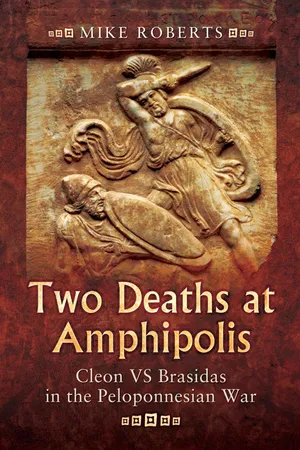
This detailed look at the deadly confrontation between a Spartan commander and a ruthless Athenian general sheds new light on the Peloponnesian War.
This book looks in detail at arguably the two most significant characters on either side in the middle years of the great Peloponnesian War—and the showdown in and around Amphipolis that led to both their deaths in 422 BC.
The Spartan commander Brasidas was already a veteran of many campaigns when he headed for the strategically important northern theater. Cleon was the key hawk in the Athenian assembly who led his fellow citizens in a major effort to counter the impact that Brasidas was having in the north. The two finally clashed in battle outside the Athenian colony of Amphipolis, which Brasidas had by then captured (the great historian Thucydides being exiled for his failure to defend it). The Spartans won, but both men died in the fighting, their passing having far-reaching consequences for the subsequent course of the war.
By focusing on the fatal duel between Brasidas and Cleon, and drawing on all available sources to supplement Thucydides' seminal account, Mike Roberts offers a valuable new perspective on the Peloponnesian War.
- 288 pages
- English
- ePUB (mobile friendly)
- Available on iOS & Android
eBook - ePub
About this book
Trusted by 375,005 students
Access to over 1.5 million titles for a fair monthly price.
Study more efficiently using our study tools.
Information
Chapter One
Leagues Collide
The Greek world in the last third of the fifth century could be well described as bipolar anarchy in the terminology of international relations theory, a situation that had developed after the Persian epic of 480–479 BC. In the wake of Xerxes’ repulse, a Hellenic league began an Aegean war of revenge against the people who had just trashed mainland Greece down to the Isthmus of Corinth. But, because this war was largely a naval affair, it was almost inevitable that a different member of the anti-Persian coalition would come to take the leading role, rather than the one who had commanded at the battle of Plataea. The city that did so, when compared with the regional giant that was Sparta, had been, up to that point, ostensibly, just one of a number of middling Greek powers. Rock and dust had been the making of Athens. The very unattractiveness of the place is claimed what made development possible. The people of Attica were sprung from the soil of a country that had not suffered the ravages of invaders, because the hordes that had descended out of the north, from legendary times, had never felt its field fair enough to entice them, or its wealth sufficient to tempt their cupidity. So, left in peace, Athens had grown. Villagers met to celebrate common gods, trade goods, and congratulate themselves on being aboriginals unlike so many other Hellenes, people who had arrived on their ancestral acres after folk wanderings out of northern lands. These Athenians met around a sanctified craggy rock, where a Mycenaean palace had once stood, and where the Parthenon still does, built to house the tutelary goddess Athena, as she enjoyed the view from 500 feet above the city. Synoecism (the amalgamation of villages into poleis, or city-states) was the beginning of community, a development common to many different societies over many parts of the world. While her farmers grew wheat and barley, and planted olives, her merchants had begun to trade far and wide from ports on the coast. In the sixth century, Athens’ black earthenware products became famous, much to the chagrin of Corinthian dealers who had previously almost monopolised the trade. Then, in the generation when the sixth century turned into the fifth, changes occurred that turned this member of the pack into a world leader.
A not untypical sequence of monarchical, aristocratic and tyrannical regimes had ended with a reorganisation of the Attic polity into a form of democracy. It had begun with Solon, a semi-legendary sage and poet claiming ancient royal lineage, who, at the beginning of the sixth century, though his impact is hugely argued over, seemed to have arranged some debt release for much of the non-aristocratic population, enabling the establishment of an economically-viable citizen body. On top of this, and almost a century on, a blue-blooded radical reordered the traditional social organisation into ten tribes, to facilitate the integration of all parts and peoples of Attica, and opened the assembly and the law courts to all citizens, of whatever economic stamp. Then this newfound polity, now the uncontested political centre of Attica, took a fateful decision to spend the windfall proceeds of a silver strike on building a brand-new navy. All this is well-trodden stuff, and no part of this work to reprise, but what was crucial was the placing of Athens to profit from the outcome of the invasion of Greece by the Great King of Persia. The story of Thermopylae, Artemisium, Salamis and Plataea was an epic for the whole of Greece, not just Athens, but for that city it was centrally significant. The Athenians twice found their homes reduced to ashes but this community that suffered so much, only a year after Xerxes left Greece, found herself at the head of a predominantly naval coalition driving the Persians back across the Aegean, freeing the Greek cities of Asia and creating a real potential for thalassocracy. Only Athens, with its fleet of sleek triremes, anchored at the port of Piraeus just an hour’s walk from the Agora, had been so admirably positioned to take advantage of the opportunity.
The victory at Plataea in 479 BC was an apogee for many. But on exactly the same day, but hundreds of miles away, another battle was fought, at Mycale. This was to be the signpost on the road that the Attic people were going to follow. Her navy had furnished the core squadrons for the victory at Salamis, and now in the aftermath she was about to reap the benefit. Athens’ success would be extraordinary. This place, hardly able, a century before, to compete for control of the island of Salamis with her neighbour Megara, and held in check by the miniature power of Aegina after the Persians departed, founded an empire quite unlike anything known amongst the Greeks before. Apart from the large island of Crete, the Aegean became, in a generation, almost an Athenian pond with colonists and garrisons spread far and wide, and the Great King of Persia’s fleet barred from entry. Only a few places like Chios, Lesbos and Samos, all allied to Athens, still retained any kind of naval muscle at all.
It was a longer than ten-year war between the two battles at Mycale and at Eurymedon that saw the Persians completely driven out of the Aegean. The victories at Salamis and Plataea had been amazing, considering the huge forces with which Xerxes had overrun most of Greece and the number of Medising locals who had joined him. But if the young Spartan regent Pausanias had achieved great things winning a bloody fight in Boeotia to destroy the Persian army left under Mardonius to complete the conquest of the mainland, so too had the Spartan king, Leotychidas, heading a coalition force that crushed another Persian army and fleet under the slopes of Mount Mycale on the Ionian coast of Asia. This man’s reputation was not flawless. He was tainted, alongside King Cleomenes, for bribing the Delphic oracle to get an adjudication that had caused his cousin to be removed from the throne over a parentage issue, and had got himself raised up into his place. His performance was not flawless either. Many had criticised him, in the run-up to the battle, for lying inactive with 110 warships off Delos while the Persian navy lay open to attack at Samos. Only when Xanthippus, Pericles’ father and, like Aristides, just recalled from ostracism and exile in the city’s time of greatest crisis, joined with the Athenian ships was the Spartan persuaded to move, happy at last that the newcomers had boosted his numbers to 250 warships. Together they took the offensive, and, if it is improbable that they knew of the victory at Plataea before they entered battle, they had definitely had the encouragement of the Ionians’ envoys reporting that their men in the Persian forces were ready to change sides when the Greek fleet appeared. This advantage was amplified when the enemy sent off their Phoenician contingent, as the remainder of the army and navy took up a defensive posture on the mainland coast. These Persians were not in good condition generally; reports of subversion amongst their allies from Samos had caused them to disarm the soldiers from there, so it was finally an ill-prepared defence that received a head-on assault. It was led by the Athenians and others at the front, and then an outflanking move by the Peloponnesians through nearby high country. When many of the Persians’ Ionian auxiliaries switched sides in mid battle, called on to join rather than fight their compatriots, victory was assured. The camp was stormed, the army dispersed and the Persian boats burned along the strand.
But after the victory the Spartan king showed timid, suggesting the Ionian Greeks’ cities were indefensible in the long run, and that the people should evacuate the whole of Asia to settle in other parts of the Greek world. The Athenians were having none of this and persuaded the allies to stay put and make a fight of it on a firm promise that they would defend their homes, an assurance made believable because many of the places in question could loosely trace their antecedents back to the Attic city. This firm resolve after Mycale saw both a second Ionian revolt against Persian rule and the adherence of these Anatolian Greeks to the counteroffensive proposed by the Athenians. The venture was soon underway and, with the Persians now on the defensive, the confederates swept north to cut the bridge that Xerxes had put over the Hellespont and so secure the straits to Europe against further attacks. On arrival, they found the structures demolished, and the great hawsers used to hold the pontoons together taken away to Sestos, on the European side of the Hellespont, where the Persians and their loyal allies were preparing to make a stand.
Exactly how bruised the Persian military was at this time is unclear. Herodotus tells us Artabazus had got back to Byzantium after Plataea without too much trouble, but another retreating army was claimed to have been lost to the treacherous assaults of their old ally the king of Macedon. Certainly they were not able to get off the back foot even when King Leotychidas took his Spartans home leaving the rest of the Greek army attacking Sestos. It was a long hard siege, taking in the whole of the winter as the defenders, running out of food, were reduced to boiling the thongs from their beds to eat, before finally agreeing to surrender. When the confederates entered they found the Persian garrison commander escaped, only to end captured and killed by local brigands near Aegospotami, while the local satrap Artayctes was taken and crucified to satisfy people from Elaeus, a place which that official had previously mercilessly plundered. After this, even the Athenians felt the need for rest and recuperation, returning home with the very cables the Persians had used to build their pontoon crossings to Europe.
That the Spartans had left the Sestos front is unsurprising as the government in the Eurotas valley had, from the start, been in two minds about going further than just kicking the Persians out of Greece. Yet still, in 478 BC the regent Pausanias was returned to command, first leading a coalition force against Cyprus, a raid as much as anything else, before turning to attack Byzantium. This place was taken, giving the allies control of both straits, and the doors to Europe were padlocked. On the surface, it looked like the people who had spearheaded the war at Thermopylae and Plataea had also been at the forefront when these key prizes had been won. But these Spartans were cut from old cloth, and just could not make friends and influence people despite their success. Pausanias, while still in command, was caught in intrigue with local Persian bigwigs, looking to try and establish himself as some kind of regional warlord. But if this worried both the people back home and his allies then it was his handling of members of the coalition that really counted against him. The siege of Byzantium had been the last action of the Hellenic alliance, and Pausanias and Xanthippus had both been on the spot, but the former’s treatment of his allies had become intolerable. There were stories of the Spartan having the rank and file beaten and the officers punished by standing for hours with an iron anchor on their shoulders. Pausanias’ own men always got the best bedding and fodder, and were given first access to the springs, and when complaints were made he would not even hear them. He was making himself so unpopular with his grasping behaviour and heavy-handed discipline that allies from Samos and Chios even attacked the trireme he was on near Byzantium in autumn 478 BC, registering in a very personal way their rejection of Spartan leadership. It was not helped by him being dogged by allegations of impurity due to his accidental killing of a girl, while in Byzantium, who he had intended for his bed partner.
In fact, this unpopular man got pulled back home as the rumours of his intrigues circulated. Though eventually he was exonerated, Spartan control of the war effort slipped away. The allies had become thoroughly disgruntled with impossible Lacedaemons just when many of the administration in Sparta became happy to withdraw from the war. Still, it was a process not an event, and some in Sparta had not completely lost interest, sending out to the front an officer called Dorkis in spring 477 BC. But the allies were having none of it. They were completely disenchanted, and the Spartan ended slinking off home leaving the Athenians in charge by default. In fact this was not the last time the confederates saw Pausanias. After being acquitted back home, he returned in 477 BC to Byzantium. This man was unpleasant but determined, and he reappeared to try and carve out a fiefdom, before his abrasive personality encouraged enemies to lay the ultimate charge against him, that he was conspiring revolution with helots. The ephors ordered his arrest, but he was warned and managed to find sanctuary in a temple of Athena of the Brazen House. Once there, he was locked in and starved to death. The other Spartan principal fared little better either. King Leotychidas was caught a few years later with his sleeve filled with silver while campaigning in Thessaly, bribed to go easy on his enemies. He was exiled and died in Tegea. None of this made the wise heads in Sparta less suspicious of their commanders interacting with the outside world, encouraging them to leave such stuff to the Athenians.
Much is unclear about what happened between Mycale and the establishment of the Delian League in 478 or 477 BC, but, with the Spartans gone, Aristides was the first man to take the lead: ‘so that, before the Lacedaemonians were aware, not by means of hoplites or ships or horsemen, but by tact and diplomacy, he had stripped them of the leadership’.1
This participant in the battle of Plataea was known as ‘the Just’, and was notable as a domestic opponent of the arch opportunist Themistocles, and would soon have a key role in adjusting the tribute rates for the league the Athenians were constructing. Almost immediately, however, his military role was taken over by Cimon, himself a Salamis veteran, who would really make a mark in this anti-Persian war. He was the first great Athenian imperialist, who both trailed glory like a cloud and had the personal funds to keep himself highly popular amongst his compatriots. He was known for feeding hometown neighbours on a regular basis and spending money, won on campaigns, to build ramparts for the Acropolis and on foundation work for the long walls that would eventually attach Athens to its ports; and all this with little smell of corruption. He achieved much for a man who is not only claimed as a wine bibber but lazy to boot, and who retained a high reputation for patriotism despite a well-known love of all things Spartan.
The confederacy this crapulous man led included the islands of Samos, Chios and Lesbos as well as many of the cities on the Asian coast that had thrown off Persian tutelage in the second Ionian revolt. There had already been Asian Greeks at the siege of Byzantium in 478 BC, and more joined following the success of Cimon’s arms and the visible waning of Persian influence in the Aegean. The exact numbers of the adherents who would soon make up the Delium League is unknown but there were at least 179, and more probably joined from the Black Sea coast to Italy as Cimon’s continuing achievements kept adherence attractive. First taking his fleet from Byzantium to drive the enemy out of the Thracian littoral, it was no coincidence he involved himself in the region. His father was Miltiades, the hero of Marathon, who was an old Thracian hand himself, and had married a local king’s daughter in his time, before Persia and the Greeks went to war. Control of the mouth of the Strymon was duly achieved by winkling the Persian garrison out of the fort at Eion.
After disposing of this determined remnant, Cimon, in 475 BC, led the allies against Scyros, an island east of Euboea, and an important staging post on the corn route to the Hellespont. This place was famous for the founder king of Athens, Theseus, whose carcass ended up there, and Cimon, after defeating the inhabitants and claiming some bones as his remains, settled the place with Athenian colonists on the grounds that the connection gave them a right despite the skeleton in question being swiftly repatriated to the mother city. The next years saw action against Carystus in the south of Euboea, which succumbed after a decent amount of fighting, while other places in Euboea that had also Medised were brought into the net. But, even in these halcyon early days, the confederation was not without its problems. The islanders on Naxos attempted to secede on one occasion, only to be brought back into line after a siege. This was perhaps inevitable with the war becoming much less like the one most places had signed on for, and the permanent nature of the tribute demanded became clearer. Even Aristides’ even-handed accounting did not impress those who had seen the alliance as a temporary arrangement, with the ousting of barbarians, rather than Athenian aggrandisement, as its reason for being.
Cimon, though, was not going to falter because of these weak links, and he ended this stage of the war with a triumph almost equal to those won in 480 and 479 BC. It came about in response to the first real effort of the Persians to raise the stakes in the contest for Greek Asia. It was the early half of the 460s that saw them brewing trouble, as an army and fleet gathered together at the mouth of the Eurymedon river near Aspendos, with the intention of retaking what they might along the coast of Asia minor. But Cimon took pre-emptive action, leading 200 of his veteran triremes and a major league army down to Pharsalus in Pamphylia to face them. It turned out a two-pronged affair, a bit like Mycale, where the Persian fleet was defeated in the estuary mouth before being driven back to shore, when the Leaguers disembarked and destroyed the enemy in their camp. Like many events in this period the dating is clumsy, the year 469 BC is suggested by Plutarch, backed by an anecdote about the Archon Apsephion, dated to 469/468 BC, choosing Cimon and his fellow generals as judges in a competition because they had just achieved a great victory. Certainly, the triumph came after the trouble at Naxos but before the people on Thasos contrived the second real test of the Athenian League’s cohesion. While others claim it as late as 466 BC, what is not in dispute is that the result was to put the Persians out of their stride at least until 451 BC, allowing the League to recruit members as far down south as Caria and possibly even further.
Well over a decade of success had built an empire but the seeds of trouble were germinating. Naxos had exposed the issues, and now, on another island called Thasos, things erupted. Indeed it may have been troubles there that stopped Cimon from truly exploiting his triumph at Eurymedon. This people were deeply unhappy about the confederation they had joined so willingly to get out from under Persian rule, foreign occupation and future menace. This package had encouraged many to join but now, with demands for tribute becoming onerous, and the barbarian threat far off, local disputes with Athens over control of the markets on the coast of Thrace and the exploitation of local mines loomed more important than any urge to anti-Persian solidarity. The dispute ended in rebellion, and the Athenians responded, quickly sending a force to reduce the islanders. A battle was fought at sea, and, after a victory, the Athenians landed and put the town under siege. This lasted for nearly three years, most likely between 465–463 BC, before the defenders finally succumbed, agreeing to pay a fine, throw down their walls, hand over their warships, roll over on the economic issues and agree to pay tribute in the future. A worrying record was developing of the Athenians taking over places on the grounds of finding a few old bones and indulging in economic bullying against folk they had recently fought with side by side against the Persian enemy.
These events tell much about what had developed in the league in the years since Mycale. After the Athenians took over leadership, most of the members, from places from the mainland to the Hellespont, around the Bosporus or the Anatolian shore, had stopped stumping up fully-equipped ships and men and, rather, just contributed funds to give the Athenians the wherewithal to fight the good fight for them. These Greeks wanted revenge against the Persians who had taken such an awful toll for their show of independence in the Ionian revolt and a guarantee against any repetition of this in the future but were happy not to spill their own blood to this end. Cimon had encouraged this, urging the confederates to hand over their warships which the Athenians could equip and man with the tribute coming in. Though convenient for many of the smaller communities, it inevitably created a two-tier system, with a big few like Chios, Lesbos and Samos retaining sign...
Table of contents
- Cover
- Dedication
- Title Page
- Copyright
- Contents
- List of Plates
- List of Maps
- Introduction
- Chapter 1: Leagues Collide
- Chapter 2: The Road to War
- Chapter 3: An Athenian Admiral
- Chapter 4: Conflict in Corcyra
- Chapter 5: An Island at the Centre
- Chapter 6: Cleon and Victory
- Chapter 7: A Distraction Then a Start
- Chapter 8: Up North
- Chapter 9: Winter War
- Chapter 10: Two Deaths at Amphipolis
- Epilogue
- Notes
- Select Bibliography
Frequently asked questions
Yes, you can cancel anytime from the Subscription tab in your account settings on the Perlego website. Your subscription will stay active until the end of your current billing period. Learn how to cancel your subscription
No, books cannot be downloaded as external files, such as PDFs, for use outside of Perlego. However, you can download books within the Perlego app for offline reading on mobile or tablet. Learn how to download books offline
Perlego offers two plans: Essential and Complete
- Essential is ideal for learners and professionals who enjoy exploring a wide range of subjects. Access the Essential Library with 800,000+ trusted titles and best-sellers across business, personal growth, and the humanities. Includes unlimited reading time and Standard Read Aloud voice.
- Complete: Perfect for advanced learners and researchers needing full, unrestricted access. Unlock 1.5M+ books across hundreds of subjects, including academic and specialized titles. The Complete Plan also includes advanced features like Premium Read Aloud and Research Assistant.
We are an online textbook subscription service, where you can get access to an entire online library for less than the price of a single book per month. With over 1.5 million books across 990+ topics, we’ve got you covered! Learn about our mission
Look out for the read-aloud symbol on your next book to see if you can listen to it. The read-aloud tool reads text aloud for you, highlighting the text as it is being read. You can pause it, speed it up and slow it down. Learn more about Read Aloud
Yes! You can use the Perlego app on both iOS and Android devices to read anytime, anywhere — even offline. Perfect for commutes or when you’re on the go.
Please note we cannot support devices running on iOS 13 and Android 7 or earlier. Learn more about using the app
Please note we cannot support devices running on iOS 13 and Android 7 or earlier. Learn more about using the app
Yes, you can access Two Deaths at Amphipolis by Mike Roberts in PDF and/or ePUB format, as well as other popular books in History & European History. We have over 1.5 million books available in our catalogue for you to explore.