- 224 pages
- English
- ePUB (mobile friendly)
- Available on iOS & Android
eBook - ePub
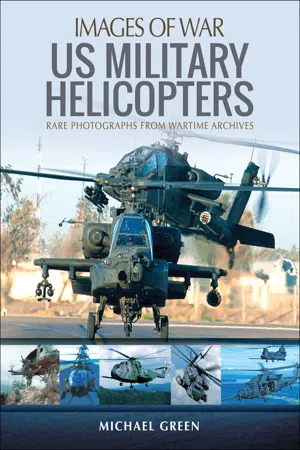
United States Military Helicopters
About this book
The helicopter came on the scene too late to play other than a minor role in the Second World War but by the Korean conflict the Bell H-13 Sioux, OH-23 Raven, and Sikorsky H–19 Chickasaw were in service.It was in Vietnam that the US military helicopters really came into their own and the best known were the Bell UH-1 Iriquois (known as the Huey), the Boeing CH-47 Chinook, and the massive CH-37 Mojave. The USAF combat search and rescue Jolly Green Giant was indispensable.Attack helicopters have evolved from the early Huey Cobra or Snake and the Boeing AH-64 Apache in the late 80s to when the Sikorsky UH-60 series became the military general purpose chopper.All these formidable aircraft and many more are covered in detail in this superbly illustrated and comprehensive book.
Information
Chapter One
Piston-Engine Helicopters
America’s first production military helicopter was designated the R-4B by the US Army Air Forces (USAAF) in 1944. It was designed and built by the Sikorsky Aircraft Company, with the pilot and a passenger sitting side-by-side. The fuselage consisted of metal tubing covered by fabric. The prototype of the R-4B flew in January 1942, with pre-production units being ordered for testing early the next year.
The prefix ‘R’ in R-4B according to the USAAF wartime aircraft designation system stood for a rotary-wing aircraft. The number ‘4’ in the designation represented the builder production sequence for the aircraft. The ‘B’ was to distinguish a minor model difference. In US Coast Guard service the R-4B was labelled the HNS-1.
The US Navy had assigned helicopter development to the US Coast Guard in early 1943. The US Coast Guard serves at the direction of the US Navy during wartime. As a result of the US Coast Guard’s pioneering work with the helicopter during the Second World War, the US Navy took over its development following the end of the conflict.
The piston-powered (reciprocating) engine on the R-4B produced 185hp. Of the 100 R-4Bs built (including pre-production test units) during the Second World War the American military took approximately half, with the other half going to the British military via Lend-Lease. In British military service the helicopter was named the ‘Hoverfly’. Most went to the British Royal Navy.
Wartime Usage
During the Second World War the R-4Bs were employed by the USAAF in different roles. This included, for example, moving small aircraft components between supply vessels and air bases. The R-4B also performed the casualty evacuation (CASEVAC) role, although no medical care was provided by the helicopter crew. A USAAF R-4B executed the first combat search and rescue (CSAR) mission in Burma in April 1944, saving four Allied soldiers trapped behind enemy lines. Non-combat rescue missions are described as Search and Rescue (SAR).
The US Coast Guard was convinced early on of the helicopter’s potential as an anti-submarine warfare (ASW) platform. By 1944, a handful could be found on Coast Guard cutters involved with convoy protection duties in the mid-Atlantic. Their assigned mission was to identify the location of enemy submarines for dedicated ASW surface ships to engage. The R-4B lacked the payload capacity to carry any ASW weapons.
Progressively-Improved Models Appear
A follow-on version of the R-4B for the USAAF had an all-metal streamlined fuselage and was fitted with a more powerful piston engine that produced 240hp. It was assigned the designation R-6A and entered service in early 1944. It was designed by Sikorsky but out-sourced and constructed by Nash-Kelvinator. This was typical of wartime production, as some or all of a design was contracted to third parties to increase overall output.
In US Coast Guard wartime service and in early post-war US Navy use, the R-6A was designated the HOS-1, which translates to helicopter/observation/Sikorsky model one. In total, 225 units of the two-man R-6A were built. As in the R-4B, the pilot and a passenger sat side-by-side.
Larger than the R-4B and R-6A, and more capable, was the two-man Sikorsky R-5A. Unlike the R-4B and the R-6A, the pilot and a passenger sat one behind the other (in tandem). The prototype had flown in August 1943 and impressed the USAAF sufficiently for it to order twenty-three pre-production trial units in early 1944 designated the YR-5A.
Testing of the pre-production YR-5A units began in March 1945 and went well enough for the USAAF to place an order for 100 production units designated the R-5A. This CSAR helicopter was powered by a piston engine that produced 450hp.
A Must-Have Helicopter
Even as the R-5A and a modified version labelled the R-5D were entering post-war American military service, the USAAF decided that a larger post-war version of the same helicopter, designated the S-51, was a better choice. The result was the cancellation of the R-5 series with only thirty-four being completed and placement of an order for 100 units of the new S-51.
The S-51 had room for a pilot in the front of the fuselage and three passengers on a bench seat behind the pilot. Like the R-5 series, S-51s acquired by the USAAF were powered by a single piston engine. In USAF service the S-51 became the R-5F.
With the formation of the United States Air Force (USAF) in 1947, a new aircraft designation system appeared in the following year. The letter prefix ‘H’ for helicopter replaced the earlier prefix letter ‘R’ for rotary-wing aircraft. The S-51 therefore became the H-5F.
A CSAR/SAR version of the S-51 that appeared in service with the USAF in 1948 was designated the H-5G. Another USAF model fitted with an arrangement of wheels and floats was assigned the designation H-5H. The letter suffix following the number represented a sequence of minor changes to the helicopter’s design.
S-51 in US Navy Service
In US Navy service the first two examples of the S-51 tested were designated the HO2S-1 with the remaining eighty-eight units labelled the HO3S-1. During the Korean War these performed in the CASEVAC and CSAR roles. These also directed the fire of US Navy warships on enemy coastal positions. In some situations the helicopter was used to identify the location of enemy sea mines.
The best-known mission of the US Navy’s inventory of HO3S-1 helicopters during the Korean War was the CSAR role. This was portrayed in the 1954 Hollywood movie The Bridges at Toko-Ri starring famous American actors of the day such as William Holden, Mickey Rooney, Fredric March and Grace Kelly.
S-51 in USMC Service
Those US Navy S-51s provided to the US Marine Corps (USMC) were also designated the HO3S-1. During the Korean War (1950–53) the helicopter performed the following roles: CASEVAC, CSAR, reconnaissance, liaison, and command and control. When a helicopter flight crew member provided medical care to a wounded passenger, it became a flying ambulance referred to as a MEDEVAC.
One innovative use of the HO3S-1 by the USMC during the Korean War was in laying communication wire over the country’s many mountains while at times under enemy fire. Without helicopters this may have been impossible.
Original Helicopter Designations
Early post-war US Navy helicopters were assigned a mixed letter and number designation. As already mentioned, the initial prefix letter ‘H’ stood for helicopter. Experimental helicopters had the letter ‘X’ placed in front of the letter ‘H’. Pre-production helicopters intended for testing had the letter ‘Y’ in front of the letter ‘H’.
The second letter in a production helicopter’s designation indicated its primary role, such as ‘O’ for observation, ‘R’ for transport, ‘T’ for trainer and ‘U’ ...
Table of contents
- Cover
- Title
- Copyright
- Contents
- Dedication
- Introduction
- Acknowledgements
- Notes to the Reader
- Chapter One Piston-Engine Helicopters
- Chapter Two Gas Turbine Engine Transport Helicopters
- Chapter Three Gunships and Attack Helicopters
- Chapter Four Special-Purpose Helicopters
Trusted by 375,005 students
Access to over 1.5 million titles for a fair monthly price.
Study more efficiently using our study tools.
Frequently asked questions
Yes, you can cancel anytime from the Subscription tab in your account settings on the Perlego website. Your subscription will stay active until the end of your current billing period. Learn how to cancel your subscription
No, books cannot be downloaded as external files, such as PDFs, for use outside of Perlego. However, you can download books within the Perlego app for offline reading on mobile or tablet. Learn how to download books offline
Perlego offers two plans: Essential and Complete
- Essential is ideal for learners and professionals who enjoy exploring a wide range of subjects. Access the Essential Library with 800,000+ trusted titles and best-sellers across business, personal growth, and the humanities. Includes unlimited reading time and Standard Read Aloud voice.
- Complete: Perfect for advanced learners and researchers needing full, unrestricted access. Unlock 1.5M+ books across hundreds of subjects, including academic and specialized titles. The Complete Plan also includes advanced features like Premium Read Aloud and Research Assistant.
We are an online textbook subscription service, where you can get access to an entire online library for less than the price of a single book per month. With over 1.5 million books across 990+ topics, we’ve got you covered! Learn about our mission
Look out for the read-aloud symbol on your next book to see if you can listen to it. The read-aloud tool reads text aloud for you, highlighting the text as it is being read. You can pause it, speed it up and slow it down. Learn more about Read Aloud
Yes! You can use the Perlego app on both iOS and Android devices to read anytime, anywhere — even offline. Perfect for commutes or when you’re on the go.
Please note we cannot support devices running on iOS 13 and Android 7 or earlier. Learn more about using the app
Please note we cannot support devices running on iOS 13 and Android 7 or earlier. Learn more about using the app
Yes, you can access United States Military Helicopters by Michael Green in PDF and/or ePUB format, as well as other popular books in History & Military & Maritime History. We have over 1.5 million books available in our catalogue for you to explore.