- 192 pages
- English
- ePUB (mobile friendly)
- Available on iOS & Android
eBook - ePub
About this book
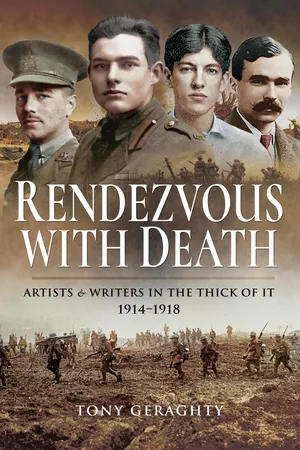
This book sheds new light on the colorful personalities including Wilfred Owen, Rupert Brooke, Alan Seeger, Ivor Gurney, Edward Thomas, Isaac Rosenberg, Ralph Vaughan Williams and George Butterworth, all major figures among England's creative artists during the First World War.Thanks to the authors research and knowledge, the book is a very English story about the tragically short spring of English artistic creativity between 1910 and 1920; the greatest such renaissance since Shakespeare and Purcell in the 17th century. It focuses on these exceptional poets, composers and artists' experiences in the front line and what resulted from these.A short personal Preface records that the authors father, Sergeant Major Anthony Geraghty (later anglicized as Garrity) survived one year and 271 days on the front line with the British Expeditionary Force in France and Flanders including the Somme, in which he served alongside the composer Butterworth in 13th Battalion, Durham Light Infantry.
Trusted by 375,005 students
Access to over 1.5 million titles for a fair monthly price.
Study more efficiently using our study tools.
Information

George Butterworth c.1914. (English Folk Dance & Song Society)
Chapter One
George Butterworth: Who Killed The Composer?
George Butterworth MC was the greatest loss to English music resulting from the First World War. He died in the early hours of 5 August 1916 during the Battle of the Somme while leading his men from a trench named after him (resulting from heroism already recognised by a Military Cross) into a wall of machine-gun and sniper fire. The Somme was more abattoir than military event; history’s first industrialised slaughter of humans by humans. It was a gigantic mincing machine that scattered living body-parts of one million men like fresh manure over receptive arable land. Butterworth’s body, also feeding the earth, was never recovered.
Squalid events surrounding Butterworth’s end, disclosed here for the first time, bestow a bitter irony upon his life’s work. Like the mocking laughter of some triumphant Mephistopheles, the degraded circumstances of his last battle overshadow Butterworth’s lyrical celebration of an idealised England, immortalised in such pastoral portrayals as The Banks of Green Willow and his famous setting of A.E. Housman’s poignant tribute to doomed youth, A Shropshire Lad.
Long before he wore the King’s uniform Butterworth was dedicated to a Utopian England. He was born into a wealthy, titled dynasty that accepted Duty as one of the privileges that came with the robes of a ruling caste. But in his case – against opposition from his father, Sir Alexander Butterworth – music led him towards a more democratic version of this fairest isle. Butterworth Jnr pursued folk songs to their roots in the soil of England (as did his friend Vaughan Williams, along with Holst and Delius). He also Morris-danced for England at a time when the English Folk Dance and Song Society was the engine that drove the renascence of that energetic culture. And of course, he played cricket, living by its code of fair play. There is no conclusive record of a romantic relationship with anyone of either gender. He was naively in love with England and surprised, exercising his duty to censor his soldiers’ letters home during his first weeks in France, to discover: ‘I don’t think I ever before realised the difference between married and single!’ His men also seemed ‘astonished at finding they cannot understand the language and complain because they can’t get English cigarettes.’
On 30 August 1914, with hundreds of other volunteers he formed up on Horse Guards Parade, then ‘marched off triumphantly to Charing Cross Underground Station to the music of a brass band, much stimulated by the cheers of the crowd.’ He was unaware that Kitchener’s five ‘New Armies’, one of which he had now joined, were invented specifically to fight a war of attrition – a prolonged blood sacrifice – rather than a few decisive battles so as to be home by Christmas. Eleven days before he volunteered Butterworth was offered an Army commission by an influential family friend. He refused because ‘it would be wrong to take advantage of private influence at the present time.’ Soon after Butterworth and five pals – a university lecturer, a musician, an engineer, a journalist and a civil servant – volunteered they were among 500 recruits sent to Aldershot for basic training and promptly invited to apply for commissions. One of them accepted immediately. But Butterworth, faithful to the gentlemanly code of fair play recalled, ‘the rest of us decided that the most important thing was to keep our party intact… Unless we could all have commissions, we would continue as we were. Naturally enough that was considered as equivalent to a refusal.’1 As yet, no one had a uniform but, he wrote, ‘getting uniforms etc was not difficult. Moss Brothers, Bedford Street WC, are wonderful people.’2 The five, all former morris dancers, now learned to march and shoot. ‘Our lieutenant performed a remarkable feat, missing the target five times running.’
When commissions were handed out to the group, Second Lieutenant Butterworth joined the Durham Light Infantry. The DLI had a proud fighting record during the First World War. More than 120,000 men served and 12,557 never returned. But taken as a whole, the regiment had the unenviable distinction ‘of having more men sentenced to death by Field General Courts Martial during the war than any other infantry regiment in the British Army’ according to a reputable academic authority. Most were cases of desertion. Two battalions provided two-thirds of the total. Butterworth’s 13th Battalion was not one of them. Most of its volunteers were former miners who worked at the coalface with pick and shovel, sometimes dying instantly as methane exploded around them or suffocating slowly after pit props collapsed. As human trench-diggers on the Western Front, the miners were ideal. Butterworth admired them for their Northernness:
‘As raw material our men are wonderfully good, physically strong, mentally alert and tremendously keen. They do not altogether understand the necessity for strict military discipline but they are eager to learn their job as quickly as possible. They are also very good fellows indeed… It is a great pleasure to be with them.’
The battalion suffered from a lack of continuity in its commanding officers; most burned out after six months. The action at Munster Alley in which Butterworth died, was designed by a controversial and colourful Member of Parliament, Brigadier General (later Lord) Henry Page Croft, a Territorial Army officer with a taste for front line action himself. Soon after Munster Alley he was removed from his command and returned under protest to Westminster politics. Croft provided several incompatible accounts of Butterworth’s death, sometimes claiming to have been with Butterworth ‘only a minute before’ the composer was shot dead in an extremely exposed position.
The battalion landed in France on 26 August 1915, marched a few miles and waited for a train to the front. A cultural gap rapidly opened and was accepted for what it was, a fact of life as unchangeable as gravity. ‘After a delay our train turned up: three first class carriages for the officers and cattle trucks for the men, forty in each.’ On Monday 6 September they began a ‘long march of over twenty miles’. They were exhausted. ‘Chief causes 1. heat; 2. cobbled roads; 3. weight of packs.’3 They could hear the guns now. A few miles distant, the German advance was held at the first Battle of the Marne thanks to the innovation of trench warfare. The French and Germans suffered 250,000 losses. British casualties were 12,733 but the nation’s modest professional army – the ‘Old Contemptibles’ – was on the brink of destruction at Ypres. Next day, the Durhams marched fifteen more miles. ‘Weather hotter still. Nearly half the brigade fell out on the way!’ They were now within five miles of the front line and ‘hear the rifles quite distinctly.’
By 18 September they were in the trenches for spells of twenty-four hours to be blooded, then withdrawn. Butterworth’s ear was becoming re-tuned, noting that even the smallest gun ‘had its turn at the evening “hate” which is… a regular occurrence.’
‘As night set in the artillery fire ceased but the rifles went on cracking occasionally but every now and then, a splutter of machine guns. We reached the entrance of the communication trench safely. It is about 600 yards long… Stray bullets were now firing all about and the explosive sound they cause as they pass overhead was new to most of us… At last we followed into the fire trench and immediately opposite I found to my astonishment a small wooden shanty and the officers of the company having dinner; so just at the moment when I felt braced up for an increased onslaught on the Hun I was hauled off to roast beef and beer while a sergeant posted my men.’
Outside the bunker, flares illuminated the flat countryside. Sentries and snipers on both sides ‘exchange compliments frequently, though there is really nothing to fire at. (I have not seen a German yet). In the trench one is perfectly safe… it is the working parties behind who are worried by the stray bullets. And so it goes on all night and every night.’ These military duets were accompanied occasionally by a machine-gun chorus.
Butterworth was learning fast:
‘The German snipers make it dangerous for anyone to expose his head above the parapet by day for more than a second or two (even at 500 yards: in this respect they are all over us) and in fact we are still behind the Hun in all the tricks of trench warfare; as regards machine guns we have pretty well caught up and our artillery distinctly has superiority.’
He was mistaken. Shortly before he was killed eleven months later the ‘superiority’ of British and friendly Australian artillery would be the death of many of his comrades as their shells fell short, time and again; English shells on English soldiers.
Butterworth’s war diary continued:
‘As far as my platoon was concerned we had a very quiet time each day we were up; only one shell fell anywhere near us and we have not had anyone hit. Others have not been quite so lucky; one platoon was caught by a machine gun on its way home the very first night (presumably through the guide’s fault) and had five wounded. Another lot narrowly escaped destruction by a mine explosion… [But] the battalion has lost less than twelve wounded altogether and none killed.’
His initial luck held. On 25 September 1915 General Sir Douglas Haig, commander of the British First Army, threw six divisions into the Battle of Loos. Butterworth’s battalion was part of a controversial reserve of two divisions held back by Field Marshal Sir John French, Commander in Chief of the British Expeditionary Force. French’s decision to dilute the strength of the attack was controversial. The reserve divisions were too far behind the line to be effective. Butterworth noted: ‘We are now in divisional reserve four miles behind.’ So far he had been up to the front line three times and had ‘seen only one shell burst and had not seen a single (a) dead man (b) wounded man (c) German and (d) gun.’
The British attacked with artillery and 5,100 chlorine gas cylinders but German machine-gunners held their ground, killing or wounding 50,000 men. German losses were half that number. Haig blamed French, the field commander, for this failure. French resigned on 19 December and returned to England. Haig succeeded him. The stage was now set for the Somme battles, and for a derisory nickname, ‘Butcher Haig’.
The 13th DLI was committed to the front line through much of October and November, pitched into a sniper’s war in heavy rain that turned trenches into quagmires; foggy days when some soldiers went man-hunting as if shooting wildlife. Lance Corporal W. Claire and Private R. Hickson, in ‘a successful sniping expedition shot two Germans and brought in valuable information.’4 Near La Houssoie village close to Armentières about 9pm on 4 November, Lieutenant P.A. Brown left the trench to inspect a party working on defensive wire. Brown, a former university lecturer, was one of the five pals including Butterworth, who signed up for a light-hearted, patriotic adventure on Horse Guards’ Parade the year before. Within twelve months three would be dead. Brown was accompanied by his observer, Private (later Company Sergeant Major) Thomas Kenny:
‘The fog was very thick and they over-ran the wire and were lost. After going a considerable distance they sat down to listen for some sound to guide them and as they rose again a rifle shot rang out nearby. Lieutenant Brown fell, shot through both thighs and Kenny took his officer upon his back to carry him away. Heavy rifle fire was now opened by the Germans and Kenny had to crawl through the mud with his burden. Sometimes he had to lie still until the fire slackened. Lieutenant Brown ordered him to go on alone, but he refused to do so and for upwards of an hour he struggled along until at last he found a ditch he recognised. Here he made Lieutenant Brown as comfortable as possible and started for the British line to get help. It was after 11pm when he came upon Captain G. White and two men in a listening post. Stretcher-bearers were summoned and, although Kenny was very exhausted, he endured until he had guided the party to the wounded man. The return journey was made under rifle fire at close range and some bombs were thrown, but Captain White got everyone back without further casualty. Lieutenant Brown – a very good and popular officer – died before he could be carried to the dressingstation, but the self-sacrifice and endurance of Thomas Kenny won him the Victoria Cross.’5
Butterworth believed Brown had ‘got lost and ran into an ambush’. Kenny survived both world wars and died in his Durham home on 29 November 1948.
When Brown was killed, Butterworth was attending an eight-day course in ‘bombs’ (the infantry’s name for fragmentation hand-grenades, also known as Mills Bombs). ‘I threw a few bombs with fair accuracy, (20–25 yards)’ he wrote. His cricketer’s eye probably helped. But the harsh conditions of a wet autumn in the trenches took their toll. Butterworth was hospitalised for four days in December 1915 and the following month granted home leave to attend the wedding of his widowed father, Sir Alexander Kaye-Butterworth, a barrister and railway executive. The bride was Dorothea Mavor, born Dorothea Ionides and ex-wife of Alfred Ebenezer Mavor. She made a stylish escape from Germany by limousine just before the war began, having luxuriated at a spar near Wiesbaden, a feat which Butterworth admired. On his return to action he was sent on a month’s signalling course. Back with the battalion towards the end of January 1916, he told his NCOs that the next two months would see ‘a definite decision’ about the outcome of the war.
Butterworth’s battalion was committed to the Somme battle on 6 July, five days after the onslaught began. They arrived after dark, wading through waist-deep mud. Butterworth wrote home that after several days, ‘I lost practically all my portable equipment and finally came out with 1 revolver (unused), 1 map and 1 flask (empty!).’ On 12 July, his thirty-first birthday, he reported: ‘We have been up to the front for a few days. Have done no actual fighting. Are back in rest for a few days… Our hardships are child’s play compared to what the Germans are undergoing. Our [artillery] guns give them no rest whatsoever…’6
The fact of the matter was that on 9 July, acting on flawed intelligence, they had advanced through the mud towards a position reportedly evacuated by the Germans. One officer and twenty-one men were wounded; seven more were killed or missing. Next day more teams – one armed with grenades – attacked a position known as Bailiff Wood. There they were shelled by British artillery to their rear and gunned down by a German machine-gun in front. The cost was eighty men killed or wounded. The wounded included Captain G.M. Long, officer commanding A Company. Lieutenant George Kaye-Butterworth, as he was known to the army, assumed control. In a letter home he reported:
‘I have been put in charge of my company… since the OC was wounded. I was standing beside him at the time and I think one shell laid out about a dozen (a very rare event). In fact I must have been the only man in the neighbourhood untouched and suffered no after effects except slight deafness in one ear which has now passed off. I tell you this to cheer you up.’
He was awarded a Military Cross soon afterwards. The citation describes how from 17 to 19 July at Pozières, Butterworth ‘commanded a company of which his captain was wounded with great ability and coolness. By his energy and total disregard of personal safety he got his men to accomplish a good piece of work in linking up the front line.’
Butterworth regularly played down the dangers of his war. His initial twenty-four hours of front line experience he dismissed as ‘the first canter’. Having handed over its sector to incoming Australians (Anzacs) on 11 July, 68 Infantry Brigade, including the 13th DLI, withdrew to the city of Albert under a barrage of gas shells. The following week, the unit was holding trenches astride the Contalmaison–Pozières road under steady German artillery fire, losing fifty men in two days.
The attack on Munster Alley to the south-east of Pozières from 26 July to 8 August 1916, in which Butterworth died, was part of the grand slaughter, a microcosm that made the word ‘Somme’ a synonym for wasted lives. It was a local action waged by tough coal miners from Durham and Northumberland and, on their left flank, Australian soldiers being blooded for the first time in a European war. The two groups, British and Australians, were opposed by equally determined Prussians defending well-entrenched positions equipped with machine guns and grenades, supported inadvertently by British artillery. As the DLI and Northumberland Fusiliers made successive frontal attacks up the Alley it became a turkey shoot for the defenders. The German trench system a little north of Contalmaison challenged any advance in that sector. The axis of the fighting there was a well-defended enemy trench named Munster Alley, running north-east across the British front for about 600 yards. From the air, it would have resembled the left arm of a letter V inscribed on the landscape.
A line of British trenches formed the right arm of the V. It comprised Butterworth Trench (named after that officer, who supervised its creation) plus two extensions known as The Loop and New Trench. Butterworth Trench, 200 yards long, was dug under cover of fog and darkness. Ten men as well as Butterworth were wounded by shrapnel in opening this route. It linked with the south-western point of Munster Alley, a fragment of which was barricaded and held uneasily by part of the 13th Battalion to be a bombing post. Butterworth wrote home, ‘In the trenches again, in support – plans uncertain. No trouble at present except intermittent shrapnel. This morning a small fragment hit me in the back and made a slight scratch which I had dressed. This is merely to warn you in case you should see my name in the casualty list! They have a way of reporting even the slightest cases.’ A War Office telegram reporting him wounded reached his family before Butterworth’s reassuring letter. Had his wound required treatment out of the line, he might have lived.
The same night, a team of...
Table of contents
- Cover
- Title
- Copyright
- Contents
- Introduction
- Chapter 1 George Butterworth: Who Killed The Composer?
- Chapter 2 Wilfred Owen: Poet, Hero … But ‘Malingerer’?
- Chapter 3 Legionnaire Alan Seeger: A Rendezvous With The City of Light (And Death)
- Chapter 4 Isaac Rosenberg, poet and artist: ‘Pack Drill is The Consequence’
- Chapter 5 Edward Thomas, Poet: Confronting The Gamekeeper and Other Enemies
- Chapter 6 Ivor Gurney composer, poet: ‘I Want To Shoot Myself’
- Chapter 7 Rupert Brooke, Poet: His Secret Box
- Chapter 8 R.C. Sherriff – Playwright, To Journey’s End And Back
- Chapter 9 Vaughan Williams, Composer: ‘No Longer A Man’ But His Lark Ascends Still
- Chapter 10 Erskine Childers, Novelist, Hero, Rebel – ‘A Step Forward, Lads’
- Chapter 11 The Red Cross Men – Age Did Not Weary Them
- Chapter 12 J.B. Priestley, Playright – Raging Against The Dying
- A Personal Epilogue: Second Lieutenant Frederick Youens VC and 21742 Acting Sergeant-Major Anthony Garrity
- About the Author
- Bibliography
- Notes
Frequently asked questions
Yes, you can cancel anytime from the Subscription tab in your account settings on the Perlego website. Your subscription will stay active until the end of your current billing period. Learn how to cancel your subscription
No, books cannot be downloaded as external files, such as PDFs, for use outside of Perlego. However, you can download books within the Perlego app for offline reading on mobile or tablet. Learn how to download books offline
We are an online textbook subscription service, where you can get access to an entire online library for less than the price of a single book per month. With over 1.5 million books across 990+ topics, we’ve got you covered! Learn about our mission
Look out for the read-aloud symbol on your next book to see if you can listen to it. The read-aloud tool reads text aloud for you, highlighting the text as it is being read. You can pause it, speed it up and slow it down. Learn more about Read Aloud
Yes! You can use the Perlego app on both iOS and Android devices to read anytime, anywhere — even offline. Perfect for commutes or when you’re on the go.
Please note we cannot support devices running on iOS 13 and Android 7 or earlier. Learn more about using the app
Please note we cannot support devices running on iOS 13 and Android 7 or earlier. Learn more about using the app
Yes, you can access Rendezvous with Death by Tony Geraghty in PDF and/or ePUB format, as well as other popular books in History & Military Biographies. We have over 1.5 million books available in our catalogue for you to explore.