eBook - ePub
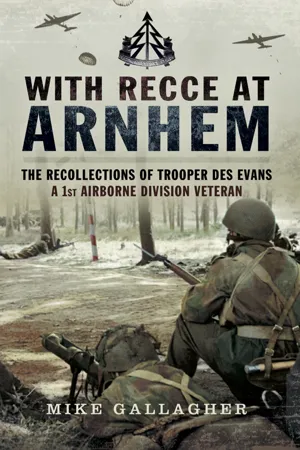
With Recce at Arnhem
The Recollections of Trooper Des Evans, a 1st Airborne Division Veteran
- 160 pages
- English
- ePUB (mobile friendly)
- Available on iOS & Android
eBook - ePub
With Recce at Arnhem
The Recollections of Trooper Des Evans, a 1st Airborne Division Veteran
About this book
Determined to 'do his bit' Des Evans absconded from a reserved occupation and joined the newly formed Reconnaissance Corps. He saw action in North Africa and Italy before being evacuated back to England with pneumonia in early 1944. Fully recovered he volunteered as a wireless operator with 1st Airborne Reconnaissance Squadron and after parachute training joined C Troop before the ill-fated but glorious attempt to seize the Rhine Bridge at Arnhem.Des vividly describes the intense action that followed the drop. Ambushed twice and badly wounded he was made a POW and eventually succeeded in escaping.Fresh first-hand accounts of the bitter fighting at Arnhem are rare indeed and this one is brutally honest, at times shockingly so. Des Evans was born in Liverpool in 1923. Despite being in a Reserve Occupation he finally succeeded in joining the Army. This book covers his wartime service in North Africa, Italy and at Arnhem. Post war he served in Italy, Palestine, Germany and the Suez Canal Zone. Cuckolded by his first wife he was convicted of the manslaughter of her lover. On release from prison he met Betty and they enjoyed nearly 40 years together until dementia necessitated residential care. Betty died in March 2010 and Des followed her three months later.
Information
Chapter One
Return to Arnhem 1984
My name is Desmond Evans, but known to everyone simply as Des. I thought that having reached the age of sixty-one my adventures were well and truly over; however, the fourteenth of September 1984 was the date when I began what was, for me, a most incredible experience. As Betty (my wife) was still recovering from her recent operation we both felt that I alone should still make a special effort to go to Arnhem. It was an unusual occasion because it was the fortieth anniversary of the battle, and I had never been back there since it took place.
The cost of taking my motor caravan over there just for me was rather too much, so I decided to hitch-hike. Yes, at sixty-one I felt that getting on the road was the only way I was going to get to Arnhem. I must admit that I did start my journey by getting the local train from West Runton to Norwich, but after that it was hitch-hike all the way (except for the sea crossing of course). I had the most extraordinary luck with my lifts because each time I was picked up, within minutes it started to rain heavily. Three vehicles picked me up this side, a car, a lorry and a van. The van driver was going over as a foot passenger on the boat, so he took me right into the ferry terminal. The boat journey was uneventful – I’d made a point of catching the night boat so that I would arrive there in daylight. I had hoped to get off the boat at the Hook of Holland quickly so that, using my card with the word ‘ARNHEM’ in large letters I would be in the right place when all the cars came off. It didn’t work out like that though. There was such a long delay getting through passport control, that by the time I got away from there all the cars had gone. However, I started walking with my pack on my back and my sleeping bag in a zipped holdall and within minutes a Dutch lorry driver picked me up and took me within fifteen miles of Arnhem via Rotterdam.
Again I started hiking and must say that I walked further than I’d bargained for, about five miles in fact. By this time the rain was coming down gently and I thought that as I had my old red beret in my pocket I might as well put it on, first of all to keep off the rain and secondly in the hope that it might get me a lift. It worked on both counts! A car pulled up, an English car driven by an ex-paratrooper who was on his way to Arnhem too. He greeted me with the words, ‘you must be going to the same place as me’. In short, he drove me into the town and, having plenty of time before booking into his hotel, he asked me where I would like to go. The cemetery seemed to be a good place to begin, so that’s where we went. I stood over the grave of one of my dead comrades and thanked him for forty years’ bonus of life, because just a few minutes before my Jeep was ambushed forty years earlier I’d asked him to change places with me on the Jeep; he agreed, and now it’s he who is lying in the cemetery and not me. Fate indeed plays strange tricks does it not?
Reg Isherwood, the chap who picked me up, was talking to a couple of young Dutch chaps when I rejoined him and it seemed that they were interested in getting personal stories of the battle. They planned to write a book of anecdotes gathered in this way. I produced the picture of myself that was taken during the battle and they were immediately fascinated by it. Opening the book they were carrying, they showed me a copy of the same picture and got me to autograph the page under the photo. The Dutch chaps then asked where we would like to go as they were prepared to take us anywhere.
We both said we’d like to go to Wolfheze, close to the LZ (Landing Zone for Gliders), to the DZ (Dropping Zone for paratroops), and also to where the news correspondent had taken the photo. This they did and although it all looked familiar to me, I couldn’t orientate myself to the point of recognizing points of interest.
We drove back into Oosterbeek just outside Arnhem, where most of the fighting took place and I said, ‘I’d like to go to the museum there.’ It’s housed in the building that was used as the Divisional HQ in 1944. The Dutch chaps left us there saying that they would be back in an hour. I walked in wearing my old red beret and almost immediately a chap threw his arms around me, ‘Des Evans’, he said, ‘Don’t you know me?’ It was one of my old friends I hadn’t seen for forty years, but he recognized me. It was George Bell, but he had changed so much I must confess that I didn’t recognize him. We had quite a chat as you can imagine. It was while we were talking that I realized that the chaps who had said they would come back in an hour had driven away with my kit. Anyway, not to worry, they did come back with the good news that they had found me an address to take me to. This they proceeded to do. On the way out I had a word with the curator. ‘The’ photograph was, as I’d anticipated, in the museum, a larger copy on the wall, and of the three men shown only one was named…Jimmy Cooke. I gave them my name, but couldn’t remember the name of the third man in the photograph at that time. For forty years all I could remember was that his name began with the letter ‘B’. He too had been killed on my Jeep.
The Dutch lads took me to the house of a member of the ‘Lest We Forget’ Committee, and she fixed me up with a bed at the youth hostel just outside the town.
So that’s where I spent my first night and, tired though I was, I took the bus into Arnhem proper to have a good look at the bridge that the fuss was all about in 1944. The following morning, Sunday, I visited the cemetery again and, as I’d anticipated, Reg Isherwood was there, talking to a large Dutchman. I was looking round the graves again when suddenly I saw a name that I instantly recognized – ‘F BRAWN’ – and I knew that this was the name of the other chap in the picture, at last after forty years. You will appreciate that all of this was extremely emotional for me.
I went across to join Reg and the chap he was talking to. He was a very big man over six feet tall and I saw that he was wearing the tie of my old unit the 1st Airborne Reconnaissance Squadron. I showed him the badge in my beret which I was carrying. It turned out that he was one of the Dutch commandos attached to my unit for the operation in Holland. I asked him if he knew what happened to the other commando who was attached directly to my Troop (C Troop) and was told that he was dead, having died from natural causes two or three years ago. He insisted on taking us home for a drink. We got into his car and he drove us to a pleasant suburb of Oosterbeek. As we approached his house he pointed out a piece of ground that was being cleared for the building of another house. ‘They started levelling that space two weeks ago’, he said, ‘and found two bodies, or what remained of them.’ They were the bodies of two paratroopers who had died in the battle and after forty years were found. The authorities go to extraordinary lengths to identify them. Their dog-tags were missing, but the Dutch hoped to identify them by their teeth amongst other things.
We had a very pleasant time with the Dutchman and his family and whilst we were there I was shown a copy of a book, Remember Arnhem by John Fairley, and it’s entirely about the role my unit played during the battle. Once again ‘my picture’ showed up; it was on the cover. I had no idea such a book existed and must try to get a copy.
‘Pim’, the Dutchman, ran us back into the centre of Oosterbeek and I said ‘cheerio’ to Reg as he was going home the following day. I then went into the museum again and this time told the curator the name of the third man in the photograph. He thanked me very warmly and said he could now bring the caption up to date. While I was telling him this, three English lads came up to me and were listening to what I had to say. When I’d finished talking to the curator, they apologized for eavesdropping and then asked me if I would sign a picture print of the battle they had just bought.
They were young chaps who, being fascinated by all they’d heard and read about Arnhem, had decided to come over and look around. They had hired bikes for the day but then opted to walk around with me asking questions about what had happened forty years ago. I spent a very pleasant afternoon with them and before leaving them I gave them my address. Imagine my surprise when, on arriving home, I found that they had sent Betty a postcard saying that they had met me and that I was safe. There was also a letter from one of them asking if he could come here to visit me, this was Mike. I was flattered; I must have made a good impression, one supposes. When I parted from them I assumed it was 5 o’clock and therefore had plenty of time to get back to the hostel for my evening (main) meal. However, I soon realized that it was in fact 6 o’clock as I hadn’t put my watch on continental time. There was no way I could get back to the hostel for 6.30pm; this was when they stopped serving, so I just went into a nearby café and ordered a meal and a drink. There I met another old friend from the unit, Bill Bateman with his wife and sister and brother-in-law.
Again we nattered about many things; this was emotional too, and I ended up literally crying on his wife’s shoulder. I had kept it all pent up until then. I suppose it just had to come out sooner or later.
Monday, 17 September 1984, I attended the wreath-laying ceremony at the huge monument at Oosterbeek opposite the Hartenstein Hotel having walked from the youth hostel. I was talking before the service to a chap in a wheelchair; he asked me how I had got to Arnhem and where I was staying. Assuming that he was just making polite conversation I told him. After the ceremony, which was short and simple, with the ‘Last Post’ being played at the end of it, I was approached by an English speaking Dutchman who introduced himself as Tanno Peterson and asked if I’d like to spend the rest of the day with him. Of course I readily agreed. I had nothing planned for the remainder of the day, so off I went with him, accompanied by his attractive second wife.
We went to many places that day because Tanno is totally committed to the ‘Lest We Forget’ Committee. One place he insisted on taking me to was Wolfheze and this time we found the exact spot where the famous picture had been taken. We also went over the route of the patrol on which my Jeep was ambushed; everything came back to me with tremendous impact. I had to ask Tanno to stop the car for a little while to get myself together; I had to tell myself it all happened forty years ago.
We went to his home where his wife cooked us a meal. Tanno dialled my home number and I was able to talk to Betty and tell her what had happened thus far.
He also told me how thrilled he was to have me in his house and that later we would collect my kit from the hostel, as he had found a ‘Host Home’ for me. These quarters are provided solely by Dutch people offering their homes to veterans like myself. I was extremely lucky with mine, a young couple, Josie and Peter Van Nordern. They put me up, fed me, even gave me a key to the door, showed me where everything was kept so that I could feed myself if I came in when they were at work, and generally made me feel very welcome. We got on very well together and made each other laugh a lot.
When I had been in the cemetery on Sunday 16 September I had a brief conversation with an English couple, who came into the cemetery behind me. The wife asked me how I had got to Arnhem, so I smiled and gave the ‘thumbing motion’ of the hitch-hiker. ‘What’? she said, ‘Do you mean you hitched?’ ‘Yes’, I said. Her husband said – rather vehemently – ‘You’re not bloody going back like that, you’re coming back with us!’ There and then we made arrangements for the meeting a week on Tuesday so that I could travel back with them. So, all the kindness didn’t come from the Dutch.
Whilst meeting the Polish contingent with Tanno I got into conversation with a young Dutch Airforce Officer. ‘Why don’t you come on the trip to the Hague tomorrow?’ he said to me. So Tuesday, 18 September found me at 9 o’clock in the morning boarding one of two coaches bound for the capital for the State Opening of Parliament by their Queen. They treated us like royalty. It was absolutely marvellous. We were given coffee and cake on our arrival, and then taken outside to a specially allocated space from where we saw the procession and the bands and finally their Queen in her golden couch. She turned and waved to us because she had been told we were there.
A really smashing occasion, the weather too was kind; from rain early in the morning it turned into a beautiful day. We all then went inside again where speeches were made and when the Polish spokesman stood up to make his speech of thanks in English, I was thinking that I was the new boy there and felt that someone else would surely speak up for the British contingent. No one did, however, so guess who volunteered? Yes, Des Evans made a short speech of thanks to the Dutch Parliament. How about that? The visit was concluded by our being given lunch and I had my photo taken with an American General by a Polish chap who wanted a picture of an English paratrooper with an American paratrooper and two Polish paras. We were all presented with a special medal and a tie made for the occasion too.
There was a coach trip of the battlefield planned for Wednesday, 19 September and I had been introduced, by Tanno, to another Dutch chap who spoke excellent English and who was going on this tour with me because he wanted to see exactly where my photo had been taken at Wolfheze in 1944. I was standing waiting for the coach when I saw another of my old mates. We got to talking; I produced the picture yet again saying: ‘That’s me, that’s Jimmy Cooke and that’s Fred Brawn’. Right away he said, ‘Fred’s brother is over there, I’ll go and get him’.
Within seconds, it seemed, I was shaking hands with Arthur Brawn, tears streaming down our faces and me saying, ‘I don’t know what to say to you Arthur’. However, we recovered and there I was talking to Fred’s brother who had been looking for forty years for someone to tell him how his brother had died at Arnhem.
I was able to tell him and assure him that Fred had not suffered, that he had in fact died very quickly and was not in any way disfigured either. We got onto the coaches and started our tour and when we reached the spot in Wolfheze where the picture was taken everyone got off the six coaches. I was surrounded by dozens of people and was showing the picture round, as I had been asked to do. Then instead of the question and answer session I had anticipated, this Dutch fellow thrust a loud hailer into my hand and asked me to tell them all about the story behind the photograph. It threw me off balance for a moment, but I got myself together and managed to tell the crowd all that had taken place. There were gasps when I told them how close I had come to being killed and had only avoided it by changing places with a friend on the Jeep. There were further gasps when I introduced Arthur as the brother of another man killed on my Jeep. After the tour I spent the rest of the day with Arthur and his wife Rene. I could see that my story cheered them to some extent and the day ended far more happily than it had begun.
The big event planned for Thursday, 20 September 1984 was the inauguration of the Eusebius Church in Arnhem; destroyed in the battle it had been beautifully rebuilt. It was not a service as such, but a well-balanced programme which included music from the Dutch Airforce band, and songs, including ‘Land of Hope and Glory’ sung by an English woman who was married to a Dutchman. She had a lovely voice, her name was Caroline Kaart. There was also an address by a Dutch chap who had escaped to England when Holland was invaded. When, in fact, he told us that Montgomery knew that we would be facing two Divisions of German tanks but still sent us into Arnhem in 1944, he was not telling us anything we didn’t already know. He was simply confirming it. What we did not know was that he – Monty – had neglected to tell our General of the presence of the tanks.
An Airborne Division is absolutely no match for an armoured division; it does not have the equipment to even give it a chance. But we faced not one but two SS Panzer Divisions, just so Montgomery could gather the praise and glory if we had succeeded. Anyway, after the inauguration ceremony there was a reception in the nearby Town Hall. Drinks and food were laid on, all free of charge. There was a very good pianist playing and after a while some members of the Dutch choir came in to join us from the church. A little lady from Liverpool organized a sing-song too, and it was great fun. General Sir John Hackett was present and when I asked him if he would give me his autograph on my picture, he said, ‘I’ll be pleased to sign your famous photograph’. A lady came up to me soon after and asked me for my autograph. She had Hackett’s and General Urquhart’s on the piece of paper she proffered. When I asked, ‘Why do you want my name when they are far better-known?’ she replied, ‘Ah, but you’re the only one who hitch-hiked to get here!’ Fame at last!
That evening there was the second social gathering of the week. The first had been in a huge hall near Wolfheze but had been for British and Poles only. This one was in an even bigger hall on the other side of the Rhine at a place called ‘Renkum’ and included our Dutch hosts as well. There were more than 5,000 people under that roof. On stage traditional Dutch dances and songs were performed and in between times a very good jazz band played on another stage. Jimmy Edwards was in the hall and he played with the jazz band. He was in the RAF dropping supplies to us during the battle and was shot down but managed to land in Allied held territory, so he was there by right, obviously. My hosts, who had driven me there wanted to leave quite early so I told them that I would stay and try to get a lift back from someone else. This I managed to do having spent an exciting and rewarding evening with even more of my old comrades.
A parachute drop had been planned for Friday, 21 September 1984 at Ginkel Heath which had been one of the DZ’s in 1944.
The day started windy and wet so it looked at first sight as if it might be called off. Soon, however, the sun came out and the wind dropped off, so that I was faced with the problem of getting there. The buses don’t go out that far and my hosts were at work with their car, so they couldn’t help. Standing at the crossroads in Oosterbeek I started chatting with the Liverpool woman who had organised the sing-song in the church. She told me that a number of British coaches were going out to the ‘drop’ and that there was sure to be room for me. Indeed there was and it was terrific. The atmosphere had to be experienced to be believed. Thousands, literally thousands of people turned out although it’s about seven or eight miles from the town (this was the drawback to the operation in 1944). We were entertained by free-fall parachutists first of all and there followed the two RAF aircraft dropping ‘two sticks’ of our lads. I was watching the la...
Table of contents
- Cover
- Title Page
- Copyright
- Contents
- List of Plates
- Introduction to With Recce at Arnhem
- Prologue: Strange Meeting
- Chapter 1: Return to Arnhem 1984
- Chapter 2: Joining the Airborne Brotherhood
- Chapter 3: Ruskington
- Chapter 4: Wings
- Chapter 5: Lead Up to Operation Market Garden
- Chapter 6: Departure for Arnhem: Sunday, 17 September 1944
- Chapter 7: Monday, 18 September 1944
- Chapter 8: Tuesday, 19 September 1944
- Chapter 9: Arnhem Aftermath
- Chapter 10: Apeldoorn and Amersfoort
- Chapter 11: Destination Germany
- Chapter 12: Journey’s End; Frankfurt-Am-Main
- Chapter 13: Stalag XIIA Limburg
- Chapter 14: Stalag IVB Mühlberg
- Chapter 15: Borna
- Chapter 16: March to Freedom
- Chapter 17: Escape and Freedom
- Epilogue
Trusted by 375,005 students
Access to over 1.5 million titles for a fair monthly price.
Study more efficiently using our study tools.
Frequently asked questions
Yes, you can cancel anytime from the Subscription tab in your account settings on the Perlego website. Your subscription will stay active until the end of your current billing period. Learn how to cancel your subscription
No, books cannot be downloaded as external files, such as PDFs, for use outside of Perlego. However, you can download books within the Perlego app for offline reading on mobile or tablet. Learn how to download books offline
Perlego offers two plans: Essential and Complete
- Essential is ideal for learners and professionals who enjoy exploring a wide range of subjects. Access the Essential Library with 800,000+ trusted titles and best-sellers across business, personal growth, and the humanities. Includes unlimited reading time and Standard Read Aloud voice.
- Complete: Perfect for advanced learners and researchers needing full, unrestricted access. Unlock 1.5M+ books across hundreds of subjects, including academic and specialized titles. The Complete Plan also includes advanced features like Premium Read Aloud and Research Assistant.
We are an online textbook subscription service, where you can get access to an entire online library for less than the price of a single book per month. With over 1.5 million books across 990+ topics, we’ve got you covered! Learn about our mission
Look out for the read-aloud symbol on your next book to see if you can listen to it. The read-aloud tool reads text aloud for you, highlighting the text as it is being read. You can pause it, speed it up and slow it down. Learn more about Read Aloud
Yes! You can use the Perlego app on both iOS and Android devices to read anytime, anywhere — even offline. Perfect for commutes or when you’re on the go.
Please note we cannot support devices running on iOS 13 and Android 7 or earlier. Learn more about using the app
Please note we cannot support devices running on iOS 13 and Android 7 or earlier. Learn more about using the app
Yes, you can access With Recce at Arnhem by Mike Gallagher in PDF and/or ePUB format, as well as other popular books in History & Military & Maritime History. We have over 1.5 million books available in our catalogue for you to explore.