- 308 pages
- English
- ePUB (mobile friendly)
- Available on iOS & Android
eBook - ePub
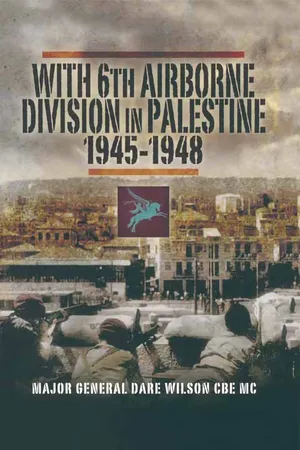
With 6th Airborne Division in Palestine, 1945–1948
About this book
The 6th Airborne Division was a major element of the British Security Force in Palestine between September, 1945 and May 1948. Faced with the unenviable task of upholding the law in a lawless country, the individual British soldier had to face continual opposition from a hostile Jewish community. This story is described by General Wilson, then a Major, who served with the division during this period. The mission of British forces was simply "to keep the peace". To achieve this goal, the 6th Airborne Division conducted a variety of counter-insurgency operations in both urban and rural environments. These operations were designed to locate illegal arms caches, limit Jewish-Arab violence and capture dissidents who had attacked British positions. The destruction of the King David Hotel, the most famous terrorist attack of the Mandate period, is treated in great detail. With 6th Airborne Division in Palestine 1945 - 48 is a tribute to the British soldier. It is also an excellent case study in unconventional warfare. It will be of great interest to any student of the intricate problem that Palestine presents.
Information
CONTENTS
| FOREWORD | ||
| PREFACE | ||
| PART ONE | ||
| SOUTHERN PALESTINE, SEPTEMBER, 1945—JANUARY, 1947 | ||
| CHAPTER I | Prelude to Palestine—Arrival of the Division in Palestine—Political Background—The Military Situation | |
| CHAPTER II | Training for Internal Security Duties—Deployment—Railway Sabotage—Riots in Tel Aviv | |
| CHAPTER III | First settlement searches—Tel Aviv again—A search is planned—Arms raid at Sarafand by I.Z.L. | |
| CHAPTER IV | Changes in Order of Battle—Successful action against I.Z.L.—Tel Aviv car park attack—The Anglo-American Committee | |
| CHAPTER V | Training—The first kidnappings—Operation “Agatha” | |
| CHAPTER VI | The attack on the King David Hotel—Operation “Shark”—The Opposition | |
| CHAPTER VII | The searches of Dorot and Ruhama—The problems of railway protection | |
| CHAPTER VIII | Finale in the South | |
| PART TWO | ||
| NORTHERN PALESTINE, JANUARY, 1947—MAY, 1948 | ||
| CHAPTER IX | Arrival and deployment in North Sector—Evacuation of British Civilians—London Conference | |
| CHAPTER X | Illegal Immigration—Road Mining—Protection of the Oil Industry | |
| CHAPTER XI | The case of Dov Gruner—Attack on Acre Gaol—U.N.S.C.O.P | |
| CHAPTER XII | I.Z.L. hang two British Sergeants—The President Warfield | |
| CHAPTER XIII | Britain will lay down the Mandate—Birth of the Barrel Bomb—Frontier Control | |
| CHAPTER XIV | Divisional Reorganisation—U.N.O. approves Partition—Syrian Invasion | |
| CHAPTER XV | Birth of “Craforce”—Fighting in Haifa | |
| CHAPTER XVI | The Division starts to withdraw—The Arab Liberation Army—Mediation at Mishmar ha Emeq | |
| CHAPTER XVII | The Battle for Haifa—Divisional Rearguard—The end of the Mandate | |
| EPILOGUE | ||
| APPENDICES | ||
| A | 6th Airborne Division Roll of Honour—Palestine Campaign, 1945–8 | |
| B | Order of Battle on 1st January, 1946 | |
| C | Order of Battle on 1st January, 1947 | |
| D | Order of Battle on 1st January, 1948 | |
| E | Units under command at various times between October, 1945, and April, 1948 | |
| F | List of Commanders and Staff Officers, 1945 | |
| G | List of Commanders and Staff Officers, 1946 | |
| H | List of Commanders and Staff Officers, 1947 | |
| I | List of Commanders and Staff Officers, 1948 | |
| J1 | Casualty Analysis, 1945–8 | |
| J2 | Casualty Graph, 1945–8 | |
| K | Summary of Major and Minor Operations, October, 1945—April, 1948 | |
| L | Summary of Illegal Immigration Transhipment Operations, 1947–8 | |
| M | Analysis of illegal arms and ammunition seized from Jews and Arabs, 1945–8 | |
| N | Diary of Events, September, 1945—May, 1948 | |
| O | Incidents Graph | |
| P | Divisional Sports Results, 1946–8 | |
ACKNOWLEDGEMENTS
The thanks of the author are due to many who have assisted in one way or another in the writing of the book. Foremost among those who played a major part in its production was the late commander of 6th Airborne Division, Major General Sir Hugh Stockwell, KBE, CB, DSO.
Major General E L Bols, CB, DSO and Major General A J H Cassels CBE, DSO, former commanders of the Division, were both kind enough to read and improve those parts of the book dealing with the periods in which they were in command. Major General G W Lathbury, DSO, MBE, late Commander 3rd Parachute Brigade, Brigadier F D Rome, CBE, DSO, late Commander 1st and 3rd Parachute Brigades, and Brigadier C H Colquhoun, OBE, late Commander Royal Artillery, 6th Airborne Division, also read through those parts concerning their late formations, and made many suggestions which have been incorporated. Mr K G Boswell, TD, BA, head of the Faculty of Modern Subjects at the Royal Military Academy Sandhurst, gave much useful advice. Lieutenant Colonel H H van Straubenzee, DSO, OBE, late GSO (Operations) of the Division, helped in a variety of ways, and Captain D E C Russell and Captain E M Rolley between them prepared most of the appendices. Lance Corporal R Stockwell of The Parachute Regiment, made a most valuable contribution by producing all the maps and plans. Many of the photographs have been kindly provided by The Associated Press Ltd, Keystone Press Ltd, The Imperial War Museum and various members of the Division. Finally, the author’s thanks are due to those who played minor, but none the less vital parts in the production of the book, but who are so numerous that it would be difficult to mention them all individually. They are asked to accept this collective acknowledgement of their assistance.
In addition to the above, the author wishes to thank Richard Gardner of The Battery Press Inc who republished Cordon and Search in the USA in 1984 and Henry Wilson of Pen and Sword Books Limited, who suggested this edition under the title With 6th Airborne Division in Palestine 1945 – 1948.
PREFACE
The purpose of this book is to place on record the main tasks and achievements of 6th Airborne Division between September 1945 and April 1948 in Palestine where, in an atmosphere of hatred and violence, the Division was faced with a responsibility in many respects more unpleasant and difficult to carry out than any it had to fulfil in war. It is a story of which those who served with the Division at that time may feel justly proud; not because of any mastery achieved over the civil population, but because of the efficient, humane and tolerant manner in which a distasteful duty was discharged. Such was the provocation that few forces in the world other than the British Army would have had either the discipline or patience to restrain themselves from counter-violence. The only reward was the satisfaction of a difficult job well done, and yet this in itself inspired the maintenance of an extremely high morale among all ranks of the Division.
In telling the story the aim has been to give the reader an accurate idea of the problems confronting the Division and how they were tackled. It is, however, important to remember that the events described are part and parcel of one of the most controversial problems of modern times. No one is yet in a position to pass judgment on the action of any government or individual, whether soldier or statesman. Opinions, where they are expressed, are the product of moral conviction, but are necessarily those of the soldier and will inevitably give rise to controversy.
If the narrative shows in an unfavourable light some of those with whom the Division had dealings, that is because of the prevailing conditions, and it is hoped that the reader will understand why it is so. The intention has been to record events and their effects on the troops at the time, and not conveniently to pass over the more difficult or unpleasant facts; to omit or soften them would present a false picture, and the production of the book would be pointless. But nothing has been included in this account with the object of exacting retribution against a people who, it is believed, were misguided enough to regard the British Army as their oppressor.
It is now nearly 60 years since the three paragraphs above appeared as part of the Preface to an account written by a young officer, at the suggestion of the last Divisional Commander, Major General Hugh Stockwell, recording 6th Airborne Division’s three years in Palestine. The previous year had seen the end of the British Mandate for Palestine, which came into being in September 1923 under the League of Nations, its basis being the Balfour Declaration of 1917. This opened a new phase in the history of a small country so closely associated in many minds with Biblical times. British involvement with Palestine, aside from the Crusades between the 11th and 13th centuries, was minimal until 1917 when General Allenby, in the course of a brilliant campaign, defeated the Turkish Army and wrested the country from the Ottoman Empire. Thence, for some 30 years, Britain was responsible for its government, administration and defence.
It was mainly owing to Palestine’s geographic location at the eastern end of the Mediterranean, forming a bridge between Africa and Asia, coupled with its ancient history as the Holy Land to Christians, Jews and Moslems alike, that contributed to its sense of international importance. The era that followed the Second World War saw new problems arising from conflicts of national interest, none more so than the sudden increase in Jewish immigration from Europe. It was characterised by the lawlessness and terrorism of dissident organisations that necessitated the presence of considerable British security forces, which soon increased to a field force of three divisions supported by base garrisons and lines of communication forces.
6th Airborne Division, which had been dropped in Normandy on D-Day and later across the Rhine, was heavily involved in the final defeat of the formidable enemy forces in North West Europe. The end of hostilities found it next to the Russians close to the Baltic, but soon it returned to England for a pause to refit and absorb reinforcements, with further active service in prospect in the Far East. However, the dropping of the atomic bombs on Hiroshima and Nagasaki removed that commitment and, by September 1945, it was on the move to Palestine. Having been sent initially for a period of training, by the time it had arrived internal security had become threatened by lawlessness and the Division remained in the country for nearly three years of further active service.
It was in some ways an unpleasant time and certainly costly in lives, but once again the men of this great Division rose to the occasion, maintaining law and order against terrorists who enjoyed the protection and support of a community, soon to gain nationhood, which chose to overlook all that Britain had done at such cost on its behalf throughout the six preceding years. Nevertheless, the years 1945–1948 in Palestine remain for Britain a chapter of history to which those former members of her Armed Forces who served there contributed with honour.
PART ONE
SOUTHERN PALESTINE
SEPTEMBER, 1945–JANUARY, 1947
CHAPTER I
PRELUDE TO PALESTINE
THE end of the war in Germany in May, 1945, found the Division at Wismar on the Baltic. Here for about two weeks it rested after its rapid advance from the Rhine, until orders were received for it to return immediately to England.
In the Pacific the war against Japan was gathering momentum, but there was yet no sign of the enemy capitulating in that theatre. Plans had been drawn up for the operations in South-East Asia which were to make possible the final overthrow of the Japanese, and in these plans an important part was to be played by 6th Airborne Division.
As soon as it became known that the Division had been selected for service in the Far East, preparations went ahead on the vast number of administrative and training problems involved. Early in July a Divisional Tactical Headquarters flew out to Bombay with Headquarters 5th Parachute Brigade. This Brigade was at that time part of the Division, and was to be given an independent role in an operation in Burma which necessitated its arrival in advance of the Division. At the conclusion of this operation it would return to the Division in time for a major airborne ...
Table of contents
- Cover
- Halftitle
- Full Title
- Copyright Page
- Dedication
- FOREWORD
- Contents
Trusted by 375,005 students
Access to over 1.5 million titles for a fair monthly price.
Study more efficiently using our study tools.
Frequently asked questions
Yes, you can cancel anytime from the Subscription tab in your account settings on the Perlego website. Your subscription will stay active until the end of your current billing period. Learn how to cancel your subscription
No, books cannot be downloaded as external files, such as PDFs, for use outside of Perlego. However, you can download books within the Perlego app for offline reading on mobile or tablet. Learn how to download books offline
Perlego offers two plans: Essential and Complete
- Essential is ideal for learners and professionals who enjoy exploring a wide range of subjects. Access the Essential Library with 800,000+ trusted titles and best-sellers across business, personal growth, and the humanities. Includes unlimited reading time and Standard Read Aloud voice.
- Complete: Perfect for advanced learners and researchers needing full, unrestricted access. Unlock 1.5M+ books across hundreds of subjects, including academic and specialized titles. The Complete Plan also includes advanced features like Premium Read Aloud and Research Assistant.
We are an online textbook subscription service, where you can get access to an entire online library for less than the price of a single book per month. With over 1.5 million books across 990+ topics, we’ve got you covered! Learn about our mission
Look out for the read-aloud symbol on your next book to see if you can listen to it. The read-aloud tool reads text aloud for you, highlighting the text as it is being read. You can pause it, speed it up and slow it down. Learn more about Read Aloud
Yes! You can use the Perlego app on both iOS and Android devices to read anytime, anywhere — even offline. Perfect for commutes or when you’re on the go.
Please note we cannot support devices running on iOS 13 and Android 7 or earlier. Learn more about using the app
Please note we cannot support devices running on iOS 13 and Android 7 or earlier. Learn more about using the app
Yes, you can access With 6th Airborne Division in Palestine, 1945–1948 by Dare Wilson in PDF and/or ePUB format, as well as other popular books in History & Military Biographies. We have over 1.5 million books available in our catalogue for you to explore.