- 152 pages
- English
- ePUB (mobile friendly)
- Available on iOS & Android
eBook - ePub
About this book
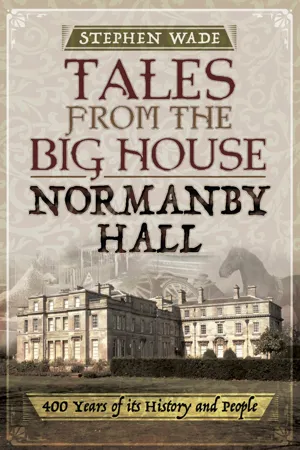
Tales from the Big House: Normanby Hall tells the story of a place known perhaps today mainly as the home where Samantha Cameron grew up, but historically it has been the seat of the Sheffield family, whose most famous member was arguably the Duke of Buckingham in the seventeenth century. As with most country houses, the Hall was used as a military hospital in the Great War, and in the Second World War there were military personnel based there again. It stands just a few miles from the great steelworks on the Brigg Road, which have always defined Scunthorpe, so it played its part in the history of steel-making also.The book includes biographies of the famous but also tells of the lives of the ordinary people who kept the house and the estate going, from the gamekeepers to the gardeners, and the cooks to the stable hands. All this is set against the social background through the centuries of its existence, up to the sale of the Hall to Scunthorpe Borough Council in 1964. The lives familiar to us today from Downton Abbey and similar family sagas are at the heart of Stephen Wades history. But along the way, the reader will meet such characters as Sir Berkeley Sheffield, model railway enthusiast, Walter Brierley, architect, Thomas Sumpter, the schoolmaster, John Fletcher, machine-maker, and perhaps most charismatically of all, Lady Arthur Grosvenor, an expert on gypsy caravans.
Information
Chapter 1
The Family and the Place
One strong man in a blatant land.
Whatever they call him, what care I
Aristocrat, democrat, autocrat – one
Who can rule and dare not lie …
Mariana, by Alfred, Lord Tennyson
In looking at an English story, with its crowds of people, all reaching out to varied lives from the very centre of their hearth and home, the character of the place in which they grew up and learned about life is the basis of those intricacies of social history that inevitably follow. The Sheffield family is no exception, and in this case, the location of their home is Normanby Hall, a place very close to Burton-upon-Stather on the Humber’s banks, and to a cluster of North Lincolnshire villages to the south. A little beyond that is the town of Scunthorpe, whose ‘four Queens’ – blast furnaces of the steelworks – always seem to take centre stage on the horizon.
In the 1920s, W.F. Rawnsley gave this very comprehensive description of this area, starting with Burton:
In the village is a really beautiful old Tudor house of brick, with stone mullions, called Walcot Old Hall, the property of J. Goulton Constable. The little isolated bit of chalk wold which begins near Walcot is but 4 miles long, and in the centre of it is perched the village of Burton-upon-Stather. The church stands on the very edge of the cliff, and a steep road leads down to the staithe, a ferry landing stage … here we stopped to admire the delightful view.
The Trent was just below us … across the Trent lay the Isle of Axholme, green but featureless, and beyond it the sinuous Ouse. … We leave the village by an avenue of overarching trees and cross the wold obliquely, passing Normanby Hall, the residence of Sir B.D. Sheffield, many of whose ancestors lie buried in Burton Stather Church.
Family history at its most basic level is still a considerable challenge for the historian and researcher. There is always a mix of occupations and events involved, and the challenge for the reader is to make sense of the interrelationships, and of course to look for stories that tend to move laterally, alongside the bare outline and lists of names. This was first apparent with reference to the Sheffield family of Normanby when I came across a scribbled attempt to provide a tree, and this showed that between John Sheffield’s eventful life in the seventeenth century through to the death of Sir Berkeley Sheffield in 1946, there was so much material in such a small space that facts crowded out any clear line of ascent through the years.
The Hall in its first inception belonged to the Hildyard family of Winestead, and it was bought in 1510 from Sir Christopher Hildyard by Nicholas Girlington. Then, in 1589, it was sold to Lord Edmund Sheffield, who became the first Earl of Mulgrave, and died in 1646. His grandson built the Restoration house, following from a Tudor building, and that grandson was the first Duke of Buckingham and Normanby: John Sheffield.
I shall resume the story of the Sheffield baronetcy shortly, but first a brief diversion into earlier history is needed, when the Sheffield men were warriors, players in power games and above all, people standing together in times when kin meant strength when there was no dependable law machine and you could not ring for the police when in trouble.
The Sheffields go back in time well before John Sheffield, the famous figure of Stuart history. In fact, as Sir Reginald Sheffield has explained, the Sheffield origins are in a certain Sir Robert at the time of the Crusades. This noble knight’s tomb is in St Andrew’s Church at Burton-upon-Stather. He was in fact a Templar, and this order later became, in the words of Sir Reginald, ‘a kind of aristocratic “Foreign Legion” including among their members not only seekers after God and heroism but also increasing numbers of failures, disappointed lovers, restless ambitious men …’ All that is known about this first Sheffield is that he took part in the Fifth Crusade, and he was followed by a string of other Sheffields, down to a William Sheffield, who was Dean of York at the time when the Battle of Bosworth Field brought the end of the Yorkists and the beginnings of the Tudor dynasty when Richard III was killed.
At that point the Sheffields moved into the Isle of Axholme and West Butterwick. In the Middle Ages through to the Tudor years, the family were engaged in the essential business of making beneficial marriages in order to strengthen their position and to ensure future success. They really began to come into prominence in the reign of Henry VIII when a Sir Robert was Speaker of the House of Commons. Sir Reginald’s account says something more about this particular Sir Robert: ‘He built a great fortified brick tower at West Butterwick on the lines of Tattershall Castle and also had a fine house in Hammersmith.’ He was painted by the great Hans Holbein, and that is surely a mark of his power and status.
The Sheffields were later involved in national events, such as the rebellion of John Kett, and a John Sheffield took on the rebels, in charge of a mercenary force. It is plain to see that the Sheffields, up to the early seventeenth century, were skilful at cultivating the arts of survival, making alliances and forming friendships to retain fundamental advantages. Typical of their status and influence is the fact that at the time of the Spanish Armada in 1588, Edmund Sheffield was in the ranks of the council of war, and later he was made a Knight of the Garter; by 1609, he was Lord President of the North, which, as Sir Reginald explains, meant that ‘he governed the whole of the North of England.’ He was a man of action and an entrepreneur on the largest scale, even being involved in financing colonization in the new ‘Americas’. The writer of the Country Life feature, mentioned in my introduction, provides startling information on this adventurer and man of action: ‘In James I’s reign he tried to quiet the suspicions raised by his marriage with a Roman Catholic by harrying the Papists very zealously. … At the coronation of Charles I he received his earldom but he turned against the king. … Of his twenty children, one daughter must be mentioned because she became the mother of Black Tom, the great Lord Fairfax.’ It has to be said that Edmund and his family are surely prime candidates for fictional treatment.
Edmund’s portrait lies in the National Maritime Museum at Greenwich, and there he sits, with a swagger, one arm akimbo and a facial expression that hints at his toughness. He had a long life (1565–1646) and was always involved in some kind of business and opposition; in the Armada conflict he commanded no less than three ships, perhaps most prominently, The White Bear. It was in 1591 that he was given the property of Mulgrave in Yorkshire and he became Lord Lieutenant of the shire.
This Sheffield and his son figure in fiction also; in fact, in the classic North Lincolnshire novel of the seventeenth century, The MS in a Red Box by John Hamilton. There is an intriguing story behind this book: in 1903, the manuscript arrived at the publisher Bodley Head in London, but there was no name nor any address attached. The publisher liked it and wanted to publish it, and so they advertised to try to attract the attention of the author, but to no avail. It was then published in 1904. Today, after research, it is almost certain that it was written by a congregational minister at Crowle – a man who would have known the Sheffield lands when they, as the Earls of Mulgrave, owned much of Axholme.
But Hamilton makes the Sheffields the villains in the novel, which concerns the strife between the Axholme men who want the land to be left alone, and the followers of the Dutch engineer Cornelius Vermuyden, and Sheffield, who want it reclaimed and developed in such a way that old patterns of life and work would go on. This passage shows how the Sheffields are textualized:
My mind was filled with apprehension, which I could not express. That Sheffield could do an act of pure kindness was incredible. His foul pursuit of beauty was a byword in the Isle, and there were fathers, brothers and lovers who were held back from murderous revenge only by terror of the old Earl, who had long been President of the Council of the North, and consequently held unlimited authority over the common people of Axholme. Even that fear might not have restrained some, but Sheffield … always went armed and attended, and had a host of spies in his pay.
This depiction of the Earl does not appear to be founded on any evidence, but it makes for a good, dramatic story.
Resuming the story of the Sheffield earls, dukes and baronets, it helps to begin with a list, so reference may be made to this when names may become confusing, especially when there is more than one person with the same forename. Here they are, in chronological order:
Lord Edmund Sheffield (1st Earl Mulgrave): died 1646
Edmund Sheffield (2nd Earl Musgrave, son): died 1658
John Sheffield (1st Duke of Buckingham and Normanby): died 1721
Edmund Sheffield (son): died 1735
Charles Sheffield (half brother): died 1774, First Baronet
Sir John Sheffield: died 12 February 1815, Second Baronet
Rev Sir Robert Sheffield: died 26 February 1815, Third Baronet
Sir Robert Sheffield: died 1862, Fourth Baronet
Sir Robert Sheffield: died 1886, Fifth Baronet
Sir Berkeley Sheffield: died 1946, Sixth Baronet
Sir Robert Sheffield: died 1977, Seventh Baronet
(current) Sir Reginald Sheffield, born 1946
Before embarking on an outline of the baronets and the social context, it is useful to have a summary of the baronetcy from the point at which it became ‘of Buckingham and Normanby’. That is, from Sir Charles Sheffield, who was born in 1706, through to the death of Sir Berkeley Sheffield in 1946, as this book ends at that point. The reader might want to use this, and refer to it, as a point of reference, as such a genealogy may be very confusing.
1st Baronet:
People
Sir Charles Sheffield, born 1706 and married Margaret Sabine in April 1741; died 1774.
Children: Sir John, Charles, Sir Robert, Anne, Alicia and Sophia. This is the man who sold Buckingham House, in St James’ Park, to King George III for the sum of £21,000 – probably about £1.5 million in today’s values.
Times and events
Sir Charles was made a baronet in 1755 – ‘of Normanby in the county of Lincoln’. The early eighteenth century brought massive social changes, and Sir Charles had a long life, in which, as an estate owner, he would have felt the effects of such episodes as the social disorder that was recurrent through this time. The 1715 Riot Act was passed after serious rioting, and in the following years, it was the fear of offences against those who had property that impinged on the landowners’ lives. For instance, The Black Act of 1723 was passed after an escalation of violence in poaching offences, and this was part of a string of legislation known as the ‘Bloody code’, which included a large number of capital offences for crime against property.
Also in Charles’s time there was the Militia Act of 1757; this was passed in a climate of fear after a European war and the fear of possible invasion. The Act created a force of 60,000 men, and a man had to serve for three years. But Sir Charles was wealthy and so he and his family could avoid service because they could pay a fine or buy a substitute.
2nd Baronet:
People
Sir John Sheffield, born around 1743, and married Charlotte Digby in December, 1784. He died in February, 1815.
Times and events
Sir John’s time included the desperate years of war with revolutionary France and then with Napoleon. He died early in the year that was to see Napoleon defeated at Waterloo. But in the last years of the eighteenth century, there was paranoia in the ranks of the rich and those in power, as there was a fear of the revolutionary spirit reaching Britain.
There were many statutes made in the 1790s that were to suppress individual or group radicalism. In 1792, for instance, there were proclamations against sedition, and in 1795, the ‘Two Acts’ of Treasonable and Seditious Practices made the law of treason applicable to spoken and written words.
3rd Baronet:
People
Rev Sir Robert Sheffield, born 1758, died 4 February 1815. First wife, Penelope Pitches, and second wife, Sarah Kennet. He had two children by his first wife (Robert and Penelope) and seven children by his second wife: Rev Charles and six daughters. He was to be 3rd Baronet for merely three weeks before his son succeeded.
Times and events
His short time as baronet saw the continuance of repressive legislation.
4th Baronet:
People
Sir Robert Sheffield, born 25 February 1786; died 7 November 1862. He married Julia Newbolt in October 1818. They had eight children, and Robert, the eldest, succeeded. He was Sheriff of Lincolnshire from 1817– 18, and was chairman of the Kirton Lindsey Quarter Sessions.
Times and events
Sir Robert’s time as baronet involved his work as chairman of magistrates, so he knew from close quarters what effects social change was having on the rural poor, and consequently on crime. For instance, it was in these years that enclosure escalated, and this displaced a great number of people whose work had been on the common land. Enclosure made common land into fenced property, and so there was an increase in maximising production of food and the breeding and rearing of animals for meat. From 1760 to 1799 there were about 1,600 Enclosure Acts. Also important for his work was the Justices Qualification Act of 1744, as this stipulated that the Justice had to have land with an annual value of £100.
He would have also lived through the time of Corn Law agitation. These laws started in 1815 and continued for thirty years, the aim being to increase food imports and reduce food exports. Obviously this would increase the pressure on the rural poor and cause industrial depressions. The laws were repealed in 1846.
His age was also the ‘Railway Age’, and by 1852, the railway network had extended considerably. By 1850, there was the Midland Railway and the ‘East Coast route’ from London to Edinburgh and Glasgow, and in the year of his death, the Great Eastern Railway was created after some amalgamations. His land was not so far from Doncaster, which by 1854 was the locomotive headquarters for the Great Northern Railway.
On the bench passing sentences to local criminals, Sir Robert would come to know the reasons behind such offences as petty theft, poaching and other regular small offences, but he also had to deal with serious crime such as assault, rape and even murder. Transportation to Tasmania stopped in the 1850s and the year before his death, the Offences Against the Person Act was passed, revising the whole of the criminal law in that context.
In agriculture generally, his years in the seat of power saw technology really start to have an impact. For instance, as T.W. Beastall notes in his agricultural history of the county, ‘Anthony Hammond reported on the implements to be seen at Lincoln in 1854 where machinery worth £28,878 was on show from 130 exhibitors submitting 1,897 articles.’
5th Baronet:
People
Sir Robert Sheffield, born 8 December 1823; died 23 October 1886. The second Sir Robert was running the Hall and Park from 1862 to the time of his death in 1886. He married Priscilla Dumaresq in 1867 and they had four children. His daughter Gwendoline married the very rich Lancelot Lowther, the Earl of Lonsdale; his daughter Helen married the equally rich and powerful Hugh, 1st Duke of Westminster, and his other daughter, Dorothy, married into yet another wealthy family, wedding the 7th Viscount Portman.
Times and events
This Sir Robert was an army man. He joined the Horse Guards (‘the Blues’) in1842 and was a captain seven years later. His wife Priscilla was also from a military background, her father being a distinguished officer. At this time (c. 1840s–50s) there was plenty for the army to do, and the culmination of various diplomatic struggles was the Crimean War of 1853–56.
6th Baronet:
People
Sir Berkeley Sheffield, born 19 January 1876; died 26 November 1946. He married Baroness Julia van Tuyll in 1904, and they had four children.
Times and events
Sir Berkeley’s assumption of the baronetcy in 1886 occurred at the time when modernity was just reaching into most areas of life. In agriculture there had been a sign of times to come with the establishment of the first agricultural workers...
Table of contents
- Cover
- Title
- Copyright
- Contents
- Introduction
- Chapter 1 The Family and the Place
- Chapter 2 The Hall, the Park and Sir Robert
- Chapter 3 The Second Sir Robert and Sir Berkeley
- Chapter 4 The Locality and the Great War
- Chapter 5 Estate Workers and Servants
- Chapter 6 The Hall in the Second World War
- Chapter 7 Social History: the 1920s to the 1960s
- Conclusions
- Acknowledgements
- Bibliography and Sources
- Plate section
Trusted by 375,005 students
Access to over 1.5 million titles for a fair monthly price.
Study more efficiently using our study tools.
Frequently asked questions
Yes, you can cancel anytime from the Subscription tab in your account settings on the Perlego website. Your subscription will stay active until the end of your current billing period. Learn how to cancel your subscription
No, books cannot be downloaded as external files, such as PDFs, for use outside of Perlego. However, you can download books within the Perlego app for offline reading on mobile or tablet. Learn how to download books offline
Perlego offers two plans: Essential and Complete
- Essential is ideal for learners and professionals who enjoy exploring a wide range of subjects. Access the Essential Library with 800,000+ trusted titles and best-sellers across business, personal growth, and the humanities. Includes unlimited reading time and Standard Read Aloud voice.
- Complete: Perfect for advanced learners and researchers needing full, unrestricted access. Unlock 1.5M+ books across hundreds of subjects, including academic and specialized titles. The Complete Plan also includes advanced features like Premium Read Aloud and Research Assistant.
We are an online textbook subscription service, where you can get access to an entire online library for less than the price of a single book per month. With over 1.5 million books across 990+ topics, we’ve got you covered! Learn about our mission
Look out for the read-aloud symbol on your next book to see if you can listen to it. The read-aloud tool reads text aloud for you, highlighting the text as it is being read. You can pause it, speed it up and slow it down. Learn more about Read Aloud
Yes! You can use the Perlego app on both iOS and Android devices to read anytime, anywhere — even offline. Perfect for commutes or when you’re on the go.
Please note we cannot support devices running on iOS 13 and Android 7 or earlier. Learn more about using the app
Please note we cannot support devices running on iOS 13 and Android 7 or earlier. Learn more about using the app
Yes, you can access Tales from the Big House: Normanby Hall by Stephen Wade in PDF and/or ePUB format, as well as other popular books in History & Architecture General. We have over 1.5 million books available in our catalogue for you to explore.