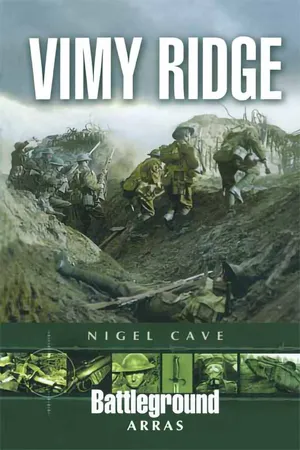
eBook - ePub
Vimy Ridge
About this book
This volume covers the battlefields of Arras around Vimy Ridge dealing with the activities of the French and the British and the start of the Battle of Arras. Vimy Ridge gives a balanced view of the fighting by detailed descriptions of various units and individuals.
Information
CONTENTS
Acknowledgements
Introduction and how to use this book
Advice to travellers
| Chapter 1 | 1915: The Year of the French Effort |
| Chapter 2 | The British Arrive: Mining Operations and Trench Raids - May 1916 |
| Chapter 3 | A Minor Affair on Vimy Ridge |
| Chapter 4 | The Brigade Major’s Diary, April - May 1916 |
| Chapter 5 | The Broadmarsh Crater, May 19 - May 21st |
| Chapter 6 | A Brief Sojourn in France - 60th Division Holds the Line |
| Chapter 7 | Tunnellers Under Vimy Ridge |
| Chapter 8 | Canada on Vimy Ridge |
| Chapter 9 | Tours |
| Chapter 10 | Behind the Lines |
| Chapter 11 | The Cemeteries |
| Chapter 12 | The Memorials |
Further Reading
Index
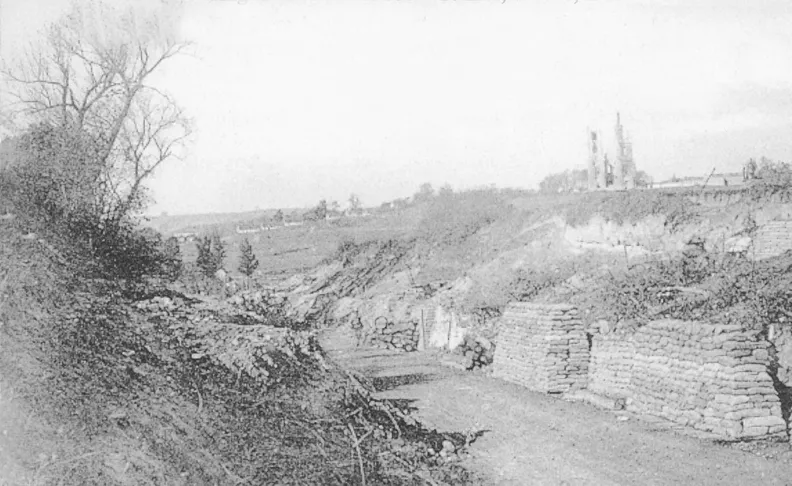
The road leading from Arras to Mont St Eloi, Winter, 1915.
ACKNOWLEDGEMENTS
Many people have helped me in putting this book together. My first tribute is to the authors of all the various material which makes up the bulk of this book - the writers of Regimental Divisional and Official histories, the officers who maintained the War Diaries, the staff officers who wrote up reports and the men who have got their war experiences into print.
I am most grateful to Richard Brucciani who took two days off work, flew me in his plane over the battlefields of Loos, Arras and the Somme and managed to perform without complaint all the aerobatic manoeuvres for which I asked in order to get some photograph or the other. Various friends on Battlefields Tours have spent longer than they might have expected on the Ridge and so I am grateful to Paul and David Fisher, Dr Graham Keech and Col Dick Burge for humouring me. On a mad dash to Arras over a weekend in January to finalize the photography I was accompanied by two past pupils from Ratcliffe, Sam Mudd and Barney Petty. Fortunately the ulterior motive (viz, pushing the car out of trouble) did not arise.
Numerous people have helped by giving freely of their own knowledge of Vimy and its area. In particular I would like to single out Lt Col (Retd) Philip Robinson RE who conducted an underground survey for the Canadian Memorial Committee and who has deluged me with information and paper which has proved fascinating. Distance is the chief obstacle from my sitting at the feet of Tom Gudmestad who spends as much time as he can, when he can get away from Seattle, on the northern Arras battlefield and who probably knows more about it than anyone.
Regimental Museums have once more proved to be a source of useful information. My chief debt in this regard is to Lt Col Pat Love, Worcesters, who has a deep respect for the achievements of his Regiment in the Great War and has been a fount of information. I have also received the assistance of the Regimental Museums of the Queen’s Lancashire Regt, of the Argyll and Sutherland Highlanders and of the Queen’s Own Highlanders. I am also grateful to them for the loan of documents and photographs.
Once more I am obliged to the Commonwealth War Graves Commission for their assistance, most notably in the matter of the loan of registers. Any visit to the battlefields has to include time spent in cemeteries. Many of the cemeteries in the area of the Ridge are more than usually isolated - Petit Vimy, Zouave Valley and Givenchy-en-Gohelle to mention a few. All the more impressive then to find these returfed and Villers Station undergoing the same treatment; even lonely and neglected (by the visitors) Thelus Cemetery was having new turf laid. Visitors come and visitors go, but the CWGC is standing firm on the promises made in its charter.
I am thankful to the following for allowing me to publish extracts, photographs or maps: Tom Gudmestad, The Worcestershire Regimental Musem, Col Philip Robinson, Dr MS Rosenbaum, Sono Nis Press (The Journal of Private Fraser), Lancelot Press (Gunner Ferguson’s Diary), the Crown Copyright Service, the Peter Taylor Photographic Library! author Mike Stedman, the Commonwealth War Graves Commission and the Museums of La Targette and Notre Dame de Lorette.
I am indebted to those who have looked through earlier drafts of this book and have made suggestions and corrections. Both George Friendship and Paul Fisher have better things to do with their time, but manfully waded through the script. My father, Col Terry Cave CBE, did the same, came up with various source suggestions, let me lose on his Great War book collection, and of course came on tour with me. We have been doing these annually (more or less) since 1980. My mother never comes on a battlefield tour, and never complains when another week in France and Flanders looms and she is left to guard the house. I dedicate this book to them both.
INTRODUCTION
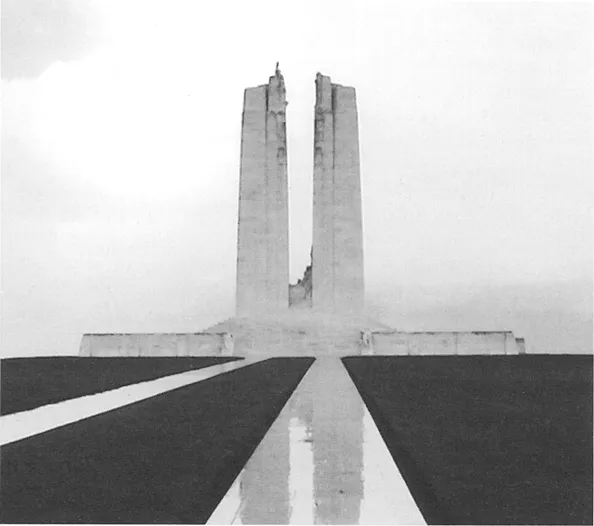
How many people come to Vimy Ridge, visit the Canadian Memorial Park and leave an hour or so later having admired the memorial, wandered over the preserved trenches and possibly gone underground in the Grange Subway? What impression do they have when they go? Perhaps they think that this was a battle fought in isolation for a notable landmark, which chiefly involved the Canadians and which was one of the great decisive battles of the war. They might be justified in thinking so.
The capture of Vimy Ridge in April 1917 was an important event and was a considerable victory. One might question whether the heroic Canadian defence at St Julien against the first use of poison gas on the Western Front in the battle of Second Ypres might have a greater claim or the outstanding contribution of the Canadian Forces in the Hundred Days of 1918 which led to Germany’s defeat. Vimy Ridge was important because it saw the birth of a Canadian Army, and with it the greater realisation of national consciousness. That alone justifies the memorial; but the battle was a fine feat of arms in its own right.
Lost in this understandable concentration on the Canadians is the contribution of the armies that stood in this sector prior to the arrival of the Canadian Corps in October 1916. There is very little left to indicate their achievement. The French army made great sacrifices in 1915 and the achievement of some of her divisions - most notably the Moroccan - stands with the greatest of wartime exploits. A visit to the Notre Dame de Lorette Cemetery overpoweringly shows the sacrifice that was made. A tour of the ground over which the battles of 1915 were fought will show just how difficult was the task that faced the French. In the spring of 1916 the French armies departed from the Arras region never to return during the Great War. In their place came British troops from an army which was expanding at a phenomenal rate. Whilst great things were planned on the Somme and were then carried out the troops here clung on to the unsatisfactory positions on Vimy Ridge whilst specialist Tunnelling Companies worked feverishly underground to overcome the German mining threat.
Finally the Canadians arrived in the autumn of 1916, relieved from their hard fought battles around Courcelette and Regina Trench on the Somme. They played their role in the 1917 Battle of Arras, the British contribution to the grandiose schemes of General Nivelle.
The region around Arras has seen many battles, and the dominant high ground of Vimy Ridge has played an important part in many of them. The Emperor Valentinian spent time here during his Gallic campaigns and the village of Etrun still shows signs of his fortifications. Men at arms involved in the Hundred Years’ War fought nearby; Charles V and his successors Philip II and Philip IV had armies battling nearby for European supremacy with their French counterparts. Vimy Ridge played a vital part in Marlborough’s campaign of 1711 - there is much more to the military history of Arleux and Monchy le Preux than their place in the battles of 1917. Some of the decisive fighting in the saving of the British Army in 1940 took place around Arras, when Frankforce struggled to hold up the encircling German Army. North European war does not seem to be able to avoid Arras.
This book is a guide to aspects of the war around Vimy Ridge, most particularly as it affected the British Army. The biggest gap from the work is the contribution of the Germans to events. The book makes no claim to be all-encompassing, but aims to give the visitor a reasonably balanced tour of the battlefield and of the events, units and personalities that were involved in the war and of the memorials, cemeteries, museums and remains of battle that mark their work.
The best way to use the book is to read the whole thing through and familiarise yourself with place names, events and the maps. Having done that, the tours are designed to take you over the whole of the area covered by the book, and each one, where appropriate, refers the tourer to the relevant chapters in the book. There is a section on further reading and advice on what the visitors should have with them. Much of the damage done to nature by shellfire and mine blast is disappearing; but with a little imagination and a willingness to learn it is possible to understand so much more by a visit to this battlefield than simply reading about it in books.
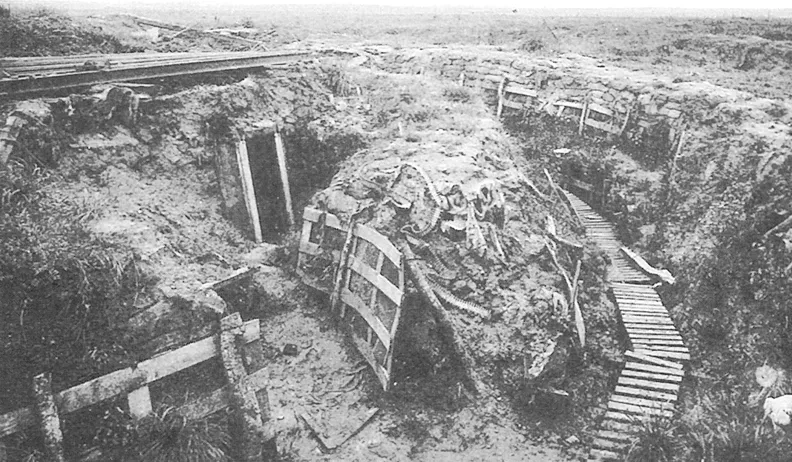
Deserted trenches at Souchez, north of Arras.
ADVICE TO TRAVELLERS
Vimy Ridge is easily accessible from the Calais - Paris autoroute; take the Vimy/Arras Central exit and this comes out on the Arras - Lens road. There are considerable road works going on at the time of writing (January 1996) and this was one of the major reasons why the book was confined in scope to the crest of Vimy Ridge - the extent and consequences of this road programme on battlefield memorials and their access is not clear at the moment.
The ...
Table of contents
- Coverpage
- Half Title
- Series
- Title Page
- Copyright
- Contents
Trusted by 375,005 students
Access to over 1.5 million titles for a fair monthly price.
Study more efficiently using our study tools.
Frequently asked questions
Yes, you can cancel anytime from the Subscription tab in your account settings on the Perlego website. Your subscription will stay active until the end of your current billing period. Learn how to cancel your subscription
No, books cannot be downloaded as external files, such as PDFs, for use outside of Perlego. However, you can download books within the Perlego app for offline reading on mobile or tablet. Learn how to download books offline
Perlego offers two plans: Essential and Complete
- Essential is ideal for learners and professionals who enjoy exploring a wide range of subjects. Access the Essential Library with 800,000+ trusted titles and best-sellers across business, personal growth, and the humanities. Includes unlimited reading time and Standard Read Aloud voice.
- Complete: Perfect for advanced learners and researchers needing full, unrestricted access. Unlock 1.5M+ books across hundreds of subjects, including academic and specialized titles. The Complete Plan also includes advanced features like Premium Read Aloud and Research Assistant.
We are an online textbook subscription service, where you can get access to an entire online library for less than the price of a single book per month. With over 1.5 million books across 990+ topics, we’ve got you covered! Learn about our mission
Look out for the read-aloud symbol on your next book to see if you can listen to it. The read-aloud tool reads text aloud for you, highlighting the text as it is being read. You can pause it, speed it up and slow it down. Learn more about Read Aloud
Yes! You can use the Perlego app on both iOS and Android devices to read anytime, anywhere — even offline. Perfect for commutes or when you’re on the go.
Please note we cannot support devices running on iOS 13 and Android 7 or earlier. Learn more about using the app
Please note we cannot support devices running on iOS 13 and Android 7 or earlier. Learn more about using the app
Yes, you can access Vimy Ridge by Nigel Cave in PDF and/or ePUB format, as well as other popular books in History & Military & Maritime History. We have over 1.5 million books available in our catalogue for you to explore.