- 168 pages
- English
- ePUB (mobile friendly)
- Available on iOS & Android
eBook - ePub
About this book
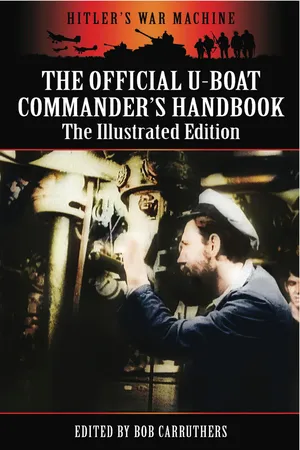
This is the complete wartime translation by the U.S. Navy of the 1943 edition of the official handbook given to all U-boat commanders. The original handbook was compiled from combat reports and was regularly updated throughout the war. The handbook was an invaluable reference for every operational U-boat commander. Simply written and highly accessible for a wider audience, the U-boat handbook attempted to anticipate every possible situation and to advise on suitable tactics. This superb war-time primary source is enhanced by a rare series of photographs taken on an actual combat patrol and published during the time of the Third Reich in the book U-Boot Auf Feindfahrt.Together the handbook and these rare photographs provide a fascinating glimpse into the world of the U-boats from a first hand perspective, and is essential reading for anyone interested in World War II from primary sources.
Information
SECTION II
THE UNDERWATER TORPEDO ATTACK
a) Fundamental Rules for the Underwater Attack
91 - The object of the underwater attack is to discharge a torpedo with the certainty of hitting, but without warning, and at short range. The shorter the distance between the submarine and the target, the more reliable the assessment of the speed, course, and position of the enemy. The torpedo attack at short range is the most advantageous also because not even important miscalculations affecting the launching of the missile can take effect to any appreciable extent, on account of the short course of the torpedo, and by reason of the fact that any counter-action on the part of the enemy - for example, a change of course (evading), if the submarine or the torpedo is spotted - comes too late.
92 - The lower limit of the torpedo attack at dose range is defined by the distance needed to set the torpedo on its course at the appropriate depth, and by the safety interval, i.e., the distance of the submarine from the point of detonation of the torpedo. No torpedo attack should, therefore, be carried out at a range under 300m.
93 - Invisibility during the attack is made possible by the judicious, invisible use of the periscope, the surgeless launching of the torpedo, and the absence of bubbles in the track of the torpedo.
94 - The efficiency of the sound-locating and ASDIC equipment of the enemy is dependent on the state of the sea, the nature of the water (i.e., conditions of “stratification,” etc.), the speed of the enemy (see Section I, B, II and III), the attentiveness of the personnel, and other factors. The danger to be anticipated from the sound location and ASDICs of the enemy should not be allowed to prevent the carrying out of a fatal attack at short range.
95 - When attacking ships with low and medium speeds, at close range, it is ballistically advantageous to fire at an angle of the target of 90, as errors in estimating the position will in this case have the least effect, besides which the speed of the enemy can be most accurately gauged in this position. If the range is longer (over 1,000m), and the target is travelling at a high rate of speed, an attempt should be made to launch the torpedo at a smaller angle, say, 60.
96 - The method of carrying out the attack is based, as long as range finding with subsequent deflection (change of bearing) measuring (keeping the reckoning) is not practicable, on the particulars of the enemy characteristics obtained by the viewing method during the preparation of the underwater attack, or on the estimates of the enemy characteristics obtained underwater: position, speed, range. The estimation of the characteristics of the target from the level of the submarine, and with the aid of the monocular optical system of the periscope, is difficult, and requires continual thorough practice.
97 - The estimation of the position is easiest when the submarine stations itself forward of the beam. If the sun is behind the target, the assessment of the position is difficult.

The diesels have been switched off for the dive. It is quiet in the boat, suddenly oddly quiet. The petty officer in the e-room operates the switch to transfer to the electric motor; because under water, it delivers the power, the diesels need air! All orders are given via the engine telegraph, as they are above water for the diesel crew. It warns with a sharp ring, its pointer sets out the ordered speed. In the same way, the petty officer gets his readings from it and reports that the actions have been carried out.
98 - The speed of the enemy can best be calculated from the position forward of the beam. In calculating the speed, attention should be paid to the water at the stern rather than to the sea near the bows, because, if the shape of the bows is narrow (pointed), the visible effect of the progress of the ship is often very slight. In addition, it is more difficult to camouflage the stern (i.e., so as to create the impression of movement, etc.). In estimating the enemy’s speed, his course in relation to the direction of the waves, as well as the change of bearing, should be taken into consideration.
99 - Every available opportunity should be taken of practicing range finding (i.e., estimating the range). In estimating ranges, conditions of visibility play an important part. In dear weather, and with the sun behind one’s back, the distance is liable to be underestimated, in poor visibility, against the sun, in conditions of twilight (dusk and dawn), and by moonlight, to be overestimated.
100 - Favourable conditions for attack.
a. | With the sun behind: The torpedo control officer (the officer in charge of the discharging of the torpedoes) is not dazzled, but can clearly see the sharp outline of the target. From the enemy ship, the periscope, raised no more than is absolutely necessary, is not to be seen among the reflections of the bright sun in the water; and also a trail of bubbles can not usually be seen until it is too late. |
b. | From the weather side (windward). The periscope should move with the sea. The waves, coming from behind, always wash over a periscope which is in the right position, that is to say, in a low position; and the splashes and spray water of the periscope are not easily made out. In addition, the enemy look-out to windward, especially in a strong wind, or in heavy rain, meets with difficulties. As regards the weather side (windward), if the wind is moderate, torpedoes discharged from the stern form an exception (i.e., to the above), inasmuch as the submarine, in moving with the waves (that is, in this case to leeward) comes near to riding on the waves, whereas to windward driving against the sea - the periscope may cause conspicuous splashes even when the submarine is travelling at low speed. In a keen wind, however, the windward side is also more favourable for the stern launching of torpedoes, because the enemy, as a matter of course, then keeps a better lookout to leeward, and observation is better. |
c. | Wind 3 to 4 and sea 2 to 3 are most favourable for making the attack, because the sea then washes over the low-lying periscope, without interfering with the view of the target, while the action of the underwater (depth) steering gear is not adversely affected. |
101 - Unfavourable conditions for attack.
a. | Heavy seas or swell: It is difficult to keep the submarine at the right depth for attack, especially when the attack has to be carried out against the sea. According to the qualities (efficiency) of the underwater steering gear of the boat, this will soon put a limit to the possibilities of underwater attack (see Section I, D, No. 78). It is in a rough sea that an attack in a direction parallel to the waves is more likely to succeed most favourable for the underwater steering of the submarine and the depth course of the torpedo). |
b. | Sea as smooth as oil: The slightest ripple even of the low periscope is noticeable, and easily observable by the enemy. Exceptions: enemy coming out of a bright sun; conditions of twilight; moonlit nights. |
c. | Attack with dark thunderclouds in the background; even the most efficiently camouflaged (painted) periscope will then appear white against the dark black clouds. |
d. | Against the sun: the estimation of speed, position and distance (range) is considerably more difficult; besides which, if the attack is carried out against the sun, there is the danger of attracting attention by the flashes of light proceeding from the objective (lens system of the periscope). |

The chief engineer ordered, “One hundred litres, deballast”. The control room seaman turns the vent and the electrically-operated pumps start to hum. When the control gauge shows that the required amount of water has flowed through, the man abruptly cuts off the stream by closing the valve. He reports the final reading on the gauge, “One hundred litres have been pumped out!”.
102 - Free
103 - Free
104 - Free
b) Preparing for the Underwater Attack
105 - General rules for the attack:
a. | The submarine commander should be alert and suspicious on patrol, as long as there is no target; but everything should be thrown into the attack. |
b. | Proceed with care when a target has been found. The attack should be carried out with indomitable resolution and steadfastness, until final success, resulting in the annihilation of the enemy, has been achieved. During the attack, situations often arise which would be a reason for disengaging from the enemy. These moments of doubt, and these temptations, must be conquered. |
c. | Never delude yourself by assuming that it is right not to attack on the instant, or not to hold on the enemy with the utmost determination, because there may be reason to hope and believe that a better target will subsequently be found elsewhere. What you have got, you have got. Do not let such considerations give you the i... |
Table of contents
- Cover
- Title Page
- Copyright
- Contents
- Introduction
- Preliminary Observations
- Section I: General
- Section II: The Underwater Torpedo Attack
- Section III: The Surface Torpedo Attack
- Section IV: Action to be Taken in Case of Defensive Action and Pursuit by the Enemy
- Section V: The Submarine as a Gunnery Vessel
- Section VI: The Submarine as a Mine Layer
- Section VII: Submarine Warfare on Merchant Shipping
- Section VIII: Operating in Packs; Reconnaissance and Attack
- Section IX: Use (Expenditure) of Torpedoes
- About Coda Books
Trusted by 375,005 students
Access to over 1.5 million titles for a fair monthly price.
Study more efficiently using our study tools.
Frequently asked questions
Yes, you can cancel anytime from the Subscription tab in your account settings on the Perlego website. Your subscription will stay active until the end of your current billing period. Learn how to cancel your subscription
No, books cannot be downloaded as external files, such as PDFs, for use outside of Perlego. However, you can download books within the Perlego app for offline reading on mobile or tablet. Learn how to download books offline
We are an online textbook subscription service, where you can get access to an entire online library for less than the price of a single book per month. With over 1.5 million books across 990+ topics, we’ve got you covered! Learn about our mission
Look out for the read-aloud symbol on your next book to see if you can listen to it. The read-aloud tool reads text aloud for you, highlighting the text as it is being read. You can pause it, speed it up and slow it down. Learn more about Read Aloud
Yes! You can use the Perlego app on both iOS and Android devices to read anytime, anywhere — even offline. Perfect for commutes or when you’re on the go.
Please note we cannot support devices running on iOS 13 and Android 7 or earlier. Learn more about using the app
Please note we cannot support devices running on iOS 13 and Android 7 or earlier. Learn more about using the app
Yes, you can access The Official U-Boat Commanders Handbook by Bob Carruthers in PDF and/or ePUB format, as well as other popular books in History & Military & Maritime History. We have over 1.5 million books available in our catalogue for you to explore.