- 224 pages
- English
- ePUB (mobile friendly)
- Available on iOS & Android
eBook - ePub
About this book
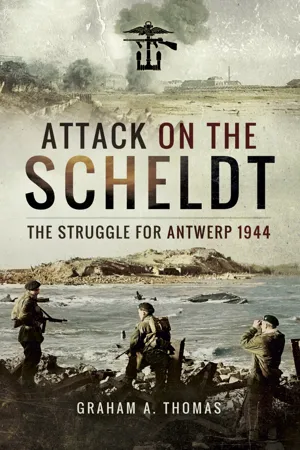
During the Allied advance across northwest Europe in 1944, the opening up of the key port of Antwerp was a pivotal event, yet it has been neglected in histories of the conflict. The battles in Normandy and on the German frontier have been studied often and in detail, while the fight for the Scheldt estuary, Walcheren and Antwerp itself has been treated as a sideshow. Graham Thomass timely and graphic account underlines the importance of this aspect of the Allied campaign and offers a fascinating insight into a complex combined-arms operation late in the Second World War. Using operational reports and vivid first-hand eyewitness testimony, he takes the reader alongside 21 Army Group as it cleared the Channel ports of Calais, Boulogne and Dunkirk, then moved on to attack the Scheldt and the island stronghold of Walcheren. Overcoming entrenched German resistance there was essential to the whole operation, and it is the climax of his absorbing narrative.
Information
Part 1
First Moves
Chapter 1
Clash of the Titans
The Allies captured the huge port of Antwerp on 4 September 1944. Surprisingly, when the 11th Armoured Division rolled in the port facilities were intact. Yet, instead of getting the vital port up and running as soon as possible, which meant clearing the Scheldt Estuary of the entrenched enemy positions, it took the Allies eighty-five days before the first convoy sailed into the port of Antwerp and began unloading supplies vital to the Allied march into Germany.
Why it took so long is a subject that has been, and likely will be, controversial. That Field Marshal Montgomery prevaricated on mounting operations to clear the Scheldt has been well documented by historians and scholars. The key reasons come down to the personalities of the three main Allied commanders, Field Marshal Montgomery, US General George Patton and Supreme Allied Commander General Eisenhower.
Antwerp was the second largest port in Europe and ‘the only port equipped to sustain an army of two million men’.1 Indeed, the number of men under arms for the Allies doubled by the time the Rhine was reached. Antwerp was the only port suitable for sustaining such an enormous army. Antwerp was the gateway to victory, the key that turned the lock and opened the door for the Allied advance to Berlin. It meant that the route across the northern plain of Germany was now open to the Allies with all roads ultimately leading to Berlin.
Before the 11th Armoured Division arrived in Antwerp the Belgian Resistance forces had fought to protect the port facilities from the retreating Germans and the damage they would have caused. In complete disarray and panic, the German forces could have been mopped up quickly, their only escape route cut off. But this was not to be.
The German Fifteenth Army, under the command of General Gustav von Zangen, quickly regained its balance and conducted an orderly withdrawal. In its wake it left behind well-armed and trained garrisons to defend the Channel ports. In order to guard the approaches to the southern bank of the Scheldt the Germans set up a near impregnable line of defence along the Leopold Canal. To defend the entry into the South Beveland isthmus, von Zangen concentrated a large force in the area of Woensdrecht. On 6 September, the bulk of von Zangen’s army began an orderly withdrawal north from Breskens, across the Scheldt Estuary to Flushing on Walcheren Island.
Despite constant air attacks by the Allies, von Zangen managed to withdraw 80,000 men, 600 guns and all their vehicles in just 2 weeks.2 Von Zangen was able to achieve this successful retreat by day under the protection of the powerful artillery guns already embedded in concrete emplacements along the dykes on Walcheren and South Beveland. To avoid air attack, he continued the bulk of the withdrawal by night.
While the Germans escaped destruction and disaster, their withdrawal was very costly for the Allies. From 6 September 1944 to the German surrender on Walcheren Island on 28 November the total number of casualties, killed and wounded, amounted to more than 60,000, with over half of them being British and Canadian.3
The battle to clear the Scheldt was one of the worst the Allies had fought. For a start the weather was foul. It was a bitter ‘winter deathtrap of the Dutch polder lands by men exposed not only to the weather but the direct fire of the enemy’.4 This was especially true on Walcheren Island where much of the battles were fought in the oozing mud that clogged vehicles, tank tracks and made advancing extremely difficult.
At this point it should be emphasised that Walcheren Island, guarding the mouth of the Scheldt Estuary, bristled with some of the most powerful and heavily concentrated gun emplacements in existence. Against this island fortress, the Allies launched an amphibious assault by 4 Commando Brigade.
Eisenhower became Supreme Allied Commander of the Supreme Headquarters Allied Expeditionary Force (SHAEF) in January 1944. He took over as Supreme Commander in the field from Montgomery on 1 September and his first priority was to capture Antwerp and clear the Scheldt Estuary.
His first struggles, however, were with Allied leaders and officers on matters vital to the success of the Normandy invasion; he argued with Roosevelt over an essential agreement with de Gaulle to use French resistance forces in covert and sabotage operations against the Germans in advance of Overlord. Admiral Ernest J. King fought with Eisenhower over King’s refusal to provide additional landing craft from the Pacific. He also insisted that the British give him exclusive command over all strategic air forces to facilitate Overlord, to the point of threatening to resign unless Churchill relented, as he did. Eisenhower then designed a bombing plan in France in advance of Overlord and argued with Churchill over the latter’s concern with civilian casualties; de Gaulle interjected that the casualties were justified in shedding the yoke of the Germans, and Eisenhower prevailed. He also had to skillfully manage to retain the services of the unruly George S. Patton.5
The urgency for this operation was sparked by the June gales that hit the Normandy beaches on 19 June, lasting four days and destroying the Mulberry harbour and the installations on the beaches. A better, more permanent solution needed to be found that would enable the Allies to land men and materiel on a continuous basis in order to supply the mainland armies. This steady flow of troops and materiel was kept going through ingenuity and hard work. However, in June the Allies were still very close to the beaches but by September they had pushed out by hundreds of miles. The supply lines grew longer and longer as the armies advanced and that meant the challenges of supplying and maintaining these armies became greater and greater. In September the gales struck again, adding to the difficulties of keeping the supply lines functioning. Antwerp had to be opened and opened soon.
However, six weeks after the actual port facilities at Antwerp had been captured a message was released by Headquarters 21st Army Group that the priority had changed and that the Army Group was going to head west to clear the Scheldt and get the port up and running. Yet, this announcement, issued on 18 October, was little more than hot air as much of the British Second Army was facing east and operationally committed elsewhere. It was the First Canadian Army that began operations to clear the Schedlt which ultimately led to the surrender by the Germans on Walcheren Island. But it would be a long and bloody slog that the Allies would pay dearly for and that could have been avoided.
In part, the slowdown along the front facing Germany was due to my decision to employ our greatest strength in the north to attain flanking bridgeheads across the lower Rhine beyond the main fortifications of the Siegfried Line. In view of the fact, however, that the main highway to Berlin, the plains and level fields of Northern Germany – lay beyond the Rhine in the north, and that the southern country was unsuitable for the desired rapid advance and continued exploitation by reason of its mountainous and forested terrain, my commanders and I were in full agreement as to the desirability of exerting our strongest pressure in the north. The attractive possibility of quickly turning the German north flank led me to approve the temporary delay in freeing the vital port of Antwerp, the seaward approaches to which were still in German hands.6
Before detailing Allied operations on Walcheren it is worth looking at what lead up to the decision to finally clear the Scheldt of enemy positions. For example, why did the Allies take so long in making that decision when they had already captured Antwerp?
First of all it is necessary to examine the period between August and September 1944 when the German armies in the Normandy sector were on the brink of total collapse. Allied commanders saw an opportunity to, what they thought would, end the war by Christmas by smashing through the disintegrating German defences and racing across France into Germany and straight to Berlin. Of course, these grandiose ideas did not take into account the logistical problems such quick thrusts would cause. ‘It was a time when Army Group and army Commanders needed to have their feet firmly on the ground as never before.’7
The quickest way to end the German war was not merely to have the free use of Antwerp, as some have alleged. It was to act quickly in the middle of August, using the success gained in Normandy as a springboard for a hard blow which would finish off the Germans and at the same time give us the ports we needed on the northern flank.8
Allied planners had calculated that the end of the European war would come on 1 June 1945. In fact, the ceasefire was three weeks earlier, on 6 May 1945. Most of the objectives formulated under Operation Overlord were reached before their planned-for date had arrived. For example, the Allies reached the Seine on 20 August 1944 – that’s D+75 days when it had been planned that the Allies would reach it in D+90 days, D-Day being 6 June 1944. What this means is that the Allies did not, and could not, have planned for the collapse of the German armies in Normandy. Instead of fighting an organised and determined enemy through France the Allies found themselves in mid-August confronting a situation for which they were wholly unprepared.
Faced with the collapsing enemy defences, Montgomery telegraphed the War Office with a bold plan. The telegram he sent on 18 August stated that the ‘U.S Twelfth and British Twenty-First Army Groups should stay together as a solid mass of forty divisions’ that would have massive firepower and be capable of sweeping aside anything that Hitler could throw in its path.9 Montgomery believed that a quick march directly to Berlin with such a huge force would end the European war quickly.
However, the plan was flawed. Montgomery pushed it onto Eisenhower on 19 August, but things were moving so quickly on the front lines that his plan became obsolete. What was missing was the strategic integrity and logistical understanding. To make matters worse a rivalry was growing between the Americans and British, specifically US General Patton’s Third Army and British General Dempsey’s Second Army.
The fast-moving events on the front line derailed Montgomery’s proposals. For example, the destruction of the German armies in the Mortain–Falaise gap was complete by 20 August. Patton’s Third Army was racing across France and the speed with which the Allied armies were moving meant they were using 1 million gallons of petrol per day.10 An astonishing figure! At the same time, in Paris, the resistance fighters mounted a fresh offensive against their oppressors that ultimately meant that the Allies would have to divert an army to liberate the city. The significance of this was not lost on the Allies. Liberating Paris meant feeding and supplying Paris as well as tying down an entire army to do so. Something Eisenhower as Supreme Commander did not want to do.11 Indeed, it was estimated by Supreme Headquarters Allied Expeditionary Force (SHAEF) planners that Paris would need 4,000 tons of supplies a day, which, according to historian Gerald Rawling, was more than enough to keep seven divisions rolling.12
The reason for this is that supplies were extremely limited. The armies were basically forging ahead faster than they could be supplied. The roads from the Normandy beaches were battered and potholed. The logistics chain was stretched to the limit and what petrol was available was funnelled forward to the advancing armies. Indeed, in Normandy entire corps and divisions not involved in the convoys for supplying the forward armies were left standing still for want of transport and gasoline. Day and night the American Red Ball convoys drove the 350 miles from the Normandy beaches over the rough roads that had been torn and ripped from the thousands of tanks and armoured vehicles that used it on the way to the front lines.
In the end, the decision to bypass Paris was, ultimately, out of Eisenhower’s hands. He had vowed not to bring politics into military decisionmaking but in this instance the decision to take Paris was a political one and could not be ignored. Eisenhower had many balls in the air and was constantly juggling the needs and desires of his subordinates, Montgomery in particular, as well as politicians such as Churchill and Rooseveldt, and many others, especially, in this case, Charles de Gaule, ‘who was not prepared to see Paris by-passed by Allied troops and then subsequently liberated by a Communistled resistance movement which would be unsympathetic to a Gaulist regime after the war’.13 So, on 25 August 1944, Paris was taken by the Allies; and while British and American troops liberated the city, other Allied divisions raced on.
A lighting strike into the heart of Germany would mean a quick end to the European war as well as glory for the Allied commander that achieved it. This was Montgomery’s idea but he also knew that for this to take place it would have to be at the expense of all the other Allied armies advancing towards Germany and ultimately Berlin. General George S. Patton, commanding the US Third Army, was the one commander in the position to be able to do this and ‘unless Montgomery could have Patton’s army grounded his own hopes were in vain’.14 ‘The way Allied armour was tearing across northern France towards Belgium, Luxembourg and Lorraine, any other course, in the circumstances, would doubtless have been regarded as total madness.’15 The visions of an end to the European war in the autumn of 1944 were just that, visions. The only way, according to R.W. Thompson writing in Eighty-Five Days, was for the port facilities at Antwerp to be captured and put into use as qui...
Table of contents
- Cover
- Title
- Copyright
- Contents
- Author’s Note
- Maps
- Part 1 – First Moves
- Part 2 – Operation Switchback
- Part 3 – Operation Infatuate
- Appendix 1 The Air Campaign Against Walcheren
- Appendix 2 First Canadian Army/84 Group RAF Operation Infatuate Target Schedule
- Plate section
Trusted by 375,005 students
Access to over 1.5 million titles for a fair monthly price.
Study more efficiently using our study tools.
Frequently asked questions
Yes, you can cancel anytime from the Subscription tab in your account settings on the Perlego website. Your subscription will stay active until the end of your current billing period. Learn how to cancel your subscription
No, books cannot be downloaded as external files, such as PDFs, for use outside of Perlego. However, you can download books within the Perlego app for offline reading on mobile or tablet. Learn how to download books offline
We are an online textbook subscription service, where you can get access to an entire online library for less than the price of a single book per month. With over 1.5 million books across 990+ topics, we’ve got you covered! Learn about our mission
Look out for the read-aloud symbol on your next book to see if you can listen to it. The read-aloud tool reads text aloud for you, highlighting the text as it is being read. You can pause it, speed it up and slow it down. Learn more about Read Aloud
Yes! You can use the Perlego app on both iOS and Android devices to read anytime, anywhere — even offline. Perfect for commutes or when you’re on the go.
Please note we cannot support devices running on iOS 13 and Android 7 or earlier. Learn more about using the app
Please note we cannot support devices running on iOS 13 and Android 7 or earlier. Learn more about using the app
Yes, you can access Attack on the Scheldt by Graham A. Thomas in PDF and/or ePUB format, as well as other popular books in History & Military Biographies. We have over 1.5 million books available in our catalogue for you to explore.