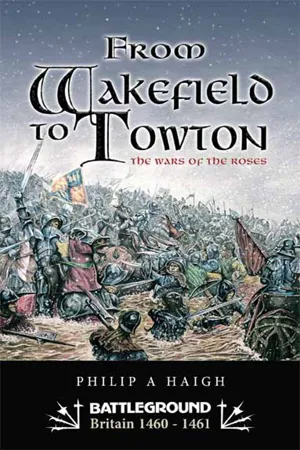
- 176 pages
- English
- ePUB (mobile friendly)
- Available on iOS & Android
eBook - ePub
About this book
The Wars of the Roses was a complicated, bloody affair between the houses of Lancaster and York, and witnessed much changing of sides. That disjointed feuding persisted for a staggering thirty years and was a north versus south affair. However, the period and conflicts covered by this title are refreshingly clear. An intriguing tale of treachery and deceit.
Information
CONTENTS
Introduction
Acknowledgements
Chapter 1Origins of the Wars of the Roses
Chapter 2The 1460 Campaign
Chapter 3The Battle of Wakefield
Chapter 4The 1461 Campaign
Chapter 5The Battle of Ferrybridge
Chapter 6The Battle of Towton
Chapter 7Wakefield, Ferrybridge, Towton History Trail
Chapter Notes
Sources and References
Appendix I Burial of Richard Duke of York
Appendix II Recruiting
Museums and Societies
Index
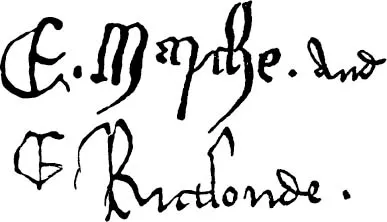
Signatures of the two brothers, Edward Earl of March and Edmund Earl of Rutland, in a letter to their father, Richard Duke of York. There was just over a year difference in their ages, and they were very close. The youngest, Edmund, aged seventeen was murdered at Wakefield Bridge following the Battle of Wakefield in which their father, the Duke of York, was slain in 1460. Edward avenged their deaths at the Battle of Towton just three months later.
Introduction
When I was asked to complete this work, I considered carefully the fact that instinctively, when people think of Yorkshire and the Wars of the Roses, they think only of the battle of Towton. Scarcely given a second thought, are the smaller, but no less interesting – and in some cases significant – battles at Wakefield and Ferrybridge.
To overcome the fact that the Wars of the Roses in Yorkshire contained not only the battle of Towton, but these other engagements too, then this work was written. It explores each in turn and allows the reader to explore yesterdays battlefields today – with the aid of a ‘tour’ – using modern day roads and footpaths. As always, in order to describe the military aspects of the Wars of the Roses, you must first tackle the events that led up to and resulted from them – and indeed their long term consequences. The reader should therefore be aware, that this is a work about military history and that therein lies the focus of this work, not the political intrigue that surrounded the battles themsleves.
Consequently, the history of the wars – and the events between each engagement – are left intentionally brief, to ensure that the military aspects of the Wars of the Roses in Yorkshire are covered in detail. However, for those who wish to have a more detailed knowledge of these political events, then there are many references to other works throughout this one, that will direct such students of history to the relevant places to find the information they require. On the subject of other works, I would like the reader to be aware that I’m not a believer in reinventing the wheel, and in writing this work, I have reviewed, as far as I am aware, much if not all of the documentation available on the actual battles and the battlefields themselves. In many instances throughout, I have, as in previous works, quoted from the authors of other books and journals, both contemporary, near contemporary and modern day, in the completion of my own. I make no apology for this, as many of these earlier writers, were, and still are, specialists in their own field, and as such, they are more qualified than I to make an assessment of a particular aspect from the battles detailed in this work. Therefore, it would be wrong for me to try and compete with them, and even more remiss of me to take their work and words as my own.
Finally, I would like to share with you the fact that it has always been my desire to see an all embracing series of works on the subject of the military aspects of the Wars of the Roses. As such, it is my hope that this work will be followed by several others, written in the same format, that will allow the many thousands of people interested in war and the Wars of the Roses, to walk all the battlefields from this period of our history sufficiently armed with information to discover today, who did what, where and when, yesterday – and more importantly why.
Acknowledgements
I would like to thank the following people for their help and support in bringing this work to its conclusion. First and foremost my wife Sarah and my children Lewis and Charlotte – once again I’m indebted for their patience and understanding. The staff of both Leeds and Wakefield Libraries, for supplying many previously produced, but out of print articles and works regarding the battles of Wakefield, Ferrybridge and Towton – I never cease to be amazed by their patience, knowledge and willingness to help. In regard to this, I would particularly like to thank Ms Jennifer Horne of Leeds Library, without whose efforts, on my behalf, much of the supporting documentation required to produce this work would have been very difficult and certainly time consuming to find.I would also like to thank my fellow historians, Andrew Boardman, Dave Cooke and Graham Bell, for enlightening me to some facts hitherto unknown to me regarding the battles of Wakefield, Ferrybridge and Towton. On that latter note, I would also like to thank Geoffrey Wheeler for his kindly help regarding the content of this work and for the illustrations in this finished book. Photographs supplied by Geoff are marked GW.Also, Christie’s of London, in particular Mr David Williams, for supplying the photograph of the ‘Wakefield Sword’ and granting permission for its use in this work. I would also like to thank my friends and colleagues – particularly those who have had to suffer my many battlefield analogies during the time we have spent together – for their on-going support in particlulary Kevin Shenton, Deborah-Jane Higginson, Michael Fellows, Lee Thornton and Mo Asif – who has been especially supportive through what has been a difficult period of my life – thank you Mo.Philip A. Haigh
Series Designer’s acknowledgements
With over sixty titles in the Battleground series of guide books covering conflicts in France, Belgium, Holland, Turkey, South Africa, and the United States of America, the time has arrived for us to apply the successful formula to the battlefields of Britain. From Wakefield to Towton by Philip Haigh is the first title in the Battleground Britain sub series. This particular subject was chosen to launch the series because of the fascinating aspects in this account of The Wars of the Roses. Usually regarded as a complicated, bloody affair between the houses of Lancaster and York lasting some thirty years and which witnessed much changing of sides, the events bracketed by Christmas 1460 (Wakefield) and Palm Sunday 1461 (Towton), are refreshingly clear. A manipulative woman married to a weak King – Henry VI – representing the House of Lancaster and pitted against a seemingly decent chap, the Duke of York; battles, betrayals, pitiless murder, beheading, ridicule and disgrace, revenge and the crowning of a Yorkist king – Edward IV. Surely, this is an interesting period in the history of England with which to begin the new series.
In directing this work I have been assisted by the following organisations and individuals: Pam Judkins, Keeper of Archaeology, Wakefield; Steve Coulson, Pontefract Castle; Kate Taylor, Wakefield Historical Publications; Christine Varney, Conisbrough Castle; Maurice Hepworth, Barnsley Libraries Archives and Local Studies. Also members of the Towton Battlefield Society and members of The Retinue of Sir Thomas Stanley. Special thanks must go to Ken Everitt for his active support of this project and his phenomenal knowledge of this period in our history.
Roni Wilkinson (November 2001)
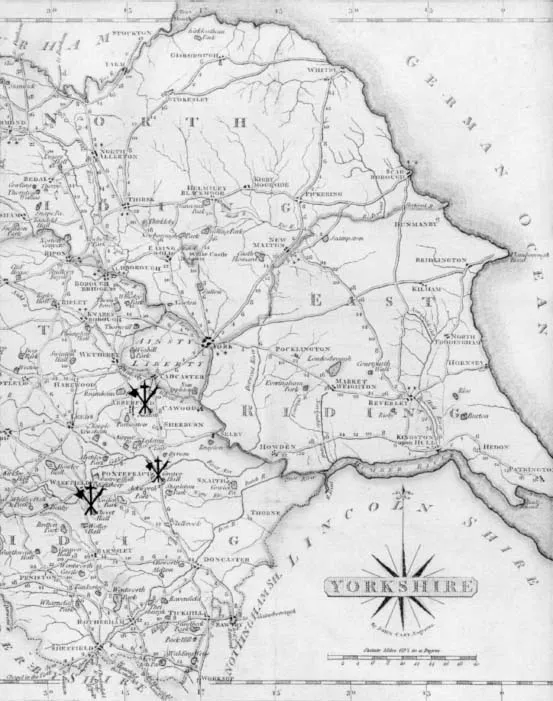
Locations of the the battles fought in Yorkshire between Christmas week 1460 (Wakefield) and March 29, Palm Sunday 1461 (Towton), by the Houses of Lancaster and York. The antagonists being the reigning monarch, King Henry VI and Queen Margaret for the House of Lancaster, and Richard Duke of York (who was killed at Wakefield) and King Edward IV (acclaimed king in March, 1461) for the House of York.
Chapter One
The Origins of the Wars of the Roses
Family feuding
ON THE MORNING of 3 March 1452, at Blackheath, near London, two armed forces faced each other prepared to commence battle, a battle which would have been – had it not been averted – the first engagement in what would, in later years, become known as the Wars of the Roses. This entire encounter was recorded in the London Chronicle and is reported as follows:
‘The 30th year of King Henry the Sixth. This year on Wednesday the 16th day of February the king with the lords rode towards the Duke of York for to take him, because he raised people to come down and take the Duke of Somerset; but when the Duke of York heard here of, he took another way and so came towards London. And also soon the king heard here of, he sent letters to the mayor, alderman and commons of London, on St Mathies’ day, that they should keep the city and suffer not the Duke of York to come therein; wherefore was made great watch in the city, the which was told the Duke of York, wherefore he left London way and went over Kingston Bridge. An...
Table of contents
- Cover
- Half Title
- Series Authors
- Title
- Copyright
- Contents
Trusted by 375,005 students
Access to over 1.5 million titles for a fair monthly price.
Study more efficiently using our study tools.
Frequently asked questions
Yes, you can cancel anytime from the Subscription tab in your account settings on the Perlego website. Your subscription will stay active until the end of your current billing period. Learn how to cancel your subscription
No, books cannot be downloaded as external files, such as PDFs, for use outside of Perlego. However, you can download books within the Perlego app for offline reading on mobile or tablet. Learn how to download books offline
Perlego offers two plans: Essential and Complete
- Essential is ideal for learners and professionals who enjoy exploring a wide range of subjects. Access the Essential Library with 800,000+ trusted titles and best-sellers across business, personal growth, and the humanities. Includes unlimited reading time and Standard Read Aloud voice.
- Complete: Perfect for advanced learners and researchers needing full, unrestricted access. Unlock 1.5M+ books across hundreds of subjects, including academic and specialized titles. The Complete Plan also includes advanced features like Premium Read Aloud and Research Assistant.
We are an online textbook subscription service, where you can get access to an entire online library for less than the price of a single book per month. With over 1.5 million books across 990+ topics, we’ve got you covered! Learn about our mission
Look out for the read-aloud symbol on your next book to see if you can listen to it. The read-aloud tool reads text aloud for you, highlighting the text as it is being read. You can pause it, speed it up and slow it down. Learn more about Read Aloud
Yes! You can use the Perlego app on both iOS and Android devices to read anytime, anywhere — even offline. Perfect for commutes or when you’re on the go.
Please note we cannot support devices running on iOS 13 and Android 7 or earlier. Learn more about using the app
Please note we cannot support devices running on iOS 13 and Android 7 or earlier. Learn more about using the app
Yes, you can access From Wakefield to Towton by Philip Haigh in PDF and/or ePUB format, as well as other popular books in History & Ancient History. We have over 1.5 million books available in our catalogue for you to explore.