Third in the trilogy of the ancient Greek dynasty. "In Grainger's account, the fall of the Seleukid is as enlightening as the rise."—Minerva Magazine
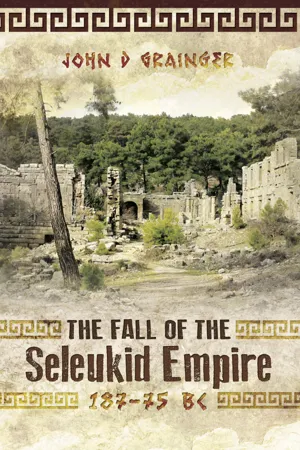
The concluding part of John D Grainger's history of the Seleukids traces the tumultuous last century of their empire. In this period, it was riven by dynastic disputes, secessions and rebellions, the religiously inspired insurrection of the Jewish Maccabees, civil war and external invasion from Egypt in the West and the Parthians in the East. By the 80s BC, the empire was disintegrating, internally fractured and squeezed by the converging expansionist powers of Rome and Parthia. This is a fittingly, dramatic and colorful conclusion to John Grainger's masterful account of this once-mighty empire.
"To get the best from
The Fall of the Seleukid it would be worthwhile making sure you've absorbed the first two volumes. Nonetheless you can enjoy and learn from this book alone. Like the fall of any other empire or the folly of human behavior—the story is compelling."—UNRV
"Grainger does a good job of producing a convincing narrative using the limited sources."—HistoryOfWar
- 240 pages
- English
- ePUB (mobile friendly)
- Available on iOS & Android
eBook - ePub
The Fall of the Seleukid Empire, 187–75 BC
About this book
Information
Topic
HistoriaSubtopic
Historia de la antigua GreciaChapter 1
The Beginning of the End (187–170 BC)
The kingdom which King Seleukos IV inherited on the death of his father in Iran in mid-187 was large, wealthy, and powerful. It was, however, faced with major problems. The death of Antiochos III cannot have been altogether a surprise, though no doubt it was unexpected, and after a long reign, a shock: he had been king for thirty-five years, longer than any other king of his dynasty; he was relatively old at fifty-six for his time, while he repeatedly exposed himself to danger in war. His death occurred in the process of attempting to seize a treasure from a temple in Elymais, an action to which the local people quite reasonably objected.
He died in the middle of an expedition into the eastern parts of his kingdom, where a delicate diplomatic arrangement he had made twenty years before had recently broken down. The kingdoms of the Parthians and the Baktrians had recently acquired new kings, and so they were no longer tied by diplomatic treaties to Antiochos. His purpose in marching to the east was, it may be conjectured, to restore the situation by making a new arrangement with the new kings. The treaties of peace which he wanted to renew with the new kings had lasted only until the death of one of the parties, and the deaths of Euthydemos I of Baktria about 200 BC, and of Arsakes II of the Parthians about 190 BC were the triggers for the new expedition.
The death of Antiochos himself had also ended the peace treaties with several western powers. The peace of Raphia with Ptolemaic Egypt, agreed in 195 and ratified by the marriage of Antiochos’ daughter Kleopatra to Ptolemy V would probably hold, since Ptolemy was fully occupied in combatting a major rebellion within Egypt. (The marriage did not constitute a political alliance: no such arrangement in the Hellenistic international system maintained peace.) There was also a peace treaty with the Attalid kingdom in Asia Minor, which was now also ended, though King Eumenes II was, like Ptolemy, hardly going to use the freedom from the treaty to attack the Seleukid kingdom, since he was fully occupied in ensuring his control over the territories he had recently been awarded, at Antiochos’ expense, within Asia Minor. His neighbours in Bithynia to his north and Kappadokia to the east were unhappy at Eumenes’ sudden growth in power; Eumenes was in fact at war more or less continuously between 187 and 179.
But the main peace treaty which came to an end with Antiochos’ death was that with the Roman Republic. This was a power which had, during Antiochos’ lifetime, expanded from controlling peninsular Italy to holding all the western Mediterranean lands and dominating Greece and Macedonia. It had defeated in succession three rival great powers, Carthage, Macedon, and Antiochos III himself. By 187 the Romans were the superpower of the Mediterranean political system, more powerful than any single state within range, and probably more powerful than any combination of its rivals. The republic’s failure to expand its direct control east of the Adriatic Sea was no doubt puzzling to contemporaries, but also relieving, and was probably due to the frontier problems in Spain and Italy. The military reach of the Roman army was in fact limited: the expedition against Antiochos had required some delicate diplomacy in Greece to allow its forces to move further east, which might not be possible again – and the Seleukid kingdom was now even more remote than before. These rivals were all able to relax their vigilance as a result of Roman forbearance, at least for the time being, but the spectre of Rome certainly hovered over all of them.
This was, from the new king’s point of view, an encouraging vista, but the present inability of his neighbours to launch an attack on his kingdom would not necessarily last very long. Above all, once Ptolemy V put down the Egyptian rebellion he would be free to attempt to recover Palestine and Phoenicia – Koile Syria – from Seleukid control – and by 187 the rebellion was almost finished. Seleukos had to be vigilant.
Seleukos IV had been made joint king along with Antiochos III several years earlier (on the death of his elder brother), and was a well experienced commander and ruler.1 However, as the preceding paragraphs will have suggested, he faced a difficult situation on his accession to sole rule. The complex web of peace agreements his father had constructed had fallen apart as soon as the news of his death spread. This had one advantage, in that the restrictive and expensive clauses of the Roman treaty – payment of 12,000 talents of silver over ten years, abandonment of a navy and of the war elephants – were no longer applicable and so not a drain on resources. On the other hand, suddenly every neighbour – Egypt, the Attalids, Rome, Parthia, Baktria – was at least potentially hostile.
The major change was in the west. It was quite possible that Rome would act to enforce the terms of the treaty with Antiochos III. The Senate had twice in the last half-century declared war on Carthage, or rejected a negotiated treaty, in order to obtain better terms, and demanding that Seleukos negotiate a new agreement would be much the same. As it turned out, on this occasion the Senate apparently did nothing. It is possible that Seleukos paid some of the instalments – Antiochos will have paid one or two by the time he died, plus the initial 2,500 talents indemnity in 189, but by the end of Seleukos’ reign, by which time all should have been paid according to the treaty, he was well in arrears. (If Antiochos had paid two instalments, each would have been 1,200 talents; with the indemnity, Rome would already have received almost 5,000 talents – perhaps this was enough to be going on with.) One hold the Romans had on Seleukos was that his brother Antiochos was held in Rome as a guarantee of payment, though it is unlikely that this consideration weighed very heavily with Seleukos – and such a hostage was hardly useable in any real sense.
Elsewhere in the west the Egyptian rebellion was brought to an end in 186–185 with the defeat of the dissident pharaonic state in the south, and the capture of the pharaoh, and with the final suppression of the concurrent rebellion in the Delta, followed by a decree of amnesty.2 But the rebellion had caused much damage to the country, and King Ptolemy V was a cautious man. He was urged by some of his courtiers to initiate a revenge Syrian war to recover the Palestinian and Phoenician lands lost to Antiochos in the last Syrian war, but he resisted such pressure. Nevertheless Seleukos was clearly under threat from both Rome and Egypt, neither of whom would bother to reassure him, and as a result he was unable to move far from Syria, which is where any attack would arrive.
The situation in the east was as unstable as in the west, but rather less directly threatening. The new King Demetrios I of Baktria had turned his attention to India, by which we may understand that land’s north-western borderlands and the upper Indus Valley. A king called Sophagasenos had ruled in the Paropamisadai in Antiochos III’s time and had been one of those with whom Antiochos had a treaty. It seems likely that either he was dead by the 190s or that Demetrios had used the freedom of manoeuvre which his father had lacked (because of the treaty) to seize Sophagasnos’ kingdom. From there he was able to move into India.
This move into India meant that the aggressive Demetrios may have been seen as only a minor threat by Seleukos IV. We do not know what contacts there were between the two men, but it is possible that they came to some agreement, though even so Demetrios himself died in about 185. If they had made contact this would restrict the possible activities of the new Parthian king, Phriapatios, who succeeded his father at about the time of Demetrios’ death. Parthia was boxed in on the west by the Seleukid kingdom and on the east by the Baktrians, and both of these were more powerful states than the one he ruled. Phriapatios remained quiet, so far as we can see, for his whole reign. On the other hand he did adopt the title of King, the first of his dynasty to do so, according to his coins.3 This may have implied that he had achieved some notable military victory, for this was the usual necessary preliminary to such a claim, though who he fought is not known.
There was real trouble in Susiana, or perhaps in Elymais, which was where Antiochos had been killed. A fragmentary record dated to 183 notes that the Governor of Susa was involved in some way with enemies.4 There is no more information in the note than this bare fact but it was surely part of the aftermath of Antiochos’ attempted raid on the temple in Elymais. Trouble of some sort was very likely to reverberate locally for a long time, especially since the king had been defeated and killed. Local pride was considerably boosted by such a victory.
Internationally, therefore, Seleukos seemed to be trapped, but not under immediate threat. He was unable to move to the east, as his father had begun to do, because of the latent threat in the west, though it may well be that he made contact with the Baktrian king – though Demetrios’ early death will have meant that any treaty made with him would have to be renegotiated with his successor. Demetrios’ move against India had been relieving to the Seleukid king, even if it was unpleasant for the Indians. In the west Seleukos was faced with hostility from the Romans and Egypt which immobilized him. Only, as it turned out, in Asia Minor did he have some room for manoeuvre.
The threat to be apprehended was military, though it would probably be preceded by hostile diplomacy. The hostility of Ptolemy V could be taken as read, but a straight military contest with Egypt was unlikely to result in defeat – unless Egypt was assisted by another, and equally hostile, power. In this the continuing association of the Attalid kingdom with Rome was the main Seleukid problem, since simultaneous attacks from south and north would be militarily disastrous. The Seleukid military power was not great enough to withstand such an assault, when combined with the need to stand on guard in the east, and to garrison the many provinces. That is, the Seleukid kingdom was militarily overstretched (as it always had been). The solution was to remain quiet, provoking no one, or to be assertive and see off one enemy at a time. Seleukos chose the first option, having seen his aggressive father suffer ultimate defeat.
This does not mean, however, that Seleukos did nothing. It was incumbent on him from the moment he succeeded as sole king, to be active diplomatically wherever possible in order to secure his kingdom by deflecting any political enemies. As early as 187, and so in the second part of the year (for Antiochos III died in June) he sent an embassy to meet the Achaian assembly with an offer of ten warships and a request for either an alliance or at least a statement of friendship. Polybios says it was to be ‘a renewal of alliance’, but there is no evidence of any earlier alliance so it was perhaps a renewal of the peace, for Antiochos and the Achaian League had been on opposing sides in Antiochos’ war with Rome, and therefore they will have made peace at the time of Antiochos’ treaty with Rome in 188.
The Achaians, wary of gifts from kings who were at enmity with Rome, accepted the renewal of the treaty, but refused the ships.5 Seleukos may thus be said to have achieved a useful diplomatic success. Achaia was the most powerful single state in Greece, now that Aitolia had been crushed by Rome, and that Philip V of Macedon had been confined to his kingdom. On the other hand, Achaia’s actual power was minimal; the treaty was thus of little use in the power game, though useful in the less helpful area of public opinion. It also lined both states up against Eumenes of Pergamon, who had made the offer of a gift of the island of Aegina, and had also been rejected.
Seleukos’ envoys also visited Athens in 186, possibly the same men who had been to Achaia, possibly a separate embassy; but Athens was another useful place for influencing public opinion within Greece.6 The two embassies add up to a careful, perhaps insidious, diplomatic assault on the solidarity of the Roman position in Greece; Seleukos could also point out that he was no longer bound by the limitations of his father’s treaty with Rome.
A neglected aspect of this diplomatic campaign is the ten warships, and a consideration of what the offer meant will provide a way to discuss the actual enforcement, or otherwise, of the terms of the Treaty of Apamaea. In that treaty Antiochos III had been permitted to possess no more than ten triremes, and was to be prevented from sailing any of them west of Cape Sarpedon in Kilikia. It is evident that Antiochos had made no attempt to reduce his navy to the treaty level, and Seleukos quite openly offered some of the ships he had inherited to Achaia. He will scarcely have offered to give away his last ten ships, so it is all but certain that he had many more than that – and that they had been inherited from his father. That is, Antiochos III had made little or no effort to comply with the naval articles of the treaty, and it is therefore likely that other elements of the treaty had been similarly ignored – the prohibition on keeping war elephants, for example. Others of the provisions of the treaty were also never implemented – including the requirement to surrender five named individuals, at least two of whom were politically active in later years. It may also be pointed out that Rome made no attempt to oversee the implementation of the treaty. It is likely that the good sources of this period of Seleukos’ rule – Livy and much of Polybios – would have included any references to any embassies sent to check in Syria on the numbers of warships and elephants there, but there is nothing. Either Rome did not care, or it was understood that when Antiochos III died the treaty lapsed.
Eumenes of Pergamon was involved in a succession of wars in Asia Minor from 186 onwards, first fighting off an attack by King Prusias of Bithynia, then against King Pharnakes of Pontos. Neither of these kings really measured up to the Attalid kingdom in terms of military power, and it is likely that they were at least encouraged and possibly directly helped by allies. Prusias was the brother-in-law of Philip V of Macedon, who was a long-time enemy of the Attalid kings; Pharnakes was Seleukos’ uncle (the brother of his mother) and this may have contributed to Seleukos’ near-intervention on the Pontic side in the war.
The war was fought between 183 and c.179, and until the end it was going Pharnakes’ way. Eumenes three times asked for Roman help but only received ineffective visits by delegations of senators, all of which Pharnakes either ignored or rebuffed.7 It was therefore only after Eumenes realized that he would have to fight his own battles that he organized an army and took the offensive, in the end successfully defeating Pharnakes, whose pretensions subsided as a result.8 At some point in all this Seleukos gathered an army and marched it towards the Taurus passes, though he went no further than the approach march.
This episode is recorded only in undated items on Diodoros and Polybios.9 One of these refers to an offer to Seleukos by Pharnakes of 500 talents. Diodoros claims that Seleukos called off the expedition because he recalled the terms of his father’s Roman treaty. These have then been linked to suggest that Seleukos was bribed by Pharnakes to intervene, but then ‘lost his nerve’. The problem here is that Seleukos is regarded with general contempt by modern historians, who believe that he should have been much more active. A Seleukid king who was not on some campaign is derided as ‘lazy’ or ‘weak’.10 Yet when he actually takes some action he is accused of ‘losing his nerve’. It is better to investigate in more detail.
A less derogatory interpretation would accept that the 500 talents subsidy was intended to pay Seleukos’ expenses; if he took the bait and intervened actively in the war it is likely that Pharnakes would have won; the Attalid forces were not likely to withstand Seleukos’ army for long. But such an intervention by the Seleukid king would put Pharnakes under a serious obligation to his nephew, so he would not be likely to ask for such help until he was in a clear danger of defeat, and that was not until the last months of the war, either towards the end of 180 or early in 179.
It was in 179, in all probability, that Eumenes finally won his war, and imposed a peace treaty. The end was sudden, for Pharnakes had been fighting only weak opponents until then, and as soon as he was defeated his allies fell away. It is perhaps at this point that Seleukos’ expedition was called off. This was not because of the terms of his father’s treaty – which, apart from being inoperative after his death, did not say anything about military expeditions into Asia Minor – nor because he ‘lost his nerve’, but most likely because he found that Pharnakes, the man he was marching to help, had been so badly defeated that he had given up the struggle. It may be, in fact, that the difficulty of marching an army through the Taurus passes was one of the factors involved, for the passes were usually blocked by snow in the winter. (It may also be that the prospect of Seleukos intervening speeded up Eumenes’ own campaign, where Roman talks had failed to.) The peace which ended the war was made some time fairly early in 179, so it was likely that Eumenes will have known of Seleukos’ preparations and intentions, and so finally decided to fight in order to pre-empt a Seleukid march and intervention.
From 180 onwards major changes were under wa...
Table of contents
- Cover
- Title Page
- Copyright
- Contents
- Maps and Tables
- Introduction
- Chapter 1: The Beginning of the End (187–170 BC)
- Chapter 2: The Wars of Antiochos Epiphanes (170–164 BC)
- Chapter 3: The Advent of Demetrios I (164–159 BC)
- Chapter 4: The Problems of Demetrios I (160–150 BC)
- Chapter 5: The Destruction of Alexander Balas (150–145 BC)
- Chapter 6: The Travails of Demetrios II (145–138 BC)
- Chapter 7: The New Seleukid Kingdom (139–131 BC)
- Chapter 8: Defeat (131–129 BC)
- Chapter 9: Dynastic Conflict (129–121 BC)
- Chapter 10: The Kingdom Failing (121–108 BC)
- Chapter 11: Destruction in the South (108–96 BC)
- Chapter 12: Survival in the North (103–88 BC)
- Chapter 13: The End of the Seleukids (88–75 BC)
- Conclusion – The Seleukid Legacy
- Notes and References
- Abbreviations
- Bibliography
Trusted by 375,005 students
Access to over 1.5 million titles for a fair monthly price.
Study more efficiently using our study tools.
Frequently asked questions
Yes, you can cancel anytime from the Subscription tab in your account settings on the Perlego website. Your subscription will stay active until the end of your current billing period. Learn how to cancel your subscription
No, books cannot be downloaded as external files, such as PDFs, for use outside of Perlego. However, you can download books within the Perlego app for offline reading on mobile or tablet. Learn how to download books offline
Perlego offers two plans: Essential and Complete
- Essential is ideal for learners and professionals who enjoy exploring a wide range of subjects. Access the Essential Library with 800,000+ trusted titles and best-sellers across business, personal growth, and the humanities. Includes unlimited reading time and Standard Read Aloud voice.
- Complete: Perfect for advanced learners and researchers needing full, unrestricted access. Unlock 1.5M+ books across hundreds of subjects, including academic and specialized titles. The Complete Plan also includes advanced features like Premium Read Aloud and Research Assistant.
We are an online textbook subscription service, where you can get access to an entire online library for less than the price of a single book per month. With over 1.5 million books across 990+ topics, we’ve got you covered! Learn about our mission
Look out for the read-aloud symbol on your next book to see if you can listen to it. The read-aloud tool reads text aloud for you, highlighting the text as it is being read. You can pause it, speed it up and slow it down. Learn more about Read Aloud
Yes! You can use the Perlego app on both iOS and Android devices to read anytime, anywhere — even offline. Perfect for commutes or when you’re on the go.
Please note we cannot support devices running on iOS 13 and Android 7 or earlier. Learn more about using the app
Please note we cannot support devices running on iOS 13 and Android 7 or earlier. Learn more about using the app
Yes, you can access The Fall of the Seleukid Empire, 187–75 BC by John D. Grainger in PDF and/or ePUB format, as well as other popular books in Historia & Historia de la antigua Grecia. We have over 1.5 million books available in our catalogue for you to explore.