The author of
A Century of British Naval Aviation, 1909-2009 examines the losses and successes of the Royal Navy during World War Two.
On the declaration of war in 1939, the British Admiralty signaled all warships and naval bases "Total Germany, Total Germany."
It was fortunate that of Germany's three armed services, the
Kriegsmarine under Grosseradmiral Erich Raeder was the least well prepared. True, Admiral Karl Donitz's U-Boat force was to give the Allies many anxious times, but Hitler was never comfortable or competent in his handling of naval surface forces.
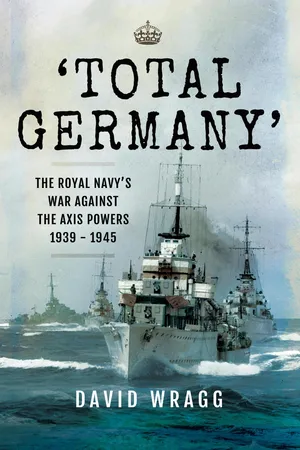
"Total Germany" is a concise yet comprehensive account of the Royal Navy's part in the war at sea and the measures taken to ensure victory. The different approaches taken by the warring countries are expertly examined. The author reviews the differing strategies and tactics of the various theatres such as the Far East, Mediterranean, Atlantic and Arctic.
"Not only does it cover every major event during WWII the author brings up some other less well known actions. A thoroughly enjoyable read."—Ton Class Association
- 272 pages
- English
- ePUB (mobile friendly)
- Available on iOS & Android
eBook - ePub
About this book
Trusted by 375,005 students
Access to over 1.5 million titles for a fair monthly price.
Study more efficiently using our study tools.
Information
Chapter 1
‘Total Germany. Total Germany.’
‘Total Germany. Total Germany.’ The message was short and succinct. It was also uncoded. It was the signal from the Admiralty in London to all warships, naval bases, fleets, flotillas and stations that war had broken out between the United Kingdom and Germany.
Communications are rarely secure. Some were not expected to be: they were public. That fateful morning of 3 September 1939, at 11.15, millions listened to British Prime Minister Neville Chamberlain when he broadcast to the British people telling them that the Anglo-French ultimatum to Germany demanding that she withdraw her forces from Poland had expired and that none of the assurances demanded from Germany had been received. He told them that this country was now at war with Germany. The signal sent out from the Admiralty was transmitted throughout the world. It was a simple message. The Germans picked up both the radio, or as it would have been known at the time, wireless broadcast, and the signal.
Immediately, the news was passed to the senior officers of the Germany navy, the Kriegsmarine or ‘War Navy’, as Adolf Hitler had renamed it in 1935, changing the title from Reichsmarine or ‘State Navy’, just over fourteen years after it had changed from Kaiserliche Marine or ‘Imperial Navy’.
Two of the recipients were Grossadmiral Erich Raeder, the chief of the Kriegsmarine, and his Führer der U-Boote, Admiral Karl Dönitz. The two men were not together at the time, but they were both at meetings. On reading the message, Raeder was so moved that he had to leave the room. Minutes later, Dönitz also received the message. Holding the signal in his hand he paced backwards and forwards, muttering to himself in consternation: ‘Mein Gott! Also wieder Krieg gegen England!’ (‘My God! So it’s war against England again!’). He too then left the room to compose his thoughts.
Later, Raeder noted in a memorandum that:
Today the war breaks out against England-France which, according to the Führer we need not have reckoned with before about 1944 and which until the last minute the Führer believed he should prevent… [the Kriegsmarine] could only show that it understood how to die with honour in order to create the foundations for later reconstruction.
Many in the United Kingdom listened to Chamberlain speaking over the radio with an air of resignation. Others were bitterly disappointed. Appeasement, in which the United Kingdom and France sacrificed the Czech Sudetenland in 1938 for another year of peace after tense negotiations with the German Chancellor Adolf Hitler at Munich, has since been criticized. Nevertheless, Mass Observation, which had started its polling of British public opinion in the late 1930s, found that appeasement was very much in tune with public attitudes. Those who remembered the First World War were prepared to pay almost any price to avoid another conflict.
Neither the United Kingdom nor Germany was in a position to fight in 1938. The UK put the extra year of peace to better use than did Germany, which was already having problems financing its massive expansion of the armed forces. Among the most important measures that the UK completed was the ‘Chain Home’ air defence radar network. Appeasement has frequently been misunderstood by later generations as there were other factors at work. Before going to Munich, Chamberlain had informed King George VI that he saw Great Britain and Germany as the two pillars in a defence against the spread of Russian Communism. Some today present Chamberlain as being sympathetic to the peace movement within the British establishment that would have collaborated with Nazi Germany, but his strenuous efforts to improve Britain’s defences indicate that this was not the case.
The Kriegsmarine in 1939
Why were these two senior German naval officers so concerned that war had broken out? After all, their country had gone to war against Poland, something which they knew about. Germany had also been asserting her rights, real or imagined, for a year or so before the invasion of Poland. The country had claimed the Czech Sudetenland on the grounds that its population were ethnic Germans; had annexed Austria; and finally taken the rest of Czechoslovakia. All this had been without much more than a murmur of protest from the British and the French.
The lack of protest was fundamental to the problem. In 1936, Britain and France had stood by while the Italians had ravaged Abyssinia (present-day Ethiopia), despite the United Kingdom preparing for war against Italy. The League of Nations had refused to act because of French reluctance to enter a war against Italy, even though the Abyssinian problem could have been brought under control by barring use of the Suez Canal to Italian shipping. The British had considered this, and had even prepared plans for an attack on the major Italian naval base of Taranto in the ‘instep’ of Italy, using aircraft from the Mediterranean Fleet’s aircraft carrier. Neither had the Western Powers done anything when Japan had invaded China.
Although the League of Nations had been proposed by an American president after the First World War, the United States was not a member. The League of Nations was toothless: in its entire existence, it did not intervene effectively and was never supported by its members. There was no such thing as a ‘League of Nations Peace-Keeping Force’, in contrast to a number of efforts by the United Nations in recent years.
In short, the Germans from Adolf Hitler downwards believed that they could invade Poland without any reaction from the United Kingdom or France. The secret Molotov-Ribbentrop Pact of August 1939 had meant that there would be no challenge from the Soviet Union, and in fact the Soviets would soon join the invasion, taking the eastern areas of Poland. The Germans also believed that they could once again argue their way out of trouble. The invasion of Poland was popular with many Germans, not all of them supporters of the Nazi regime, as it meant Germany regaining territory lost after the First World War when the boundaries of Poland and Russia both moved westwards.
This complacent view had led Hitler to assure his naval commanders that they could not expect a war with the United Kingdom until 1943 at the earliest, and more possibly 1944 or 1945. Raeder had been assured by Hitler that war with ‘England’, as they put it, was not imminent as recently as that fateful morning.
This was crucial to the Kriegsmarine. The German navy was not prepared for war, despite its aggressive-sounding title. Hitler had given priority to the creation of the Luftwaffe and the rebuilding of the German army. The Kriegsmarine had not been neglected completely, but it was still far short of what Raeder, and more especially Dönitz, wanted it to be. The planners had come up with a scheme for a navy that would be able to compete with the Royal Navy: this was known as ‘Plan X’, later replaced by ‘Plan Y’, which called for a stronger navy still, and next came ‘Plan Z’. When they first worked together, Raeder and Dönitz had much the same aims and aspirations for the Kriegsmarine, but Raeder doubted whether any future war would see the submarines – the famed and feared U-boats – playing an important role because of improvements in anti-submarine detection, known at the time as ASDIC. Dönitz disagreed strongly, and was able to modify Plan Z so that it called for a much-enhanced submarine arm.
The trouble was that this would take time. Plan Z would not be completed until 1944 at the earliest. Germany lacked the manpower, the materials and most of all the money to do better. Indeed, many believe that Plan Z was beyond the nation’s capabilities. While Germany was an advanced industrial nation able to match any other country in Europe in output, quality and innovation, it was also a country with few natural resources. The only fuel available was coal. The growth of the German war machine was such that even in 1939 the budget was stretched. Germany could afford only two out of three of her armed services and had spent all it could on both of them, leaving the navy at the end of the line. Raeder and Dönitz knew all of this, especially the former, who realized that Germany could not win a new war.
Ironically, this pessimistic outlook was shared by his counterpart in the Imperial Japanese Navy, although in his case, rather than considering the UK, it was the knowledge that Japan could not match the strength of the United States Navy or the industrial output of the United States.
The Italians had no need for such pessimism in 1939. Belatedly, the Italian dictator Benito Mussolini had made it clear to Adolf Hitler that Italy would not enter the Second World War in 1939. The new Spanish leader Franco knew that his country, still suffering from the effects of a bloody civil war, was unable to enter the war and could not endure the strains it would impose on a still-divided population. Across the other side of the world in the Far East, Japan was still preparing to go to war with the United States. In any event, once the war became global, Japan was too far distant for any joint operations with the Axis.
So in 1939, Germany was on her own.
Plan Z
Raeder believed that there was a danger of war between Germany and both the United Kingdom and France even before the Munich crisis of 1938. This possibility was not discussed officially. Nevertheless, the belief among senior German naval officers at the time was that any war would see the Kriegsmarine operating against British and French shipping rather than seeking a major fleet action as at Jutland, which had so concerned their predecessors during the First World War.
The German naval staff appreciated that the location of the British Isles hindered German access to the open sea, but the First World War had also shown that the UK’s strategic weakness was the country’s heavy dependence on overseas trade. The German position could be improved if Norway, Denmark, The Netherlands, Belgium and northern France as far south as Brest were to be occupied, giving unrestricted German access to the North Atlantic. The Luftwaffe would also benefit, being able to attack British convoys in the Atlantic including the Bay of Biscay and the Western Approaches, while British ports on the south coast from Dover to Plymouth, including the major naval base of Portsmouth and the major merchant port of Southampton, would also be exposed to attack from the air and from the sea.
Admiral Hellmuth Heye prepared a paper, ‘Seekriegführung gegen England’, ‘Sea Warfare against England’, on 25 October 1938. The paper was more interesting for what it did not say, and indeed it gave very little idea of how the war would be conducted at sea, but it was very dismissive of the potential for the U-boat. Like Raeder, Heye believed that British anti-submarine measures were so sophisticated that there would be little scope for submarine warfare. The one concession that he did make in giving the U-boat a role was the use of the ‘cruiser U-boat’. He envisaged a small fleet of large cruiser U-boats that would each have four 12.7cm (5in) guns and a high surface speed of 25 knots, which could engage British merchant shipping on the surface. Even so, the paper expressed concerns that once forced to dive, the slow speed of the submarine would mean that these large U-boats would be at the mercy of the Royal Navy’s anti-submarine measures.
Heye’s idea was similar to the concept of the cruiser submarine that had been the British M-class and the French Surcouf, but with lower-calibre weapons for the German boats. The cruiser U-boats would be positioned along the main convoy routes and close to major ports, but it was also felt that they would end up playing a sacrificial role because of the concentration of countermeasures at such locations.
The main thrust of the paper was that the Kriegsmarine should engage in commerce raiding using the Panzerschiffe (armoured ships) known to the British and American media as ‘pocket battleships’, later re-classified by the Germans as heavy cruisers. Each Panzerschiff would be escorted by light cruisers, while a squadron of powerful battleships would be necessary to enable the Panzerschiff to break out into the open seas. Heye also considered it necessary that the Kriegsmarine should have its own aircraft.
Raeder appointed the commander of the fleet, Admiral Carls, to head a planning committee. Carls was enthusiastic about the paper and was among the first to urge that the Kriegsmarine should begin planning for war. The naval staff had already drawn up a series of plans for the expansion of the service, starting with Plan X which was superseded by Plan Y, in turn superseded by Plan Z.
Plan Z was very much Raeder’s baby. It envisaged big battleships and aircraft carriers, armoured cruisers and many smaller vessels, including 249 U-boats. Finalized in late 1938, it was given Hitler’s approval in January 1939. Most of Plan Z would be completed by 1945, but the full plan would not be in place until 1947.
The initial plan called for no fewer than 4 aircraft carriers, although this was intended to rise to 8 later with the addition of some smaller ships; 6 large battleships, known as the H-class; 3 battle-cruisers, known as the O-class, later to be increased to 12; 12 P-class Panzerschiffe; 2 heavy cruisers; light cruisers and large destroyers; and 249 U-boats. Given the size of the projected fleet, and especially the number of major surface units including capital ships, it is surprising that there were intended to be only fifty-eight destroyers.
This was an ambitious plan, but Germany did not have the shipbuilding capacity to fulfil it and also lacked the necessary materials. The fuel that this vast fleet would consume exceeded the total fuel consumption of Germany in 1938. Germany was effectively rebuilding her new navy from scratch as there had been no sustained construction of major warships since the end of the First World War, so even the slipways were not available.
The first German aircraft carrier, the Graf Zeppelin, had been started in 1936 and she was launched in 1938, after which plans were made to begin work on a second ship, the Peter Strasser, although she was never started. Orders were placed in 1939 for carrier versions of the Messerschmitt Bf 109 fighter and the Junkers Ju 87 Stuka dive-bomber, designated as the Bf 109T and the Ju 87C. In the middle of that year, the two battleships Bismarck and Tirpitz were both launched and the keels laid for the first three of the H-class battleships.
Despite Hitler’s approval for Plan Z, the Minister for Air, Hermann Göring, refused to allow the navy to have its own aviation, despite the British having recognized belatedly that combining all service aviation in the Royal Air Force had been a mistake. German inexperience in carrier aviation also meant that the Graf Zeppelin was obsolete even before she was launched, with a design on a par with the British Courageous-Class and France’s sole aircraft carrier, the Béarn.
Dönitz, meanwhile, was lobbying for a stronger U-boat arm; this did not please his superior, Raeder, but eventually Plan Z was amended to allow the construction of 300. Early in 1939, Dönitz published a book, Die U-Bootswaffe, The U-boat Arm, and while it did not mention the wolf pack or group tactics, it made the case that the U-boat was to be the major offensive weapon and that merchant shipping would be a primary target. It took British Naval Intelligence until 1942 to obtain a copy. While Dönitz may have seemed to be stretching the already ambitious Plan Z beyond reason, his ideas were far more realistic than those of Raeder as the U-boats were cheaper to build and required fewer raw materials than the big ships and also made better use of increasingly scarce manpower.
The pessimism of both Raeder and Dönitz at Germany’s ‘early’ entry into the war was, surprisingly enough, shared by senior officers in the Luftwaffe. These men knew that their service had been created as a tactical air force, highly effective in supporting ground troops. This strategy was known as Blitzkrieg, ‘lightning war’, and meant the use of air power and armoured formations to overwhelm the enemy and ensure a rapid advance. The British use of the term ‘Blitz’ to describe the air-raids on London and other British cities was nothing more than slang. This policy had left the Luftwaffe with a fundamental weakness: the absence of a longer-range heavy bomber. This programme had been scrapped during the late 1930s in favour of building large numbers of twin-engined medium bombers and single-engined dive-bombers, but dive-bombers were of limited use against hardened targets or those with substantial anti-aircraft defences and well-trained gunners.
War meant that RAF bombers could reach Germany, despite suffering heavy losses, but that the Luftwaffe could not reach the UK unless bases were secured in northern France. This was a direct parallel with the Kriegsmarine, as bases in France would ensure that U-boats and surface raiders did not have to take the long passage arou...
Table of contents
- Cover
- Title Page
- Copyright
- Contents
- Acknowledgements
- Introduction
- Glossary
- Chapter 1: ‘Total Germany. Total Germany.’
- Chapter 2: A Strong Navy but Thinly Spread
- Chapter 3: The Belligerent Navies
- Chapter 4: The Royal Navy goes to War
- Chapter 5: Early Losses and Successes
- Chapter 6: The Norwegian Campaign and Dunkirk
- Chapter 7: At War with an Ally
- Chapter 8: Night of Judgement
- Chapter 9: Destroying Germany’s Capital Ships
- Chapter 10: Battle of the Atlantic
- Chapter 11: War in the Mediterranean
- Chapter 12: Disaster and Revenge in the Far East
- Chapter 13: The Siege of Malta
- Chapter 14: Fighting the Weather and the Enemy in the Arctic
- Chapter 15: The Submarine War
- Chapter 16: Changing Ships and Aircraft
- Chapter 17: The Invasion Fleets
- Chapter 18: NEPTUNE and OVERLORD
- Chapter 19: Returning to the East
- Chapter 20: A Balanced Fleet
- Bibliography
Frequently asked questions
Yes, you can cancel anytime from the Subscription tab in your account settings on the Perlego website. Your subscription will stay active until the end of your current billing period. Learn how to cancel your subscription
No, books cannot be downloaded as external files, such as PDFs, for use outside of Perlego. However, you can download books within the Perlego app for offline reading on mobile or tablet. Learn how to download books offline
Perlego offers two plans: Essential and Complete
- Essential is ideal for learners and professionals who enjoy exploring a wide range of subjects. Access the Essential Library with 800,000+ trusted titles and best-sellers across business, personal growth, and the humanities. Includes unlimited reading time and Standard Read Aloud voice.
- Complete: Perfect for advanced learners and researchers needing full, unrestricted access. Unlock 1.5M+ books across hundreds of subjects, including academic and specialized titles. The Complete Plan also includes advanced features like Premium Read Aloud and Research Assistant.
We are an online textbook subscription service, where you can get access to an entire online library for less than the price of a single book per month. With over 1.5 million books across 990+ topics, we’ve got you covered! Learn about our mission
Look out for the read-aloud symbol on your next book to see if you can listen to it. The read-aloud tool reads text aloud for you, highlighting the text as it is being read. You can pause it, speed it up and slow it down. Learn more about Read Aloud
Yes! You can use the Perlego app on both iOS and Android devices to read anytime, anywhere — even offline. Perfect for commutes or when you’re on the go.
Please note we cannot support devices running on iOS 13 and Android 7 or earlier. Learn more about using the app
Please note we cannot support devices running on iOS 13 and Android 7 or earlier. Learn more about using the app
Yes, you can access 'Total Germany' by David Wragg in PDF and/or ePUB format, as well as other popular books in History & Military & Maritime History. We have over 1.5 million books available in our catalogue for you to explore.