- 336 pages
- English
- ePUB (mobile friendly)
- Available on iOS & Android
eBook - ePub
About this book
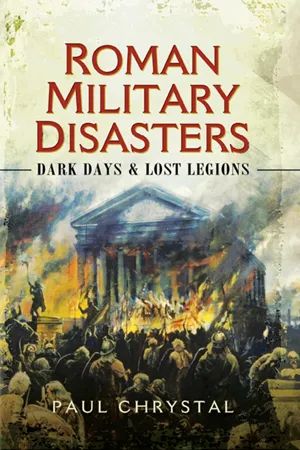
Over some 1200 years, the Romans proved adept at learning from military disaster and this was key to their eventual success and hegemony. Roman Military Disasters covers the most pivotal and decisive defeats, from the Celtic invasion of 390 BC to Alaric's sack of Rome in AD 410. Paul Chrystal details the politics and strategies leading to each conflict, how and why the Romans were defeated, the tactics employed, the generals and the casualties. However, the unique and crucial element of the book is its focus on the aftermath and consequences of defeat and how the lessons learnt enabled the Romans, usually, to bounce back and win.
Information
Part One: The Republic
Chapter 1
Rome’s Peninsular Wars
Before they suffered their first disaster in 387 BC at the Battle of Allia, the Romans had enjoyed some 366 years of sustained and consistent military success, dating from the traditional founding of Rome in 753 BC.
Early reverses were suffered at Pometia in 502 BC and at Antium in 482 BC, but these were of little significance compared to what was to follow at the River Allia. The Romans’ early record of success is a remarkable achievement in itself, particularly when we consider that war was a virtual constant, an inescapable way of life in the monarchy and the early Roman Republic. Of the 250 or so significant battles fought between 500 BC and 100 BC, 200 could be counted as victories. The doors of the Temple of Janus – that all too visible and tangible indicator of Rome’s at-war status – stood open for the whole period. There were just three exceptions, when peace broke out for a significant amount of time: Numa Pompilius (Rome’s second king after Romulus, 715–673 BC) founded the temple and established the tradition of the doors, and it was he who was first able to close those doors, for the duration of his reign1; after the First Punic War, during the consulship of Titus Manlius Torquatus, in 235 BC; and then after Augustus’ victory at the battle of Actium.
The serial warmongering is well recorded. First, Josephus, writing in the first century AD, tells us that the Roman people were delivered from the womb bearing weapons. Centuries later, F.E. Adcock echoed these words in a roundabout way when he said, ‘A Roman was half a soldier from the start, and he would endure a discipline which soon produced the other half.’2
So what was the reason for – and the nature of – this constant warring? What was the cause and outcome of these three centuries of near continuous conflict?
The first Romans were an agricultural, pastoral community, living on defendable hilltops and grazing their sheep on the pastures in the valleys and plains below, around the River Tiber. Rome was the product of synoikism with other Latin settlements in the valley of the Tiber, a process that began in the seventh century BC. She was the largest of these settlements. Her first conflicts would have been little more than isolated cattle-stealing skirmishes involving hundreds of men at most; defence of the king and the livestock were the main causes of attrition. By the end of the monarchy, in roughly 509 BC, Roman territory would have comprised a small walled city within about 500 square miles of land. Defence was rudimentary, with alarms announcing the proximity of an Etruscan raiding party communicated to compatriots by hoisting a flag on the Janiculum. The army comprised no more than 8,000 men. Strategically, alliances were crucial, and it is with alliances involving one town or another that Rome fought most of her battles against enemy coalitions; from 486 the Hernici were the ally of choice for the Romans. Apart from battles at the Fucine Lake in 406 and against the Volsinii in 392, all of Rome’s early wars were fought in the immediate vicinity of the city and on the Latin plain. Rome, then, was but one of many cities embroiled in fighting each other around the River Tiber. Many of her conflicts at this time were fought against the southern Etruscans, especially the Veii; also the Aequi, hill folk from the Aniene valley above Praeneste and Tibur; and the Volsci, who were originally from the Liri valley but had spilled onto the Latin plain to threaten Roman territory. As is often the case with mountain folk, the Volsci and the Aequi were covetous of lower lying, more yielding lands and were anxious to alleviate overcrowding back home and to banish famine and a dearth of cultivatable land. They were to cause Rome much irritation with their raids and incursions in the fifth and fourth centuries BC. By now, though, Rome herself needed more land, and more fertile land at that; expansion and annexations continued apace to achieve this.
In the twenty-four years between 440 and 416, there were only ten years in which the Roman army was not fighting; in the next twenty-four years between 415 and 391, Rome was at peace only in 412 and 411. Warfare virtually every year was, therefore, a fact of Roman life which continued through to the end of the First Punic War, when overseas expansion began in earnest, and, inevitably, more war. Even when there was no critical reason for conflict – defending against attack, attacking to expand territory, for example – the consuls could always find a pretext for military action, if Livy’s account of the year 303 BC is anything to go by.3 This was a year in which no war was recorded, until, that is, the consuls mounted raids into Umbria, ostensibly to curtail the plundering activities of armed men there, ne prorsus imbellem agerent annum – ‘lest they [the Romans] should have a war-free year.’ Moreover, it was essential to keep the socii – the allies – on side, and one important way of cementing their alliances was to insist on their obligation to military support; interrupt or remove this and you remove one of the foundation stones of the alliance. Allies were acquired by enfranchisement: conquered enemies were subsumed into Rome and became de facto citizens, often enjoying many of the rights, privileges and obligations citizenship brought – paying taxes to Rome and fighting in her army, intermarriage and legal and political rights.
An invasion by Gauls in 390 BC wrecked the triple alliance between Rome, the Latins and the Hernici. For the next forty years, Rome was busy fighting former allies who then took advantage of her preoccupation with the Gallic marauders. It was not to be Rome’s Italian neighbours who inflicted the first military disaster, but marauding Gauls at the battle of Allia around 387 BC.
The Romans, and others, had learnt much from the Etruscans, immigrants in the tenth and eighth centuries BC from Asia Minor. These newcomers brought with them sophisticated, urbanized skills in city building, metalworking and pottery. Much of what they made had, in turn, been influenced by contact with Phoenicia, Egypt and early Greece. The Etruscans capitalized on their skills by establishing Etruscan cities extending from the Po valley to Rome and trading with the Greek cities of Italy, opening up vital trade routes around Rome with strategic crossings over the Tiber at Fidenae and Lucus Feroniae. The Etruscans viewed Rome as a strategically important city because it was the last place before the sea where the Tiber could be crossed; the Tiber estuary was a major source of salt, a commodity much traded by Romans and Etruscans alike. Inevitably, the more cosmopolitan Etruscans, by now a loose confederation of twelve or so cities, overwhelmed the more agrarian Rome, introducing new ideas in architecture, town planning, commerce, science and medicine, and the arts. The Etruscans gave the Romans the Latin alphabet, the fasces (symbols of magisterial power), temple design and elements of their religion.4
So, by the end of the monarchy in 509 BC, Rome was developing from a settlement populated by former agricultural hill-dwellers to a more sophisticated, vibrant city, complete with a dedicated religion and a history. Rome had acquired a legendary past – with heroes like Aeneas, Romulus and Remus – a viable socio-political system, a thriving culture and a citizen army. The traditional heroes, of course, were warriors: Aeneas had to battle his way to the founding of Rome, while for Romulus the future involved slaying Remus, his brother – a victory for one, a disaster for the other. The latter-day hill people had come down from their hills and built a central market close to the Tiber, the forum, the crux of Roman life. Their kings wielded imperium – absolute power. They were also empowered to consult the gods (auspicium) on all manner of things, including declarations of war and most other military activity. The site of Rome was defensible, being backed by the Appenines and located at a crossing of the Tiber. It was also on the Italian trade routes, including the Via Salaria, by which commercially vital salt deposits were brought from the coast.
Between 700 and 500 BC, then, the Romans and the Etruscans were at odds with each other over land disputes in central Italy. The early conflicts have come down to us as legend, described by Livy in the opening books of his Ab Urbe Condita, and by Virgil in the second half of The Aeneid – both written some 700 years after the alleged events. In 509 BC, the monarchy, under Lucius Tarquinius Superbus, was replaced by a republic. Tarquinius, however, did not take this lying down and enlisted the support of the similarly disaffected cities of Veii and Tarquinii; they were all defeated by the Romans at the decisive Battle of Silva Arsia. The victorious consul, Publius Valerius Poplicola, returned to Rome weighed down with Etruscan booty; he celebrated a triumph from a four-horse chariot, thus providing a template and precedent for subsequent Roman triumphs.5
The Sabines were just as troublesome to the early Romans as the Etruscans. The first episode was the ‘rape’ – or abduction – of the Sabine women in 750 BC.6 This essentially was an act of nation building; the Romans needed women to prolong their race, so they took what they found, married them and produced their offspring.
Later, Titus Tatius (d. 748 BC), the Sabine king of Cures, attacked Rome and captured the Capitol, helped by the duplicitous Tarpeia. The Sabine women, now Roman wives and mothers, bravely rallied to persuade Tatius and Romulus to bury their respective hatchets and cease hostilities; the outcome was joint rule by the Romans and Sabines.7
Later, during the reign of Rome’s third king, Tullus Hostilius (r. 673–642 BC), the Sabines took a number of Roman merchants prisoner at a market near the Temple of Feronia. Tullus invaded and met the Sabines at the forest of Malitiosa. The Roman force was superior because the cavalry had been strengthened with ten new turmae of equites recruited from the Albans, now themselves citizens of Rome. The Romans won the battle with a successful cavalry charge, inflicting heavy losses on the Sabines.
The Fasti Triumphales record a triumph for a victory over the Sabines and the Veientes by Rome’s fourth king, Ancus Marcius (r. 642–617 BC). Ancus it was who famously defeated the Latins before the Latin League had come to accept the leadership of Rome during the reign of Tarquinius Superbus (535–509 BC). The League was a confederation of about thirty or so towns and tribes in Latium who coalesced in the seventh century BC for mutual defence and protection. Rome made a treaty with Carthage, that other emerging Mediterranean power, in 507 BC, in which Rome arrogantly assumed Latin lands surrounding Rome to be Roman territory, an issue that would become a festering sore in Roman and Latin relations down the years.8 The Latins had naively thought that Ancus was a man of peace like his grandfather, Numa Pompilius, and so invaded Roman territory. When a Roman embassy sought reparations for war damage and received nothing more than an insult from the Latins, Ancus declared war. This is significant because it was the first time that the Romans had declared war through the rites of the fetiales. Ancus Marcius took the Latin town of Politorium and displaced its inhabitants to the Aventine Hill, where they were subsumed and granted Roman citizenship. The ghost town that Politorium now became was later occupied by other Latins; Ancus simply responded by taking the town again, sacked it and razed it. Much booty and many Latins were sent back to Rome, these new citizens being settled at the foot of the Aventine. Ancus fortified the city, annexing the Janiculum, strengthening it with a wall and connecting it with the city by the Pons Sublicis, with its crucial implications for trade. He built the Fossa Quiritium, a ditch fortification, and opened Rome’s first prison, the Mamertine. He also developed lucrative salt mines at the mouth of the Tiber and snatched the Silva Maesia, a coastal forest north of the Tiber, from the Veientes.9
In 585 BC, during the reign of Rome’s fifth king, Lucius Tarquinius Priscus (r. 616–579 BC), the Sabines resumed hostilities and attacked Rome. Tarquinius was busy strengthening Rome’s defences with a stone wall around the city. The initial engagement led to heavy loss of life on both sides, but it was inconclusive. In the second battle, the Romans shipped rafts of burning logs down the River Anio in order to burn down the bridge over the river. The Roman cavalry outflanked the Sabine infantry, routed them, and blocked their flight from the battlefield, helped by the destruction of the bridge. Many Sabines drowned, their weapons drifting downstream into the Tiber, floating through Rome to give the citizens a palpable, very visible sign of victory. Tarquinius made a pyre and burnt the spoils in sacrifices to Vulcan, sending prisoners and booty back to Rome. He then invaded Sabine territory and destroyed their newly-formed army; the Sabines sued for peace. Tarquinius returned to Rome to celebrate a triumph on 13 September 585 BC.10
After he was deposed in 510, a disgruntled Lucius Tarquinius Superbus defected and persuaded the Sabines to help him restore the monarchy at Rome. After an initial defeat, Tarquinius, strengthened by the support of Fidenae and Cameria, was again defeated in 505 BC. The Sabines attacked again the following year, facing the two experienced Roman consuls, Publius Valerius Poplicola and Titus Lucretius Tricipitinus at the River Anio.
The Bloodless War followed in 501 BC, the result of a fracas which broke out with Sabine youths when they assaulted some prostitutes during games in Rome. The Sabine ambassadors sued for peace, but were rejected by the Romans who demanded that the Sabines pay Rome for the costs of a war. The Sabines refused, and war was declared, but it all evaporated and there was no battle. The war was significant because it marked the first appearance of a dictator. Dictators were appointed to deal specifically with the crisis in hand, to get the job done, rei gerundae causa, in place of the consuls. Their use died out in the Second Punic War, when Scipio Africanus and his successors assumed sole control of Roman armies, although it was revived by Sulla, who was appointed dictator legibus faciendis et rei publicae constituendae causa – ‘dictator for the enacting of laws and for the setting of the constitution.’11
The One-day War of 495 BC was inconclusive too. A Sabine army invaded Roman territory as far as the river Anio, and devastated the land. Aulus Postumius Albus Regillensis and Publius Servilius Priscus Structus rounded up the Sabines. In 494 BC, the Volsci, Sabines and Aequi revolted. Manius Valerius Maximus was appointed dictator and an unprecedented ten legions were raised; four were assigned to Valerius to enable him to deal with the Sabines, who were duly routed.
The sixth century had ended badly for Rome. When in 502 BC the Latin colony of Pometia renounced its allegiance to Rome and sided with the Auruncians, an outraged Rome invaded and destroyed the Auruncians. At Pometia there was no quarter: over 300 hostages were slaughtered. The following year, the Romans laid siege to Pometia, but they badly underestimated the resolve ...
Table of contents
- Cover
- Title Page
- Copyright
- Dedication
- Contents
- Acknowledgements
- List of Plates
- List of Diagrams
- List of Maps
- Timeline
- Introduction
- Part One: The Republic
- Part Two: The Empire
- Epilogue
- Appendix 1: Typical Cursus Honorum in the Second Century BC
- Appendix 2: Roman Assemblies
- Appendix 3: The Seven Kings of Rome
- Appendix 4: Some Carthaginian Generals
- Appendix 5: Greek and Roman Authors
- Appendix 6: Glossary of Greek and Latin Terms
- Notes
- Bibliography
Trusted by 375,005 students
Access to over 1.5 million titles for a fair monthly price.
Study more efficiently using our study tools.
Frequently asked questions
Yes, you can cancel anytime from the Subscription tab in your account settings on the Perlego website. Your subscription will stay active until the end of your current billing period. Learn how to cancel your subscription
No, books cannot be downloaded as external files, such as PDFs, for use outside of Perlego. However, you can download books within the Perlego app for offline reading on mobile or tablet. Learn how to download books offline
Perlego offers two plans: Essential and Complete
- Essential is ideal for learners and professionals who enjoy exploring a wide range of subjects. Access the Essential Library with 800,000+ trusted titles and best-sellers across business, personal growth, and the humanities. Includes unlimited reading time and Standard Read Aloud voice.
- Complete: Perfect for advanced learners and researchers needing full, unrestricted access. Unlock 1.5M+ books across hundreds of subjects, including academic and specialized titles. The Complete Plan also includes advanced features like Premium Read Aloud and Research Assistant.
We are an online textbook subscription service, where you can get access to an entire online library for less than the price of a single book per month. With over 1.5 million books across 990+ topics, we’ve got you covered! Learn about our mission
Look out for the read-aloud symbol on your next book to see if you can listen to it. The read-aloud tool reads text aloud for you, highlighting the text as it is being read. You can pause it, speed it up and slow it down. Learn more about Read Aloud
Yes! You can use the Perlego app on both iOS and Android devices to read anytime, anywhere — even offline. Perfect for commutes or when you’re on the go.
Please note we cannot support devices running on iOS 13 and Android 7 or earlier. Learn more about using the app
Please note we cannot support devices running on iOS 13 and Android 7 or earlier. Learn more about using the app
Yes, you can access Roman Military Disasters by Paul Chrystal in PDF and/or ePUB format, as well as other popular books in History & Military & Maritime History. We have over 1.5 million books available in our catalogue for you to explore.