- 160 pages
- English
- ePUB (mobile friendly)
- Available on iOS & Android
eBook - ePub
About this book
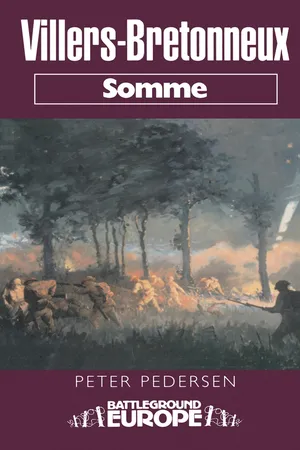
Villers-Bretonneux was the key to the strategically important communications centre of Amiens, a principal objective of the German offensive that began in March 1918. Until the Germans took the town, Amiens would remain beyond their grasp. The successful defence of Villers-Bretonneux has come to be regarded as an Australian battle but British formations were heavily involved as wel
Trusted by 375,005 students
Access to over 1.5 million titles for a fair monthly price.
Study more efficiently using our study tools.
Information
CONTENTS
Introduction by the Series Editor
Introduction
Acknowledgements
Advice to travellers
Maps
How to use this book
Chapter 1 The Germans Approach
Chapter 2 Early Encounters
Chapter 3 The Lull
Chapter 4 Attack and Counterattack
Chapter 5 Hangard and After
Chapter 6 Villers-Bretonneux Lost
Chapter 7 Villers-Bretonneux Regained
Chapter 8 Aftermath
Chapter 9 Cemeteries and Memorials
Chapter 10 Battlefield Tours
Bibliography
Index

The remains of the red château, a remarkable relic of the war on the Western Front, in partivular the fighting around Villers-Bretonneux, after it was destroyed to make way for a supermarket, by permission of the local authority in August 2004. Incredibilis superbia!
INTRODUCTION BY SERIES EDITOR
This is another fine contribution to the Battleground Europe series by Dr Peter Pedersen. It is a model of clarity in describing two complex battles around Villers-Bretonneux in April 1918, and has the same lucidity and even-handed judgements of his Hamel, a battle fought nearby, and Fromelles, in French Flanders.
Villers-Bretonneux is now a town much associated by the military historian with Australia; and this is reflected in the close links today’s commune has with that country – in the excellent museum, in the name of a street and, of course, in the impressive memorial to the missing dead of Australia who fell in France (those in Belgium are on the Menin Gate). It was the last of the great Commonwealth Memorials to the Missing to be built, and the only one to be unveiled by George VI. The connection was also shown by the selection of an unknown Australian soldier from a cemetery on this battlefield to become the Unknown Australian Soldier in Canberra. The saving of Villers-Bretonneux, in particular during the second battle on 24-5 April, was amongst the finest achievements of the Australians. It is notable how ‘modem’ that battle seems – aircraft and tanks, small unit actions and the like. What might appear alien to others is the appearance of the cavalry and the important, if not crucial, part it played in the operations. Indeed the lack of cavalry was a significant factor in the failure of the Germans to take full advantage of the breakthrough that had been gained – perhaps better to say almost gained – by their other fighting arms.
Although the allied success here owed much to the Australian soldier and his commanders, the role of the British has not been downplayed; just as rightful criticism has been made as well. The British formations involved had been engaged in desperate fighting, some since the German onslaught began on 21 March, and were severely undermanned. By the time of the second German onslaught in late April, they were dependent on large numbers of new conscript recruits. Not surprisingly, their performance was often below par.
Villers-Bretonneux is a fine example of how the fighting of 1918 was so very different from that of earlier years in the war – just as the fighting of 1917 was different from 1916. It is not just the Australian pilgrim who should come to these fields, so close to the Somme valley, to pay tribute to remarkable men. What took place in them also serves to show everyone that lessons were learnt in the Great War and that skill at all levels, determination, loyalty and mutual dependence were essential elements in winning the war.
Nigel Cave Vimy Ridge 2004
AUTHOR’S INTRODUCTION
Straddling the road and railway into Amiens on the southern side of the Somme, the town of Villers-Bretonneux was a backwater until the great German Michael Offensive reached it at the end of March 1918. Coming close on 4 April, the Germans finally succeeded in taking it on 24 April but were ejected by the Australians in one of the war’s great feats of arms. A largely Australian counterattack had also kept them at bay earlier. Saving Villers-Bretonneux meant saving Amiens, which thrust the town onto centre stage and forever associated the Australians with it.
British divisions were the defenders on both occasions and the Australians criticised their performance to the extent that the high command saw fit to intervene. But those divisions had been in action almost from the start of the German offensive and were exhausted. One of them, the 18th Division, fought at Villers-Bretonneux for longer than any other division, British or Australian, and ranked it alongside Ypres, Messines, Thiepval, and Cambrai as ‘one of the place-names that spring sharply to the memory of anyone who was in the war’.1 The British cavalry played a prominent part in stemming the German tide – as the Australians themselves acknowledged. This book fully describes the British contribution and seeks to give credit where it is due.
The fighting saw the first ever tank duel. It also encompassed a series of largely forgotten actions at nearby Hangard that achieved nothing but heavy casualties. Hangard raises the question of whether the commanders gave their men the best chance of success. The question is even more pertinent in relation to the 24 April counterattack at Villers-Bretonneux, the preparations for which were muddled to say the least.
Finally, the fog of war around the town was thick, literally and metaphorically, throughout April and the battles very fluid. Consequently, unit war diaries and personal accounts sometimes differed over the times and locations of events or were rather vague. The British Official Historian acknowledged the problem and the detailed work of the Australian Official Historian occasionally reflects it. Nonetheless, the fighting readily breaks down into battalion, company and even platoon actions that can be located on the ground and easily followed. Together, they made Villers-Bretonneux historically significant. They also made it significant as a place where mighty deeds were done.
P.A. Pedersen Sydney, Australia
1. G.H.F Nichols, The 18th Division in the Great War (William Blackwood, 1922), p. 302.
ACKNOWLEDGEMENTS
This book could not have been written without the unstinting support of my father during the part of each year that I spend at my desk in Sydney. As always, Dad, I owe you more than I can say.
In France, Nicolas Goret’s help was indispensable. Bombarded with queries over many months, he replied promptly with a wealth of information and also provided many of the photographs and maps. The hours I spent on the battlefields with him were as instructive as they were enjoyable, especially with regard to unravelling the mess the A29 autoroute has made of the local road network. Nicolas lives in Hamel and his website, http://hamelfriends.free.fr, is an essential tool for anyone studying the battles in the area or wishing to visit the battlefields. Claude Pecquet, head of the Association Villers Mémoire, clarified aspects of the town’s history and contributed photographs as well. Jean-Pierre Thierry, President of the France-Australia Association in Villers-Bretonneux, gave me the run of the ANZAC Museum. As usual, Anais Bertoux lent enthusiastic support!
In England, Professor Peter Simkins of the Centre for First World War Studies at the University of Birmingham generously let me have a copy of his landmark study of the battle, which covers the fighting from the British perspective. He sent a steady stream of useful material, answered questions as they arose and read the manuscript. I greatly valued his advice. John Bourne of the Centre allowed me to use his work on some of the British commanders. Richard Jef...
Table of contents
- Cover
- Half-Title
- Battleground Series
- Title
- Copyright
- CONTENTS
Frequently asked questions
Yes, you can cancel anytime from the Subscription tab in your account settings on the Perlego website. Your subscription will stay active until the end of your current billing period. Learn how to cancel your subscription
No, books cannot be downloaded as external files, such as PDFs, for use outside of Perlego. However, you can download books within the Perlego app for offline reading on mobile or tablet. Learn how to download books offline
Perlego offers two plans: Essential and Complete
- Essential is ideal for learners and professionals who enjoy exploring a wide range of subjects. Access the Essential Library with 800,000+ trusted titles and best-sellers across business, personal growth, and the humanities. Includes unlimited reading time and Standard Read Aloud voice.
- Complete: Perfect for advanced learners and researchers needing full, unrestricted access. Unlock 1.5M+ books across hundreds of subjects, including academic and specialized titles. The Complete Plan also includes advanced features like Premium Read Aloud and Research Assistant.
We are an online textbook subscription service, where you can get access to an entire online library for less than the price of a single book per month. With over 1.5 million books across 990+ topics, we’ve got you covered! Learn about our mission
Look out for the read-aloud symbol on your next book to see if you can listen to it. The read-aloud tool reads text aloud for you, highlighting the text as it is being read. You can pause it, speed it up and slow it down. Learn more about Read Aloud
Yes! You can use the Perlego app on both iOS and Android devices to read anytime, anywhere — even offline. Perfect for commutes or when you’re on the go.
Please note we cannot support devices running on iOS 13 and Android 7 or earlier. Learn more about using the app
Please note we cannot support devices running on iOS 13 and Android 7 or earlier. Learn more about using the app
Yes, you can access Villers-Bretonneux by Peter Pedersen in PDF and/or ePUB format, as well as other popular books in History & British History. We have over 1.5 million books available in our catalogue for you to explore.