This in-depth chronicle examines the series of political upheavals that led to division, violence, and civil war in the ancient Roman Republic.
The last century of the Roman Republic saw the consensus of the ruling elite shattered by a series of high-profile politicians who proposed political or social reform programs, many of which culminated in acts of bloodshed on the streets of Rome itself. This began in 133 BC with the military recruitment reforms of Tiberius Gracchus, which saw him and his supporters lynched by a mob of angry Senators.
Gracchus's grim example was followed by a series of radical politicians, each with their own agenda that challenged the status quo of the Senatorial elite. Each met a violent response from elements of the ruling order, leading to murder and even battles on the streets of Rome. These bloody political clashes paralyzed the Roman state, eventually leading to its collapse.
Covering the period 133–70 BC, this volume analyzes each of the key reformers, what they were trying to achieve and how they met their end, narrating the long decline of the Roman Republic into anarchy and civil war.
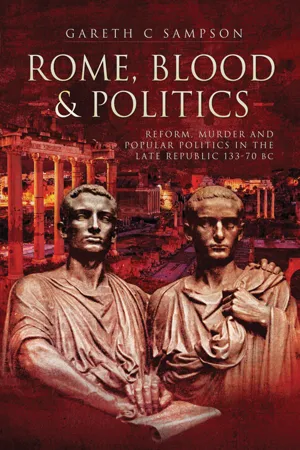
eBook - ePub
Rome, Blood & Politics
Reform, Murder and Popular Politics in the Late Republic, 133–70 BC
- 304 pages
- English
- ePUB (mobile friendly)
- Available on iOS & Android
eBook - ePub
Rome, Blood & Politics
Reform, Murder and Popular Politics in the Late Republic, 133–70 BC
About this book
Information
End Notes
Introduction: From Conquest to Collapse
1. See G. Sampson. (2010). The Crisis of Rome. The Jugurthine and Northern Wars and the Rise of Marius (Barnsley) and (2013). The Collapse of Rome. Marius Sulla and the First Civil War (Barnsley).
2. G. Sampson. (2005). A re-examination of the office of the Tribunate of the Plebs in the Roman Republic (494 – 23 BC) (Unpublished thesis).
Chapter One: Politics, Violence and the Evolution of the Republic (c.508–146 BC)
1. Sall. Cat. 10
2. Polyb. 6.11
3. Throughout this work, we will be avoiding the term ‘faction’. Faction, when it comes to Roman politics, implies an active undermining of the status quo as oppose to the various ad hoc and temporary political alliances.
4. For a fuller description see A. Lintott. (1999). The Constitution of the Roman Republic (Oxford), pp.94–146.
5. See C. Brennan. (2000). The Praetorship in the Roman Republic Volumes 1 & 2 (Oxford).
6. There were other types of Assembly, but for the purposes of this study we have simplified the situation into the two key ones.
7. See G. Botsford. (1904). ‘On the Distinction between Comitia and Concilium’, Transactions of the American Philological Association 35 (1904), pp.21–32 and (1909). The Roman Assemblies from their Origin to the End of the Republic (New York), K. Sandberg. (2001). Magistrates and Assemblies. A Study of Legislative Practice in Republican Rome (Rome). For a shorter introduction, see A. Lintott. (1999), pp. 40–64.
8. See J. Nicholls. (1956). ‘The Reform of the Comitia Centuriata’, American Journal of Philology 77, pp.225–254, G. Sumner. (1962). ‘Aspects of the History of the Comitia Centuriata in the Middle and Late Republic’, Athenaeum 40, pp. 37-84, R. Develin. (1978b). ‘The Third Century Reform of the Comitia Centuriata’, Athenaeum 56, pp.346-377 and L. Grieve (1985). ‘The Reform of the Comitia Centuriata’, Historia 34, pp.278–309.
9. See T. Cornell. (1995). The Beginnings of Rome: Italy and Rome from the Bronze Age to the Punic War (c. 1000-264 BC (London), pp.218-222 and A. Drummond. (1978). ‘The Dictator Years’, Historia 27, pp.550-572.
10. He was leading a Roman army against the city of Ardea.
11. L. Iunius Brutus, the king’s nephew and L. Tarquinius Collatinus, his cousin.
12. A modern retelling of which can be found in the currently popular television drama Game of Thrones, where...
Table of contents
- Cover
- Title
- Copyright
- Dedication
- Contents
- Acknowledgements
- Maps
- Introduction
- Timeline of the Key Events of the Period 146–70 BC
- Notes on Roman Names
- The Myth of the Golden Age (c.508–146 BC)
- Reform and Murder in Roman Politics (146–120 BC)
- From Bloodshed to Civil War (119–91 BC)
- Political Reform and the First Civil War (91–70 BC)
- Conclusion
- Appendix One
- Appendix Two
- Appendix Three
- End Notes
- Bibliography
- Plate section
Trusted by 375,005 students
Access to over 1.5 million titles for a fair monthly price.
Study more efficiently using our study tools.
Frequently asked questions
Yes, you can cancel anytime from the Subscription tab in your account settings on the Perlego website. Your subscription will stay active until the end of your current billing period. Learn how to cancel your subscription
No, books cannot be downloaded as external files, such as PDFs, for use outside of Perlego. However, you can download books within the Perlego app for offline reading on mobile or tablet. Learn how to download books offline
Perlego offers two plans: Essential and Complete
- Essential is ideal for learners and professionals who enjoy exploring a wide range of subjects. Access the Essential Library with 800,000+ trusted titles and best-sellers across business, personal growth, and the humanities. Includes unlimited reading time and Standard Read Aloud voice.
- Complete: Perfect for advanced learners and researchers needing full, unrestricted access. Unlock 1.5M+ books across hundreds of subjects, including academic and specialized titles. The Complete Plan also includes advanced features like Premium Read Aloud and Research Assistant.
We are an online textbook subscription service, where you can get access to an entire online library for less than the price of a single book per month. With over 1.5 million books across 990+ topics, we’ve got you covered! Learn about our mission
Look out for the read-aloud symbol on your next book to see if you can listen to it. The read-aloud tool reads text aloud for you, highlighting the text as it is being read. You can pause it, speed it up and slow it down. Learn more about Read Aloud
Yes! You can use the Perlego app on both iOS and Android devices to read anytime, anywhere — even offline. Perfect for commutes or when you’re on the go.
Please note we cannot support devices running on iOS 13 and Android 7 or earlier. Learn more about using the app
Please note we cannot support devices running on iOS 13 and Android 7 or earlier. Learn more about using the app
Yes, you can access Rome, Blood & Politics by Gareth C. Sampson in PDF and/or ePUB format, as well as other popular books in History & German History. We have over 1.5 million books available in our catalogue for you to explore.