- 224 pages
- English
- ePUB (mobile friendly)
- Available on iOS & Android
eBook - ePub
Victory in the Falklands
About this book
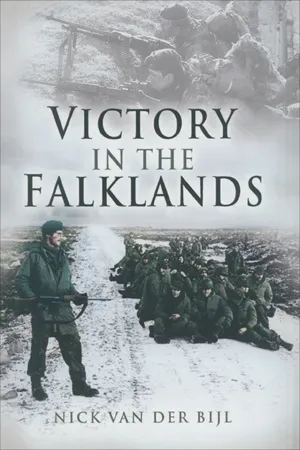
The Hundred Days that saw the British response to General Galtiere of Argentinas invasion of the Falklands are for many British people the most remarkable of their lives. It describes the dark days of early April, the feverish response and forming of the Task Force, the anxieties and uncertainties, the naval and air battles that preceded the landings by 3 Commando Brigade and 5th Infantry Brigade. The extraordinary battles such as Goose Green, Mount Tumbledown, Wireless Ridge etc are narrated fully but succinctly. This is a very balanced overview of a never-to-be-repeated but triumphant chapter in British military history.
Information
Contents
| List of Maps and Diagrams | |
| Foreword | |
| Glossary | |
| Chapter One | The Historical Perspective |
| Chapter Two | Crisis in the South Atlantic |
| Chapter Three | Invasion of the Falklands and South Georgia |
| Chapter Four | Occupation |
| Chapter Five | The British Response |
| Chapter Six | Approach to Battle, 8 to 20 May |
| Chapter Seven | The Landings and Beachhead, 21 May to 3 June |
| Chapter Eight | The Battle of Goose Green, 28 May |
| Chapter Nine | The Left Flank – 3 Commando Brigade, 27 May to 11 June |
| Chapter Ten | The Right Flank – 5 Infantry Brigade |
| Chapter Eleven | The Bold Move, 5 to 8 June |
| Chapter Twelve | Port Pleasant – 8 June |
| Chapter Thirteen | The Outer Defence Zone, 11 to 12 June |
| Chapter Fourteen | The Battles of Mount Tumbledown and Wireless Ridge, 12 to 14 June |
| Chapter Fifteen | Phase Three – Mount William and Sapper Hill, 14 June |
| Chapter Sixteen | Postscript |
| Appendix | Author’s Kit List |
| Bibliography | |
| Index | |
List of Maps and Diagrams
Capture of Stanley, 2 April 1982
The South Atlantic
Planning Stages – possible landing areas
The Beachhead, 21 to 28 May 1982
The Plan – the advance on Stanley
Foreword
In 1982, two countries went to war over a group of isolated islands of little strategic value in the South Atlantic. One country had played a significant role in the economic development of the other and both had a keen interest in rugby union, polo and football. Neither had a major disagreement until 1982 when both went to war over nationalism. One side sailed nearly 8,000 miles from the early European summer, across the equator to the early Antarctic winter and, accompanied by triumph and tragedy, drove their enemy into a situation whereby surrender was the only option, before asking, in that matchless sense of military humour, ‘Where’s the transport home?’ The welcome by the people of Great Britain was almost Victorian and will not be forgotten. The welcome to the abandoned men of the losing side was frosty. The war, in the early southern hemisphere winter, was probably unique in that there were no atrocities, the rules of warfare were followed and there has been no lasting dispute between the protagonists, apart from the occasional diplomatic foray to divert attention from domestic affairs.
A large number of informative and analytical books have been written about those four months of hostility, and this one is another. The book began its life as part of the Pen & Sword Battleground series but has since strayed into an account of the contest between the two armies. Although warfare has changed since 1982 from conventional front lines to asymmetric operation, in which there are no front lines, I have included quotes from a variety of sources to illustrate that the activity, incidents and emotions experienced by the combatants were no different before the Falklands or since. I have included contemporary maps and diagrams to add flavour to the text, together with as many photographs as possible that have not been seen before.
As always, I must thank several people. Over the years, I have collected all sorts of memorabilia, not a small percentage either deposited on my desk or sent through the mail, often anonymously, with the comment: ‘Thought you might like this.’ To these colleagues and donors, I am grateful for their consideration; some are Argentine. As always, there are enough stories, accounts and views to fill several volumes, however I hope that those who have provided me with information will understand that space is limited. I must thank Major Chris Baxter RM, who has allowed me to use several photographs from the 1st Raiding Squadron, Royal Marines archives. He commanded this unit of small boat coxswains during the campaign. To Bobby Gainher, who undertook the editing entirely by e-mail, which was a new experience for me. To John Noble, who undertook the complexities of the indexing. To Brigadier Henry Wilson of Pen & Sword Books Ltd, for his support and encouragement. To the staff of Pen & Sword Books, and others involved in the production of this book. And finally to the authors and publishers of the works from which I have quoted in order to provide a balanced account of the Falklands War.
Most importantly, to my wife, Penny, who spent many lonely hours while I worked at this project and then was kind enough to proofread the text. She is one of the often forgotten army of family and friends who uncomplainingly experienced the highs and lows of the spring and summer of 1982, and whose role is rarely mentioned. Penny has been incredibly supportive of this and other projects.
Nick van der Bijl
Somerset
Somerset
Glossary
| AFV | Armoured Fighting Vehicle |
| ARA | Armada Republica Argentina |
| ASW | Anti-Submarine Warfare |
| BAS | British Antarctic Survey |
| BMA | Brigade Maintenance Area |
| Camp | The Falklands territory outside Stanley |
| CB | Citizens’ Band (radio network) |
| CLIFFI | Commander Land Forces Falkland Islands |
| CO | Commanding Officer |
| COMAW | Commander Amphibious Warfare |
| CTF | Combined Task Force |
| CTG | Combined Task Group |
| CVR(T) | Combat Vehicle Recce (Tracked) – refers to a family of British tracked light-armoured vehicles |
| DCM | Distinguished Conduct Medal |
| DSC | Distinguished Service Cross |
| FCO | Foreign and Commonwealth Office |
| GHQ | General Headquarters |
| GPMG | General Purpose Machine Gun (British, 7.62mm) |
| HF | High Frequency (communication channel band) |
| HQ | Headquarters |
| ‘Kelpers’ | Literally, seaweed collectors |
| LADE | Lineas Aereas del Estado. The Argentine state airline. |
| LARC-5 | Lighter Amphibious Resupply and Cargo Series 5. US amphibious wheeled vehicle. |
| LAW | Light Anti-Tank Weapon (66mm) |
| LCT | Landing Craft Tank |
| LCU | Landing Craft Utility |
| LCVP | Landing Craft Vehicle and Personnel |
| LFFI | Land Forces Falkland Islands |
| LPD | Landing Platform Dock |
| LSL | Landing Ship Logistic |
| LVTP-7 | Landing Vehicle Tracked Personnel Series 7. US tracked amphibious assault armoured personnel carrier. |
| MAG | Miteailleuse d’Appui Général, literally GPMG. Belgian 7.62mm GPMG support machine gun. |
| MEZ | Maritime Exclusion Zone |
| NAS | Naval Air Squadron |
| NCO | Non-Commissioned Officer |
| NGFO | Naval Gunfire Support Officer |
| OC | Officer Commanding |
| OCRM | Officer Commanding Royal Marines |
| OP | Observation Post |
| QRF | Quick Reaction Force |
| RAMC | Royal Army Medical Corps |
| RAPC | Royal Army Pay Corps |
| RCT | Royal Corps of Transit |
| REME | Royal Electrical and Mechanical Engineers |
| SAMA (1982) | South Atlantic Medal Association (1982) – veterans’ association |
| SAS | Special Air Service |
| SBS | Special Boat Squadron |
| ‘Tab’ | Tactical approach to battle. Although primarily associated with the Parachute Regiment, the word was also used by other infantry units. |
| Tactical HQ | Tactical Headquarters – a small battle HQ |
| TEZ | Total Exclusion Zone |
| UKLF | United Kingdom Land Forces |
| UN | United Nations |
| VHF | Very High Frequency (communications channel band) |
| 66mm | 66mm Light Anti-Tank Weapon |
Chapter One
The Historical Perspective
Roughly 6,700 miles from Great Britain and 350 miles from South America lies the Falkland Islands archipelago of two main islands and over 200 smaller ones, mostly treeless, with a total area of about 4,700 square miles. There are good anchorages and the windswept terrain is generally hilly moorland with an abundance of wildlife.
The British first took an interest in the islands in 1592 when they were sighted by the Elizabethan explorer John Davis as his ship was driven off course in a storm. A century later, the privateer John Strong landed and named them after Anthony Carey, 5th Viscount Falkland, First Lord of the Admiralty. In February 1764, Louis Antoine de Bougainville, largely inspired by the loss of Canada to the British, founded the settlement of Port Louis in Berkeley Sound with immigrants from St Malo and named the islands ‘Les Iles Malouines’. The British reacted by despatching Commodore John Byron, grandfather of the poet, and he raised the Union flag at Port Egmont on West Falkland on 12 January 1765. In January the following year, Captain John McBride landed a 100-strong garrison and gave the French six months to leave.
In April 1767, the French sold Port Louis to Spain, who christened the islands ‘Las Malvinas’. For the next two years, the British and Spanish existed in isolation until Captain Anthony Hunt encountered a Spanish warship. In June 1770, five ships from the Spanish province of Buenos Aires threatened Port Egmont and while Hunt was negotiating terms, 1,600 troops landed and forced the twenty-three Royal Marines to surrender. The British were outraged. Prime Minister Lord North considered war and Foreign Secretary Lord Weymouth resigned. In 1982, another Hunt and party of Royal Marines were forced to surrender and another minister resigned. When Louis XV of France told Charles III of Spain that he would not support war with Great Britain, North agreed to Spain’s sovereignty over Las Malvinas, but omitted this clause from their copy of the declaration. In 1771, Spain returned Port Egmont ...
Table of contents
- Cover
- Half Title
- Full Title
- Copyright Page
- Dedicaiton
- Contents
Trusted by 375,005 students
Access to over 1.5 million titles for a fair monthly price.
Study more efficiently using our study tools.
Frequently asked questions
Yes, you can cancel anytime from the Subscription tab in your account settings on the Perlego website. Your subscription will stay active until the end of your current billing period. Learn how to cancel your subscription
No, books cannot be downloaded as external files, such as PDFs, for use outside of Perlego. However, you can download books within the Perlego app for offline reading on mobile or tablet. Learn how to download books offline
Perlego offers two plans: Essential and Complete
- Essential is ideal for learners and professionals who enjoy exploring a wide range of subjects. Access the Essential Library with 800,000+ trusted titles and best-sellers across business, personal growth, and the humanities. Includes unlimited reading time and Standard Read Aloud voice.
- Complete: Perfect for advanced learners and researchers needing full, unrestricted access. Unlock 1.5M+ books across hundreds of subjects, including academic and specialized titles. The Complete Plan also includes advanced features like Premium Read Aloud and Research Assistant.
We are an online textbook subscription service, where you can get access to an entire online library for less than the price of a single book per month. With over 1.5 million books across 990+ topics, we’ve got you covered! Learn about our mission
Look out for the read-aloud symbol on your next book to see if you can listen to it. The read-aloud tool reads text aloud for you, highlighting the text as it is being read. You can pause it, speed it up and slow it down. Learn more about Read Aloud
Yes! You can use the Perlego app on both iOS and Android devices to read anytime, anywhere — even offline. Perfect for commutes or when you’re on the go.
Please note we cannot support devices running on iOS 13 and Android 7 or earlier. Learn more about using the app
Please note we cannot support devices running on iOS 13 and Android 7 or earlier. Learn more about using the app
Yes, you can access Victory in the Falklands by Nicholas van der Bijl in PDF and/or ePUB format, as well as other popular books in History & Modern History. We have over 1.5 million books available in our catalogue for you to explore.