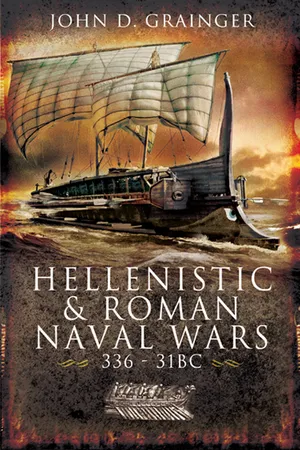
A technological, strategic, and tactical history of ancient naval ships from Alexander to the battle of Actium.
The period covered in this book is well known for its epic battles and grand campaigns of territorial conquest, but Hellenistic monarchies, Carthaginians, and the rapacious Roman Republic were scarcely less active at sea. Huge resources were poured into maintaining fleets not only as symbols of prestige but as means of projecting real military power across the Mediterranean arena.
Taking the period between Alexander the Great's conquests and the Battle of Actium, John Grainger analyzes the developments in naval technology and tactics, the uses and limitations of sea power and the differing strategies of the various powers. He shows, for example, how the Rhodians and the Romans eschewed the ever-larger monster galleys favored by most Hellenistic monarchs in favor of smaller vessels. This is a fascinating study of a neglected aspect of ancient warfare.
"An inherently fascinating and impressively informative study . . . an extraordinary work of exceptionally thorough and painstaking research." —Midwest Book Review
- 208 pages
- English
- ePUB (mobile friendly)
- Available on iOS & Android
eBook - ePub
Hellenistic & Roman Naval Wars, 336–31 BC
About this book
Information
Subtopic
Greek Ancient HistoryIndex
HistoryChapter 1
Alexander’s Naval War
When Alexander of Macedon set off to campaign against the Persian Great King in 334 BC, he had no experience of war at sea.* His father, King Philip II, whose career of intrigue and victory was his inspiration, had built up a small navy, and had used it in a characteristically cunning way. Both of them faced Athens and its large fleet of warships, and both, in attacking Persia, were tackling the other great naval power of the Mediterranean. One of Alexander’s priorities was to keep these two apart, since if they combined against him their fleets would make every part of his home kingdom vulnerable. For several years he was careful to hold Athenian hostages and at the same time to pay court to Athenian sensibilities.
Alexander’s invasion force consisted of a formidable army and a weak fleet. Also he had very little cash at first and, like most conquerors from Sargon of Akkad to Adolf Hitler, he aimed to finance his expedition out of the booty of his conquests. Alexander’s fleet consisted of 160 triremes, of which an unknown number were Macedonian; probably most were contributed by the Greek allies of the League of Corinth, though the only specific contribution known is the twenty ships of Athens.1 It seems probable that the burden was spread widely amongst the allies, partly for financial reasons – the allies were paying their own men – and partly to forge a wider sense of participation in the campaign.
In getting his army across the Hellespont and into Asia these warships were assisted by an unspecified number of cargo ships, presumably hired or impressed for the occasion. No Persian ships were able to interfere with this crucial initial movement. Indeed it is not clear that anyone on the Persian side realized what was happening, for no Persian mobilization had yet begun. Once Alexander was victorious over the local Persian forces in western Asia Minor in the battle at the Granikos River in 334, he moved south to liberate the Greek cities of the Aegean coast and the fleet moved south in company.
The Persian reaction to this early setback was to organize the assembly of a great army, and to gather a large fleet from the Phoenician, Cypriot, and Kilikian cities. Some of these vessels had been used in 335 to suppress an Egyptian rebellion, and the construction of more vessels was commissioned. The figure of 400 ships is mentioned, but it is unlikely that this was ever achieved, and another figure of 300 is reported later.2 There were fleets at the cities ready to be mobilized and used, but it would clearly take some time to build a new set of ships. So the Persian ships which confronted Alexander’s fleet at Miletos in the summer of 334 were only the first contingent. There were certainly not 400 ships, for Parmenion, Alexander’s cautious senior general, is said to have recommended that the Persian fleet be attacked. He would not have expected 160 Greek and Macedonian ships – and some of the Greeks of suspect loyalty – to beat a Persian fleet more than twice that size. So we must assume the Persian fleet was roughly the same size as Alexander’s at the time, perhaps 200 or less ships, but with more ships likely to turn up at any time. The implication of an approximately comparable strength is encouraged by the fact that neither side was willing to engage the other in battle. The Greek-Macedonian fleet merely ensured that local water points on the coast were occupied to deny them to the enemy, then blocked access to Miletos harbour during the army’s siege of the city. The Persian fleet retired to Mykale several miles away, and then had to get supplies from Samos, which was an Athenian island – a good indication of the anti-Macedonian attitude of at least some of the Greeks.3
The lesson Alexander learned was that a fleet could be kept at bay by controlling its land supplies. His ships were costing him a good deal of money. Both 100 and 250 talents a month have been suggested, and the Greek allies seem to have failed to contribute their ‘share’ of the expenses. Except for the Hellespont crossing, the fleet had been of little use. Further, if the Persian project of a fleet of 400 ships was reached, his own fleet would be overwhelmed, and he could not afford a serious defeat so early in the campaign. So Alexander disbanded his fleet, except for the twenty ships of Athens and a few others, and some of his own Macedonian ships. The Athenian ships and crews could be seen as hostages for the city’s good behaviour.4
The decision to disband the fleet was soon shown to be premature, since a substantial fleet would have been very useful at the siege of Halikarnassos which followed in the autumn. Skilfully used, this could have deterred the Persian fleet. Alexander could have appealed for more ships from the League members, principally Athens, which had a fleet of over 400 ships available. That would, however, have tied him to the Aegean area until the Persian fleet was driven off, and would also have made him hostage to Athens, the reverse of the position he wished to be in. So, if the fleet was costing him a lot, and was liable soon to be beaten anyway, he might as well collect the soldiers from it and send the ships home. The only other use for the ships was to transport supplies, and by then he controlled enough resources in Asia to live off the land. So he marched off to the east to attack the interior of Asia Minor. He will have understood, even if he did not have accurate information about it, that a new Persian Army was being collected in the east. It was clearly best to meet it away from the vulnerable Aegean coast.
The Persian strategy in Asia Minor, implemented by the Greek mercenary general Memnon of Rhodes, was to carry the war, by means of the fleet, into Alexander’s home territory, and to encourage disaffection and perhaps revolt among his allies. The fleet had a free hand in the Aegean, for a time. To be effective it had to range widely and seize the initiative, but it also required a secure local base. Memnon began well, gaining control of Chios to add to Kos, which was already under the fleet’s control, and these islands gave him adequate bases. He could count on Samos to be at least benevolently neutral, for its Athenian colonists had already helped his fleet when it needed supplies during the fight for Miletos. From Chios he moved north to Lesbos, won over several of the cities of that island, but then sat down to besiege Mitylene. Most of the Kyklades Islands sent envoys to him. This was not quite submission to Persia, but it was certainly the first step on the way.5
Memnon was thus slowed in his progress by the need to take Mytilene, but it was sufficiently disturbing for Alexander to reverse his non-naval policy. From his winter quarters at Gordion, in central Asia Minor, he sent two of his officers, Hegelochos and Amphoteros, with 500 talents to revive the fleet. There had been time enough, evidently, to return the ships to their home ports when the fleet was disbanded and to lay them up for the winter of 334/333; reassembling and crewing them again would take some time, but the Macedonian-Greek fleet took the sea again in the spring of 333. Hegelochos was to command an army to guard the Hellespont, now seen to be a vital element in Alexander’s communications; and Amphoteros was to defend the islands, and to take command of the fleet. In addition, Antipater, Alexander’s viceroy in Macedon, was sent 600 talents, presumably to assist in the reequipping and crewing of the ships. The league members were also to provide ships, no doubt those they had received back the previous autumn.6
It is curious, to say the least, that within a few months of disbanding the fleet partly because it was too costly, Alexander was able to send over a thousand talents home. The money obviously came from the cities and lands he had already conquered and the Persian treasury at Sardis, and it seems difficult to believe that he did not have access to adequate supplies of money earlier – when the decision was made he already held Sardis and most of the cities of the Aegean coast, all of them fruitful sources of taxation. This rather suggests that the real reason for disbanding the fleet was that it was too small to face the Persian force.
Arrian, Alexander’s biographer, tells a tale whereby Alexander interpreted the sighting of an eagle on shore astern of the Macedonian fleet to mean that he would be able to defeat the Persian fleet by controlling the land.7 If this is so, he then changed his mind (and so no doubt the omen was conveniently forgotten or re-interpreted). Further, it was not a strategy he put into practice, for to do so he would have needed to garrison every port, and to patrol every river mouth. He did not do this, any more than he garrisoned every place inland. It is best to accept, as Alexander eventually did, that disbanding the fleet had been a bad mistake. It is all to his credit that he reversed himself when it was seen to be necessary.
It was going to take time to reassemble the fleet, and had Memnon been able to get on with his own campaign it might well have been too late. The obvious Persian strategy was to encourage Greek defections, especially among the mainland cities in Greece. This could threaten the Macedonian homeland, and, if Antipater, Alexander’s viceroy and commander in Macedon, could be beaten, this ought to bring Alexander home hot-foot. The fleet had made some progress in this under Memnon’s command, but then suffered two disabling blows. First Memnon was ordered to send all his Greek mercenaries to join the new Persian army which was being prepared to meet Alexander in battle. They went off under the command of Memnon’s nephew Thymondas in a large fraction of his fleet, perhaps 200 ships.8
Then, in about June 333, Memnon himself died. He appointed his nephew Pharnabazos to take over the command, and Pharnabazos was competent enough, but inevitably the campaign stalled further. Mitylene was finally taken (perhaps even before Memnon died), and Pharnabazos was able to threaten the Hellespont by taking Tenedos, but it is likely that by then Hegelochos had beefed up the garrisons in the many small cities along the Hellespontine coasts, though Amphoteros had not yet been able to collect enough ships to be able to challenge Pharnabazos’ fleet. A Persian squadron which penetrated the Hellespont was defeated, and either then, or on the removal of the Persian main fleet, the Tenedians revolted from Persian control.9
Another detachment of ten ships, commanded by Datames, had been sent south from Mitylene to Siphnos, one of the Kykladic islands which had presumably sent envoys to Memnon earlier. No precise purpose is stated for the move, but it must have been in connection with the preliminary moves by King Agis of Sparta, who was showing clear signs of responding to Persian promptings. Sparta was not a member of the League of Corinth, so technically Agis could have diplomatic relations with the Persians without falling foul of Antipater and Alexander, though even by listening to Pharnabazos or Datames he was showing hostility to Macedonian pretensions. It may also have been a response to the Kykladic contacts initiated by Memnon. Ten ships would not be enough to give serious help to Agis, but they may have encouraged Persian sympathizers in Siphnos and the Kyklades, and they were adequate as an escort for a diplomatic mission. Combining two tasks would make sense to Pharnabazos.10
Alexander’s instructions to the league to collect a new fleet had begun to have an effect by this time. A Macedonian, Proteas son of Andromachos, had command of a squadron of fifteen ships at Chalkis in Euboia. Hearing of Datames’ arrival at Siphnos he sailed to nearby Kythnos and, in a dawn attack after a careful reconnaissance, he captured eight of Datames’ ships; the remaining two, with Datames himself, escaped. Proteas was clearly able to gather information easily, and no one on Kythnos warned Datames, while word had gone from Siphnos to Proteas at Chalkis very quickly. It seems clear that, even if some of the Kykladians sent envoys to Memnon, many others – Arrian says most – remained sympathetic to Alexander.
Pharnabazos had used the bulk of his fleet, a hundred ships, at Lesbos and Mitylene. At some point he was able to retake the city of Miletos, and the Persian garrisons in the forts at Halikarnassos seem to have been able to recover control of the city – the Persian base at Kos was close by and could give support.11 Despite the minor setback to Datames at Siphnos, therefore, it could be said that Pharnabazos’ fleet was still making some progress. Neither Hegelochos nor Amphoteros was apparently yet in a position to challenge the Persian fleet, even weakened as it was, and the small detachment under Proteas at Chalkis rather suggests that the Macedonian fleet was scattered in order to block raids and show the flag in Greece and the islands. All concerned, however, must have been listening hard for news from the east as Alexander marched his army ever further away, and as Dareios gathered his new army. Pharnabazos sent some ships to Kos and Halikarnassos, and then sailed with a hundred ships to Siphnos in order to resume negotiations with Agis, who in turn had already sent envoys to meet the Great King in Asia. News came at last from the east while Agis and Pharnabazos were talking. The Great King had been decisively beaten by the Macedonian army at Issos.12
At once the conference at Siphnos ended. Agis was given thirty talents and ten of the Persian triremes to help him prepare for war, if that was what he intended. The rest of the Persian fleet now broke up: Pharnabazos took twelve ships to Chios to hold that island; his co-commander Autophradates took the rest, now 75 ships, to join the squadron at Halikarnassos, no doubt to wait for news and instructions. The total fleet’s size is not clear, though it was still over a hundred ships. But it was composed of squadrons from the several cities of Cyprus and Phoenicia, and those cities were now menaced by Alexander’s victorious army. At least one of the Phoenician contingents, from Arados, was commanded by the city’s king, Gerostratos. These contingents now sailed for home and they were followed by the Cypriot contingents.13
Pharnabazos was left with only a small force, the twelve ships he took to Chios, plus any already there and the few others which did not desert. Meanwhile Hegelochos and Amphoteros had finally collected their fleet together, which is said by one source to be of 160 ships. This is possible, though it is suspiciously the same size as Alexander’s original fleet. Having the necessary numerical superiority at last, Amphoteros set about recovering Pharnabazos’ conquests. Tenedos (if not earlier), Lesbos, and Chios were taken, and then Kos, where Pharnabazos was captured, though he succeeded in escaping. Miletos changed hands yet again, and the forts at Halikarnassos at last surrendered.14
But all was not yet finished. A large force of Greek mercenaries had escaped from the battlefield at Issos. They reached the coast at Tripolis, a relatively recently-founded Phoenician city (with a Greek name) where they found ships, presumably some of those which had carried Memnon’s troops to Syria. Part of the group sailed off to Egypt, where their leader tried to make himself the imperial satrap, though he failed. Another group sailed west, heading for Greece. They stopped in Cyprus, but the Cypriot kings, whose fleets had now broken away from Pharnabazos’ fleet, were in the process of switching sides. The refugee soldiers moved on, no doubt to the Cypriots’ relief. Crete was their next stop, a place where their military skills were useful, and where Agis had been recruiting allies and soldiers. They were soon recruited by Agis.15
These soldiers in effect helped to revive the Persian Aegean campaign. They may well have included some of those who had originally campaigned with Memnon – one of their commanders was Thymondas – and they were all clearly very determined opponents of Alexander. An alliance between these men and Agis, to which would be added the remnants of Pharnabazos’ fleet, which was still in the Aegean, would pose a major threat to the Macedonian position in the region, particularly while Alexander himself was stalled by the seven-month siege of Tyre. However, during that siege Alexander’s maritime position changed, so he was essentially able now to make a serious effort by sea in the Aegean area to counter this new situation.
Alexander moved south from the battlefield of Issos, first to Arados, an island city with a mainland suburb, Marathos. The king’s son, left in charge while his father was with the fleet in the Aegean, promised to switch sides, and communicated with his father. The kings of Arados, Byblos, and Sidon, and the Cypriot kings, then brought their persons and their ships to Phoenicia, where Alexander was balked at Tyre, the only Phoenician city to defy him. The presence of the Phoenician and Cypriot ships allowed a strict blockade to be imposed on the island city, and this hostility allowed Alexander to concentrate on the siege without having to worry about other local powers.16 So the balance of naval power had now swung decisively in his favour in Syria, while Hegelochos and Amphoteros mopped up in the Aegean, though this process took even longer than the campaign in Syria.
At Tyre Alexander collected fleets from the three Cypriot cities which had them, Salamis, Amathos, and Kourion (this last a Phoenician city), from the three Phoenician cities which had come over to him, Sidon, Arados, and Byblos. He was joined by small flotillas from Rhodes (finally jumping off the fence), and Lykia – these were thus no longer threatened by the Persian fleet, and since they had not joined Alexander earlier, their new presence may well have been intended to make up for this earlier lapse. Mallos in Kilikia also sent a small number of ships.17
Alexander’s siege method at Tyre was to construct a mole by which he could reach the island the city was built on – a mode of attack which clearly demonstrates his non-maritime mindset. The city’s two harbours had therefore to be blocked by his new fleet. The ships were sorted into two squadrons: the Cypriots’ 120 ships on the north; the rest, probably more than 120 ships, on the south. He ...
Table of contents
- Cover
- Title
- Copyright
- Contents
- List of Maps and Illustrations
- Introduction
- 1. Alexander’s Naval War
- 2. The End of Athens’ Sea Power
- 3. Antigonos Takes to the Sea
- 4. The Campaign of Demetrios
- 5. Demetrios the Sea-King and the Super-Galleys
- 6. The Ptolemaic Sea-Empire
- 7. Agathokles and Carthage
- 8. A War for Sicily
- 9. Hannibal’s War
- 10. Philip V
- 11. Roman Domination Established
- 12. Roman Domination in Action
- 13. Pirates
- 14. Mithradates, Pirates and Rome
- 15. Roman Civil Wars
- 16. Actium
- Conclusion: Sea Power
- Notes
- Abbreviations and Bibliography
- Index
Trusted by 375,005 students
Access to over 1.5 million titles for a fair monthly price.
Study more efficiently using our study tools.
Frequently asked questions
Yes, you can cancel anytime from the Subscription tab in your account settings on the Perlego website. Your subscription will stay active until the end of your current billing period. Learn how to cancel your subscription
No, books cannot be downloaded as external files, such as PDFs, for use outside of Perlego. However, you can download books within the Perlego app for offline reading on mobile or tablet. Learn how to download books offline
Perlego offers two plans: Essential and Complete
- Essential is ideal for learners and professionals who enjoy exploring a wide range of subjects. Access the Essential Library with 800,000+ trusted titles and best-sellers across business, personal growth, and the humanities. Includes unlimited reading time and Standard Read Aloud voice.
- Complete: Perfect for advanced learners and researchers needing full, unrestricted access. Unlock 1.5M+ books across hundreds of subjects, including academic and specialized titles. The Complete Plan also includes advanced features like Premium Read Aloud and Research Assistant.
We are an online textbook subscription service, where you can get access to an entire online library for less than the price of a single book per month. With over 1.5 million books across 990+ topics, we’ve got you covered! Learn about our mission
Look out for the read-aloud symbol on your next book to see if you can listen to it. The read-aloud tool reads text aloud for you, highlighting the text as it is being read. You can pause it, speed it up and slow it down. Learn more about Read Aloud
Yes! You can use the Perlego app on both iOS and Android devices to read anytime, anywhere — even offline. Perfect for commutes or when you’re on the go.
Please note we cannot support devices running on iOS 13 and Android 7 or earlier. Learn more about using the app
Please note we cannot support devices running on iOS 13 and Android 7 or earlier. Learn more about using the app
Yes, you can access Hellenistic & Roman Naval Wars, 336–31 BC by John D. Grainger in PDF and/or ePUB format, as well as other popular books in History & Greek Ancient History. We have over 1.5 million books available in our catalogue for you to explore.