- 224 pages
- English
- ePUB (mobile friendly)
- Available on iOS & Android
eBook - ePub
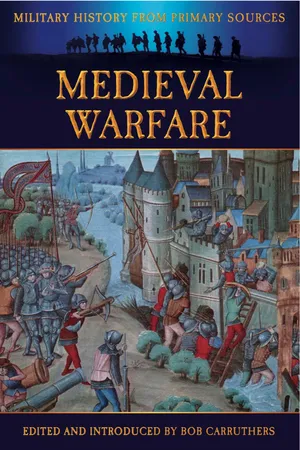
Medieval Warfare
About this book
James Grant (1822–1887) was a Scottish author and was born in Edinburgh, Scotland, and was a distant relation of Sir WalterScott. He was a prolific author, writing some 90 books, including many yellow-backs. Titles included Adventures of an Aide-decamp, One of 'The Six Hundred', The Scottish Musketeers and The Scottish Cavalier.Medieval Warfare collects Grant's work on the subject, from the Battle of Hastings in 1066 to the Battle of Barnet in 1471, a decisive engagement in the Wars of the Roses. The book contains remarkably detailed accounts of many key battles from the period including the Battle of the Standard and Bannockburn to Poitiers and Agincourt from the Hundred Years' War. The historically defining strategies employed during these battles are explored throughout.Illustrated with vivid portraits of battle and detailed drawings of the tools and weapons of the period, this is the definitive account of a trying and bloody period in history.
Information
Topic
HistoireSubtopic
Histoire antique- CHAPTER V -
STIRLING BRIDGE, 1297 - FALKIRK, 1298
STIRLING BRIDGE
IN DETAILING the preceding sea-fight, we have somewhat anticipated a quarrel the most disastrous perhaps in British history, and which for many generations of men was the cause of bloodshed.
In 1282, Scotland was in all the enjoyment of profound peace, and of most unprecedented prosperity, under the gentle sway of Alexander III, who had married Margaret, a daughter of Henry III of England, and consequently was brother-in-law of the reigning king of that country, Edward I. In the forty-second year of his age, and having a son and daughter grown to maturity, Alexander had every prospect of leaving his sceptre to a long line of descendants. The year 1282 saw his daughter united in marriage to Eric, the young King of Norway; and soon after his son, who was named after himself, married the daughter of Guy of Dampierre, the powerful Count of Flanders.
But a brief space of time sufficed to cover with sorrow and darkness all this prospect of a happy future. The Queen of Norway had only been married a year, when she died in giving birth to a daughter; the death of Prince Alexander, without heirs, followed in January 1284; and on the 16th March, two years afterwards, the king, when riding on a dark night, was thrown from his horse over a high cliff at Kinghorn, opposite Edinburgh, and killed on the spot. By this fatality terminated the male line of the Celtic or old Macalpine kings, who had ruled the race of the Dalriadic Scots from the prehistoric times of dark and unknown antiquity - times clouded by fable and romance - and now the sovereignty of the most turbulent kingdom in Europe devolved upon an infant Norwegian princess, who, of course, was still absent at the court of her father. Had this child survived, the calamities that fell upon her kingdom might perhaps have been averted. The crown of her grandfather had been secured to her by the estates of the realm and since his death it had been arranged that as soon as she was brought home she should be betrothed to her second cousin, the eldest son of the King of England - a measure which, had it been carried out, might have finally united the two kingdoms under one sceptre - but this politic hope was doomed to blight, for on her passage home, the little Queen of Scotland died in the Orkneys, in her eighth year. When tidings of this fatal event came, “the kingdom was troubled,” says the Bishop of St. Andrew’s, “and its inhabitants sank into despair.”
And now there fell on Scotland the greatest and most terrible calamity that can befall a warlike state - a disputed succession - but in this case, advantage was taken by the bold, able, and unscrupulous Edward I to endeavour to make himself master of Scotland by force or fraud; and for more than twenty years the land was involved in all the barbarities of a war, waged as only in those days war was waged, bequeathing to posterity a long and unmeaning inheritance of hate. Thirteen competitors appeared for that crown which has been so often one of thorns for its hapless wearer; but the claims of two, John Baliol and Robert Bruce, were declared by Edward, who was unhappily selected as umpire, superior to the rest. They were the descendants of David, a younger brother of William I, surnamed “The Lion,” from having first borne that cognisance on his seals and banners; Baliol being the grandson of the eldest daughter, Bruce the son of the second. Finding Baliol mean, timid, pliant, and ambitious, Edward, intending ere long to advance his own imaginary claim, decided in his favour, a measure which ultimately retarded the union of the countries for centuries. Prior to making any award, Edward, with great cunning and foresight, had required that English garrisons should be put in the principal fortresses, on the plea that the gift might be in the hand of him who was to bestow it.
To the disgust and indignation of the Scots, the half Norman Baliol did fealty to Edward for the crown awarded him, and the spring of 1296 saw the nation in arms against him. This effort, however, was conducted without ability, and after a short time Edward again overran the Lowlands; and as this was called the suppression of a “rebellion,” the sword was allowed more than usual licence, and even priests were murdered in cold blood within the rails of the altar, as it was sought by sheer massacre to strike terror into the hearts of the people. On the 2nd of July, the miserable Baliol surrendered into the hands of Edward the kingdom which should never have been his, and which he had obtained on terms unknown to the Scottish people; and an English noble, John de Warrenne, Earl of Surrey, was made governor over it, or at least that part of it where English garrisons lay, with Hugh Cressingham as his Justiciary. Edward’s conception, the union of the entire island under one crown, was doubtless a great one; it was infamously and cruelly enforced, but was never to be achieved by the sword.
Amid incessant turmoil, petty strife, and marauding, this state of matters only remained two years, when a body of Scots were again in arms. This time their leader was William Wallace, a man neither rich nor noble, but the second son of Sir Malcolm Wallace, of Ellerslie, near Paisley. He is said by his detractors to have come of Norman blood; but even were it so, the lapse of 230 years and nearly six generations must have made him Scot enough to resent the oppression of his country. His father, his elder brother, and many of his kinsmen, had been slain in skirmishes with the enemy. His wife and family had been burned with his house at Lanark, and from that time he devoted himself to the cause of vengeance and freedom. Distinguished for bravery and hardihood, in an age when all men were hardy and brave, the fond admiration of his countrymen has endued him with attributes of strength and beauty equalled only by the demigods of Homer; but, however, his many achievements prove that he must have been no ordinary man. Scotland owed little then as ever to her unpatriotic and infamous nobility; and in this case it was to one of the people she was to owe all her future existence.,” When we read the story of William Wallace,” says an eloquent English writer, “imagination wanders back to the times of heroic antiquity, and enthusiasm can scarcely keep pace with reason in forming an estimate of his services to his country. He gave new birth to the land of his nativity, and interested the sympathies of the world in behalf of her gallant struggle for existence. Personal wrong and the grinding oppression practised on his friends first stung him to revolt; but his passion soon hardened into principle, like the burning lava converted into stone. Against the victorious might of England he threw himself, and carved his way to honour without the shouts of a thousand vassals to proclaim his feudal greatness, or a coronet on his brow to tell of the nobility of his blood. Fortune did not look askance upon his sacrifice. The discipline of English chivalry quailed before him; castles changed masters; ridicule gave way to reflection; the oppressor deigned to assign reasons for his oppression; injury and insult were followed by retaliation and revenge; the haughty Plantagenet found himself no longer invincible; and conquest gained by so many intrigues, so much artful policy, and such elaborate chicane, vanished like a dream.”
Among the many victories he won, that at Stirling Bridge, on the 13th of September, 1297, is alike the most splendid and remarkable. Edward I was then warring with France, but he had remitted to John de Warrenne, Earl of Surrey and Sussex, and to Hugh Cressingham (whom we have already named), a military ecclesiastic, his Lieutenant and Treasurer, or Justiciary, in Scotland, full power to repress all resistance; and for this purpose an army of 50,000 infantry and a great body of horse, under their orders, marched through the south Lowlands in quest of Wallace, who was then besieging Dundee with all the men that he and his friends, Graham, Ramsay, and Murray, could muster - only 10,000 in all. Yet, quitting Dundee, they crossed the Tay and marched with all speed to dispute with the English the passage of the Forth, by which they alone could penetrate into the more northern parts of the kingdom.
The bridge across the Forth near Stirling was then of timber, and stood at Kildean, where some remains of the stone pillars which supported the woodwork are still visible, exactly half a mile above the present ancient bridge. It is described as having been so narrow that only two persons could pass along it abreast, yet the English leaders absurdly proposed to make 50,000 foot and all their horse undergo the tedious operation of passing it in the face of an enemy. Walter de Hemingburgh, Canon of Gisborough, in Yorkshire, and author of a History of England from 1066 to 1308, records that a Scottish traitor named Sir Richard Lunday (Lundin?), who served the Earl of Surrey, strenuously opposed this measure, and pointed out a ford at no great distance where sixty men could have crossed the stream abreast; but no regard was paid to his suggestions, and the sequel proved how headstrong was the folly of the English leaders. To increase their troubles, they, had in their army certain Scottish barons of the Baliol faction, on whom, with their followers, they could little rely in case of disaster. Notwithstanding all his force, Surrey was by no means anxious to encounter Wallace, whose success in past encounters had won him a formidable name; he wished to avoid a general action, all the more so that he knew that he was about to be superseded in his post by Brian Fitzalan, and consequently was less zealous in the cause of the king their master.
Seeking therefore to temporise, he dispatched two Dominican friars to Wallace, whose force was then encamped near Cambuskenneth Abbey, on the hill so well known as the Abbey Craig; thus both armies were within perfect view of each other, and only separated by the river, which there winds like a silver snake between the green and fertile meadows. The request of the friars was brief - that Wallace and his followers should lay down their arms and submit…’
“Return to your friends,” said he, “and tell them we come here with no peaceful intent, but ready for battle, determined to avenge our wrongs and to set our country free. Let your masters come and attack us; we are ready to meet them beard to beard.”
Enraged by this reply, many of the English knights now clamoured to be led on. Then it was that the active traitor Lunday said to Surrey, ‘’ Give me but five hundred horse and a few foot, and I shall turn the enemy’s flank by the ford, while you, my Lord Earl, may pass the bridge in safety.”

Wallace and the monks.
Still Surrey hesitated, on which Hugh Cressingham exclaimed, passionately, “Why do we thus protract the war, and waste the king’s treasure? Let us fight, it is our bounden duty.” Surrey, contrary to his own judgment, yielded; and by dawn of day the English began to cross the bridge, and Wallace heard the tidings with joy. Slow was this process; when the sun rose they were still defiling across, and were permitted to do so without interruption till eleven o’clock, by which time one-half of Surrey’s army was over the river, and gradually forming in order of battle, while the Scots looked quietly on from the gentle slope above it.
The reader must bear in mind that, save in the details of their surcoats, banners, and insignia, these two armies, English and Scottish, were now pretty much alike in their war equipment. On one side were the banners of the English, bearing the arms then chosen by Edward I. - gules, three lions passant regardant; St. George argent, a cross gules and of St. Edward the Confessor, a cross fleury between six martlets, or, on the other side floated the Scottish lion rampant, and the silver cross of St. Andrew. Now the tunics worn over the mail-shirts were elaborately painted and blazoned, and those curious ornaments called ailettes were worn on the shoulders of knights in battle. The barrel-shaped helmets were surmounted by their crests; that of Wallace was a dragon. Skull-caps, spherical and conical, were worn by the infantry; in lieu of the long pennons, the lances now had little emblazoned banners; the mail gloves of the hauberks were divided into separate fingers; and triangular shields were almost universally worn: for every generation saw some improvement in the panoply for man and horse.
When one-half of the Englishmen were over, Wallace-began to advance, having previously sent a strong detachment to hold the ford already referred to. The moment the Scots began to move, Sir Marmaduke Twenge, a gallant knight, belonging to the North Riding of Yorkshire, who, together with Cressingham, led the vanguard of horse, displayed the royal standard amid loud cries of “For God and St. George of England!” and at the head of the heavily-mailed horse, made a furious charge up the slope upon the Scottish infantry, who received the shock upon their levelled spears, while their archers kept shooting fast and surely from the rear, and caused the English forces to waver and recoil upon each other.
Led on by Wallace, Sir John Grahame of Dundaff, Ramsay of Dalhousie, and others, the Scots made a furious downhill charge towards the bridge; while in the meantime a masterly movement was executed by another body, who by a quick detour got in between it and those who had already crossed the river, completely cutting off their retreat. All became immediate confusion, 2nd the little discipline then known was entirely lost. Wallace, as soon as he saw the movement for intercepting their retreat achieved, pressed on with greater fury; and the half-formed columns of the English on the north bank of the river began at once to give way, and thousands of their heavy-armed cavalry were hurled into the river and drowned. Surrey, who witnessed this scene from the opposite bank, sought to retrieve the fortune of the day by sending across, at a moment when the bridge was open, a strong reinforcement at full speed, with his own banner; but unable to form amid the recoiling masses of their own infantry, they only added to the confusion and slaughter, being assailed on every side by Scottish spearmen. At this terrible moment the bridge parted, a disaster of which there are several versions; but this catastrophe, together with the passage of the river by a body of Scots at the ford, whence they fell on Surrey’s own rear, decided the victory. An incredible number of English were drowned in attempting to cross the stream. There perished the nephew of Sir Marmaduke Twenge, a young knight greatly beloved by his soldiers; while his uncle cut his way across the bridge ere it fell, and escaped. On being advised at first to throw himself into the river, he replied, “It shall never be said of me that I voluntarily drowned myself. God forbid that such dishonour should ever fall on any Englishman!”
The traitor Scottish barons who served in Surrey’s ranks - one of whom was the Earl of Lennox - now threw off the mask, and, with their followers, joined in the pursuit, when the flight became, as usual in those days, a mere scene of barbarous slaughter. “No quarter was given. The country for miles round was covered with the bodies of the English soldiers; 20,000 men are believed to have fallen in the battle and the flight. Among these was Cressingham, a man so detested by the Scots that they mangled his dead body, and are said to have torn the skin from the limbs. The loss of the Scots was trifling; and the only man of note among them that fell was Sir Andrew Moray.” Surrey, after making one brave attempt to rally his soldiers in the Torwood, on being assailed by Wallace, again resumed his flight, and rode on the spur to Berwick, and thence sent to his master news of his terrible defeat.
Scottish historians assert that the bridge had been sawn through by order of Wallace, and that on a certain trumpet being sounded, a man beneath it drew out a wedge, and let the whole fabric fall. On the other hand, an English chronicler says it was broken down by Surrey to secure his retreat. The present burgh seal of Stirling seems to commemorate this victory. It represents the old wooden bridge, in the centre of which is a crucifix. At the south end are soldiers with English bows attempting to pass, on the northern are others with Scottish spears; and the legend around it is, ‘Hie armis Bruti, Scoti stant hie cruce tuti’ a plain allusion to the safety of Church and State resulting from the valour and victory of Sir William Wallace, who by this event also won the castle of Stirling, where he supped that night with his companions. The Scots now regarded him as the deliverer of their country, and crowded to his standard. He was chosen protector of the kingdom, an office which he executed with fidelity and dignity, though not without exciting the malignity of those who have so generally been Scotland’s curse, her nobility; and as warfare had brought a famine on the land, and a pestilence too - “produced by the exhalations from the putrid carcasses that lay rotting on the ground, aggravated by the deficient and unhealthy food of the people” - he marched his army into England, that he might subsist it in the northern counties, and send food to the famishing people at home.
By the result of this single battle the English were entirely driven out of Scotland, save at Roxburgh and Berwick, in the castles of which two gallant garrisons maintained a stubborn resistance, till they were relieved by Surrey when, in January, 1298, he entered Scotland for that purpose.
FALKIRK
Filled with rage at the effect produced by the battle at Stirling, and the terrible retaliations of the Scots in the English border counties, Edward concluded in haste a truce with the King of France, and hastened home intent on vengeance. He reached England about the middle of March, and instantly summoned the barons and other military tenants to assemble with their followers at York on the Feast of Pentecost; and he also pompously ordered the Scottish nobles to meet him in the same place on the day appointed, threatening otherwise condign punishment; but to this summons they paid not the slightest regard, either deterred by f...
Table of contents
- FRONT COVER
- TITLE PAGE
- COPYRIGHT PAGE
- CONTENTS
- AN INTRODUCTION TO MEDIEVAL WARFARE
- I HASTINGS, 1066
- II THE BATTLE OF THE STANDARD, 1138
- II DAMME- BOUVINES- DOVER, 1214 - 1217
- IV LEWES, 1264 - EVESHAM, 1265 - IN THE CHANNEL, 1293
- V STIRLING BRIDGE, 1297 - FALKIRK, 1298
- VI BANNOCKBURN, 1314
- VII HALIDON HILL, 1333 - SLUYS, 1346
- VIII CRESSY, 1346
- IX DURHAM, 1346 - WINCHELSEA, 1349
- X POICTIERS, 1356
- XI THE BLACK PRINCE IN SPAIN- NAJERA, 1367
- XII SEA-FIGHT, 1378 - OTTERBURNE, OR CHEVY CHASE, 1388
- XIII HOMILDON, 1402 - SHREWSBURY, 1403
- XIV AGINCOURT, 1415
- XV BAUJÉ, 1421 - CREVANT, 1423 - VERNEUIL, 1424
- XVI ROVERAI, 1429
- XVII BLORE HEATH, 1459 - ST. ALBANS; TOWTON, 1461 - BARNET, 1471
Trusted by 375,005 students
Access to over 1.5 million titles for a fair monthly price.
Study more efficiently using our study tools.
Frequently asked questions
Yes, you can cancel anytime from the Subscription tab in your account settings on the Perlego website. Your subscription will stay active until the end of your current billing period. Learn how to cancel your subscription
No, books cannot be downloaded as external files, such as PDFs, for use outside of Perlego. However, you can download books within the Perlego app for offline reading on mobile or tablet. Learn how to download books offline
Perlego offers two plans: Essential and Complete
- Essential is ideal for learners and professionals who enjoy exploring a wide range of subjects. Access the Essential Library with 800,000+ trusted titles and best-sellers across business, personal growth, and the humanities. Includes unlimited reading time and Standard Read Aloud voice.
- Complete: Perfect for advanced learners and researchers needing full, unrestricted access. Unlock 1.5M+ books across hundreds of subjects, including academic and specialized titles. The Complete Plan also includes advanced features like Premium Read Aloud and Research Assistant.
We are an online textbook subscription service, where you can get access to an entire online library for less than the price of a single book per month. With over 1.5 million books across 990+ topics, we’ve got you covered! Learn about our mission
Look out for the read-aloud symbol on your next book to see if you can listen to it. The read-aloud tool reads text aloud for you, highlighting the text as it is being read. You can pause it, speed it up and slow it down. Learn more about Read Aloud
Yes! You can use the Perlego app on both iOS and Android devices to read anytime, anywhere — even offline. Perfect for commutes or when you’re on the go.
Please note we cannot support devices running on iOS 13 and Android 7 or earlier. Learn more about using the app
Please note we cannot support devices running on iOS 13 and Android 7 or earlier. Learn more about using the app
Yes, you can access Medieval Warfare by Bob Carruthers in PDF and/or ePUB format, as well as other popular books in Histoire & Histoire antique. We have over 1.5 million books available in our catalogue for you to explore.