- 176 pages
- English
- ePUB (mobile friendly)
- Available on iOS & Android
eBook - ePub
About this book
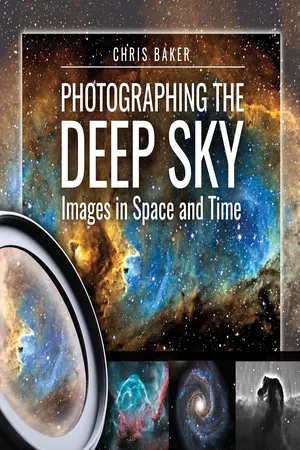
Spectacular nebulae where stars are born, beautiful star clusters from the early formation of the Milky Way, and galaxies as far as a billion light years away, all feature in this book of stunning images from astrophotographer Chris Baker.The author takes the reader on a journey through time and space to the Deep Sky, far beyond our Solar System. It is a pictorial description of the awe-inspiring wondrous objects that exist out there."The images are of objects from hundreds to many millions of light years away; distances of such enormity are hard for our minds to grasp. The book presents fascinating information on what the Earth was like when the light started its earth-bound journey through space.For example, as the light left the Andromeda Galaxy 2.5 million years ago on its interstellar journey to Chriss telescope, the Himalayas are still being raised and Polar Bears roam Britain.Chapters are included describing the basics of astrophotography, as modern telescopes and cameras make this a rewarding hobby well within reach of the amateur astronomer. Chris describes his observatory in the mountains of Spain along with practical guidance on how to get started in astrophotography.With a concise, clear discussion on the background of astronomical science, this is above all, a book to celebrate the beauty and fascination of space.
Information
Topic
ArtSubtopic
PhotographyIMAGES FROM WITHIN OUR GALAXY
Messier 45 Pleiades
Messier 45 also known as Pleiades and the Seven Sisters is a stunning cluster of stars. This cluster can easily be seen with the naked eye in winter in the northern hemisphere. It is a beautiful example of an open star cluster. It is a loosely bound collection of relatively young, very hot blue stars. As these stars move through space they cause dust clouds to glow around them as can be seen in this image. Pleiades is close to Earth in deep space terms at 440 LY away.
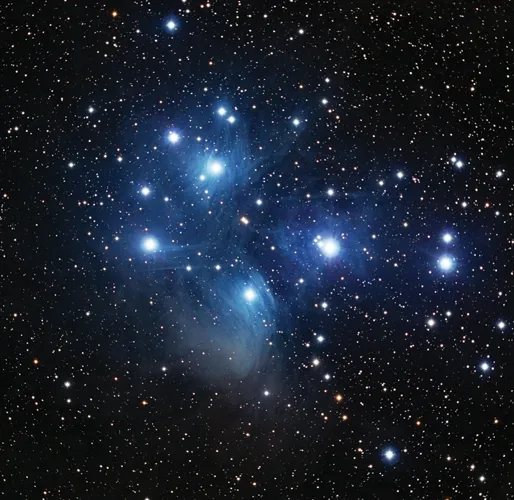
Messier 45-Pleiades photographed by Chris Baker
NGC 1333
NGC 1333 is a relatively large star-forming region at least 15 LY across and relatively close in space terms, being approximately 1000 LY away.
This picture really captures the structural complexity of the cloud, with thick dust lanes, red, yellowish and blue light and shock waves spreading out within the blue areas.
All this activity and complexity is generated by the intense star formation occurring throughout the region. Researchers have identified many stars less than one million years old, which is very young.
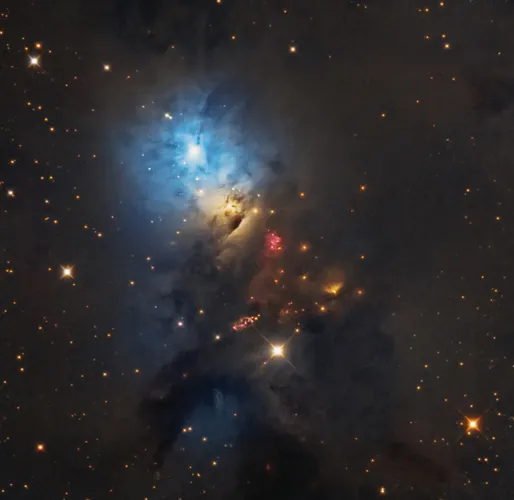
NGC 1333 photographed by Sara Wager
NGC 1499 The California Nebula
An example of an emission nebula, this is a large area of dust and gas ionized by the powerful radiation from a very hot star named Menkib.
The California nebula is about 1000 LY from Earth and extends for about 100 LY. To put this in perspective, our Solar System has a diameter of about 1.87 LY.
Intricate patterns weave throughout the structure making it a challenging and fascinating object to photograph. Here I have captured just the central portion of the nebula, showing the wispy filaments extending far out into space. It is named as such because parts of it appear to resemble the outline of the US State.

NGC 1499 Photographed by Chris Baker
Messier 42 The Orion Nebula
This beautiful nebula is a star-forming region with glowing hot gases, plasma and dust creating a stunning range of colours. The nebula is approximately 1,300 LY away from the Sun, therefore a close neighbour in astronomical terms.
The Orion Nebula is one of the most iconic objects in the night sky, rising on winter nights in the northern hemisphere. Easily viewed with the naked eye it can be seen just below the three stars of Orion’s belt forming part of his sword.
Orion Nebula is part of a much large nebula known as the Orion Molecular Cloud which appears to extend over much of the constellation Orion. Throughout the cloud there are many concentrated star-forming regions with baby stars in various stages of development. Astronomers sometimes refer to these regions as stellar nurseries. A number of these areas are also images in this book, such as the Horsehead Nebula and Messier 78.
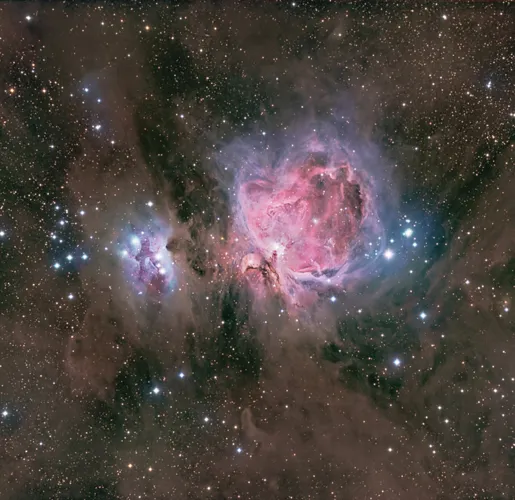
Messier 42 The Orion Nebula photographed by Sara Wager
Messier 27 The Dumbbell Nebula
The Dumbbell is the remains of a star going through the penultimate stage of its life. As stars of average mass run out of fuel they blow-off their outer shells of gas and in doing so often create interesting and colourful surrounding structures. These are known as planetary nebulae although they have nothing to do with planets. Our Sun will end its life as a planetary nebula, but no time soon.
Planetary nebulae are targets for astro photographers as they show intricate details and can be quite beautiful or even dramatic. In this picture, you can see the filaments are quite uneven in their structure. This is because the star in its death throes has a second star as a neighbour which is younger and not yet dying, the forces of the two stars combining to create the uneven structure. The Dumbbell is in the region of 1,400 LY away.
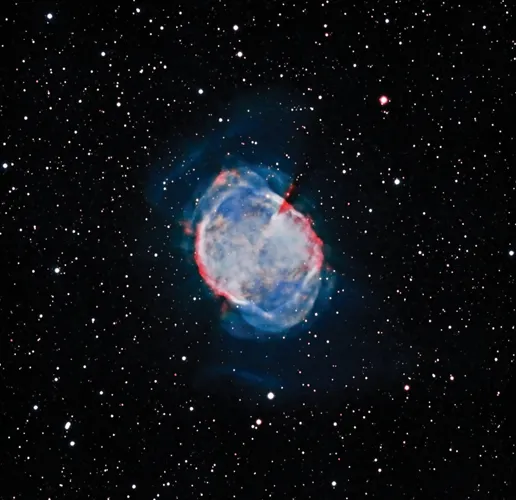
Messier 27 The Dumbbell Nebula photographed by Chris Baker
The Horsehead Nebula
This image captures not only the Horsehead Nebula but also the orange Flame Nebula, the bright star Alnitak and the blue reflection nebula NGC 2023.
The Horsehead and the other nebulae you see here are approximately 1,500 LY away. All these nebulae are part of a larger nebulous region known as the Orion Molecular Cloud.
The Horsehead shape on the right of the image is a column of ionized gases combined with dense clouds of dust; the particles are less than a millimetre in size. Despite the small particle size, the cloud’s density is so high the cloud obscures light shining through from the bright emission nebula behind. It is the column of dust that creates the iconic Horsehead, appearing to rise dramatically in space.
Surrounding and behind the Horsehead are less dense dust clouds and ionized gases in which new stars are being born. Unlike the Horsehead itself, this background expanse of dust and gas has dissipated. It is predicted that within 6 million years the Horsehead shape will disappear as the gas and dust itself also dissipates. For the time being though, the Horsehead is in the region of 4 LY in height and 3 LY across and a magnificent object to photograph.
Below and to the left of the Horsehead is the blue reflection nebula, catalogued as NGC 2023. This nebula at 4 LY in size is one of the largest reflection nebulae discovered. The dust within this area is reflecting energy from the hot star at the centre, showing as blue light. This star is many times hotter than our own Sun.
To the left of the image is the nebula known as the Flame Nebula. This quite beautiful area of dust and gas is a star forming region, with stars ranging from a few hundred thousand years old to a kindergarten age of 1-2 million years. The dark lane which splits the Flame in two is a thick dust cloud in the foreground, probably from the same cloud which makes up the Horsehead Nebula.
Finally, the magnificent bright star Alnitak is the easternmost star of the three stars in Orion’s belt. If you get the chance on a winter’s night to see the constellation Orion then you will easily see these three stars.

The Horsehead Nebula photographed by Chris Baker
The Horsehead Nebula (in Black and White)
Most of the images in this book are photographed through a range of filters. The data from each filter is then combined in a variety of ways to create colour images. Typically, red, green and blue filters have been used. This photograph was taken with a single filter, hence its black and white appearance.
Star forming regions (such as that surrounding the Horsehead in the nebula), typically emit strongly at one wavelength of visible light. This light is emitted by an ionized state of hydrogen. Therefore, astro photographers use a filter which isolates that wavelength or colour of light.
The attraction of using this one filter (to capture the strong signal) is that it shows the most intricate details of a nebula. This is a great example.
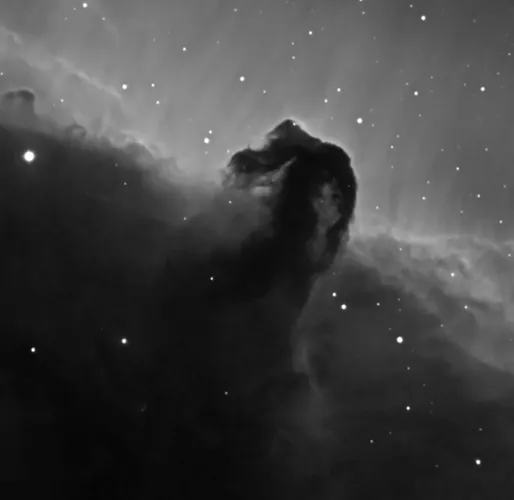
The Horsehead Nebula (Black and White using a Hydrogen Alpha filter) photographed by Chris Baker
The Pelican Nebula
The Pelican Nebula is a large cloud of dust combined with hot and cold gases, stretching across almost 6 LY of space. It is in the direction of the constellation Cygnus (the Swan) which can be seen high in the summer night sky from the northern hemisphere. The nebula is approximately 1,500 LY away.
The Pelican Nebula is a star-forming region. The young and very hot stars are heating the cold gas and causing shock waves and fronts in the cloud. These shock waves can clearly be seen in this image. The darker areas are clouds of dust obscuring the light from behind and help create the pelican shape.
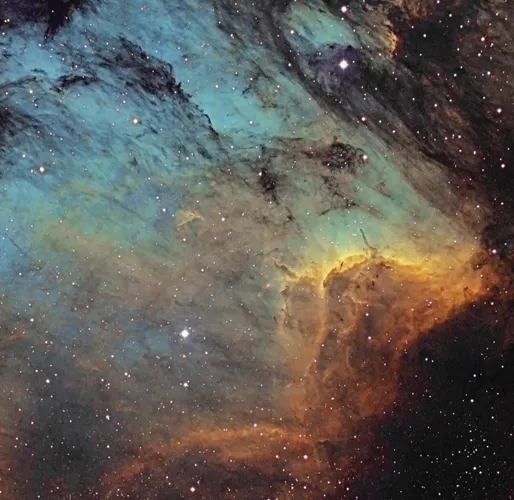
The Pelican Nebula photographed by Chris Baker
The Pelican Nebula- Star Formation
This image is a close-up of the back of the Pelican’s neck. At the very tip of the column you can see two white plumes ejecting in opposite directions. This is known as a Herbig-Haro object, after the joint discoverers and is a tell-tale sign of star formation.
During a star’s development, there is a period during which there is a spinning accreting disc of dust and gas. In certain circumstances, this matter can be ejected at high speeds in line with the magnetic poles of the developing star. Travelling at many thousands of miles per second the matter hits the surrounding material and shows up as a white plume at visible wavelengths. This is exactly what you can see here. These Herbig-Haro...
Table of contents
- Cover
- Title
- Copyright
- CONTENTS
- ACKNOWLEDGEMENTS
- ABOUT THE AUTHOR
- PREFACE
- SPACE, TIME AND PLACE
- IMAGES FROM WITHIN OUR GALAXY
- THE ANCIENT EARTH
- IMAGES FROM BEYOND OUR GALAXY
- OBSERVING AND PHOTOGRAPHING SPACE
- THE CONTRIBUTORS
- APPENDICES
- POEM by Susan Taylor
Trusted by 375,005 students
Access to over 1.5 million titles for a fair monthly price.
Study more efficiently using our study tools.
Frequently asked questions
Yes, you can cancel anytime from the Subscription tab in your account settings on the Perlego website. Your subscription will stay active until the end of your current billing period. Learn how to cancel your subscription
No, books cannot be downloaded as external files, such as PDFs, for use outside of Perlego. However, you can download books within the Perlego app for offline reading on mobile or tablet. Learn how to download books offline
Perlego offers two plans: Essential and Complete
- Essential is ideal for learners and professionals who enjoy exploring a wide range of subjects. Access the Essential Library with 800,000+ trusted titles and best-sellers across business, personal growth, and the humanities. Includes unlimited reading time and Standard Read Aloud voice.
- Complete: Perfect for advanced learners and researchers needing full, unrestricted access. Unlock 1.5M+ books across hundreds of subjects, including academic and specialized titles. The Complete Plan also includes advanced features like Premium Read Aloud and Research Assistant.
We are an online textbook subscription service, where you can get access to an entire online library for less than the price of a single book per month. With over 1.5 million books across 990+ topics, we’ve got you covered! Learn about our mission
Look out for the read-aloud symbol on your next book to see if you can listen to it. The read-aloud tool reads text aloud for you, highlighting the text as it is being read. You can pause it, speed it up and slow it down. Learn more about Read Aloud
Yes! You can use the Perlego app on both iOS and Android devices to read anytime, anywhere — even offline. Perfect for commutes or when you’re on the go.
Please note we cannot support devices running on iOS 13 and Android 7 or earlier. Learn more about using the app
Please note we cannot support devices running on iOS 13 and Android 7 or earlier. Learn more about using the app
Yes, you can access Photographing the Deep Sky by Chris Baker in PDF and/or ePUB format, as well as other popular books in Art & Photography. We have over 1.5 million books available in our catalogue for you to explore.