eBook - ePub
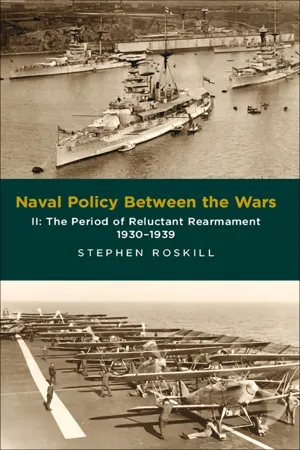
Naval Policy Between the Wars, Volume II
The Period of Reluctant Rearmament, 1930–1939
- 544 pages
- English
- ePUB (mobile friendly)
- Available on iOS & Android
eBook - ePub
Naval Policy Between the Wars, Volume II
The Period of Reluctant Rearmament, 1930–1939
About this book
First published in 1968 and 1976, the two volumes of this work still constitute the only authoritative study of the broad geo-political, economic and strategic factors behind the inter-war development of the Royal Navy and, to a great extent, that of its principal rival, the United States Navy. Roskill conceived the work as a peacetime equivalent of the official naval histories, filling the gap between the First World War volumes and his own study of the Navy in the Second. As such it is marked by the extensive use of British and American sources, from which Roskill extracted shrewd and balanced conclusions that have stood the test of time. Picking up the story in 1930, this volume covers the rise of the European dictatorships on the one hand, alongside continuing attempts at controlling arms expenditure through diplomacy and treaties. Eventually, Italian, German and indeed Japanese aggression diminished the prospects for peace, to the point where Britain felt forced to rearm. How the Navy used the precious few years leading up to the outbreak of war is a crucial section of the book and forms a fitting conclusion to this important study of the inter-war years.
Information
Topic
GeschichteSubtopic
Militär- & SeefahrtsgeschichteCHAPTER I
Setting the Stage
1929–1930

IN THE British General Election held on 30th May 1929 the Labour Party won 287 seats and was for the first time the largest party; but as the Conservatives held 261 seats and the Liberals 59 Ramsay MacDonald found himself, as in 1924, in a minority—if the other two parties combined against him. None the less when Baldwin resigned on 4th June and the King sent for MacDonald he accepted the invitation to form a government. Though unemployment was slightly lower than a year earlier, and continued to fall until December, the Labour Party had the misfortune to resume office just before the whole structure of post-war international economy collapsed. The crisis began with the crash on the American Stock Exchange at the end of October.
In the United States Herbert Hoover took over the Presidency from Calvin Coolidge on 4th March 1929 and appointed as his ambassador to London General Charles G. Dawes, whose name had previously been connected with the 1924 ‘Dawes Plan’ for the restoration of economic stability in Germany and the resolution of the Reparations issue which had bedevilled European economic and political relations ever since the signature of the Versailles Treaty.1
At the end of May 1929, shortly before the General Election, Admiral W. W. Fisher, the Deputy Chief of Naval Staff, circulated a comprehensive ‘Summary of Admiralty Policy’. It began with a restatement of the principle of the ‘One Power Standard’, which he defined as the maintenance of ‘such strength as will ensure adequate security for British territory, together with freedom of sea passage to and from all parts of the Empire’. As war with the USA was not considered a possibility and Japan was the next strongest naval power ‘war in the Far East’, he continued, ‘[must] form the general basis on which preparations are made’. Thus the development of the Singapore base, even on the ‘truncated scheme’ approved in 1926,2 which should be completed by 1937, assumed great importance, as did the building up of the oil reserves which were essential to enable a major fleet to proceed to the Far East and operate there. As regards building programmes the Admiralty aimed to obtain approval for steady and continuous replacements within the terms of the Washington Treaty of 1922, so that specialised manufacturing equipment did not become obsolete or skilled workmen lost to the industries concerned. As seventy cruisers, ten of which could be over the twenty-year age limit, were necessary ‘to meet Empire requirements’ three such ships should be laid down yearly. Taking account of the submarine strength of other powers a total of 144 flotilla leaders and destroyers was considered necessary, to meet which total nine ‘must be laid down annually’. ‘War requirements’ of submarines were assessed at sixty large ones for overseas patrol and fleet work, to achieve which six must be included in each year’s programme. Finally fifty-three sloops were needed for the variety of duties likely to fall to that class, including minesweeping; and that meant that seven should be built each year.
Regarding the reduction of armaments the Admiralty reiterated their preference for limitation by ‘categories’ rather than by ‘global tonnage’, and for limitation of displacement and calibre of main armaments within each category.
Policy concerning the Fleet Air Arm was governed by the Trenchard-Keyes agreement of 1924;3 but the Admiralty planned to keep five aircraft carriers in full commission and one in reserve. The new ship of that class, provision for which had originally been included in the 1929–30 estimates,4 had been ‘deferred’, but the Admiralty planned a steady increase of carrier aircraft from the 141 in service in 1929 to 251 in 1938—plus 50% reserves of aircraft and 150% of engines.5
In July Sir Oswyn Murray, the Permanent Secretary, circulated another paper by the DCNS on ‘Redistribution of the Fleet’. Admiral Fisher drew attention to the fact that this matter had been under discussion since 1924, and that the congestion prevailing in Malta’s harbours when the whole Mediterranean Fleet was concentrated there, together with the problems produced by the large proportion of naval personnel on foreign service, made it desirable to undertake a fundamental review of policy. The proposals put forward came under two headings. The first was to combine the Atlantic and Mediterranean Fleets under one C-in-C, while the second was to transfer certain ships from the Mediterranean to the Atlantic Fleet. As opposition to the first alternative by the Cs-in-C concerned was apparent Fisher suggested that the only solution was to transfer the Queen Elizabeth class battleships, except for the name ship which would stay on as Mediterranean fleet flagship, to the Atlantic Fleet. Admiral Sir Charles Madden, the First Sea Lord, concurred and the redistribution was in fact gradually carried out.6
To turn to the US Navy’s policy at the opening of our period it was governed, firstly, by the basic principles of the achievement of parity with Britain—the ‘navy second to none’ of the Paris Peace Conference7—which in fact corresponded exactly to the Admiralty’s ‘one Power Standard’. Second came the maintenance of the Monroe Doctrine, which at this time was still regarded as having authority approaching that of holy writ.8 The third principle was support for the ‘Open Door’ for trade with China. In addition the General Board remained anxious regarding the strategic weakness of the US Navy’s position vis à vis that of Japan in the western Pacific which resulted from the Four Power Pact signed at Washington in 1922, and of the difficulty of defending the Philippines and other American possessions or dependencies in that area with no properly equipped base west of Hawaii. As regards the composition of the fleet the General Board strongly disliked any reduction of capital ship displacement and armament below the 35,000 tons and 16-inch guns agreed as the upper limits in the Washington Treaty.
The General Board still stood firmly by the view that ‘the battleship is the ultimate measure of strength of the Navy’9—as indeed did the British Sea Lords. None the less Admiral W. A. Moffett, still Chief of the Bureau of Aeronautics,10 remained a staunch supporter of the carrier-borne strike aircraft as the primary offensive weapon of the future; and it was perhaps his influence that led to President Hoover’s acceptance of the view that the end of the period of dominance by the big gun battleship was approaching.
As regards cruisers the US Navy was still inferior to the British both in numbers and in tonnage, which rankled with the General Board. But the Act of 13th February 1929 authorised the building of fifteen cruisers (five in each year 1929–31) and one aircraft carrier.11 The General Board was always insistent that their country’s needs in relation to Japan made large numbers of 10,000-ton long-endurance Washington Treaty cruisers essential.
In meeting the difficulties produced for naval architects by the need to design the completely new class of cruiser permitted by the Washington Treaty the US Navy was markedly more successful than the British Navy, whose Kent and London classes of 1924–26 (10,000-ton, eight or six 8-inch guns), comprising fifteen ships in all,12 were poorly protected and had the disadvantage of very high silhouettes. The Japanese too produced better treaty cruisers than the British, but in their case the superiority was we now know achieved by disregarding the displacement limitation in the case of their later ships.13
In April 1929 the US Navy’s General Board produced its programme for the Fiscal Year 1931, in which they reaffirmed the large five-year programme first put forward in 1927 and approved by the President except for the five battleships proposed and nine flotilla leaders;14 but as that programme was subject to substantial alteration we need not consider it in detail here.
The basic organisation of the US Navy established in 1922—namely a Battle Fleet, a Scouting Fleet, a Control Force and a Fleet Base Force15—was still in being in 1929; but at the end of the following year the Control Force disappeared and a Submarine Force was added.16 Prior to 1931 the Battle Fleet and the Base Force normally operated in the Pacific and the Scouting Fleet and Control Force in the Atlantic. In May 1932, as a result of Japanese aggression in Manchuria and at Shanghai, the Scouting Fleet remained in the Pacific, and the main strength of the US Navy stayed in that ocean until early in 1941 when a separate Atlantic Fleet was created.17
As regards British-American relations, on the naval level there had certainly been a marked improvement since the disastrous Geneva Conference of 1927;18 and on the American side much of the credit for the change of outlook must be accorded to Admiral W. V. Pratt, who succeeded Admiral Charles F. Hughes as Chief of Naval Operations (the equivalent to the British First Sea Lord) on 17th September 1930. Though not an extreme Anglophile like Admiral W. S. Sims, who had thereby brought violent criticism and even obloquy on his head,19 Pratt was a very fair and level-headed man whom members of the Board of Admiralty soon began to like and to trust, and with whom they never got seriously at loggerheads during negotiations on naval limitation—as had happened with Admiral W. S. Benson at the Paris Peace Conference of 1919.20 Such coolness as still existed was on the British rather than the American side, the former still regarding the US Navy as something of a parvenu from whom they had little or nothing to learn. In contrast to British naval hauteur, when American officers visited their former ally’s ships and establishments the Americans appear to have shown commendable open-mindedness and readiness to learn. For example when Captain W. D. Puleston, the future biographer of Alfred Thayer Mahan,21 toured the British naval and military staff colleges and the Imperial Defence College in 1930 he reported very favourably on our instructional methods and wanted his own service to copy the IDC.22 One may find in his report a contribution to the establishment of the US Na...
Table of contents
- Cover
- Title Page
- Copyright
- Dedication
- Contents
- Illustrations
- Glossary of Abbreviations
- Foreword
- Chapter I: Setting the Stage 1929–1930
- Chapter II: The London Naval Conference 1929–1930
- Chapter III: Financial Stringency and Disarmament 1929–1931
- Chapter IV: Invergordon, September 1931, and the Aftermath
- Chapter V: The Failure of the Search for Disarmament 1932–1933
- Chapter VI: First Moves for Rearmament 1933–1934
- Chapter VII: The Naval Aviation Controversy 1930–1935
- Chapter VIII: More Sealing Wax than Ships 1935–1936
- Chapter IX: Crisis in the Middle East 1935–1936
- Chapter X: The Second London Naval Conference 1935–1936
- Chapter XI: The Beginning of Rearmament 1936–1937
- Chapter XII: The Spanish Civil War 1936–1939
- Chapter XIII: The Naval Aviation Controversy Resolved 1936–1939
- Chapter XIV: The Road to War 1938–1939
- Chapter XV: The Last Months of Peace 1939
- Appendices
- Supplement to Bibliography
Trusted by 375,005 students
Access to over 1.5 million titles for a fair monthly price.
Study more efficiently using our study tools.
Frequently asked questions
Yes, you can cancel anytime from the Subscription tab in your account settings on the Perlego website. Your subscription will stay active until the end of your current billing period. Learn how to cancel your subscription
No, books cannot be downloaded as external files, such as PDFs, for use outside of Perlego. However, you can download books within the Perlego app for offline reading on mobile or tablet. Learn how to download books offline
Perlego offers two plans: Essential and Complete
- Essential is ideal for learners and professionals who enjoy exploring a wide range of subjects. Access the Essential Library with 800,000+ trusted titles and best-sellers across business, personal growth, and the humanities. Includes unlimited reading time and Standard Read Aloud voice.
- Complete: Perfect for advanced learners and researchers needing full, unrestricted access. Unlock 1.5M+ books across hundreds of subjects, including academic and specialized titles. The Complete Plan also includes advanced features like Premium Read Aloud and Research Assistant.
We are an online textbook subscription service, where you can get access to an entire online library for less than the price of a single book per month. With over 1.5 million books across 990+ topics, we’ve got you covered! Learn about our mission
Look out for the read-aloud symbol on your next book to see if you can listen to it. The read-aloud tool reads text aloud for you, highlighting the text as it is being read. You can pause it, speed it up and slow it down. Learn more about Read Aloud
Yes! You can use the Perlego app on both iOS and Android devices to read anytime, anywhere — even offline. Perfect for commutes or when you’re on the go.
Please note we cannot support devices running on iOS 13 and Android 7 or earlier. Learn more about using the app
Please note we cannot support devices running on iOS 13 and Android 7 or earlier. Learn more about using the app
Yes, you can access Naval Policy Between the Wars, Volume II by Stephen Roskill in PDF and/or ePUB format, as well as other popular books in Geschichte & Militär- & Seefahrtsgeschichte. We have over 1.5 million books available in our catalogue for you to explore.