"A lively account" of Napoleon's first exile and his "escape, full of cunning and daring, accident and error" (
The New York Times Book Review).
The year is 1814. The Allies have driven Napoleon's once-mighty armies back to Paris. Trapped, forced to abdicate after two decades of triumphant rule, the emperor takes leave of his comrades-in-arms and sets sail for his new domain—the tiny, poverty-stricken, pestilential island of Elba.
Yet within ten months Napoleon will enter Paris once again, at the heels of the fleeing Bourbon king, flushed with victory and cheered by the masses.
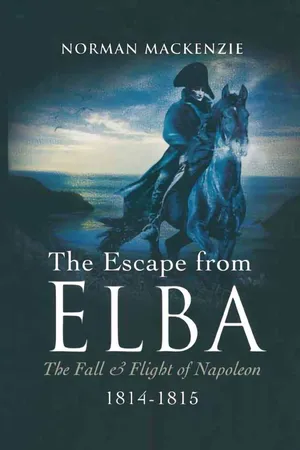
The Escape from Elba tells the heroic story of Napoleon's exile and phoenix-like return. In this classic account, Norman MacKenzie chronicles this extraordinary year: the tense last hours of Napoleon's empire, his humiliating exile, his midnight escape, and his whirlwind march over snowbound mountains to Grenoble where, in a dramatic confrontation with the French army, he became a reigning prince again.
Also described in vivid detail are Napoleon's adventures as the head of Elba. He brought society, splendor, organization, and political intrigue to this run-down backwater—and displayed on this small stage the many sides of his charismatic leadership.
Includes illustrations
- 320 pages
- English
- ePUB (mobile friendly)
- Available on iOS & Android
eBook - ePub
About this book
Information
CONTENTS
| List of Illustrations | |
| Cast of Characters | |
| Prologue | |
| 1 | The fall of the colossus |
| 2 | Surrounded by wolves |
| 3 | An ambiguous mission |
| 4 | Journey into exile |
| 5 | A change of fortunes |
| 6 | The King of Elba |
| 7 | A very small island |
| 8 | The fruits of victory |
| 9 | Family affairs |
| 10 | Two kinds of love |
| 11 | A man of ordinary talents? |
| 12 | The game of secrets |
| 13 | Confidential friends |
| 14 | The threat of default |
| 15 | Perfidious intrigues |
| 16 | Necessary preparations |
| 17 | The last of Elba |
| 18 | The flight of the eagle |
| 19 | The test of success |
| 20 | Caught in a whirlwind |
| 21 | Imperial magic |
| Epilogue | |
| Bibliographical Note | |
| Index | |
ILLUSTRATIONS
Between pages 176–177
Napoleon, 1815. An engraving by Sandoz
The Mansell Collection
The Mansell Collection
Napoleon’s Arrival on Elba (French cartoon, 1814)
‘The Robinson Crusoe of the Island of Elba’ (French cartoon, 1814)
‘Nap Dreading His Doleful Doom.’ (English caricature, April 1814)
General Drouot
BBC Hulton Picture Library
BBC Hulton Picture Library
General Cambronne
BBC Hulton Picture Library
BBC Hulton Picture Library
General Bertrand
BBC Hulton Picture Library
BBC Hulton Picture Library
Pons de l’Hérault
Colonel Sir Neil Campbell
Count Neipperg
BBC Hulton Picture Library
BBC Hulton Picture Library
Marie-Louise and the King of Rome
The Mansell Collection
The Mansell Collection
Portoferraio from the anchorage
Portoferraio: the harbour and walls
Portoferraio: Fort Stella
The house at San Martino
Napoleon’s departure from Elba, 26 February 1815
Napoleon meets the troops at Laffrey
The Congress of Vienna’, caricature by George Cruikshank
MAPS
Elba, 1814
Portoferraio
The Escape from Elba, 26 Feb–1 Mar 1815
The Route Napoleon: Golfe Juan to Grenoble, 1–7 March 1815
CAST OF CHARACTERS
This list is provided for easy reference, and it does not include persons who are of minor importance or those who are given only passing notice in the text.
| Captain John Adye | Commanding the British sloop Partridge during the escape in 1815 |
| Alexander I | Tsar of Russia from 1801 to 1825 |
| Comte d’Artois | Younger brother of Louis XVIII, who became Charles X in 1824 |
| Giuseppe Balbiani | Sub-Prefect on Elba |
| Eugene de Beauharnais | Son of the Empress Josephine, a successful soldier and Napoleon’s viceroy in Italy |
| Hortense de Beauharnais | Daughter of the Empress Josephine, wife of Louis Bonaparte, known during the first Restoration as the Duchess of St Leu |
| Josephine de Beauharnais | Widow of a guillotined aristocrat, Napoleon’s first wife and Empress until divorced in 1810 |
| Colonel de la Bédoyère | Commanding the 7th Infantry at Chambéry |
| Marshal Berthier | Napoleon’s chief of staff from 1805 to 1814 |
| General Bertrand | Appointed Grand Marshal of the Palace in 1813, and Napoleon’s chief assistant on Elba |
| Fanny Bertrand | The wife of General Bertrand, and daughter of an Irish general serving in the French army. |
| Jacques-Claude Beugnot | Royalist Director-General of police |
| Comte Blacas | Chief minister to Louis XVIII |
| Caroline Bonaparte | Napoleon’s youngest sister, married to Joachim Murat, King of Naples |
| Elisa Bonaparte | The eldest of Napoleon’s sisters, Grand Duchess of Tuscany from 1809 to 1814, married to Felix Bacciochi |
| Jerome Bonaparte | Napoleon’s youngest brother, King of Westphalia from 1807 to 1813 |
| Joseph Bonaparte | Napoleon’s elder brother, King of Naples from 1806 to 1808, King of Spain from 1808 to 1813 |
| Letizia Bonaparte | Napoleon’s widowed mother, known as Madame Mère |
| Louis Bonaparte | Napoleon’s third brother, King of Holland from 1806 to 1810 |
| Lucien Bonaparte | The only one of Napoleon’s brothers and sisters who declined royal honours |
| Napoleon Bonaparte | Former Emperor of France |
| Pauline Bonaparte | Napoleon’s second sister, separated from her husband Prince Borghese |
| Louis Guérin de Bruslart | Former royalist resistance leader, appointed military governor of Corsica in 1814 |
| General Cambronne | A veteran of the revolutionary wars, who commanded the detachment of the Imperial Guard which accompanied Napoleon to Elba |
| Colonel Neil Campbell | British commissioner on Elba in 1814 and 1815 |
| Lord Castlereagh | British Foreign Secretary from 1812, and chief delegate to the Congress of Vienna |
| General Caulaincourt | French ambassador to Russia from 1807 to 1811, Foreign Minister in the last months of the war, and Napoleon’s closest adviser during the abdication crisis |
| Captain Chautard | Commanding the Inconstant on which Napoleon made his escape from Elba |
| General Dalesrne | Commanding the French garrison on Elba at the time of Napoleon’s arrival |
| Marshal Davout | The most loyal of Napoleon’s marshals, he continued to hold Hamburg for a month after the Emperor had abdicated |
| General Drouot | A much respected artilleryman, known as ‘the sage of the army’, who became governor of Elba and then commanded the Imperial Guard at Waterloo |
| Cardinal Fesch | Half-brother to Letizia Bonaparte, who owed his successful career to Napoleon’s patronage |
| Fleury de Chaboulon | A young official who took himself to Elba early in 1815 as a self-appointed and clandestine emissary from Bonapartists in France |
| Joseph Fouché | A notable Jacobin who became Minister of Police and supported Napoleon in his rise to power. A master of secret intrigue, he was again appointed Minister of Police after Napoleon’s return to France, but after Waterloo he stage-managed the second Restoration |
| Francis I | Emperor of Austria from 1792 to 1835, and father of Marie-Louise |
| Frederick William III | King of Prussia from 1797 to 1840 |
| George, Prince of Wales | Prince Regent from 1811, he was effectively king during his father’s long illness. He became George IV in 1820 |
| Baron Hager | Head of the Austrian secret police |
| Prince Hardenberg | Chancellor of Prussia, and the most trusted adviser of Frederick William III |
| Hyde de Neuville | French royalist agent, who undertook many secret missions |
| Comte de Jaucourt | Talleyrand’s deputy in the Ministry of Foreign Affairs under Louis XVIII |
| King of Rome | The son of Napoleon and Marie-Louise, born in 1811, also known as Napoleon II and the Duke of Reichstadt |
| General Köller | Austrian commissioner accompanying Napoleon to Elba |
| Colonel Téodor Lacynski | Brother of Maria Walewska, and one of several Polish officers closely attached to Napoleon |
| Dr Christian Lapi | Commander of the National Guard on Elba |
| Count Lavalette | A former aide of Napoleon’s, married to the niece of Empress Josephine, and Postmaster-General in the last days of the Empire. An ardent Bonapartist |
| Lord Liverpool | British Prime Minister from 1812 |
| Louis XVIII | Brother of the guillotined Louis XVI, leader of the royalist emigration, he returned to Paris in 1814, and again after Waterloo, remaining king until his death in 1824 |
| Marshal Macdonald | Son of a Jacobite exile, he served through all the wars and played a leading role in the abdication crisis |
| General Marchand | Commander of the garrison at Grenoble in 1815 |
| Hughes Bernard Maret | One of Napoleon’s closest advisers, a trusted diplomat, Foreign Minister from 1811 to 1813, and one of the leaders of the Bonapartist faction in France under the first Restoration |
| Marie-Louise | Daughter of the Emperor Francis of Austria, she became Empress of France on her marriage to Napoleon in 1810 |
| Chevalier Mariotti | French consul and secret agent at Livorno |
| Marshal Marmont | One of Napoleon’s closest comrades-inarms, he negotiated the surrender of Paris in March 1814, and planned the defection of the Sixth Corps a few days later. |
| Comte de Maubreuil | Royalist intriguer, involved in abortive assassination plots against Napoleon |
| Baron de Méneval | Personal secretary to Marie-Louise |
| Prince Clemens Metternich | Austrian ambassador in Paris from 1806 to 1809, he became Foreign Minister, and he was the dominant figure at the Congress of Vienna |
| Marshal Moncey | Commander of the National Guard in Paris in 1814 |
| Marshal Mortier | Commanded the Old Guard during the fighting in Champagne and the defence of Paris |
| Joachim Murat | Married to Napoleon’s sister Caroline, and King of Naples from 1808, he abandoned Napoleon’s cause in 1814 after secret negotiations with the Austrians |
| Count Neipperg | Austrian general and diplomat who negotiated Murat’s defection in 1814, and was charged with the supervision of Marie-Louise after Napoleon’s defeat |
| Marshal Ney | Commander of the rearguard during the retreat from Moscow, he was spokesman for the dissident marshals during the abdication crisis and then became a senior officer under the first Restoration |
| Oil Merchant | The name given to a French secret agent on Elba reporting to Mariotti, who was probably an Italian named Alessandro Forli |
| Louis Philippe | The duc d’Orléans, who fought with the revolutionary armies in 1793, though a member of the French royal family. He then defected and spent twenty years in exile. Considered a liberal, and an alternative to the more reactionary Bourbons, he was long a focus for intrigue though he was never personally compromised. He became King of France after the 1830 revolution |
| Guillaume Peyrusse | Napoleon’s treasurer |
| Pons de l’Hérault | Administrator of the iron mines on Elba |
| Pozzo di Borgo | Corsican exile who became one of Tsar Alexander’s advisers |
| Marshal Schwarzenberg | Commander in chief of the Allied armies from August 1813 |
| General (Count) Shuvalov | Personal envoy of the Tsar and Russian commissioner accompanying Napoleon to Elba |
| Lieutenant Taillade | Commanding Napoleon’s small flotilla on Elba until shortly before the escape |
| Prince Charles Maurice de Talleyrand | Former bishop, first appointed Foreign Minister in 1797, a strong supporter of Napoleon until 1807. Thereafter much involved in political intrigue, and after secret negotiations with the Allies he became the organizer of the Provisional Government in 1814. A notable champion of French interests at the Congress of Vienna |
| Traditi | Mayor of Portoferraio |
| Count Truchsess-Waldbourg | Prussian commissioner accompanying Napoleon to Elba |
| Captain Thomas Ussher | Commanding the British frigate Undaunted in 1814, which carried Napoleon to Elba |
| Maria Walewska | Known as Napoleon’s ‘Polish wife’, she became his mistress in Warsaw in 1807 and their son Alexander was born in 1810 |
PROLOGUE
In the first months of 1814 the Emperor Napoleon was defeated, forced to abdicate, and banished to the island of Elba. Within a year, after an escape which startled Europe like a thunderclap, he was back in France and preparing for the campaign which ended in the ruin of all his hopes at Waterloo. There was nothing more remarkable in his whole remarkable career than these rapid changes of fortune, and his response to them, which are the subject of this book.
There have been many biographies of Napoleon, as the legend of his victories echoes down the years, but on Elba we see him at close quarters, stripped of his panoplies and perquisites, yet still displaying the habits of power, deprived of his army and his host of functionaries, yet still moved by the impulses that drove his troops to the Pyramids and to the Kremlin and created an empire that briefly rivalled ancient Rome. Against his two decades of fame the year on Elba seems small, like an image seen through the wrong end of a telescope, but it shines sharp, with every characteristic clear. It shows the egotism of the Corsican soldier of fortune who has tamed a revolution, crowned himself like a Caesar, married a Habsburg, and become the master of Europe. It reveals the brooding patience and the capacity for sudden decision that mark a brilliant commander, the systematic vision of the lawgiver, the benevolence with which he patronizes the arts and sciences, encourages manufacturers, trade, improves agriculture, education, and sanitation, builds roads and harbours. And it focuses on the personal charm and the petulance with which he gets his way, the soldierly camaraderie which seems the only spontaneous aspect of a man so absorbed in his self-created role of greatness that he finds it easier to strike attitudes than to show real pity, anger, remorse or affection.
Napoleon on Elba was indeed a complete miniature of the Man of Destiny, with all his virtues and all his faults scaled down to human size, with no field of action for his abounding energy except the tiny kingdom in which his enemies had with derision installed him; and the contrast between past glories and present adversity was peculiarly humiliating. He had been the foremost man of his time, shaking kingdoms and redrawing maps as the fancy took him, etching such battle-honours as M...
Table of contents
- Cover
- Half Title
- Full Title
- Copyright Page
- Acknowledgements
- Contents
Trusted by 375,005 students
Access to over 1.5 million titles for a fair monthly price.
Study more efficiently using our study tools.
Frequently asked questions
Yes, you can cancel anytime from the Subscription tab in your account settings on the Perlego website. Your subscription will stay active until the end of your current billing period. Learn how to cancel your subscription
No, books cannot be downloaded as external files, such as PDFs, for use outside of Perlego. However, you can download books within the Perlego app for offline reading on mobile or tablet. Learn how to download books offline
We are an online textbook subscription service, where you can get access to an entire online library for less than the price of a single book per month. With over 1.5 million books across 990+ topics, we’ve got you covered! Learn about our mission
Look out for the read-aloud symbol on your next book to see if you can listen to it. The read-aloud tool reads text aloud for you, highlighting the text as it is being read. You can pause it, speed it up and slow it down. Learn more about Read Aloud
Yes! You can use the Perlego app on both iOS and Android devices to read anytime, anywhere — even offline. Perfect for commutes or when you’re on the go.
Please note we cannot support devices running on iOS 13 and Android 7 or earlier. Learn more about using the app
Please note we cannot support devices running on iOS 13 and Android 7 or earlier. Learn more about using the app
Yes, you can access The Escape from Elba by Norman MacKenzie in PDF and/or ePUB format, as well as other popular books in History & Military & Maritime History. We have over 1.5 million books available in our catalogue for you to explore.