A documentary history of the war of annihilation Nazi Germany fought against the Soviet Union, its people and the Red Army during World War II.
Histories of the German army on the Eastern Front generally focus on battlefield exploits on the war as it was fought in the front line. They tend to neglect other aspects of the army's experience, particularly its participation in the racial war demanded by the leadership of the Reich. This ground-breaking book aims to correct this incomplete, often misleading picture. Using a selection of revealing extracts from a wide range of wartime documents, it looks at the totality of the Wehrmacht's war in the East.
The documents have previously been unpublished or have never been translated into English, and they offer a fascinating inside view of the army's actions and attitudes. Combat is covered, and complicity in Hitler's war of annihilation against the Soviet Union. There are sections on the conduct of the war in the rear areas logistics, medical, judicial and the army's tactics, motivation and leadership. The entire text is informed by the latest research into the reality of the conflict as it was perceived and understood by those who took part.
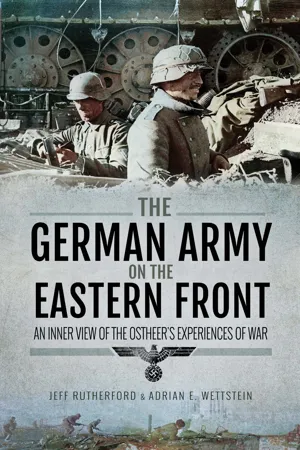
eBook - ePub
The German Army on the Eastern Front
An Inner View of the Ostheer's Experiences of War
- 240 pages
- English
- ePUB (mobile friendly)
- Available on iOS & Android
eBook - ePub
The German Army on the Eastern Front
An Inner View of the Ostheer's Experiences of War
About this book
Information
Print ISBN
9781473861749
Chapter 1
Combat on the Eastern Front
During the Second World War, the decisive theatre of war for the German army was the Eastern front. Perhaps the most effective way to measure the importance of this front for the German war effort is by looking at the army’s casualties in the east. According to the historian Stephen Fritz, the Germans suffered over 3.5 million dead fighting the Red Army, with another 363,000 dying in Soviet POW camps. This total meant that ‘almost four of every five German military deaths thus came at the hands of the Red Army.’1 The Germans inflicted much heavier casualties on their Soviet adversaries, with 11.5 million the generally accepted number of military deaths, though other estimates reach upwards of some 25 million.2 These numbers – which far and away dwarf those from the Western Allied-German conflict – not only suggest that the German-Soviet war was the largest and deadliest theatre of war, but they also highlight the German army’s primary goal during the conflict: defeating the Red Army on the battlefield. This seemingly obvious point, however, has been somewhat lost in the recent historiography which has focused – rightly – on the accompanying war of extermination waged by the Nazi state. While the Third Reich’s ideological war will be examined in chapters 5 and 7, this chapter will examine the army’s struggle on the field of combat and the success, as well as the trials and tribulations it suffered during the little more than three years of war within the borders of the Soviet Union.3
German planning for the invasion of the Soviet Union was based upon two fundamental ideas. First, success in the campaign would depend on the panzer divisions, concentrated in panzer groups, driving quickly into the interior of the Soviet Union and destroying the bulk of the Red Army before it could retreat behind the Dvina and Dnieper rivers. Following this initial operational phase, the army would then carry out a mopping-up of the shattered Soviet forces, eventually pushing what remained behind the Ural mountains.4 Second, the army possessed a not entirely mistaken belief in its superiority vis-á-vis Soviet forces. Germany’s blitz victories over a whole series of opponents in between 1939 and 1941, but especially its shocking defeat of British and French forces in 1940, generated a true self-confidence throughout the army’s ranks. This was contrasted by the Red Army’s poor performances during its 1939 occupation of Eastern Poland and, more importantly, during the 1939–40 Winter War with Finland. The confidence, even hubris, with which the army approached the eastern campaign thus led to a criminal underestimation of Red Army capabilities, as well as a negligent attitude towards issues of intelligence and supply (see chapter 4 for a thorough analysis of the latter point). From the German perspective, the army’s superiority at the operational and tactical level would ensure a quick and decisive victory, making other considerations secondary at best.5
On 22 June 1941, some three million German and allied soldiers invaded the Soviet Union, the largest invasion in history up until that point. On the macro-level, German forces achieved success along the entire breadth of the front, from the Baltic States to Ukraine. With the exception of Army Group South, whose initial advance was more pedestrian, German forces, particularly the Panzer Groups attached to Army Group Centre, plunged deep into Soviet territory and not only reached their initial geographic goals, but destroyed numerous Soviet armies in the process.6 The following battle report compiled by Panzer Group 3 highlights both the unit’s role in the Minsk battle and the conflict that emerged at the upper levels of the German army concerning the employment of armour: should manageable encirclement battles be waged in succession, or should the panzers drive as deeply into the Soviet rear as possible in an attempt to completely dislocate the Soviet defence?7
The border heights were quickly taken. [...] On all places along the front, only minimal enemy resistance was reported. Only a very few prisoners, all of whom were completely in the dark about the beginning of the war and the situation.
The question arose at the Panzer Group if the German attack really was a complete surprise for the Red Army or if the enemy had pulled back some of his forces from between the border and the Niemen [River] to the east under a wide-ranging radio deception.
Gradually, the evidence increased during the course of 22.6. That still stronger enemy forces existed west of the Niemen than at first presumed. If the reported divisions existed in full strength or only partially [as they were] still in the process of formation, because they were too poorly armed, remained unclear. It was determined that these elements were without live ammunition, allegedly released for an exercise.
Where the enemy chooses, he fights tenaciously und courageously until death. Deserters and surrender has been reported by no command. The struggle became therefore harder than in the Polish and the Western campaigns.
As in Poland, the enemy was driven into the forests by our air attacks, from which he conducts a successful guerrilla war against rear elements and [supply] columns. This may also be a reason for the initially surprisingly small appearance of enemy forces. How much of them are hidden in the forests and how much equipment that they were forced to leave in them cannot be overlooked yet. [...]
From Vilna to Minsk
During all discussions for the Barbarossa deployment, there existed differing conceptions about the continuation of the operation after the crossing of the Niemen for Army Group B and Panzer Group 3. Panzer Group 3 had the intention to push on to the Dvina [River] on the nearest road without turning to secondary issues too quickly. The intention of the OKH8 to create the prerequisite for the destruction of the enemy between Bialystok and Minsk with Panzer Group 2 and 3 would have been better achieved, in the view of Panzer Group 3, through a thrust to the Dvina to prevent withdrawal and new resistance there, than [through a thrust] with the narrowly pinned goal on Minsk. The army group left the decision open before the beginning of the attack and ordered an intermediate objective Molodeczno-Narach Lake to proceed either to Minsk or to Vitebsk-Polotsk.
After reaching Vilna on 26.6., Army Group Centre ordered a thrust on the high ground near Minsk to encircle the retreating troops in front of Fourth and Ninth Armies and to make a connection with Panzer Group 2.
Panzer Group 3, still believing that elements of the enemy pulled back to the east and that it was necessary to pursue them over the Dvina, once again tried to plead its point of view to the OKH through the OKH liaison officer. OKH, however, maintained its conviction for the objective for Panzer Group 3 from the deployment directive: to reach the heights of Minsk.
Once the connection was made with Panzer Group 2, Panzer Group 3 decided to start the advance on the Dvina with the bulk of the group. In contact with Ninth Army and Panzer Group 2, two divisions should have continued to block against the encircled enemy by Minsk. In contrast to Army Group Centre, Panzer Group 3 believed this was acting properly because it no longer attached any combat value to the encircled enemy and therefore the larger goal lay on the Dvina. Waiting until the last Russian had surrendered was not permissible, especially since the encircled enemy seemed to escape to the southeast through the gaps of Panzer Group 2 from 30.6. on.
The intention of Panzer Group 3 was to drive on to the upper Dvina from 2.7. without further delay. It was expected that the enemy would defend the Berezina and Dvina River sectors with resistance groups of reserves and elements of soldiers broken out of the encirclements, without depth and a coherent front, but they has already been shattered through the drive of Panzer Group 2 at Bobruisk and Panzer Group 4 by Dvinsk.
As the report notes, the war experienced by German units at the sharp end was costly during the opening days of the invasion. Despite the surprise achieved along the breadth of the front, and the tremendous numbers of prisoners taken, Soviet forces resisted tenaciously in various places and the casualties of German units involved in the initial battles were among the highest in the war.9 More importantly, the document highlights the central issue between the various Army Group, Army, and Panzer Group commanders concerning the use of armour. For the generals commanding infantry armies, the encircled enemy forces to their front needed to be eliminated and this could only be accomplished by the Panzer Groups not merely closing the trap, but also turning the vice and driving Red Army troops into the cauldron created by the eastward marching infantry. For the panzer generals, however, what mattered was utilizing the speed and mobility of the Panzer Groups to the utmost; instead of wasting them in relatively static engagements against an already encircled foe, they wanted to leave a minimum of force to maintain the encirclement and put the remainder of their units on the road to the east to forestall the formation of any form of coherent Soviet defence. Such visions of deep Panzer thrusts to the east, however, failed to correspond to the realities of the Germans’ already creaking logistic system, as well as the much slower speed of the infantry armies that were essential to both occupying Soviet territory and destroying the cauldrons created by the Panzer Groups. In the example given here, Army Group Centre sided with the infantry generals and ordered Panzer Group 3 to close the encirclement of Soviet troops at Minsk with Panzer Group 2. This led to one of the most noteworthy successes of the campaign: the twin encirclement battles of Bialystok-Minsk in which some 324,000 Soviet soldiers were taken prisoner and more than 5,100 tanks and artillery pieces were wiped out of the Red Army’s order of battle.10 The employment of German armour thus led to spectacular battlefield victories, but the Soviet Union’s very geography presented the Germans with stiff challenges to their preferred method of war.
The German army soon found that the Soviet theatre did not lend itself to the type of armoured warfare that had worked so spectacularly in France. One of the primary issues in the east was the lack of suitable roads. While this was a problem across the breadth of the front, it proved to be an especially intractable one for units operating in Army Group North, as its area of deployment was peppered with swamps and bogs. The following excerpts from the 8th Panzer Division’s war diary highlight this obstacle to a blitz-type campaign.11
6.7.41: In addition to numerous smaller corduroy roads, an especially long corduroy road was built along the east bank [of the Ludza] that required some three to four thousand tree trunks that were cut down by the engineers from the outlying forests, had all the branches cut off, were cut into pieces, transported to the departure point and since they needed to be driven to the work site, were put on trucks that had been captured on the east bank and made drivable. Since the forest terrain was swampy, the engineers stood with water over their waists most of the time while dragging around the trunks. [...]
19.10.41: The extraordinarily difficult road conditions, the swampy terrain, with no room for the tactical manoeuvre of vehicles, and the slow movement of troops over the Volkhov bridges make only a very gradual advance of forces possible. Mine and tree obstacles allow for only a dismounted advance. All available forces must be deployed for road construction. [...]
31.10.41: The moors under the snow covering are only frozen a little bit and after each passing of only a few tanks, the road is completely impassable. [...]
Unlike France and its well-maintained and relatively dense road network, the Soviet Union’s nearly non-existent system of roads precipitously slowed German armour and motorized divisions, frequently forcing them to wait for engineers to construct makeshift roads and bridges along the routes of advance.12 The document also hints at the mounting tasks for soldiers, who were not only expected to fight the Red Army while advancing, but also found themselves labouring to make the advance possible.
Partially a result of these poor roads, but also due to stiff Soviet resistance, German armour divisions suffered heavy material losses during the opening months of the invasion. The following war diary entry from the XXXXVIIth Panzer Corps paints a troubling picture of those units that the success of the entire operation depended on.13
The following numbers are symptomatic of the present strength of the 18th Panzer Division:
From an authorized strength = 42 3.7cm and 9 5cm anti-tank guns are as of now 22 3.7cm and 8 5cm anti-tank guns combat-ready guns available. The 52nd Rifle Regiment alone has altogether 1,000 casualties from a combat strength of 2,359 men on 22.6.41, and what has to be considered here is that the disproportionally largest share of the casualties fall upon the dismounted elements that fight the battle. The division now has only 47 battle-worthy tanks against the 276 it had on 22.6. In addition, the division has a total loss of 1,300 vehicles. A further 1,000 vehicles are under repair, of which 500 can again be made operational. The French vehicles, with which the 18th Panzer Division is predominantly equipped, have proven to be cumbersome and therefore of limited use off-road.
The dramatic decrease in operational tanks significantly damaged the 18th Pa...
Table of contents
- Cover
- Title
- Copyright
- Contents
- Introduction
- Chapter 1: Combat on the Eastern Front
- Chapter 2: Command and Leadership in the Ostheer
- Chapter 3: The German Army in the East as a Fighting Machine: Tactics, Weapons and Organization
- Chapter 4: Supplying the German Eastern Army
- Chapter 5: The Occupied Rear: Pacification, Exploitation and Mobilization
- Chapter 6: Sustaining the German Army in the East – Replacements and Training
- Chapter 7: The German Army’s Understanding of the War in the East: Ideology and Motivations
- Conclusion
- Appendix A: Glossary
- Appendix B: Organization of a German Infantry Division Staff
- Appendix C: Table of units and their size
- Appendix D: Table of ranks
- Notes
- Plate section
Trusted by 375,005 students
Access to over 1.5 million titles for a fair monthly price.
Study more efficiently using our study tools.
Frequently asked questions
Yes, you can cancel anytime from the Subscription tab in your account settings on the Perlego website. Your subscription will stay active until the end of your current billing period. Learn how to cancel your subscription
No, books cannot be downloaded as external files, such as PDFs, for use outside of Perlego. However, you can download books within the Perlego app for offline reading on mobile or tablet. Learn how to download books offline
Perlego offers two plans: Essential and Complete
- Essential is ideal for learners and professionals who enjoy exploring a wide range of subjects. Access the Essential Library with 800,000+ trusted titles and best-sellers across business, personal growth, and the humanities. Includes unlimited reading time and Standard Read Aloud voice.
- Complete: Perfect for advanced learners and researchers needing full, unrestricted access. Unlock 1.5M+ books across hundreds of subjects, including academic and specialized titles. The Complete Plan also includes advanced features like Premium Read Aloud and Research Assistant.
We are an online textbook subscription service, where you can get access to an entire online library for less than the price of a single book per month. With over 1.5 million books across 990+ topics, we’ve got you covered! Learn about our mission
Look out for the read-aloud symbol on your next book to see if you can listen to it. The read-aloud tool reads text aloud for you, highlighting the text as it is being read. You can pause it, speed it up and slow it down. Learn more about Read Aloud
Yes! You can use the Perlego app on both iOS and Android devices to read anytime, anywhere — even offline. Perfect for commutes or when you’re on the go.
Please note we cannot support devices running on iOS 13 and Android 7 or earlier. Learn more about using the app
Please note we cannot support devices running on iOS 13 and Android 7 or earlier. Learn more about using the app
Yes, you can access The German Army on the Eastern Front by Jeff Rutherford,Adrian E Wettstein in PDF and/or ePUB format. We have over 1.5 million books available in our catalogue for you to explore.