The definitive history of this enduring and versatile anti-aircraft weapon, including many photos and drawings.
The 40mm Bofors gun, first produced in the 1930s, has become one of the most famous artillery pieces of all time. It shows no sign of fading from the defense scene as, in the second decade of the twenty-first century, it performs in many roles that were not contemplated by its original designers. It has also proven to be so versatile that it is now allied to electronic and other technological marvels that were mere pipe dreams only a few years ago.
When the Bofors entered the international defense market, its primary quarry, the military aircraft, was still a slow and fragile machine that could be terminally damaged by a single hit from a 40mm projectile. Terry Gander describes this early period in the gun's development and he shows how, despite recent increases in target speed and other performance parameters, it can still inflict a one-hit kill on almost any aircraft, helicopter or guided missile. Perhaps the most astonishing aspect of the story is that the fundamentals of today's Bofors guns remain virtually unchanged from the very first examples to come off the Karlskoga production line in Sweden.
In all its forms, the Bofors continues to be a sound, reliable, and lethal piece of military hardware that has given good service to gunners all over the world. Terry Gander's comprehensive account of the history of this remarkable weapon over the course of almost eighty years is fascinating reading and an invaluable work of reference for military historians and artillery specialists alike.
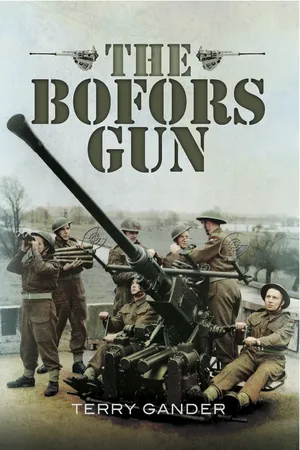
- 256 pages
- English
- ePUB (mobile friendly)
- Available on iOS & Android
eBook - ePub
The Bofors Gun
About this book
Information
Chapter 1
Beginnings
The name Bofors originally related to a small, unremarkable community located on what was known as the Boo estate not far from the then small mining town of Karlskoga, itself located in the province of Värmland to the west of the Swedish capital, Stockholm. Bofors was of little concern to anyone other than the inhabitants and their close neighbours until 1646. During November of that year a local artisan, Paul Hossman, was granted a royal charter to construct a forge and foundry in Bofors. From these modest beginnings grew the mighty industrial monolith of AB Bofors, a concern that, although the name has changed, still looms large on the international defence industry scene, although it no longer concentrates its activities on artillery products.
Little of note outside the immediate locality happened at Bofors until the nineteenth century. Yet by the middle of that century the concern had gradually expanded until it was the largest producer of steel roll bar stock in Sweden. By gradually taking other Swedish steel makers (and other metallurgical concerns) under its wing, in 1873 the position was reached when the business became a joint stock company with the title of Aktiebolaget Bofors-Gullspång, generally known as AB Bofors. Since then the corporate name has undergone several changes, at one time assuming the banner of Swedish Ordnance, but the name Bofors was considered so valuable as an identification and marketing device that it still survives in the current name (at the time of writing) of BAE Systems Bofors AB.
Following their 1878 acquisition of the French Martin cast steel process, during 1883 AB Bofors made the momentous decision to enter the armaments business with the manufacture of ten coast defence guns for the Swedish Admiralty. Those guns, the 8cm fästningskanon M/1883 (actual calibre 84mm), were a Krupp design, and were the first of many to bear the AB Bofors trademark (a blue capital B pierced left to right by an arrow) although AB Bofors made only the barrels and breech mechanisms. Their first export order arrived from Switzerland in 1888, this time for twenty-eight 12cm guns. By the time of the 1914–1918 War the company had expanded in size and expertise to the point where the name Bofors could be uttered in the same breath as such European defence giants as Krupp, Vickers, Škoda and Schneider. Much of this expansion was due to the 1894 acquisition of AB Bofors by Doctor Alfred Nobel, the well-known originator of various explosives and the instigator of the Peace Prizes that are awarded annually to this day. Although Nobel died in 1896 his dynamism and forward planning meant that the company expanded into the development and manufacture of explosives and propellants and, by about 1900, into the highly specialised art of designing and manufacturing artillery fuzes.
The company underwent another period of expansion during the Great War years when, despite the Swedish nation’s strict policy of neutrality, it was able to sell its products to a wide and voracious export market. The years after 1918 were marked by another corporate change when the German Krupp AG steel and armaments concern arranged an association with AB Bofors that further extended the numerous licence manufacturing arrangements between the two concerns that dated back to the 8cm fästningskanon M/1883.
This new and closer association, brought about by the acquisition of a significant proportion of AB Bofors shares (some references mention as much as 33 per cent), had several influences upon the subsequent histories of both AB Bofors and Krupp AG. One of the immediate measures introduced soon after the Bofors/Krupp arrangement was that a contingent of Krupp technicians and designers moved from Essen to Sweden to utilise AB Bofors facilities and work closely with Bofors personnel on state-of-the-art artillery projects.
This was important to Krupp for the terms of the 1919 Treaty of Versailles specifically excluded Krupp AG from indulging in artillery (and other weapons) development and from the manufacture of heavy artillery, fields in which they had formerly been world leaders. During the early 1920s the Treaty terms were strictly enforced and monitored so the move to Sweden and away from the scrutiny of Treaty observers enabled the Germans to continue their former activities to ensure they could be ready for whatever the future might bring
The Krupp/Bofors association extended to an exchange of existing patents and was fruitful for both sides with AB Bofors gaining access to Krupp designs, expertise and know-how, especially regarding the latest manufacturing and production techniques. On the other side was the continuing ability of the Krupp design bureaux personnel to remain abreast of the latest technological and design developments without attracting unwanted attention. Numerous joint projects, many of them confined to paper studies, were undertaken, one of the most important being the design and development of a 75mm anti-aircraft gun, also produced in 80mm and 76.2mm calibre, the latter for Finland. The intention was to produce a heavy anti-aircraft gun for both the Swedish Army and for potential export sales, with the prospect of its adoption by the future German armed forces. In time the 75mm version was adopted by the Swedish Army as the 7.5cm luftvärnskanon m/36 (static) and 7.5cm luftvärnskanon m/37 (on a mobile field carriage). However, the Germans wanted something heavier so from the 75/80mm design evolved the famous 88mm FlaK series used to such effect on all Fronts between 1939 and 1945 – but that is another story.
Such results gave rise to the suggestion that the 40mm Bofors Gun was developed from Krupp expertise and was greatly influenced by Krupp experience with various automatic cannon designs introduced during the Great War years (none of which entered service under the Krupp AG banner). While a high degree of technical cross-fertilisation no doubt took place at purely personal levels between Swedish and German personnel, it was a corporate policy that some AB Bofors projects were kept concealed from their Krupp associates, presumably primarily for commercial reasons or (perhaps) at the behest of the Swedish Government.
Among these projects was the 40mm automatic gun project, a strictly guarded Swedish programme. Another factor that mitigated against any significant Krupp influence regarding the 40mm gun was that during 1931 the association between Krupp AG and AB Bofors was terminated by the introduction of a law passed by the Swedish parliament that severely restricted the degree to which foreign concerns could invest in Swedish industry. The Krupp technicians and designers therefore returned to Essen at a time when the 40mm Bofors Gun was barely past the preliminary drawings stage and with much of the highly involved development work and transition to production standards still outstanding. Perhaps the best indication of the lack of German influence on the 40mm Bofors Gun was that while the German 3.7cm FlaK series of air defence guns bore a passing visual resemblance to the ultimate appearance of the Bofors Gun, such impressions were highly misleading. The German 3.7cm FlaK series utilised entirely different operating and loading mechanisms, owing virtually nothing to their AB Bofors counterparts. In addition, the guns in the German 3.7cm FlaK series were not Krupp products but were designed and manufactured by Rheinmetall-Borsig AG.
Although, as mentioned above, some Krupp ideas were no doubt bandied about during the early development days the 40mm Bofors Gun was very much a Swedish product. Yet the Krupp influence myth persists. Exactly how the 40mm Bofors Gun came about follows.
Early Days
During the early 1920s the minds of many naval staff planners were becoming increasingly focussed on the defence of warships against aircraft. The Great War years had witnessed the first attempts to employ aircraft to attack naval vessels with bombs and torpedoes while by the early 1920s the first tentative experiments with what were to become dive bomber tactics had begun. Measures had to be introduced to deter such attacks but the exact means were still undetermined.
Two main streams of thought emerged. One was the emergence of the heavy calibre anti-aircraft gun, even though such guns were large, heavy, slow-firing and expensive. Yet such guns could ensure that one hit would neutralise any airborne target at whatever altitude they might be flying, other than at the lower altitude band below about 3,000m which, for fire control and other reasons, was considered their lowest effective range. Low-flying aircraft were deemed suitable for engagement by rifle-calibre machine guns but the maximum ceiling potential of such weapons was at the extreme about 750m. That left a considerable altitude gap between the target engagement potential of the machine gun and that for the heavy anti-aircraft gun.
The Royal Swedish Navy were well to the fore in exploring the means to fill this altitude gap and initially investigated the potential of 20mm cannon, then still in their infancy but with some combat experience gleaned from before the end of 1918. At one stage AB Bofors were requested to produce a 20mm cannon but before any hardware emerged it was realised that the high explosive payload of any 20mm projectile was insufficient to ensure that one hit on an aircraft meant one kill. The immediate response was to double the calibre specification to 40mm, a measure that would result in the required destructive performance without enlarging the resultant gun and mounting beyond the realms of practicality.
Swedish sailors had already acquired some experience of the 40mm calibre for in 1922 the Royal Swedish Navy had adopted the Vickers 2-pounder ‘Pom-Pom’ as their 40mm automatkanon (akan) M/22. At around the same time AB Bofors obtained a licence to manufacture the gun and its ammunition. The Vickers guns turned out to be large, heavy and prone to jamming in the choppy sea conditions that could arise in the Baltic, the Swedish Navy’s main operational theatre. In addition the fabric ammunition feed belts soaked up spray in rough weather and broke or caused further jams. Overall, the gun performance was rated as poor and the 40 x 158mm ammunition proved to be underpowered. AB Bofors were asked to investigate the problems but soon came to the conclusion that as the gun was a scaled-up Maxim dating from the early days of machine-gun development there was little that could be achieved to enhance their overall performance. AB Bofors therefore never did manufacture any Vickers guns although they had started to manufacture 2-pounder ammunition and had managed to introduce a few improvements of their own to the design of the basic round, even if the muzzle velocity was still considered too low.
By the late 1920s the Swedish Navy Board had reached the point where they approached AB Bofors with the notion of their designing and developing a state-of-the-art 40mm gun for naval applications. The Navy considered that to ensure a reasonable degree of reliability a semi-automatic gun coupled with some form of loa...
Table of contents
- Cover
- Title Page
- Copyright
- Contents
- Preface
- Acknowledgements
- Chapter 1: Beginnings
- Chapter 2: The Land Service Model 1934 L/60 Described
- Chapter 3: The Swedish L/60 Guns
- Chapter 4: British and Commonwealth L/60 Guns
- Chapter 5: The American Guns
- Chapter 6: L/60 Licenses and Exports
- Chapter 7: Bofors L/70
- Chapter 8: BOFI
- Chapter 9: Trinity and After
- Chapter 10: Self-Propelled Guns
- Chapter 11: CV90
- Chapter 12: Postscript
- Bibliography
Trusted by 375,005 students
Access to over 1.5 million titles for a fair monthly price.
Study more efficiently using our study tools.
Frequently asked questions
Yes, you can cancel anytime from the Subscription tab in your account settings on the Perlego website. Your subscription will stay active until the end of your current billing period. Learn how to cancel your subscription
No, books cannot be downloaded as external files, such as PDFs, for use outside of Perlego. However, you can download books within the Perlego app for offline reading on mobile or tablet. Learn how to download books offline
Perlego offers two plans: Essential and Complete
- Essential is ideal for learners and professionals who enjoy exploring a wide range of subjects. Access the Essential Library with 800,000+ trusted titles and best-sellers across business, personal growth, and the humanities. Includes unlimited reading time and Standard Read Aloud voice.
- Complete: Perfect for advanced learners and researchers needing full, unrestricted access. Unlock 1.5M+ books across hundreds of subjects, including academic and specialized titles. The Complete Plan also includes advanced features like Premium Read Aloud and Research Assistant.
We are an online textbook subscription service, where you can get access to an entire online library for less than the price of a single book per month. With over 1.5 million books across 990+ topics, we’ve got you covered! Learn about our mission
Look out for the read-aloud symbol on your next book to see if you can listen to it. The read-aloud tool reads text aloud for you, highlighting the text as it is being read. You can pause it, speed it up and slow it down. Learn more about Read Aloud
Yes! You can use the Perlego app on both iOS and Android devices to read anytime, anywhere — even offline. Perfect for commutes or when you’re on the go.
Please note we cannot support devices running on iOS 13 and Android 7 or earlier. Learn more about using the app
Please note we cannot support devices running on iOS 13 and Android 7 or earlier. Learn more about using the app
Yes, you can access The Bofors Gun by Terry Gander in PDF and/or ePUB format, as well as other popular books in History & 20th Century History. We have over 1.5 million books available in our catalogue for you to explore.