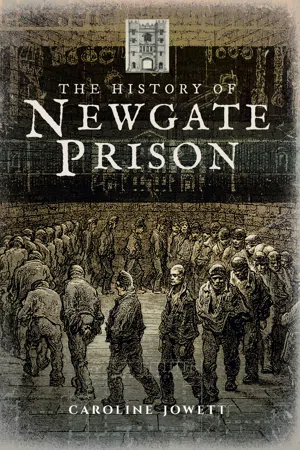
A history of the iconic London prison, featuring insights on daily life, the evolution of prison systems, and famous inmates.
As the place where prisoners, male and female, awaited trial, execution, or transportation Newgate was Britain's most feared gaol for over 700 years. It probably best known today from the novels of Charles Dickens including
Barnaby Rudge and
Great Expectations.
But there is much is more to Newgate than nineteenth century notoriety. In the seventeenth century it saw the exploits of legendary escaper and thief Jack Sheppard. Among its most famous inmates were author Daniel Defoe who was imprisoned there for seditious libel, playwright Ben Jonson for murder, and the Captain Kidd for piracy.
This book takes you from the gaol's 12th century beginnings to its final closure in 1904 and looks at daily life, developments in the treatment of prisoners from the use of torture to penal reform as well as major events in its history.
Praise for
The History of Newgate Prison
"An amazing, entertaining and informative book!" —Books Monthly
"This is a highly readable and accessible account, not only of the iconic institution, but also of the history of crime and punishment. It is packed full of evocative detail and is essential reading for all those interested in crime history." —
Who Do You Think You Are? magazine
- 128 pages
- English
- ePUB (mobile friendly)
- Available on iOS & Android
eBook - ePub
The History of Newgate Prison
About this book
Information
Chapter 1
Foundations 1188 - 1499
LONDON BEFORE NEWGATE
London in the Middle Ages was still the walled city it had been since Roman times. Southwark and Westminster, the two other communities that over the centuries would merge with it and expand to form the London we know today, were no more than villages. Southwark, a haven of criminals and unregulated trade on the south, Surrey, side of the Thames, was the home of St Thomas’s Hospital and later that notorious den of lawlessness the Southwark Mint. Westminster, on the other hand, with its royal palace and abbey was the seat of government. Like the City, Westminster was on the north, Middlesex, side and the two settlements were connected by the single straight line of Fleet Street and The Strand. In common with the City, Southwark and Westminster had their own sheriffs, courts and gaols.
The City walls had seven gates: Ludgate, Newgate, Moorgate, Cripplegate, Bishopsgate, Aldersgate and Aldgate through which ran the main roads to other parts of the country. The road that passed through Newgate ran to the south and west to Reading, Dorset and Hampshire. If necessary, for example in times of rebellion and therefore high arrest rates, when London’s two official prisons were full, these gatehouses would be pressed into use.
By the middle of the twelfth century, the two official prisons were the Tower of London, and the Fleet. Both had been built shortly after the Norman Conquest and were under the jurisdiction of the king. Outside London, justice was in the hands of the nobles and prison was the dungeon or keep of the local lord’s castle, where the idea of incarceration as a punishment in itself did not exist. Gaol was more like a remand centre of today, though nowhere near as comfortable, where prisoners would be held pending trial. Nor was there was any segregation of prisoners either by sex or crime, women and men, murderers and pickpockets were all jumbled in together.
The Tower, as is often thought, was not exclusively for the use of nobles who had got on the wrong side of the king but was open to anyone who fell foul of the law. The Fleet, which before the construction of Newgate was known as the Gaol of London, also housed felons (serious offenders), committers of misdemeanours (petty offenders) and debtors. Like modern prisons they were built on the edge of the community, the Tower to the east on the Thames south of Aldgate and the Fleet by the river Fleet that flowed into the Thames at Ludgate in the west. But they were close enough to the gates to serve as a daily reminder, in the days before a police force, of the need to obey the law. They were the first purpose-built prisons in the country and today only the Tower remains.
BUILDING NEWGATE
In 1188, Henry II, an enthusiastic if occasionally ruthless reformer who laid the foundations of English Common Law and our jury system, decreed that London needed another prison. It would be under the administration of the City of London itself, a first, though Henry, would make occasional grants and also keep a watching brief to ensure the authorities were doing their job properly. A piece of land next to Newgate where Newgate Street joined Old Bailey was purchased for £3 6s 8d, two carpenters and a smith were hired and the new prison built. Given the occupations of the builders it seems probable that, unlike the Tower and the Fleet, this first Newgate was made of wood.
In 1236, the City and the Crown funded some improvements to the tune of £100 and one of the gatehouse’s stone turrets and the dungeons were incorporated into the gaol. Even at this early stage, prisons were divided into a masters and a common side, for rich and poor so when in 1281-2 the privy was cleaned and the ‘aperture in the stone wall for ejecting excrement’ was mended as part of a wider programme of repairs costing £66, it is probable that this was on the masters side. It is unlikely that the common side would have enjoyed such fancy sanitation arrangements.
In addition, the ditches and sewers were cleared, two windows installed and two doors created between the prisoners and the privy. The prisoners remained on site during the repairs and four extra guards were hired for four nights to prevent escapes. After that, nothing much was done for 200 years except that in 1316, Edward II ordered that the sewer, which was in a very bad state, should be ‘restored at speed’.
In 1406, a group of female prisoners complained about their cramped accommodation and that to reach the privy, they had ‘to their great shame and hurt’ to go through the men’s quarters. A separate tower was built for them, though it probably amounted to them having their own sleeping quarters since the idea of the segregation of men and women was still a long way off and there was free movement within the gaol. There is evidence of women getting pregnant while in Newgate, though whether this was non-consensual or a way of passing the time is impossible to tell. Women could escape a hanging if they were pregnant by ‘pleading the belly’, so it might have been a mixture of all three.
By now, Newgate was far from the most recent addition to London’s protopenal system. Nine other gaols had been added since the end of the twelfth century, making a total, including the Fleet and the Tower, of twelve. There was a new gaol five minutes down the road at Ludgate while The Tun, so-called because of its barrel shape, was on Cornhill and mostly housed ‘street walkers and lewd women’. There were two compters, a cross between a prison and a sheriff’s office, at Bread St and Poultry St, which held debtors, adulteresses and minor offenders. Until these new gaols were introduced, sheriffs had held and tried people in their own homes.
The compters, The Tun, Ludgate and Newgate were administered by the City. Under the Crown’s control were: the Marshalsea of the Household and the Marshalsea of the King’s Bench in Southwark which held, among others, men accused of crimes at sea, those convicted of sedition and of course the ubiquitous debtors. The Clink, on the notorious Bankside where brothels, theatres and a colourful nightlife flourished, was under the jurisdiction of the Bishop of Winchester and it held anyone who broke his rules. In addition, there were stocks and pillories placed on the busiest thoroughfares and market squares since public humiliation played a big part in the medieval concept of punishment.
In 1419, it was decided that the gaol at Ludgate, which had been operational for about a hundred years, should close and all the prisoners transferred to Newgate. This led to such terrible overcrowding that within months there was a sharp spike in deaths blamed on Newgate’s ‘fetid and corrupt atmosphere’ and Ludgate was re-opened.
By now Newgate was 250 years old, and although some parts were considerably newer, some, for example, the dungeons, might have been even older and overall the gaol was in a pretty appalling condition. It seems that the Lord Mayor, Richard Whittington, thought so at any rate because in 1423 he left money in his will for it to be completely rebuilt.
The new gatehouse and gaol was on a much bigger and grander scale than its predecessor and took around eight years to build. While construction was going on the prisoners were sent to the Bread Street Compter up the road at Cheapside. The new gaol arched over Newgate Street and stretched down Old Bailey, and it reflected changes in prisoner management that had evolved since it was founded.
It housed 150 inmates, with separate quarters for men and women, and minor criminals were to be kept apart from serious offenders though this was loosely adhered to at best. This indicates a desire to improve conditions for the poorest inmates. There was a hall, a chapel, day and night wards, privies, underground dungeons and rooms with chimneys. It also had a water fountain, which was impure and made the inmates very ill. Over the centuries, Newgate’s terrible stench became legendary, almost a living inmate of the prison in its own right. After the gaol’s demolition in 1904, an underground waterway was discovered which might have been the source of the smell and this fountain of bad water.
Among the improvements was a fresh water supply from St Bartholomew’s Hospital, installed shortly after the prison was finished, maybe after the authorities discovered the water in the fountain was undrinkable. Later, a former Lord Mayor, Thomas Knollys paid for lead pipes to be installed to provide more fresh water and clean the privy. He was also granted a licence to supply water to the poor prisoners of Newgate and Ludgate so the fountain may just have been intended for those on the masters side.
This new gaol became known among thieves as the Whittington, more commonly shortened to the Whit, and lasted with only minor alterations until 1666, when it was badly damaged in the Great Fire and extensively repaired.
CONDITIONS
While there was no real segregation of prisoners according to gender or offence, there was clear segregation based on wealth; money talked and even those convicted of the most serious crimes could buy themselves luxury and comfort until their case came up.
Gaols were privately run and the accused had to fund their own stay. Even before Whittington’s Newgate was built, it seems that gaols were divided into a masters side, where experience of prison life could be vastly improved according to ability to pay, and a common side, where the poor man’s experience would be one of unrelenting squalor and almost unimaginable misery. There were some exemptions to fees: the destitute who relied on alms, and anyone committed by the mayor, aldermen or sheriffs, these were exempt from the committal and deliverance fees and also from the payment to maintain the lamps in the corridors which was 4d unless provided by charity.
Though the terms masters and common were not used until much later it is clear that even from its earliest days, there were rooms offered out at differing rates and for different categories of prisoner.
An ordinance issued in 1431, as Whittington’s gaol was completed, allocated the accommodation with the areas surrounding the gate housing ‘freeman of the City and other honest persons’ – men to the north and women to the south. These were the best rooms and would have probably had windows, fireplaces and chimneys. They would have been higher up in the building away from noise and nearer fresh air. Anyone who was not a freeman of the City of London (that is anyone outside the protection of the Livery Companies which governed the trades) or was a stranger to the City would get the next best accommodation. Felons, major offenders and anyone thought to be an escape risk were held in the underground dungeons known as ‘holes’, which were small, damp and without natural light. Even then, the authorities were aware of the effect of these places on the health of prisoners and of the risk of infection, but either the keepers didn’t have anywhere else to put them or they didn’t much care.
With the masters side on the upper floors, the poor prisoners of the common side had to make do with the lower floors where the smell was thicker, the light dimmer and the air damper. Under a system known as chummage, a prisoner on the masters side might pay a poorer cellmate off and have his or her own room, or maybe share with one other person, a ‘chum’, while on the common side prisoners were herded into wards where there was no privacy at all. Prisoners could also pay either to have a lighter set of irons fitted or escape ironing altogether. This was called easement of irons and didn’t stop until the end of the eighteenth century.
In the new Whittington-financed Newgate of the mid-fifteenth century, the keeper was forbidden from charging freemen and freewomen prisoners more than a penny a night for a bed with a blanket and sheets or a penny a week for the use of a couch. If the inmates wanted to bring their own beds from home, they could do so for free. Bed and board for a gentleman or freeman was 3s a week, 2s for a yeoman, and the keeper was banned from selling candles, food or charcoal so that prisoners could shop around. Presumably this was an attempt to weaken the keeper’s monopoly on goods sold within the prison and stop the perennial complaints of overcharging; whatever the reason, it was not long before the keepers were back in charge of their monopoly.
In the taprooms, prices stayed the same as they had before the gaol was rebuilt, perhaps because the water was still undrinkable. It was a poor deal for the keepers who bought in best ale at 3½d a gallon but were only allowed to sell it on for tuppence. Unless they could sell it to visitors at an inflated price, they would have lost money.
The fees for coal were 2d a bushel, 1d a half bushel and ½d a peck ‘full and heaped up’. A bushel and a peck were imperial dry measures of goods. A bushel was eight gallons (about 36.5 litres) and a peck two gallons (nine litres).
Garnish was payable on entry to the prison but was due to the cellarman not the prison authorities. The intention was that it would provide extras such as clean straw, more candles, beer and blankets or to provide charity for those who were too poor to fund themselves. However, it was frequently abused and often the cellarman would drink it away. Garnish had to be paid and there was no comeback against unscrupulous cellarmen as the authorities turned a blind eye to the whole practice. This wasn’t so hard on the masters side where inmates could afford to purchase whatever they needed, but on the common side it might mean sitting in the dark, sleeping on the bare floor or having nothing to eat. Prisoners who couldn’t pay had to forfeit their clothes and the cry on entry to the ward was ‘pay or strip’.
At the King’s prisons, such as the Fleet, inmates were sometimes allowed to leave on licence to carry on their businesses or sort out personal affairs, and it is possible this also applied to the City-regulated Newgate. They could also make articles for sale. At the end of the fifteenth century, for example, a haberdasher called John Wysbeche provided bones for the prisoners to carve which he then sold. If they didn’t get money in exchange for this work, it is likely they would have received food or other preferential treatment. There is evidence that this practice carried on throughout Newgate’s history. At the end of the eighteenth century one inmate did a roaring trade in hand-made artificial flowers.
With poor sanitation in the gaol, diseases such as cholera were rife. It is impossible to determine how many people died from sickness or starvation in the early years of the prison’s existence since records are patchy. However, there is a twenty-seven-year period at the beginning of the fourteenth century where 549 deaths were recorded in the City. Of these, 190, just over a third, died in prison and of those between 1315 and 1340, 160 were in Newgate, eleven in the Tower and nineteen over the river in the Marshalsea. Many of these were recorded as ‘rightful death’ - that is not from disease or starvation but, in the absence of forensics and pathology, natural causes. Surprisingly, none appear to be the result of violence.
The biggest fear among the prisoners and the biggest problem for the officials right up to the nineteenth century was gaol fever, also known as crinkums. It’s now recognised as a form of typhus known as Rickettsia prowazekii, but in the Middle Ages it was thought to be an unpreventable condition of prison life. It thrives in overcrowded, poorly-sanitised conditions such as gaols and slums and is carried by lice. There are accounts of prisoners being so swarmed with these vermin that their clothes seemed to move of their own accord and the floor of Newgate was so covered in them that their bodies cracked beneath the feet of anyone crossing the floor.
The bites itch and when they are scratched with filthy fingers they become infected with dirt and faeces and the disease takes hold. Symptoms include a rash, nausea, vomiting - enough to bring up blood - retching, tremors, headaches and purple lesions on chest and back, weakness, thirst, chest pains and convulsions. It is extremely virulent and in the cramped conditions of a prison can spread like wildfire through wards and down corridors. Perversely, sometimes only one person would be infected. In 1419, gaol fever killed the keeper and sixty-four inmates and in 1750, a group of prisoners brought it into the Old Bailey sessions house when they came for trial and it killed another sixty-four including the Lord Mayor.
If a prisoner had no money or means of support, or were so old or ill they were likely to die, the king, the mayor and aldermen could authorise a release.
On the common side, the food ration was a penny loaf a day, that is a small loaf weighing about 8oz (228g), sometimes made of pure ingredients, sometimes packed with alum or other cheap flour substitutes. To supplement this, the inmates relied on alms, confiscated goods and the leftovers from rich men’s tables and records show they had a reasonably regular supply of food and drink which would have sustained them, even if it did not make them fat.
Sometimes these were one-off donations; for example William Halyot left orders in his will for two oxen to be distributed round London’s prisons. Newgate and Ludgate got half an ox each, while the rest got smaller portions.
Excavations on the site of the Fleet prison give an indication of what the Newgate prisoners’ diet might have been - it would not have varied much over the centuries and could have included blackberries, cherries, elderberries, hazelnuts, grapes, plums and sloes, which were grown in the ...
Table of contents
- Cover
- Title
- Copyright
- Contents
- About The Author
- Acknowledgements
- Foreword
- Chapter 1 Foundations 1188 - 1499
- Chapter 2 Crimes and Punishments
- Chapter 3 Newgate Under the Tudors and Stuarts 1500 - 1665
- Chapter 4 The Great Fire 1666 - 1699
- Chapter 5 Inside the Prison-republic 1700 - 1769
- Chapter 6 The New Newgate 1770 - 1799
- Chapter 7 Reform 1800 - 1902
- Appendices Newgate’s Famous Inmates
- Newgate in Literature
- Newgate Cant - The Secret Language of Thieves
- Bibliography
- Plate section
Trusted by 375,005 students
Access to over 1.5 million titles for a fair monthly price.
Study more efficiently using our study tools.
Frequently asked questions
Yes, you can cancel anytime from the Subscription tab in your account settings on the Perlego website. Your subscription will stay active until the end of your current billing period. Learn how to cancel your subscription
No, books cannot be downloaded as external files, such as PDFs, for use outside of Perlego. However, you can download books within the Perlego app for offline reading on mobile or tablet. Learn how to download books offline
Perlego offers two plans: Essential and Complete
- Essential is ideal for learners and professionals who enjoy exploring a wide range of subjects. Access the Essential Library with 800,000+ trusted titles and best-sellers across business, personal growth, and the humanities. Includes unlimited reading time and Standard Read Aloud voice.
- Complete: Perfect for advanced learners and researchers needing full, unrestricted access. Unlock 1.5M+ books across hundreds of subjects, including academic and specialized titles. The Complete Plan also includes advanced features like Premium Read Aloud and Research Assistant.
We are an online textbook subscription service, where you can get access to an entire online library for less than the price of a single book per month. With over 1.5 million books across 990+ topics, we’ve got you covered! Learn about our mission
Look out for the read-aloud symbol on your next book to see if you can listen to it. The read-aloud tool reads text aloud for you, highlighting the text as it is being read. You can pause it, speed it up and slow it down. Learn more about Read Aloud
Yes! You can use the Perlego app on both iOS and Android devices to read anytime, anywhere — even offline. Perfect for commutes or when you’re on the go.
Please note we cannot support devices running on iOS 13 and Android 7 or earlier. Learn more about using the app
Please note we cannot support devices running on iOS 13 and Android 7 or earlier. Learn more about using the app
Yes, you can access The History of Newgate Prison by Caroline Jowett in PDF and/or ePUB format, as well as other popular books in History & British History. We have over 1.5 million books available in our catalogue for you to explore.