An absorbing study of the tanks and the tank tactics of the Red Army and the Wehrmacht during the Axis invasion of the Soviet Union in World War II.
When the Germans invaded the Soviet Union in 1941, the Red Army had four times as many tanks as the Wehrmacht and their tanks were seemingly superior, yet the Wehrmacht won the border battles with extraordinary ease. The Red Army's tank force was pushed aside and for the most part annihilated. How was this victory achieved, and were the Soviet tanks really as well designed as is often believed? These are the basic questions Boris Kavalerchik answers in this compelling study of tank warfare on the Eastern Front. Drawing on technical and operational documents from Russian archives, many of which were classified until recently and are unknown to Western readers, he compares the strengths and weakness of the tanks and the different ways in which they were used by the opposing armies. His work will be essential reading for military historians who are interested in the development of armored warfare and in this aspect of the struggle on the Eastern Front.
"So much has been written on this subject, and yet this book dispels myths and offers fresh insights in a study of Soviet and German tanks at the beginning of the war on the Eastern Front . . . a fascinating selection of images."—Firetrench
"This book is highly recommended due to the excellent use of data, the organization of the book established by the author, and thoughtful and comprehensive coverage of the subject."—
IPMS/USA
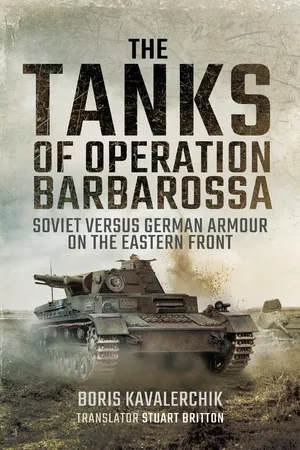
eBook - ePub
The Tanks of Operation Barbarossa
Soviet versus German Armour on the Eastern Front
- 288 pages
- English
- ePUB (mobile friendly)
- Available on iOS & Android
eBook - ePub
The Tanks of Operation Barbarossa
Soviet versus German Armour on the Eastern Front
About this book
Information
Chapter 1
The Main Factors that Determine the Design of Tanks
One of the most widespread mistakes is the tendency to look at tanks from former years from a contemporary standpoint and to evaluate them using modern criteria. Such an approach has its attractions: in the first place, it is simple, and secondly, it allows us to sense our superiority over the people of the past, who created and used those tanks, in which today we see so many imperfections and flaws. At the same time often the blaming of one or another detail of a tank for its shortcomings is in fact a result of the elementary misunderstanding of how, why and for what purpose each detail was made part of it from the beginning. It often isn’t simple to determine the real plusses and minuses of one or another. Moreover, one and the same feature might in one case be a strong point, and in another case a shortcoming. The main point is that it must never be forgotten that every tank of all eras and nations without exception had both their positive and negative sides. Thus one mustn’t issue snap judgements, only viewing the tanks from one side while putting some of them on a pedestal and tossing others into a waste bin entirely on the basis of some particular features that are taken out of context. It is much harder to look into the actual qualities and inadequacies of specific tank types, but also more interesting and useful for understanding them.
First of all it is necessary to conceptualize the role of tanks. They weren’t some inherently abstract things, but represented working tools, used in order to resolve concrete problems. As a rule, teams of engineers design them according to the technical specifications formulated by armies, which use them to achieve objectives they’ve been given or future goals. That is why solitary geniuses, who worked in fits and starts according to their own comprehensions and insights, despite all their efforts and individual stellar accomplishments, rarely achieved substantive successes. This isn’t surprising: most of all they were hindered by an elementary misapprehension or even lack of desire to grasp what their potential customers really required. However, it mustn’t be forgotten that the tasks of tanks vary in different countries and in different periods, and moreover they change with the passage of time. Thus it is necessary to shed light on what those tasks were at the time each tank was created, and which they were intended to meet. Without this understanding it is impossible to grasp why one particular tank was designed in one way and not another. In this connection it should be noted that the success or failure of various models of tanks is determined to a great extent by their capability to be adapted in a timely manner to the constantly changing tactical demands throughout their service life. In other words, the length of the career of many tanks depended directly on their ability to be updated; i.e., whether or not they had sufficient spare internal space and allowance for extra weight. This permitted, in the event of necessity, the enhancing of their combat qualities, principally in firepower and armour strength, while preserving adequate mobility and conditions for the crew.
There is one more important category that influenced the design of tanks – the level of modern technology, not only at the abstract worldwide level, but in the manufacturing capabilities of each specific factory that planned to produce them. This also includes the number and qualifications of its workers; the presence and capabilities of its manufacturing equipment; its financial resources; the availability of time, raw materials and component parts; the possibility of cooperating with other factories, etc. It was no less important to know the planned programme of tank production and the amount of time allowed for carrying it out.
Only a consideration of the influence of all these factors makes it possible to understand the real reasons for using one or another technical decision applied to the design of combat vehicles. At the same time it makes clear why one and the same decision might be optimal for one specific factory at one period of time, but impractical for the same factory at a different time. Moreover it might be unsuitable for different factories in the same country, and even more so for the industry of other countries. What is more, even the very best and leading design, if it proved impossible to manufacture in sufficient quantities within the necessary time using the available resources, would in essence be only a senseless waste of time, materials and funds.
Finally, the third group of characteristics that is directly reflected in the design of any tank is connected with its forthcoming use by troops. This relates to the average level of qualification and training of tank crews; problems with maintaining and repairing it; keeping it supplied with fuel, lubricants, ammunition and spare parts; its proposed period of service; the expected conditions in which the tank would be used and its reliability and durability influenced by them; the serviceability of the tank as well as its systems and components; the standardization of its parts, and so on. These features also frequently vary widely according to the country, the people and the period of time, and accordingly relate substantially to the understanding of ‘what is good and what is bad’ in the design of tanks for the concrete situation of their use.
It is easy to note that the deeper we delve into the study of the factors that influenced the design and manufacturing of tanks, the more quickly the number of factors grows and the more complicated it becomes. Therefore, let’s take a look at the above cited factors and figure out how they operated in practice. We’ll look first of all at the role of tanks.
Chapter 2
The Role of Tanks
Tanks first appeared at the height of the First World War. They were born out of the ‘trench stalemate’ in which the participants unexpectedly found themselves. Soon after the war started, noman’s land, entangled with dense rows of barbed wire swept by countless machine guns and field guns, became an impenetrable barrier in the path of the attacking troops. The front lines became essentially frozen in place for their entire extent over hundreds of kilometres. Back then, no one actually knew how to properly break through a defence that was saturated to the extreme with firing positions. According to the military theory that predominated at that time, a series of attacks should be conducted one after the other with powerful artillery support in order to resolve this problem. However, in practice, over the time it took to conduct repeated attacks, the enemy invariably managed to bring up fresh reserves to the battlefield and to seal off local penetrations. Further offensives, as a rule, led to the agonizing process of frontal attacks to force the enemy out of their next line of occupied trenches until the attacking side’s strength was completely exhausted. In the best case it resulted in a limited success in the form of seizing an insignificant sector of ground, which had to be paid for with extremely heavy losses in men and materiel. Such a price was unacceptable for the combatants, and thus they began actively searching for a qualitatively new, effective instrument for breaking through a defence.
For the armies of the Entente, tanks became this instrument. They protected the attacking infantry from enemy bullets with their armour, laid down a path for them through the rolls of barbed wire, and destroyed with fire and their tracks those enemy weapons that survived the artillery preparation. Thus, the main role for tanks from the outset was the direct support of infantry when breaking through an enemy defence. For this reason they didn’t need high speed, because the infantryman burdened with his gear and weapons could only advance at an average speed of 4–7 kilometres per hour.
Direct support of infantry for a long time remained the priority for tanks in the majority of armies that possessed them. In 1920 in France and the United States the armoured forces were deprived of an independent role and became subordinate to the infantry. It isn’t a coincidence that the French ‘Regulations for the use of tanks’ that came out in the early 1920s give them the following definition:
Armoured vehicles with mechanized propulsion are called tanks, the role of which is to facilitate the advance of infantry, crushing the stationary obstacles and the enemy’s active resistance on the field of battle.
[…]
They are only a powerful support means in the infantry’s possession. Tanks should coordinate their combat work of manoeuvre and fire with the actions of the infantry.1
A draft of the 1939 Field Manual of the Red Army (FM-39) postulated the very same: ‘The primary task of tanks consists in directly supporting the infantry and in clearing a path for it during an offensive.’ Only subsequently did it mention other tasks:
Given the successful development of the offensive and in mobile combat tanks might be used for a deeper strike at the enemy’s combat formations with the aim of destroying his artillery, reserves and headquarters. In this case they might play a decisive role in encircling and destroying the enemy. Tanks are an effective means for combating enemy tanks. On the defensive, tanks are a powerful means of counterattack.
Even after the beginning of the Second World War, a textbook for cadets in the Red Army’s military academies still stated: ‘The main role of the tank forces amounts to constant and comprehensive assistance to the infantry (or the cavalry) in the most rapid fulfilment of its combat assignments with the least losses.’2
In order to fulfil these main tasks, the first generation of tanks were equipped with armour that protected them from bullets and correspondingly armed with machine guns and cannons with a calibre from 37mm to 57mm. Guns of a larger calibre at that time were not often mounted on tanks. But when they were, short-barrelled cannons or howitzers were used, with a low initial muzzle velocity that was fully adequate for combating enemy infantry, its weapons and light field fortifications. In order to increase the density of the tanks’ fire, sometimes they were made with multiple turrets, and the turrets were occasionally placed side by side. This arrangement allowed all of the tank’s fire to be concentrated in front of it when on the attack, and while crossing an enemy trench to ‘comb through’ it with machine-gun fire simultaneously from both sides. Such tanks at that time were called ‘trench sweepers’. Here is what the future Soviet Marshal M.N. Tukhachevsky, who at the time was occupying the post of Chief of Armaments of the Red Army, wrote about them:
Concerning the British Vickers tank that was recently examined by me, I found it suitable like nothing else to the task of escort when attacking enemy trenches. … The positioning of the turrets side by side allows the tank quite advantageously to develop strong flanking fire when crossing dug-in positions and trenches … against which the breastwork offers no protection. …
At this critical moment, as can be seen, the tank lacks one more firing point in the form of a machine gun or light cannon, directed towards the front when moving in order to knock out targets (like a machine gun or cannon) of the second line of defence. …
It isn’t difficult to grasp why the British then adopted the twin-turreted and triple-turreted scheme, which is very farsighted and more advantageous for overcoming an enemy defence when among their own infantry.3
Tukhachevsky was talking about the twin-turreted Vickers Mark E 6-ton tank, which was being produced in the USSR by licence under the designation T-26, and the triple-turreted Vickers Mk. III 16-ton tank, which became the prototype for the Soviet T-28 (see Chapter 7).
In our time many people, when comparing tanks of past times among themselves, evaluate them first of all from the point of view of their capability to combat enemy tanks. Such an approach is fundamentally incorrect, because before the Second World War, in the majority of the world’s armies this assignment was given primarily to anti-tank artillery. Meanwhile tanks had their primary roles, as formulated in the Soviet textbook Tactics of armoured forces:
Armoured forces in the system of contemporary combined-arms battle are:
1) the best means for outflanking or enveloping an enemy defensive position detected or formed when penetrating flanks;
2) one of the most powerful means for breaking through an enemy line;
3) together with artillery and aviation are one of the means of simultaneously suppressing the tactical depth of the enemy’s defence; and
4) an active part of the anti-tank defence of the infantry’s (the cavalry’s) attacking combat formation.4
Thus, tanks were authorized to engage enemy combat vehicles last and only in those cases when it was unavoidable. German tankers at the beginning of the war behaved in just that manner. Here is how Directive No. 0127 ‘On the shortcomings in the use and actions of tanks together with the combined-arms formations and measures to eliminate them’ from the Commander of the Soviet Northwestern Front on 5 August 1941 characterized their actions: ‘Enemy tanks, as a rule, refuse open combat with our mechanized formations, instead striving to bring our tanks under the fire of anti-tank artillery and large-calibre artillery.’5 The ‘Instructions on the use of a tank brigade in the main types of combat’ issued to the troops of the Soviet Western Front on 27 September 1941 stated, ‘The experience of combat operations demonstrates that German tanks, when our attacking tanks appear, fall back behind the combat positions of their infantry, which have organized an anti-tank defence.’6
At the same time the Soviet tankers, who had a high combat morale but insufficient tactical training, seized any opportunity to clash with the German tankers, forgetting in the process about carrying out their main assignments. This tendency, which jeopardized the success of the overall cause, was noted in People’s Commissar of Defence Order No. 325 from 16 October 1942 ‘On the combat use of tank and mechanized units and formations’, which was developed under Stalin’s personal direction.7 There, in particular, it indicated:
Tanks, operating jointly with infantry, have as their primary mission the destruction of enemy infantry and should not be separated from their own infantry by more than 200–400 metres.
In battle the tank commander organizes observation of the battle formations of the infantry. If the infantry has gone to ground and is not advancing behind the tanks, the commander of the tank unit allots some of the tanks to destroy the enemy firing positions which are preventing the advance of our infantry.
[…]
If enemy tanks appear on the battlefield, the artillery conducts the primary fight against them. Tanks engage enemy tanks only in the case of a clear superiority of forces and an advantageous position.
[…]
The [tank] corps should not engage in tank battles with enemy tanks if there is no clear superiority over the enemy. When encountering large enemy tank units, the corps designates anti-tank artillery and some of the tanks against the enemy tanks; the infantry for its part moves up its anti-tank artillery, and the corps, protected by all these means, w...
Table of contents
- Cover
- Title
- Copyright
- Contents
- Introduction
- Chapter 1: The Main Factors that Determine the Design of Tanks
- Chapter 2: The Role of Tanks
- Chapter 3: Germany’s Panzer Forces
- Chapter 4: The Wehrmacht’s Panzers
- Chapter 5: German Panzers in Combat
- Chapter 6: Soviet Armoured Forces
- Chapter 7: The History of Tanks in the Red Army
- Chapter 8: Pre-War Soviet Tanks
- Chapter 9: Qualitative Characteristics of the Tanks
- Chapter 10: The Survivability of Tanks and Crews
- Chapter 11: The Tank Battle at Raseiniai, Lithuania, 1941
- Chapter 12: The Results of the Initial Fighting
- Appendix I: Report on Long-Range Test March of Three T-34 Tanks
- Appendix II: Tactical and Technical Specifications of Soviet and German Tanks in the Initial Period of the Great Patriotic War
- Appendix III: Dimensions and Cross-country Performance Specifications of Soviet and German Tanks in the Initial Period of the Great Patriotic War
- Appendix IV: Armaments of Soviet and German Tanks in the Initial Period of the Great Patriotic War
- Notes
- Plate section
Trusted by 375,005 students
Access to over 1.5 million titles for a fair monthly price.
Study more efficiently using our study tools.
Frequently asked questions
Yes, you can cancel anytime from the Subscription tab in your account settings on the Perlego website. Your subscription will stay active until the end of your current billing period. Learn how to cancel your subscription
No, books cannot be downloaded as external files, such as PDFs, for use outside of Perlego. However, you can download books within the Perlego app for offline reading on mobile or tablet. Learn how to download books offline
Perlego offers two plans: Essential and Complete
- Essential is ideal for learners and professionals who enjoy exploring a wide range of subjects. Access the Essential Library with 800,000+ trusted titles and best-sellers across business, personal growth, and the humanities. Includes unlimited reading time and Standard Read Aloud voice.
- Complete: Perfect for advanced learners and researchers needing full, unrestricted access. Unlock 1.5M+ books across hundreds of subjects, including academic and specialized titles. The Complete Plan also includes advanced features like Premium Read Aloud and Research Assistant.
We are an online textbook subscription service, where you can get access to an entire online library for less than the price of a single book per month. With over 1.5 million books across 990+ topics, we’ve got you covered! Learn about our mission
Look out for the read-aloud symbol on your next book to see if you can listen to it. The read-aloud tool reads text aloud for you, highlighting the text as it is being read. You can pause it, speed it up and slow it down. Learn more about Read Aloud
Yes! You can use the Perlego app on both iOS and Android devices to read anytime, anywhere — even offline. Perfect for commutes or when you’re on the go.
Please note we cannot support devices running on iOS 13 and Android 7 or earlier. Learn more about using the app
Please note we cannot support devices running on iOS 13 and Android 7 or earlier. Learn more about using the app
Yes, you can access The Tanks of Operation Barbarossa by Boris Kavalerchik, Stuart Britton in PDF and/or ePUB format, as well as other popular books in History & German History. We have over 1.5 million books available in our catalogue for you to explore.