This "valuable" summary of every significant battle from Augustus to Justinian I is "an indispensable reference guide for any student of the Roman military" (
The NYMAS Review).
In a single volume,
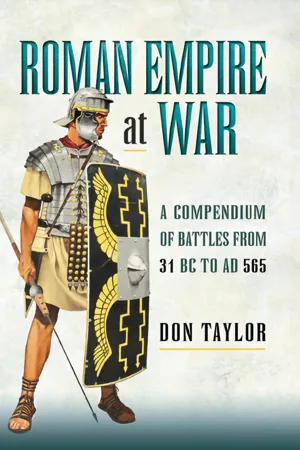
Roman Empire at War catalogues and offers a brief description of every significant battle fought by the Roman Empire from Augustus to Justinian I (and most of the minor ones too). In lists arranged both alphabetically and chronologically, the information in each entry is drawn exclusively from Ancient, Late Antique, and Early Medieval texts, in order to offer a brief description of each battle based solely on the information provided by the earliest surviving sources that chronicle the event. This approach provides a concise foundation of information to which you can then confidently apply later scholarly interpretation presented in secondary sources in order to achieve a more accurate understanding of the most likely battlefield scenario.
In writing the battle descriptions, the author has not sought to extensively analyze the evidence contained in the surviving accounts, nor embellish them beyond what was necessary to provide clarity to the modern reader. He allows the original writers to speak for themselves, presenting a succinct version of what the ancient chroniclers tell us of these dramatic events. It is an excellent first-stop reference to the many battles of the Roman Empire.
- 224 pages
- English
- ePUB (mobile friendly)
- Available on iOS & Android
eBook - ePub
About this book
Information
Part One
Introduction to Roman Imperial Warfare
The Roman Imperial Army
The Roman Legion, First Century BC–early Fourth Century AD
‘The Roman army, clashing their shields and spears together, as was their custom and uttering their battlecry, advanced against the foe.’
Polybius I.34.23
Throughout the long history of Imperial Rome, the army served as a touchstone of power for the state. The growth of Roman political influence was oftentimes synonymous with the expansion of military strength, and the power of the army became a measure of the state’s vitality. In similar fashion, the evolution of the army reflected the social, political and cultural changes which shaped and reshaped the empire over the course of five-and-a-half centuries.
Unlike its Early Republican predecessor, the Roman army of the Late Republic and Principate consisted entirely of professional troops divided into legions and auxilia. By the time the Emperor Tiberius assumed the purple in AD 14 the army’s total manpower strength was approximately 300,000, divided in roughly equal measure between the two component forces. This division was the continuation of a practice originating in the Republic.
Soldiers (milites) in legionary service were Roman citizens, and largely voluntarii, though conscription was still an option during the Empire, especially in times of crisis or preceding a major campaign.1 As early as the emperorship of Augustus (30 BC–AD 14) most recruitment, particularly in Italy, was voluntary, while the delectus (levy) was increasingly reserved for the raising of legionaries in the provinces.
Provincial recruitment became more important for the Roman army throughout the first century as the enlistment of soldiers from Italy declined precipitously during the Early Empire. By the time of the Emperor Hadrian (AD 117–138) most recruits serving in the western legions were from Gaul, Spain and northern Italy, while those in the East consisted largely of soldiers drawn from the eastern regions of the Empire.2
Soldiers were typically recruited from the poorer citizen classes, and were expected to be in sound health and meet certain minimum height requirements. These qualifications of the candidate were determined through an interview, called a probatio or inquisitio, conducted by Roman authorities in Italy, while it was carried out by the local governor in each province.3 This screening also involved a medical examination at which time the applicant’s physical qualifications were assessed. According to Vegetius, recruits who entered service with the first cohort of a legion or a cavalry ala were required to be of strong carriage, and at least 5ft 10in tall.4 In reality, the necessities of active service in the ancient world most probably resulted in many recruits not meeting this ideal height standard.5 If accepted for army service, the sacramentum was administered, by which the tiro (recruit) swore personal allegiance to the emperor. He was then sent to his assigned unit to complete basic training before assuming the duties of a legionary.
Service was thereafter for a period of sixteen to twenty-five years, with most recruits entering active service in their late teens or early twenties.6 Once posted to a unit, the soldier’s time was divided between wartime and peacetime responsibilities. When not engaged in combat operations, units were routinely employed to provide physical labour for the completion of engineering projects ranging from road building to fort construction, but peacetime duties ordinarily involved mundane daily tasks such as patrols, drill, field training and camp fatigues.7
Soldiers received regular wages, which were supplemented by a portion of booty from campaigns and special bonuses called donativa paid on occasion by the emperors in recognition of their supreme authority, and to further secure the loyalty of the legions to their imperial person.8 Each soldier (miles) was routinely paid three times a year, and from these payments stoppages were typically made for clothing and equipment, while a further portion was garnered by the miles’ cohort in the form of savings. An additional annual payment was also made to a burial account (ad signa).9 On the successful completion of his military service, the legionary was discharged with a gratuity equal to about thirteen years’ pay.10
Upon leaving service, veterans were recognized by the Roman army as missus honesta missione (honourably discharged), missio causaria (discharged due to ill-health or injury)11 or missio ignominiosa (dishonorably discharged).12 During the emperorship of Augustus, veterans were often settled together in military colonies, though it became increasingly common from the late Julio-Claudian period onward for veterans to reside in a village (canabae or vicus) near their former legion’s base, or even to return to their native province.
One determining factor was often whether the discharged soldier had acquired a family during his tenure of service. Until the emperorship of Septimius Severus (AD 193–211), soldiers of the Empire were prohibited from marrying. In many cases this restriction did not hinder their effort to establish a long-term relationship with local women and raise families.13 Ultimately, this circumstance not only impacted the local economies where veteran settlements were established, but in a very real sense the future of the Roman army, as the male offspring of ex-soldiers commonly provided a rich pool of new provincial recruits for those legions posted semi-permanently on the Empire’s frontiers.
Cohortal Legion, c.105 BC–313 AD
Between the era of Scipio Africanus (d. 183 BC) and the time of Julius Caesar (d. 44 BC), the manipular construction of the legion was superseded by a tactical organization based on the cohors. The exact evolution of this change is unknown. The historians Livy and Polybius allude to the cohort in their accounts of the fighting in Spain during the Second Punic War, but the manipulus, or maniple, was still the basic unit around which the 4,200-man legion was constructed, and appears to have remained so until the eve of the first century BC.14 The cohort was essentially an amalgamation of three maniples, and early uses of a cohors, like that described by Polybius in his account of Scipio’s battle against Indibilis, suggest this modification was valuable under certain situations as a more robust tactical response to an enemy threat.
By the first century BC a new ‘cohortal’ legion, consisting of 5,000–6,000 men arrayed in ten cohorts, replaced the earlier manipular formation. In composition, the cohort consisted of 480 soldiers, divided into six centuries of eighty men. The size of the first cohort was subsequently reorganized during the second half of the first century AD in order to accommodate five double centuries of approximately 800 legionaries in total. With the change from manipulus to cohors, the tactical distinctions between the older unit’s heavy infantrymen called hastati, principes or triarii disappeared. In addition, the accompanying lightly-armed skirmishers known as velites were completely eliminated as a distinct fighting force. All troops were now armed alike with a spear called a pilum. These changes are typically ascribed by many modern scholars to the body of reforms introduced by the consul Caius Marius, in part because the last textual references regarding the maniple and velites in battle are found in Sallust’s account of Caecilius Metellus’ campaign against Jugurtha, in 109–108 BC.15
Attached to each legion was a small force of 120 cavalry, the equites legionis, and various support personnel. The contingent of cavalry was recruited from within the ranks of the legionaries, so consisted of Roman citizens. The primary role of the cavalry force was as scouts and couriers. Because of its ability to perform a variety of tasks, this type unit remained critical to the legion, and its size did not alter from the time of its inception until it was increased by the addition of some 600 riders during the emperorship of Gallienus.16
The Cohortal Legion: the officers, and career structure below the centuriate during the Principate
By the reign of Caesar Augustus, a legatus was recognized as holding permanent command of a legion by special appointment of the emperor. Whereas under the Republic a legatus was selected by a regional governor from among personal friends, family or political supporters; during the Empire the choice fell within the purview of the emperor to make the selection based on similar criteria. In no case were such posts ever determined by election. Legates were typically of senatorial rank, selected from among ex-praetors and ex-quaestors. This practice continued until the second half of the third century AD when the Emperor Gallienus issued an edict prohibiting senators from assuming army commands.17
In the Principate a provincial army was commanded by a governor (legatus Augusti pro praetore) whose title and rank were determined by the location of their posting: propraetors of senatorial rank governed provinces where legions were deployed, while those provinces without a permanent legionary presence were typically under the authority of a procurator of equestrian status. In both cases the appointed magistrate exercised the authority of an imperial legatus, while each legion in the provincial army was under the direct command of a legatus legionis.18
The legatus legionis was the senior officer in the legion. Because of past military and political service, this officer was commonly in his thirties, and might expect a two- or three-year posting. His authority extended over both the legion and supporting auxiliary units.19
Assisting the legate in his responsibilities was the tribunus laticlavius, recognized as the senior tribune and second-in-command of the legion. Such officers typically sought a political rather than military career, and as a result served only a one-year term of military service in the legion prior to age 25, before entering the Senate as a quaestor. Because of their unique station, each such officer wore a broad, or laticlavian, purple stripe on the toga, denoting their senatorial aspirations.20
Next in line of authority was the praefectus castrorum, who was the senior professional officer in the legion and commonly possessed years of field experience, having previously served as the senior centurion, or primus pilus, of a legion. His responsibilities included oversight of camp construction and maintenance, transport supervision of the legion’s equipment during deployment, maintenance of supplies and munitions, and command of the legion’s artillery during military operations. In the absence of the two senior officers, the praefectus castrorum commanded the legion. Over time, the authority invested in this position increased. After the reign of Septimius Severus (AD 193–211), the title was altered to praefectus legionis, and under Emperor Gallienus (AD 260–268) this officer supplanted the legatus legionis as the senior officer of the legion.21
Assigned to each legion were the tribuni legionis augusticlavii, five tribunes of equestrian rank who typically aspired to either civil or military careers. The expectation of military service was much higher for these officers than for their laticlavian counterparts, and each officer could anticipate additional military service in the auxilia. Young equestrians entering the army normally advanced through the following sequence of posts: praefectus cohortis (commanding officer of an auxiliary cohort – peditatae or equitatae); tribunis angusti-clavius; and praefectus alae (officer commanding a cavalry detachment – an ala). Each such officer wore a narrow, or angusticlavian, purple stripe on their toga. The angusticlavian tribunes of a legion were usually about five to ten years older than the unit’s laticlavian officer, and routinely possessed more service experience.22
Following the tribuni angusticlavii were the sixty centurions of the legion. Each centurion (centurio; plural centuriones) commanded one of the legion’s centuries. The senior centurions were recognized as prior centuriones and the junior centurions as posterior centuriones. Because the distribution of the centurions continued to reflect the older three-part division of heavy infantrymen (hastati, principes and triarii) found in the manipular model, each centurion was still identified specifically as hastatus prior, hastatus posterior, princeps prior, princeps posterior, pilus prior or pilus posterior. The single exception to this arrangement was the centurions of the first cohort, known as the primi ordines. Accompanying the reorganization and enlargement of the cohors I in t...
Table of contents
- Cover
- Dedication
- Title Page
- Copyright
- Contents
- Acknowledgements
- Preface
- Part One: Introduction to Roman Imperial Warfare
- Part Two: Battles of the Roman Empire
- Notes
- Bibliography
Trusted by 375,005 students
Access to over 1.5 million titles for a fair monthly price.
Study more efficiently using our study tools.
Frequently asked questions
Yes, you can cancel anytime from the Subscription tab in your account settings on the Perlego website. Your subscription will stay active until the end of your current billing period. Learn how to cancel your subscription
No, books cannot be downloaded as external files, such as PDFs, for use outside of Perlego. However, you can download books within the Perlego app for offline reading on mobile or tablet. Learn how to download books offline
We are an online textbook subscription service, where you can get access to an entire online library for less than the price of a single book per month. With over 1.5 million books across 990+ topics, we’ve got you covered! Learn about our mission
Look out for the read-aloud symbol on your next book to see if you can listen to it. The read-aloud tool reads text aloud for you, highlighting the text as it is being read. You can pause it, speed it up and slow it down. Learn more about Read Aloud
Yes! You can use the Perlego app on both iOS and Android devices to read anytime, anywhere — even offline. Perfect for commutes or when you’re on the go.
Please note we cannot support devices running on iOS 13 and Android 7 or earlier. Learn more about using the app
Please note we cannot support devices running on iOS 13 and Android 7 or earlier. Learn more about using the app
Yes, you can access Roman Empire at War by Don Taylor in PDF and/or ePUB format, as well as other popular books in History & Military & Maritime History. We have over 1.5 million books available in our catalogue for you to explore.