- 264 pages
- English
- ePUB (mobile friendly)
- Available on iOS & Android
eBook - ePub
Scarborough in the Great War
About this book
In the early months of the war, for most people Scarborough was just another town somewhere in northern England, where exactly, they weren't entirely sure. But all of that changed at 8 am on the morning of 16 December 1914, when three vessels of the Imperial German Navy positioned themselves about 10 miles off of the north-eastern coastline and opened fire. The ensuing attack lasted for some 30 minutes and by the time it was over, 78 people, including women and children, had been killed and a further 228 were wounded.The disbelief at how the attack had been allowed to take place was keenly felt by the British public, and the Government were quick to turn the attack to their advantage by making it part of a propaganda campaign 'Remember Scarborough', which they used on Army recruitment posters.If it hadn't been before, the war had suddenly become a harsh reality for the entire nation, and the town of Scarborough was now well and truly on the map.After the war, the names of the hundreds of young men from the town who had been killed on a foreign battlefield, or the in the icy waters of the high seas, were commemorated on the Scarborough War Memorial at Oliver's Mount. All of these names, as well as those who had been killed in the raid of 16 December 1914, are a true testament to the price Scarborough paid for playing her part in the First World War.
Information
Topic
HistoireSubtopic
Histoire de la Grande-BretagneCHAPTER 1
A Brief History of Scarborough

Scarborough today is both a borough and a town within the county of North Yorkshire which covers a large stretch of coastline down the eastern side of Yorkshire, one of its nearest neighbours being the North Sea.
Two of the similarities the town of Scarborough has today with that of a hundred years ago, are its fishing industry and its attraction as one of the major holiday destinations on the Yorkshire coast. Its harbour, home to the town’s fishing fleet, is overlooked by the eleventh-century ruins of Scarborough Castle which is also one of its most prominent features.
There is evidence to suggest both Stone and Bronze Age settlements existed in what is now Scarborough, and during the fourth century, it was also the location of a Roman signal station, albeit for a brief period. In the following centuries, Scarborough, which is believed to have been founded around 966 AD, had both Saxon and Viking influences.
King Henry II granted Scarborough its first charter in 1155 which allowed the town to have a market. As can be seen by its early history, the trauma and fighting of the First World War was nothing new for Scarborians.
In 1312 Scarborough Castle was home to Piers Gaveston, the 1st Earl of Cornwall. Although a favourite of both King Edward I and his son, Edward II, his conduct and behaviour were not always appreciated by members of the nobility, which ultimately resulted in his exile on three separate occasions. So bad was the last occasion of his exile that it was decided that should he ever return, he was to be treated as a common outlaw. Despite this threat hanging over his head he returned to Scarborough Castle, which led to its siege in 1312, by the barons Percy, Warenne, Clifford and Pembroke. Gaveston was eventually captured and taken to Warwick Castle where he was executed. He was only 28 years of age. Rumours, although never confirmed, suggested that Gaveston and King Edward II were lovers.
Only six years later in 1318 the town was sacked and burnt to the ground by the marauding Scots under the command of Sir James Douglas, one of Scotland’s chief commanders during the First War of Scottish Independence.
During the English Civil War, between 1642 and 1651, Scarborough Castle was the scene of many a battle between Royalists and Parliamentarians; this continuous stream of fighting left much of the town in ruins.
By the 1660s, Scarborough had become popular as a spa location because of the discovery by Elizabeth Farrow in 1626 of a natural spring which she believed to have health-giving properties. This was later written about by a Doctor Wittie and subsequently attracted numerous visitors to the town who were keen to experience at first hand the therapeutic qualities of the town’s water. Scarborough became a much sought after holiday destination, especially for wealthier people and city dwellers.
With the arrival of the railway in Scarborough in 1845 there was a massive increase in the number of visitors arriving for leisure and recreation, who were able to stay at such locations as the Crown Hotel, which opened the same year on Tuesday, 10 June and which overlooks the picturesque South Bay. This was Scarborough’s first purpose-built hotel, although it would be a staggering twenty-two years before it was actually completed.
The town remained a popular destination, both for the wealthy holidaymaker or the more frugal day tripper, all the way through to the outbreak of the First World War.
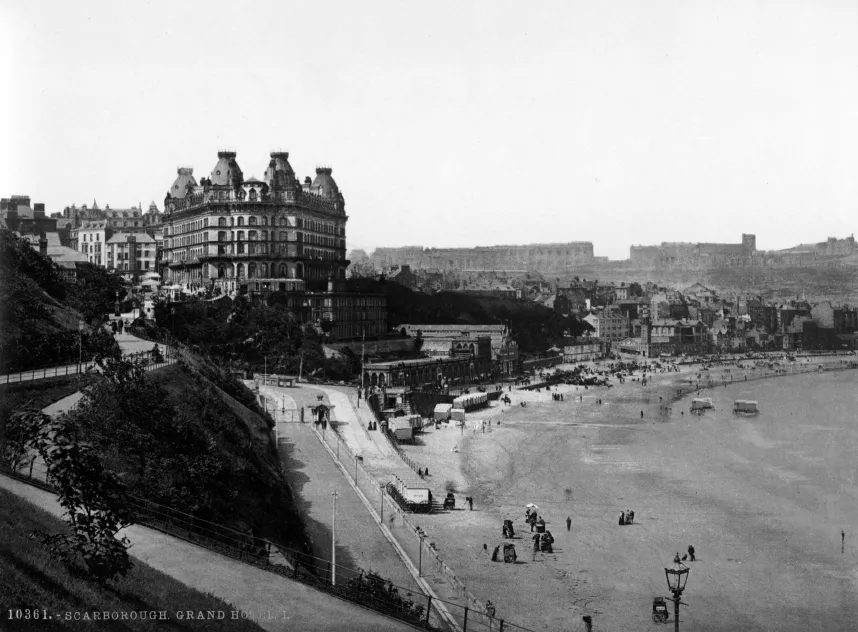
Scarborough’s Grand Hotel.
CHAPTER 2
1914 – Starting Out
By the end of 1914 the town of Scarborough was well and truly on the map, not only had twenty-two of its young men been killed in the war, but its place in history was guaranteed by the events of Wednesday 16 December of that year, when it was bombarded by two battle cruisers of the Imperial German Navy. It was an event which would be remembered by those who had lived through that day, long after the war was over.
Those young men who died during the first five months of the war were:
Albert Featherstone Bennett
Daniel Bratt
Absolom Cave
Dudley Luis de Tavora Fernandes
F. Hawxwell
Douglas Horton
Percy Ireland
Charles John Jones
Robert Jowsey
James Elijah Mann
John Mansfield
George James Medd
Arthur William Meller
Joseph E. Monkman
John Richard Pegg
T.W. Reed
William Reynolds
George Henry Saturley
W. Smith
W. Thompson
Harry Wilson
John Lionel Wordsworth
The first man from the town to die during the war just a matter of weeks old was Second Lieutenant Arthur William Mellor of the 1st Battalion, East Yorkshire Regiment. He was 31 years of age when he was killed in action on 20 September 1914, with the war just weeks old. He has no known grave, but his name is commemorated on the impressive Memorial to the Missing, in La Ferté-sous-Jouarre, a small town which is about 40 miles east of Paris, in the Seine-et-Marne region of France.
The Memorial to the Missing commemorates the names of 3,740 British officers and soldiers whose bodies were never found, after they had fallen during the Battles of Mons, Le Cateau, the Marne and the Aisne, between August and October 1914.
The exotically named Second Lieutenant Dudley Luis de Tavora Fernandes, of the 2nd Battalion, Bedfordshire Regiment, was killed by a German artillery shell on 22 October 1914. He had joined the Bedfordshire Regiment, which at the time was stationed in Pretoria, South Africa, after having passed out from the Royal Military College at Sandhurst on 13 September 1913. Having returned from South Africa with his battalion, he was sent to France, arriving on 6 October 1914, only to be killed seventeen days later, his young life extinguished at the age of 21. He does not have a grave, but his name is commemorated on the Menin Gate Memorial, in Ypres, Belgium.
The 1901 Census showed him as a 7-year-old boy living with his younger sister, Marjorie and their grandfather, Thomas Fernandes, a retired wine merchant, at 25 Grosvenor Crescent, Scarborough. The National Probate Calendar, Index of Wills and Administrations, which covered the date when Dudley was killed, showed his home address as being ‘Coomrith’, Bodorgan Road, Bournemouth.
Captain John Lionel Wordsworth, who was born on 21 April 1882, in Manningham, Yorkshire, was 32 years of age and serving in the 5th (Royal Irish) Lancers when he was killed in action on 4 November 1914. He was killed by a German shell which exploded close to his position near Ypres. The circumstances of his death dictate that he has no known grave, but his name is commemorated on the Menin Gate Memorial.
The 1911 Census records that John, who was only 18 years of age at the time, was already a lieutenant in the army, having been gazetted as a second lieutenant on 23 May 1906. He was further promoted to the rank of lieutenant two years later on 16 May 1908 and was a boarder at 11 Wenlock Terrace, York.
His brother, Captain W.H. Wordsworth, lived at ‘The Glen’, Scalby, Scarborough.
Wednesday, 16 December 1914 was a cold, foggy day in Scarborough, as the mist drifted slowly in from the North Sea, not untypical for the time of year. Despite the freshness of the early morning air some people were bathing, some still nice and warm in their beds; others were eating breakfast, or on their way to work, totally oblivious what was about to befall them.
Out at sea, two ships from the Imperial German Navy’s battle cruiser squadron, the SMS Derfflinger and the SMS Von der Tann, were preparing to carry out their audacious attack on the town and its inhabitants. Somehow they had managed to travel undetected across the North Sea and quietly position themselves in preparation to carry out their wanton carnage.
The war was about to become very real as the roar of the battleships’ massive guns burst into life as they commenced their surprise and indiscriminate bombardment. By the time it was all over, eighteen of the townspeople were dead, all of them civilians and over half of them women and children, with many more injured. Numerous buildings were either damaged or destroyed, including the Scarborough lighthouse, churches, private houses, shops, hotels, including The Grand, boarding houses, a hospital, public offices and buildings, such as Kingscliffe Camp, one of the locations throughout the town where soldiers were billeted. Scarborough Castle and the Sea Bath Infirmary were also hit.
The Scarborough lighthouse on Vincent’s Pier was hit twice during the bombardment; once half way up the main tower and once in the harbourmaster’s quarters. The overall damage was deemed to have made the structure unsafe and within a matter of days it was pulled down. It was not rebuilt until 1931.
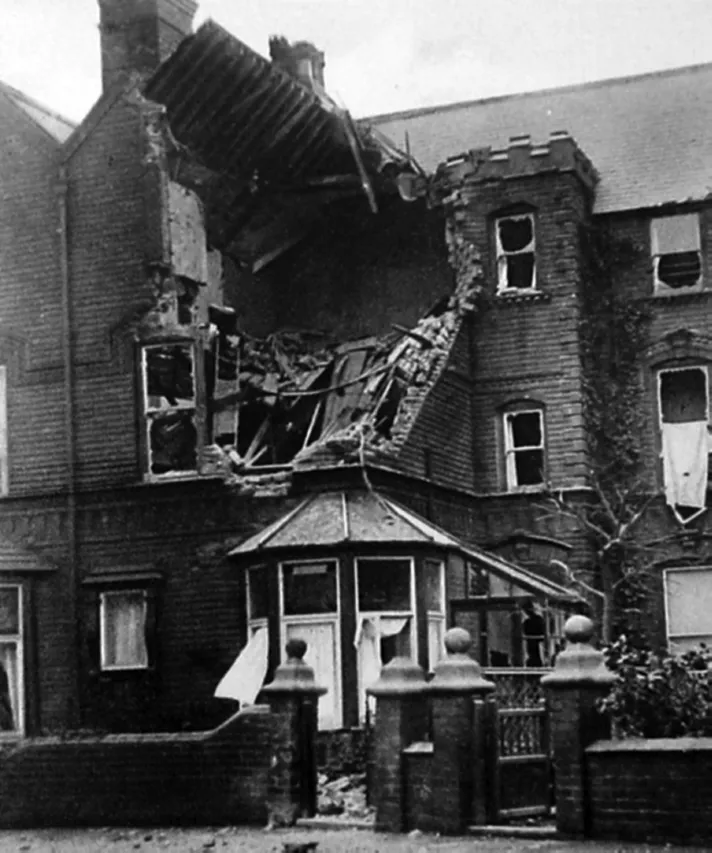
One of Scarborough’s homes damaged by the German bombardment.
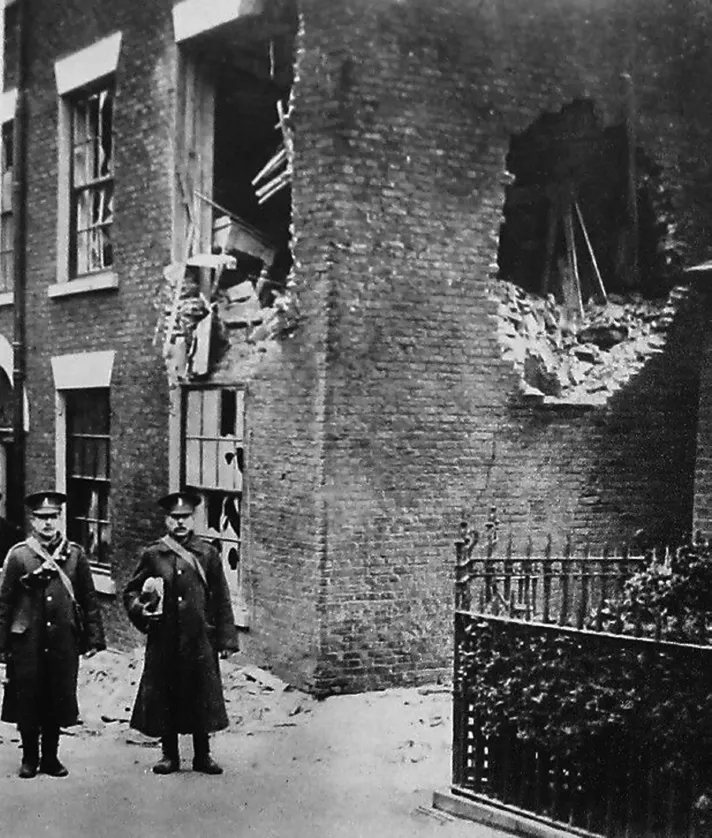
Damaged buildings.
As a prequel to this attack, the German submarine SM U-17, under the command of Oberleutnant zur See Johannes Feldkirchner, had been sent to the area of the North Sea immediately off the coastline of Scarborough and Hartlepool to check the state of British coastal defences. Feldkirchner reported back that he had seen little in the way of any defensive batteries, that there had been no mines laid by the British within twelve miles of their coastline, and that a steady stream of merchant shipping was prevalent in the area. Add to these facts that Britain’s naval presence in the same area was nowhere near the level that it should have been. Some had been redeployed, others were underg...
Table of contents
- Cover
- Title
- Copyright
- Contents
- Sources
- Acknowledgements
- About the Author
- Chapter 1: A Brief History of Scarborough
- Chapter 2: 1914 – Starting Out
- Chapter 3: 1915 – Deepening Conflict
- Chapter 4: 1916 – The Realisation
- Chapter 5: 1917 – Seeing it Through
- Chapter 6: 1918 – The Final Blow
- Chapter 7: VAD Nurses from Scarborough
- Chapter 8: Those who Died after the Armistice
- Chapter 9: Scarborough War Memorial – Oliver’s Mount
- Chapter 10: Aftermath
- Chapter 11: Some who Returned
Trusted by 375,005 students
Access to over 1.5 million titles for a fair monthly price.
Study more efficiently using our study tools.
Frequently asked questions
Yes, you can cancel anytime from the Subscription tab in your account settings on the Perlego website. Your subscription will stay active until the end of your current billing period. Learn how to cancel your subscription
No, books cannot be downloaded as external files, such as PDFs, for use outside of Perlego. However, you can download books within the Perlego app for offline reading on mobile or tablet. Learn how to download books offline
Perlego offers two plans: Essential and Complete
- Essential is ideal for learners and professionals who enjoy exploring a wide range of subjects. Access the Essential Library with 800,000+ trusted titles and best-sellers across business, personal growth, and the humanities. Includes unlimited reading time and Standard Read Aloud voice.
- Complete: Perfect for advanced learners and researchers needing full, unrestricted access. Unlock 1.5M+ books across hundreds of subjects, including academic and specialized titles. The Complete Plan also includes advanced features like Premium Read Aloud and Research Assistant.
We are an online textbook subscription service, where you can get access to an entire online library for less than the price of a single book per month. With over 1.5 million books across 990+ topics, we’ve got you covered! Learn about our mission
Look out for the read-aloud symbol on your next book to see if you can listen to it. The read-aloud tool reads text aloud for you, highlighting the text as it is being read. You can pause it, speed it up and slow it down. Learn more about Read Aloud
Yes! You can use the Perlego app on both iOS and Android devices to read anytime, anywhere — even offline. Perfect for commutes or when you’re on the go.
Please note we cannot support devices running on iOS 13 and Android 7 or earlier. Learn more about using the app
Please note we cannot support devices running on iOS 13 and Android 7 or earlier. Learn more about using the app
Yes, you can access Scarborough in the Great War by Stephen Wynn in PDF and/or ePUB format, as well as other popular books in Histoire & Histoire de la Grande-Bretagne. We have over 1.5 million books available in our catalogue for you to explore.