- 224 pages
- English
- ePUB (mobile friendly)
- Available on iOS & Android
eBook - ePub
About this book
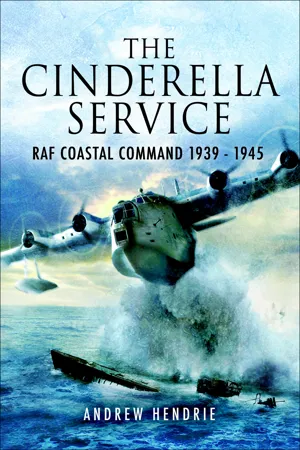
This book reveals the vital contribution that RAF Coastal Command made to the Allies war effort. Although often referred to as the 'Cinderella Service' because by its nature, it did not gain the recognition it deserved and was overshadowed by Fighter and Bomber Commands and considering that it was not given priority in terms of aircraft and equipment, its wartime record was second to none.The two main roles of Coastal Command were anti-submarine work in the Atlantic and anti-shipping operations against enemy warships and merchant vessels. This work looks at every aspect of the command's work, equipment and aircraft and draws upon many first-hand accounts. Lengthy and comprehensive appendices cover Orders of Battle, Commanders, U boats sunk, ships sunk, aircraft losses and casualties.
Information
CHAPTER ONE
Aircraft
INTRODUCTION
In this chapter I have considered the various aspects of aircraft that feature in the Command’s records emanating from the four Commanders-in-Chief. Aspects that prevailed throughout the war were the role of Coastal Command, the aircraft available, their speed, range and endurance, production, procurement and engines. For that reason, I have depended to a considerable degree on the memoranda stemming from the meetings of Coastal Command’s commanders. Armament and equipment are given in Chapter 2.
Secondary sources that refer to aircraft are seldom concerned specifically with Coastal Command’s needs, but rather of the RAF as a whole. Thus A.J.P. Taylor refers specifically to aircraft production and the ‘innovation’ of Churchill appointing Beaverbrook as Minister of Aircraft Production, and the ‘battle’ that prevailed with Ernest Bevin, the Minister for Labour. As Taylor states, ‘Beaverbrook could produce the goods. Only Bevin could produce the labour.’ A.J.P. Taylor refers to the Air Ministry being set on bombing Germany and thus grudging the supply of aircraft to Coastal Command.1
Dr Goulter in her thesis on the strike wings deals with those aircraft applicable to Coastal Command anti-shipping campaign, and rightly gives most attention to the Beaufighter and Mosquito with which the strike wings were armed. Dr Goulter dismisses, however, the Anson and Hudson that initiated attacks by Coastal Command on enemy shipping with: ‘Neither aircraft was particularly suited to a maritime function.’2 The operational records demonstrate otherwise.
Richard Overy in his The Air War 1939–1945 refers briefly to eight types of British aircraft, but they were bombers and fighters. Under ‘Aircraft and Sea Power’, however, Overy acknowledges that land-based aircraft were the key to sea power and that naval demands for purpose-built aircraft became the Cinderellas.3
Owen Thetford’s comprehensive Aircraft of the RAF Since 1918 gives technical details of most types of aircraft used by the RAF, and may be considered a standard work of reference.4
Denis Richards in the official RAF history states that Coastal Command was initially badly equipped due to priority being given to a ‘fighter force … and a bomber force’, and because the Allies had ‘superiority in naval resources’ Coastal Command came third in priority.5
The official naval historian, Captain Roskill, likewise refers to the deficiencies in Coastal Command’s aircraft and touches upon the availability, speed and range of its aircraft.6
It is left to Sir Arthur Harris to complain, later in the war, that he was losing aircraft from Bomber Command in favour of Coastal Command, although he had no wish to use the American aircraft that went to Coastal Command.7
Despite such an unfavourable beginning in respect of aircraft, it will be seen that there was a progressive improvement throughout the war, but never to be completely resolved in the operational range of aircraft.
THE ROLE OF COASTAL COMMAND
As early as October 1937, the Senior Air Staff Officer (SASO) at Coastal Command’s headquarters, Air Commodore G. Bromet, in a memo to the Air Officer Commander-in-Chief, Air Marshal Sir Frederick Bowhill, suggested that it was essential to create a modern defence organisation in cooperation with the Admiralty behind which Coastal Command could function, adding that both Fighter and Bomber Commands had clear roles.
Bromet gave the role of the Command in war against Germany as being to give warning of air raids approaching the coast; the prevention, if possible, of raiders approaching; and to assist in the protection of shipping by escorting convoys, anti-submarine patrols and reconnaissances for surface vessels.8
On 1 December 1937 the Air Ministry issued a directive that the primary role for Coastal Command would be reconnaissance in Home Waters, and cooperation with the Royal Navy in convoy protection. Additionally, in defence of British trade, offensive operations would be undertaken against surface vessels, submarines and enemy aircraft, as part of British trade protection, but the primary role was to remain reconnaissance. Earlier in 1937, the Commander-in-Chief of Coastal Command, Air Marshal Sir Frederick Bowhill, had obviously considered such requirements, and had suggested that a paper be submitted to the Air Ministry ‘on the characteristics we require for our aircraft in General Reconnaissance squadrons’.9
The characteristics that Sir Frederick specified were speed, range, good armament and good navigational facilities. Additionally he proposed that aircraft might be constructed entirely of wood, and with engines that could be jettisoned. This was so that the aircraft would float if ditched.10
Throughout 1938 the availability of aircraft, their serviceability, their location and the provision of suitable bases were considered. The Admiralty had overall responsibility for maritime operations, and a discussion was held at the Admiralty on 15 December 1938 covering the Coastal Command and Naval plans. During that discussion an embryo convoy system was considered and the lack of the Navy’s escort vessels emphasised. Because of this lack of vessels, the C-in-C Home Fleet was concerned about protecting his minelayers in the Dover Straits, and two squadrons, Nos 500 and 42, were specified for that duty.
Although no convoy system had been organised in December 1938, it was considered that protection would be required for Norwegian convoys, in the Minch Channel, and the east-coast and Dutch convoys. For the Western Approaches convoys, protection would be required in the English, Bristol, and St George’s Channels. It was considered that the east-coast and Dutch convoys would require protection against air attack, and the Air Ministry was to consult Fighter Command for that purpose.11
By the end of June 1939 a memorandum was issued by the Air Officer Commanding-in-Chief Coastal Command, outlining its command structure and its duties.
At that time there were three operational Groups in the Command, with headquarters to coincide with those of the Naval Commanders-in-Chief at Plymouth, Rosyth and Nore, and Coastal Command would be formed that year. The role of the Command was then specified as:
- (i) To assist the Home Fleet in the detection and prevention of enemy vessels escaping from the North Sea to the Atlantic.
- (ii) The provision of air patrols in cooperation with anti-submarine surface craft, or air escorts to convoys.
- (iii) Air searches, when required, over Home Waters.
- (iv) Provision of an air striking force for duty, mainly on the east-coast.
The AOC-in-C would order any readjustment of his forces according to conditions. Of the routine North Sea patrols, there was to be a continuous patrol from Montrose to the nearest point on the Norwegian coast (Obrestadt) every 45 minutes during daylight hours.
As the only aircraft available in sufficient numbers, the Avro Anson, lacked the range, submarine patrols would be established at the Norwegian end of the line. The submarines would be withdrawn when the Anson squadrons were re-equipped with the longer-range American Lockheed Hudson.12
In April 1940, at a conference held at the Air Ministry, the operational roles of the aircraft then available were given thus:
- (i) General Reconnaissance–the flying-boats Sunderland, PBY4 (Catalina), Saro Lerwick and Singapore Mark IIIs. Reconnaissance was to be by day or night over the sea and coasts of enemy territory to assist Naval, Land and Air Force in the protection of sea communications against sea-borne attack. Convoy escort by day and anti-submarine cooperation generally.
- (ii) Bombing: high, low and shallow dive-bombing by day or night of both stationary and moving targets. Hudsons, Beauforts and Bothas were to be used for reconnaissance by day or night in addition to bombing requirements. Nos 22 and 42 Squadrons with Beauforts were to be trained for torpedo attacks.Ansons were to be used for reconnaissance, especially for convoy and anti-submarine patrols, but additionally for bombing.
These extreme measures indicate how desperate the situation was considered. They were made just a week after the invasion of Norway. At home, the obsolescent Singapore flying-boat must have been included of necessity; the Anson was certainly no bomber aircraft; and the Botha was to be proved unsuitable for operations.13
Prior to the invasion of Norway it had been decided that Sunderlands and PBYs (Catalinas) would be mainly employed in the Atlantic and the Arctic, ‘where particularly long endurance is required’.14 Air Chief Marshal Sir Philip Joubert succeeded Sir Frederick as Commander-in-Chief Coastal Command in June 1941, and was to express the role of the Command thus:
Recent experience shows conclusively that there are two main tasks which have to be carried out by this Command ... close escort of convoys up to the limit of endurance of present day aircraft and the sweeping an area ... for sighting, attacking or neutralising enemy submarines by forcing them to submerge. These two are complementary ... carried out only if Coastal Command possesses sufficient aircraft to do the jobs.
Thus the role of the Command was redefined. Joubert added that additional tasks were shipping reconnaissance, attacks on warships and merchant vessels and reconnaissance against possible invasion forces, and further that there was ‘at present a tendency to force on to Coastal Command commitments which more properly belong to the Navy and to shipborne aircraft’.15
AIRCRAFT AVAILABLE
At the outbreak of war in September 1939 Air Marshal Sir Frederick Bowhill, the Air Officer-in-Chief of Coastal Command, had forces of ten Anson squadrons, including four Auxiliaries, one Hudson squadron, and two strike squadrons of Vildebeests. The flying-boat units were two squadrons of Sunderlands, three with Saro Londons, and one equipped with Supermarine Stranraers. The Vildebeest strike-aircraft and the Londo...
Table of contents
- Title Page
- Copyright Page
- Table of Contents
- Dedication
- Preface
- Acknowledgements
- Abbreviations and Glossary
- Introduction
- The Research
- CHAPTER ONE - Aircraft
- CHAPTER TWO - Armament
- CHAPTER THREE - Anti-Submarine Warfare 1939–1941
- CHAPTER FOUR - Anti-submarine Warfare 1942–1945
- CHAPTER FIVE - Anti-Shipping Operations–Merchant Shipping
- CHAPTER SIX - Anti-Shipping Operations–Warships
- CHAPTER SEVEN - ‘Cinderella’ Units
- CHAPTER EIGHT - Coastal Command in Retrospect
- CHAPTER NINE - Conclusions
- APPENDIX 1 - Coastal Command’s Commanders
- APPENDIX 2 - Summary of Planned Expansion of RAF, 19 4–1936
- APPENDIX 3 - Coastal Command Order of Battle, 10 September 1939
- APPENDIX 4 - Aircraft in Service with Coastal Command, 10 September 1939
- APPENDIX 5 - Coastal Command Order of Battle, 1 November 1940
- APPENDIX 6 - Coastal Command Order of Battle, 15 June 1941
- APPENDIX 7 - Coastal Command Aircraft Wastage, September 1939 to June 1941
- APPENDIX 8 - Sightings and Attacks on U-boats, September 1939 to June 1941
- APPENDIX 9 - Coastal Command Order of Battle, 15 June 1942
- APPENDIX 10 - Coastal Command Order of Battle, 15 October 1942
- APPENDIX 11 - Coastal Command Order of Battle, 15 February 1943
- APPENDIX 12 - Coastal Command Order of Battle, Establishment, Strength and Availability, 1 March 1943
- APPENDIX 13 - Coastal Command Order of Battle, Establishment, Strength and Availability, 1 January 1944
- APPENDIX 14 - Distribution Between Anti-U-boat and Anti-Shipping Operations, 1 March 1945
- APPENDIX 15 - Coastal Command Order of Battle, Establishment, Strength and Availability, 1 April 1945
- APPENDIX 16 - Summary of Coastal Command, 1 April 1945
- APPENDIX 17 - Distribution Between Anti-U-boat and Anti-Shipping Operations, 1 April 1945
- APPENDIX 18 - U-boats Sunk or Damaged by Coastal-Command-Controlled Aircraft
- APPENDIX 19 - Enemy-Controlled Ships Sunk or Damaged by Coastal-Command-Controlled Aircraft
- APPENDIX 20 - Coastal-Command-Control led Aircraft Lost During the Second World War
- APPENDIX 21 - Coastal Command Casualties, 3 September 1939 to 8 May 1945
- Bibliography
- Notes
- Index
Trusted by 375,005 students
Access to over 1.5 million titles for a fair monthly price.
Study more efficiently using our study tools.
Frequently asked questions
Yes, you can cancel anytime from the Subscription tab in your account settings on the Perlego website. Your subscription will stay active until the end of your current billing period. Learn how to cancel your subscription
No, books cannot be downloaded as external files, such as PDFs, for use outside of Perlego. However, you can download books within the Perlego app for offline reading on mobile or tablet. Learn how to download books offline
Perlego offers two plans: Essential and Complete
- Essential is ideal for learners and professionals who enjoy exploring a wide range of subjects. Access the Essential Library with 800,000+ trusted titles and best-sellers across business, personal growth, and the humanities. Includes unlimited reading time and Standard Read Aloud voice.
- Complete: Perfect for advanced learners and researchers needing full, unrestricted access. Unlock 1.5M+ books across hundreds of subjects, including academic and specialized titles. The Complete Plan also includes advanced features like Premium Read Aloud and Research Assistant.
We are an online textbook subscription service, where you can get access to an entire online library for less than the price of a single book per month. With over 1.5 million books across 990+ topics, we’ve got you covered! Learn about our mission
Look out for the read-aloud symbol on your next book to see if you can listen to it. The read-aloud tool reads text aloud for you, highlighting the text as it is being read. You can pause it, speed it up and slow it down. Learn more about Read Aloud
Yes! You can use the Perlego app on both iOS and Android devices to read anytime, anywhere — even offline. Perfect for commutes or when you’re on the go.
Please note we cannot support devices running on iOS 13 and Android 7 or earlier. Learn more about using the app
Please note we cannot support devices running on iOS 13 and Android 7 or earlier. Learn more about using the app
Yes, you can access The Cinderella Service by Andrew Hendrie in PDF and/or ePUB format, as well as other popular books in History & Military & Maritime History. We have over 1.5 million books available in our catalogue for you to explore.