- 192 pages
- English
- ePUB (mobile friendly)
- Available on iOS & Android
eBook - ePub
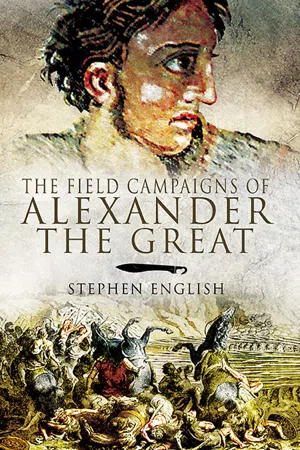
The Field Campaigns of Alexander the Great
About this book
Alexander the Great is one of the most famous men in history, and many believe he was the greatest military genius of all time (Julius Caesar wept at the feet of his statue in envy of his achievements). Most of his thirteen year reign as king of Macedon was spent in hard campaigning which conquered half the then-known world, during which he never lost a battle. Besides the famous set-piece battles (Granicus, Issus, Gaugamela, Hydaspes), Alexander's army marched thousands of miles through hostile territory, fighting countless smaller actions and calling for a titanic logistical effort.There is a copious literature on Alexander the Great, but most are biographies of the man himself, with relatively few recent works analyzing his campaigns from a purely military angle. This book will combine a narrative of the course of each of Alexander's campaigns, with clear analysis of strategy, tactics, logistics etc. This will combine with Stephen English's The Army of Alexander the Great and The Sieges of Alexander the Great, to form a very strong three-volume examination of one of the most successful armies and greatest conquerors ever known.
Information
Chapter One
Methodology
My earlier book The Sieges of Alexander the Great began with a discussion of the surviving ancient source material for the career of Alexander. For historians, however, the sources are only the first step. The key to history is how we treat that material. This book will open with a development of that material to discuss methodology and how we, as historians, undertake the study of history.
One of the very first issues that any historian, ancient or modern, must address is source analysis. How can we separate the possible (or perhaps inevitable) invention of later historians from the views of the original contemporary source? How can we overcome the bias in any source? How can we reconstruct events from disparate accounts? And of particular interest to us as military historians, how can we reconstruct a battle narrative without the benefit of modern communication? Within this opening chapter I will attempt to answer these questions and essentially set out the methodological approach taken in this book and its predecessors to the sources and to the complex issues of source analysis.1
The survival of source material makes any study of ancient history difficult, but there are specific issues regarding the Alexander sources that make the study of this period particularly challenging. At first sight, for the career of Alexander, we are blessed with surviving source material. There are two full-length histories of his reign by Arrian and Curtius (although Curtius contains some significant lacunae), a biography by Plutarch, two books of Justin's epitome of Pompeius Trogus, an entire book of Diodorus' history and some significant sections of Strabo; along with these there are some interesting passages in Polybius which are frequently and unjustifiably ignored. This apparent embarrassment of source material is extremely misleading, however, as they are all of late date, the earliest (Diodorus) being late first century BC. Strabo wrote shortly afterwards, in the late Augustan period, and Curtius was probably late first century AD, with Plutarch and Arrian writing some time in the second century. Pompeius Trogus wrote under Augustus; the date of Justin's epitome is disputed but is much later, probably either third or fourth century. The issue of the transmission of accurate information is particularly acute, therefore, in the Alexander historians.2
Despite there being a great number of works written on Alexander during his life and shortly afterwards, no contemporary source survives in anything more than fragmentary form. Of the fragments that remain, most are from a relatively small group of historians, namely: Callisthenes, Aristobulus, Chares, Cleitarchus, Nearchus, Onesicritus, and Ptolemy.3 All of these primary sources present problems: despite their loss, the fact that they were used to such a degree by those sources who do survive means they cast a long shadow indeed over all later scholarship. For most, we do not really know the main thrust of these primary sources: some may have concentrated on military matters, on geography, on natural history, or on the king's character, etc.; we simply do not know with any certainty. We can, however, reasonably speculate that Ptolemy, for example, would have taken care to present his own role as critical to the success of the entire campaign, but even this is speculation given the lack of surviving material. Further to the abundant yet limited source material, there are very few surviving inscriptions and numismatic evidence is sparse, but there are a few references in contemporary orators like Demosthenes.4
Of the now lost primary contemporary sources, the first to be written was perhaps Anaximenes' work On Alexander, written during Alexander's lifetime. The surviving fragments of this work are far too sparse to support any conclusion as to its aim, tone or quality. Along with Anaximenes was Callisthenes' Deeds of Alexander which covered the period down to late 331 at least (the latest datable fragments describe the battle of Gaugamela in that year) and was only cut short by the author's killing in 327 by Alexander. Alexander's death brought a wealth of material written by senior commanders. Onesicritus and Nearchus wrote soon after the king's death, and Ptolemy wrote before 283 (the date of his own death) but probably fairly close to it. Aristobulus composed his history at some point after the battle of Ipsus in 301, contemporary with Cleitarchus' work, which was the most widely read on the subject in the ancient world.5
There were also many pamphlets published on Alexander after his death, including a treatise on the deaths of Alexander and Hephaestion by Ephippus and the works of a more formal reporting nature like the stathmoi of the Royal surveyors and the Ephemerides, which was allegedly compiled by Eumenes. These primary sources provided a rich and wide-ranging pool from which the surviving tradition was able to draw. Modern historians have always felt a tremendous temptation to trace their effect upon the extant tradition by using the surviving fragments. The method has been to analyse the surviving fragments and attempt to trace bias and other characteristics whilst simultaneously trying to identify these in the surviving tradition.6 The approach can be very enlightening when we have some other verifiable evidence that a particular fragmentary historian was used by a secondary source, as is the case with Arrian for example, but when the identification is speculative then it often leaves more questions than answers.
The major problem with this approach to Alexander historiography is that we have very little opportunity to examine a large section of any primary source against the available secondary tradition. One of the rare instances where we can do this is with Nearchus' account of his voyage from India to Susa, which forms the narrative base for the second half of Arrian's Indica.7 To act as a control sample, we also have large sections of Strabo where Nearchus was also the primary source. A similar exercise can be conducted with Aristobulus, although less successfully as we do not have as much surviving material from him to work with. More often than not, this approach is very difficult due to the lack of surviving material, and the tangential material often preserved.
Many secondary authors were very selective in citing their sources and only tend to do so either when they are in disagreement or when the validity of what they are quoting was in question and they are seeking to try to remove any blame from themselves for inaccurate information. As a result of this, when sources are named, it is usually where they were likely incorrect; material that was sober and informative would simply be copied without citation or comment.
Callisthenes demonstrates the above point very well: we may reasonably expect the first historian of Alexander to have been very widely used by secondary historians, but there are only around twelve citations of his Deeds of Alexander. Many of the surviving references are only loosely linked with the narrative that we can assume he would have provided (as the official court historian); the largest group are regarding the mythology of Asia Minor, as reported by Strabo.8 Of the remainder of the surviving fragmentary material of Callisthenes, there are two longer sections preserved by Polybius which are crucial and concern Callisthenes' narrative of the battle of Issus. Polybius uses the first section, citing his source in order to prove (in his eyes at least) the incompetence of Callisthenes as an historian. The two sections primarily deal with troop numbers and the inaccuracy of the description of the topography of the plain.9 There are undoubted problems with Callisthenes' account: the eulogistic approach to Alexander is not helpful (and one of the reasons he does not survive). The secondary sources are far from perfect in their approach to the primary material as Polybius demonstrates here. Polybius tends to assume that all of Alexander's infantry were pezhetairoi and that they were as rigid and inflexible as the Macedonian phalanx had become in his own day. Despite the failings of Callisthenes (albeit hardly proved by Polybius), Polybius' detailed criticisms have proved the basis for a number of reconstructions of the site of the battle of Issus.10
The second of the two major fragments concerns Alexander's visit to Siwah, and is used by Strabo. The sections where Callisthenes is used are highlighted by Strabo to demonstrate that Callisthenes was an archflatterer. Strabo was not here attempting to give a full narrative from Callisthenes, merely to use him to provide a flattering view of Alexander (having ravens act as guides to help him find the oasis, for example). The implicit criticism of Callisthenes for providing an unashamedly flattering picture of Alexander is echoed by Plutarch, who also related the story of the ravens, although this time without citation.11 Strabo's narrative of the Siwah episode culminates in the statement that Alexander was indeed the son of Zeus, a theme no doubt also coming from Callisthenes' work.
This section of Callisthenes was widely cited and used to demonstrate the belief that he was little more than a flatterer of Alexander. Several other fragments also appear to show this theme (unsurprising in a historian who was writing under the watchful eye of the king himself). Plutarch notes Alexander's prayer to Zeus in similar flattering terms.12
Polybius' criticisms of Callisthenes show that he preserved some very detailed material that would have been especially useful to the military historian. There is some good detail on troop numbers and movements which, coming as it did from an eye witness, has a high likelihood of being accurate and correct. This potentially useful material is not what we have citations for, however; he is frequently only quoted in the context of the eulogistic and bizarre.13 Having said this, simply because we do not have a citation in a particular passage does not mean that he was not the ultimate source (an argument that can be applied to any primary source who is cited); absence of evidence is not evidence of absence after all. We should be wary, however, of attributing too much material to Callisthenes, as its attribution is almost always speculative and based upon assumptions. Whilst Callisthenes may not have been the most widely read of the contemporary Alexander historians, he certainly influenced the early tradition.
The source problems are even more acute with Cleitarchus. It appears that Cleitarchus was a very popular historian, especially during the Roman period, and was probably the most popular of the primary historians of Alexander. In total, Jacoby accepts thirty-six fragments as being authentic; unfortunately all of them deal with minor and trivial matters. These fragments are mostly preserved by Aelian and deal with the fauna of India, and by Strabo who criticizes Cleitarchus for errors in his geographical and topographical descriptions of Asia, again illustrating that citations are frequently used in order to discredit an historian and remove blame for errors from the secondary source. Of the remaining fragments, “Demetrius focuses on his stylistic impropriety (F 14), Curtius Rufus on exaggeration and invention (F 24–5), Cicero on rhetorical mendacity (F 34). The general impression conveyed by the fragments alone is therefore far from favourable”.14 These fragments, considered in isolation, tend to suggest that Cleitarchus was prone to exaggeration and therefore not a reliable source; if this is correct then it has a significant effect on Alexander scholarship as he was so widely read. We must remember three vital points, however; the first is that, as far as we know, Cleitarchus was not an eye witness to the events he describes and we must, therefore, consider who his ultimate source may have been. In all likelihood he had several primary sources himself. Probably Callisthenes, Onesicritus and Nearchus were major providers of information for Cleitarchus, as were the large number of Macedonian veterans in Alexandria at the time of his writing. Secondly we do not have enough surviving material to be able to condemn Cleitarchus absolutely: the fragments may well be unrepresentative. The final point follows from that: as noted above, primary sources are only usually cited in order to discredit them and make the secondary author seem more plausible and authoritative. This tendency would lead directly to only negative material being preserved and therefore a conclusion based upon this material is dangerous. Following this, however, we can say that there was evidently a fair amount of negative and sensationalist material in Cleitarchus; otherwise later historians would have used a different primary source in order to prove the point they wished to make.
The general impression conveyed by fragmentary material may well be accurate, but it is unlikely to tell the whole story. If, for example, we were to have citations in Athenaeus and Plutarch's On the Malice of Herodotus, we would come to the same conclusion about the father of history as some do of Cleitarchus (and Callisthenes); that his history was filled with malice, trivialities and bias. It would certainly be true to say that such things exist within Herodotus, but not that it is the main thrust of his work.
In order to make a proper judgement of Cleitarchus, more data is required. Modern source analysis has convincingly established that large sections of both Diodorus and Curtius are so similar that the only realistic conclusion is that they derived from the same primary source. The same material is also detectable in both Justin and the extant sections of the Metz Epitome. A common tradition has long been recognized and the term ‘vulgate’, albeit unsatisfactory because of its negative assumption, has been applied to this tradition.15 It would be entirely incorrect to conclude, however, that a historian from the vulgate tradition never used a primary source from outside of that tradition, e.g. Ptolemy or Aristobulus. Plutarch, for example, frequently used sources that are clearly different from the vulgate and therefore cannot always be considered to be part of that tradition.
The term vulgate does not imply a single primary source, but rather suggests a shared tradition.16 Having said this, however, that shared tradition probably had a single stronger voice than the rest, namely Cleitarchus. The key passage in indicating this is Curtius 9.8.15, which refers to Cleitarchus as his source for the number of Indians killed during the Sambus campaign:17
According to Cleitarchus, 80,000 Indians were slaughtered in this area and many captives auctioned off as slaves.
The passage of Curtius/Cleitarchus is clearly the source of the equivalent passage of Diodorus:18
Next he ravaged the kingdom of Sambus. He enslaved the population of most of the cities and, after destroying the cities, killed more than eight thousand of the natives. He inflicted a similar disaster upon the tribe of the Brahmins, as they are called; the survivors came supplicating him with branches in their hands, and punishing the most guilty he forgave the rest. King Sambus fled with thirty elephants into the country beyond the Indus and escaped.
The two accounts probably come from the same source, and Curtius tells us explicitly that that source is Cleitarchus (although interestingly again citing his source when the information being given seems unbelievable: 80,000 Indian dead). Whilst this does not prove that the rest of the shared tradition of the vulgate also originates with Cleitarchus, it is a strong indication that at least some of it does. This is supported by what we know of Diodorus, that he generally used a single source for several chapters and only switched sources when he came to the end of his current primary source's work.19 For Diodorus' Book Seventeen, there are no real digressions, no discussion of the history of Persia or the west, and no discussions on geography or natural history. This further indicates that Diodorus was using a single source for Book Seventeen, as digressions would likely have come from another source, and therefore the idea of Cleitarchus being the primary source for the vulgate is further strengthened.
Arrian's history has generally and rightly been regarded as the finest of the surviving narratives of the career of Alexander the Great. His text is unique in the ancient world in that he specifically gives us information about his use of sources: in his Preface, he identifies both his sources and his reasons for using them as his primary material. Arrian's reasons for selecting his sources are often considered naïve, and I beli...
Table of contents
- Cover Page
- Title Page
- Copyright
- Contents
- Maps
- Preface
- Acknowledgements
- Chapter One: Methodology
- Chapter Two: Campaign in Europe, 335–4
- Chapter Three: The Battle of the Granicus River, 334
- Chapter Four: The Campaign of Asia Minor, 334—3
- Chapter Five: The Campaign of Issus, 333
- Chapter Six: Gaugamela, 331
- Chapter Seven: The Northeast Frontier, 330–327
- Chapter Eight: India, 327–5
- Notes
- Bibliography
- Index
Trusted by 375,005 students
Access to over 1.5 million titles for a fair monthly price.
Study more efficiently using our study tools.
Frequently asked questions
Yes, you can cancel anytime from the Subscription tab in your account settings on the Perlego website. Your subscription will stay active until the end of your current billing period. Learn how to cancel your subscription
No, books cannot be downloaded as external files, such as PDFs, for use outside of Perlego. However, you can download books within the Perlego app for offline reading on mobile or tablet. Learn how to download books offline
Perlego offers two plans: Essential and Complete
- Essential is ideal for learners and professionals who enjoy exploring a wide range of subjects. Access the Essential Library with 800,000+ trusted titles and best-sellers across business, personal growth, and the humanities. Includes unlimited reading time and Standard Read Aloud voice.
- Complete: Perfect for advanced learners and researchers needing full, unrestricted access. Unlock 1.5M+ books across hundreds of subjects, including academic and specialized titles. The Complete Plan also includes advanced features like Premium Read Aloud and Research Assistant.
We are an online textbook subscription service, where you can get access to an entire online library for less than the price of a single book per month. With over 1.5 million books across 990+ topics, we’ve got you covered! Learn about our mission
Look out for the read-aloud symbol on your next book to see if you can listen to it. The read-aloud tool reads text aloud for you, highlighting the text as it is being read. You can pause it, speed it up and slow it down. Learn more about Read Aloud
Yes! You can use the Perlego app on both iOS and Android devices to read anytime, anywhere — even offline. Perfect for commutes or when you’re on the go.
Please note we cannot support devices running on iOS 13 and Android 7 or earlier. Learn more about using the app
Please note we cannot support devices running on iOS 13 and Android 7 or earlier. Learn more about using the app
Yes, you can access The Field Campaigns of Alexander the Great by Stephen English in PDF and/or ePUB format, as well as other popular books in History & Military Biographies. We have over 1.5 million books available in our catalogue for you to explore.