- 304 pages
- English
- ePUB (mobile friendly)
- Available on iOS & Android
eBook - ePub
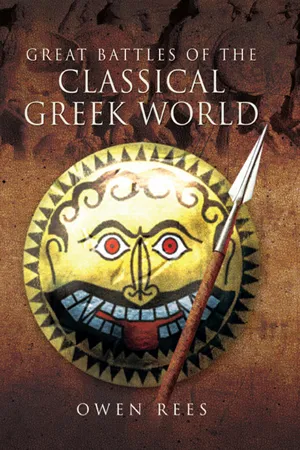
Great Battles of the Classical Greek World
About this book
This book presents a selection of eighteen land battles and sieges that span the Classical Greek period, from the Persian invasions to the eclipse of the traditional hoplite heavy infantry at the hands of the Macedonians. This of course is the golden age of the hoplite phalanx but Owen Rees is keen to cover all aspects of battle, including mercenary armies and the rise of light infantry, emphasising the variety and tactical developments across the period. Each battle is set in context with a brief background and then the battlefield and opposing forces are discussed before the narrative and analysis of the fighting is given and rounded off with consideration of the aftermath and strategic implications. Written in an accessible narrative tone, a key feature of the book is the authors choice of battles, which collectively challenge popularly held beliefs such as the invincibility of the Spartans. The text is well supported by dozens of tactical diagrams showing deployments and various phase of the battles.
Information
Part I
The Peloponnesian War
After 479 BC, and the successful repelling of the last Persian invasion, Greece became a political battlefield, with Athens at the fore expanding its power and authority. By the 430s, Athens had accumulated a vast alliance of small poleis who were duty-bound to them, known as the Delian League. It was an alliance that was tantamount to an empire. Only the strongest of poleis could resist their overtures, many of whom joined a looser alliance with Sparta, known as the Peloponnesian League.
As Athens looked to expand further afield, tensions rose with the powerful Peloponnesian polis of Corinth. This tension had come to the fore because of Corinthian interests in the north-westerly region of Greece, and a former colony of theirs called Corcyra. Corcyra had the second largest navy of the Greeks and formed an alliance with the largest, namely Athens. Fearing that the Athenians would reinforce the islanders’ navy, Corinth acted and fought the largest naval battle Greece had ever witnessed, the battle of Sybota (433 BC).
Corinth claimed victory against the Corcyraeans on the day, butchering any survivors they found, but once an Athenian fleet joined the fray Corinth refused to continue hostilities through fear of breaking the peace accord between the two states. According to our main source, Thucydides, this was the first of two main complaints that induced Corinth to finally go to war with Athens.
Athens had become increasingly suspicious of Corinthian intentions and there was one very major and volatile area for Athenian-Corinthian diplomatic discord. It was a town to the very north of Greece, on the isthmus that connected the Pallene Peninsula to Chalcidice, called Potidaea. Potidaea had been founded by Corinthian settlers and so considered Corinth its metropolis (mother-city), but on the other hand it was a tribute paying ally of Athens in accordance with its membership of the Delian league – so both poleis laid claim to it.
Athens began with some harsh demands: they ordered the southern city walls to be burnt to the ground, they demanded that Potidaea gave hostages to Athens as a sign of good will, and they told them to dismiss the Corinthian magistrates from the town and to refuse the next appointees that Corinth would send (as Corinth did every year).
The Athenians had an added concern that Potidaea might in some way serve as a large, remote base for resistance against them. Its location lent itself to being influenced by the Macedonian King Perdiccas II, who was trying to resist the uprising of his younger brother, Philip, and another Macedonian ruler, Derdas. Philip and Derdas had already secured the support of the Athenians, forcing Perdiccas to try and re-direct Athenian attentions by invoking a war. He first tried to elicit the Peloponnesian states into war by going straight to Sparta, but when this did not work he set his sights on the Thracian tribes around him, as well as the Greek inhabitants of Chalcidice, and encouraged them to revolt.
For all of these reasons Athens began preparations to send a force of 1,000 hoplites on 30 ships, led by Archestratus, even before they had heard from the Potidaean envoys the response to their demands. Potidaea’s representatives were unable to persuade the Athenians to revoke their demands, and further envoys had been sent to Sparta and Corinth to confirm their support should Athens attack. So, even though Athens refused to back down, the support shown verbally by Sparta and Corinth was enough for the Potidaeans to feel secure in their position and join the Perdiccas-inspired revolt of Chalcidice. At Perdiccas’ request the Chalcidians abandoned most of the coastal cities and refortified Olynthus, which was to stand as the real base of the revolt. Thus, after defeating the confederate army outside the walls of Potidaea, Athens became embroiled in a two-year siege, beginning a conflict that would engulf Greece for over twenty-five years, on and off.
From the outset of the conflict the battlefield tactics were shown to be fluid and at times quite innovative. At Olpae (426/5 BC), the Athenian general, Demosthenes, utilised light-armed troops in an ambush position to attack a stronger Spartan-led force that opposed him. The tactic had pre-empted the plans of Eurylochus, the Spartan commander, who had placed his strongest troops on the left wing, rather than the more customary right wing, to attack the position of Demosthenes directly. This Spartan plan to attack the ‘head of the snake’, as the later Theban general Epaminondas is said to have so eloquently described it, was repeated over fifty years later by the Thebans at Leuctra (371 BC).
At Delium (424 BC) we see, for the first time, the massing of the Theban phalanx, where they chose a much deeper formation and chose to sacrifice the width of their battle lines. This gave the Thebans a greater staying power, with more ranks to call upon. We also see the use of the oft-ignored cavalry, whose appearance caused panic within the ranks of the Greek phalanx – when it was used effectively. Finally, the redeployment of horse during battle shows the level of tactical control still available to the Greek commanders as they fought shoulder to shoulder with their men, or conversely it shows how well they planned the battles.
During the Thracian campaign of Brasidas (424–422 BC), which culminated in the Battle of Amphipolis, we see the importance of the wider diplomatic issues that surrounded a Greek campaign. Brasidas was given carte blanche to form alliances and wage war with whomever he wished, without the need for authorization from Sparta. But at times this diplomatic need tore him away from his objectives. Brasidas was a great tactician who could use innovations with devastating effect. Most interesting was his implementation of a flamethrower during the siege of Torone (424/3 BC) which had ostensibly been seen for the first time during the siege of Delium, following the battle in that same year. Brasidas’ pre-emptive ambush/sally from the walls of Amphipolis shows us an ability, like Demosthenes at Olpae, to second guess the actions of the enemy and exploit their weaknesses with good preparation and planning.
Finally, at the First Battle of Mantinea (418 BC), the issues of dissent and social pressures become self-apparent. The Spartan king, Agis II, felt obliged to fight a battle he had intended to avoid because of the stigma that was already being placed upon him for his (previously failed) military endeavours. The battle saw numerous mistakes being made and attempts to exploit them by both sides; showing the chess-like nature that hoplite battle could take. It also reveals one quirk of Greek warfare to its fullest: both armies were prone to veering to the right as they marched. This battle was the first time we can see this habit being counteracted tactically, by Agis and his trained Spartan troops.
Chapter 1
The Battle of Olpae (426/5 BC)
The Background (Thucydides, III.91–105; Diodorus XII.60.1–6)
By 426 BC the Peloponnesian war had spread throughout Greece, but most of the conflict so far had consisted of naval battles or else within the medium of siege.1 But this year saw a shift in ambitions from both the Athenian and the Peloponnesian sides. A shift that was perpetrated by one man’s pursuit of glory followed by his desire for forgiveness. This man was a young Athenian general, Demosthenes.
The summer of 426 BC saw a more confident Athenian strategy come into fruition. After securing their position in Mytilene, which had risen in a bloody revolt the year before, Athens looked to push the war out of Attica. They sent out two fleets, the first was sixty ships strong and under the command of Nicias, whose primary goal was to force the small island of Melos into submission; a task that sounded simpler in theory than it turned out in practice.2 Resorting to the common Greek military tactic of raiding, Nicias devastated the Melian countryside. However, the people of Melos were unmoved. The Athenian fleet then decided to go back to the mainland, landing at Oropus, directly north of Athens. From this position Nicias began to ravage the Tanagran territory, before defeating a force of Tanagrans who sallied from their city to try and stop them. With this minor victory Nicias decided to return back to Athens, wreaking havoc on the Lorian shore along their way.
The second fleet was under the joint command of Procles and none other than Demosthenes. With a force of thirty Athenian ships they were travelling around the Peloponnese and headed towards the western frontier of Leucas and the Acarnanian coast. When Demosthenes landed in the territory of Leucas he orchestrated a successful ambush of a guarding garrison at Ellomenus, giving him a foothold in the region from which to prepare an escalation of the conflict. He set his eyes firmly on the eponymous city of Leucas and, after receiving reinforcements from the Acarnanians, Zacynthians, Cephallenians and Corcyraeans, he instigated a policy of agricultural destruction similar to Nicias. As in Melos, however, this did not have the desired effect because the Leucadians had no intention of leaving their walls to fight against such a vast and superior army. Demosthenes was thus urged by the Acarnanians to try a different approach and exploit the geographical phenomena on which Leucas was situated.
Leucas was a peninsula, connected to the mainland by a very narrow isthmus. The Acarnanians advised Demosthenes to build a small wall across this isthmus, which would isolate the Leucadians and allow them to be sufficiently weakened so that they would either surrender or else be taken with greater ease. If Demosthenes had not succumbed to the lure of even greater glory, this could have been the first major victory of his career.
Within Demosthenes’ army was a contingent of Messenians from the Athenian colony of Naupactus. They succeeded in convincing Demosthenes that the size of his army could be put to better use by conquering the region of Aetolia. This in turn would then make it easier for the Athenians to secure the central mainland of Greece.3 Demosthenes was quickly convinced. He had visions of using this victory to increase his army size, using his new Aetolian allies. This would enable him to march on Boeotia without the need for support from Athens.4
The Athenian fleet set sail away from Leucas, to the dismay of the Acarnanians, leaving with a slightly reduced force that consisted of Cephallenians, Messenians, Zacynthians and 300 Athenian marines.5 The fleet landed in the territory of the Athenian allies Ozolian Locris, to the east of Naupactus. They set up base at Oeneon. Demosthenes hoped that his army would swell with his allies in Locris, who would meet him during his march inland; these warriors had the added benefit of being similarly armed to the Aetolians and also had many years’ experience fighting them.6
Demosthenes marched his army with great confidence, taking the towns of Potidania, Krokyle and Tichium with ease. His aim was to penetrate north until he reached the Ophionian settlements. If he could not convince them to submit to him, he would return to Naupactus and regroup before heading back out on a second expedition. The only drawback to this plan was that Demosthenes’ success thus far was not due to his military superiority, but because the Aetolians, aware of his plans, had simply avoided contact with him. As soon as the Athenian army had entered Aetolia, the many tribes of the region began to amass a joint force, with men coming from the furthest depths of the rugged Aetolian wilderness, all with the intent of removing this enemy from their land.
None the wiser, Demosthenes was cajoled into action by the counsel of his Messenian troops, who were now joined by the concurring voices of his own advisors. No longer content to wait for his Locrian allies to join him, Demosthenes ordered his men to march on as fast as they could towards Aegitium and storm its walls.7 The inhabitants fled the city, moving into the hills that surrounded it, and beyond. As quickly as the hills emptied of refugees they filled again, flooded by the confederate army of the Aetolian peoples. The soldiers descended upon Demosthenes’ men from every side, hurling their javelins as they ran. Faced with this onslaught, the Athenians had only two options: retreat or engage if they wanted to survive. They tried to chase down the Aetolians, but they could never catch them. As the hoplite line retired, the darters attacked once more. This ebb and flow characterized the battle for a long period of time, with the Athenians worse off in both positions as attacker and defender.
The only saving grace for Demosthenes’ army was their own contingent of archers who were able to drive back the Aetolian advances with their arrows. With one accurate javelin this advantage was swiftly lost; the captain of the archers was killed and with him went the bravery and cohesion of the archer unit. The Athenian infantry were left exposed and, as the repetition of advance and retreat took its toll, they finally turned and fled.
This rout was an even greater disaster. With no guides to show them the way, the hoplites ran themselves into gullies and unknown woodland, weighed down by their equipment.8 The lighter-armed Aetolians were much quicker in their running and were soon making short work of the panicked masses. Those Athenians who had entered the woods would fare worst: as the trees were set alight and the woods were burnt to the ground - with them inside. It is not known how many died that day, but 120 Athenian hoplites were killed, as well as Demosthenes’ colleague Procles.9 A truce was call...
Table of contents
- Cover
- Title Page
- Copyright
- Contents
- Acknowledgements
- Preface
- Introduction
- Glossary
- Part I: The Peloponnesian War
- Part II: The Spartan Hegemony
- Part III: Siege Warfare
- Part IV: Greco-Persian Conflicts
- Part V: Conclusions
- Notes
- Bibliography
Trusted by 375,005 students
Access to over 1.5 million titles for a fair monthly price.
Study more efficiently using our study tools.
Frequently asked questions
Yes, you can cancel anytime from the Subscription tab in your account settings on the Perlego website. Your subscription will stay active until the end of your current billing period. Learn how to cancel your subscription
No, books cannot be downloaded as external files, such as PDFs, for use outside of Perlego. However, you can download books within the Perlego app for offline reading on mobile or tablet. Learn how to download books offline
Perlego offers two plans: Essential and Complete
- Essential is ideal for learners and professionals who enjoy exploring a wide range of subjects. Access the Essential Library with 800,000+ trusted titles and best-sellers across business, personal growth, and the humanities. Includes unlimited reading time and Standard Read Aloud voice.
- Complete: Perfect for advanced learners and researchers needing full, unrestricted access. Unlock 1.5M+ books across hundreds of subjects, including academic and specialized titles. The Complete Plan also includes advanced features like Premium Read Aloud and Research Assistant.
We are an online textbook subscription service, where you can get access to an entire online library for less than the price of a single book per month. With over 1.5 million books across 990+ topics, we’ve got you covered! Learn about our mission
Look out for the read-aloud symbol on your next book to see if you can listen to it. The read-aloud tool reads text aloud for you, highlighting the text as it is being read. You can pause it, speed it up and slow it down. Learn more about Read Aloud
Yes! You can use the Perlego app on both iOS and Android devices to read anytime, anywhere — even offline. Perfect for commutes or when you’re on the go.
Please note we cannot support devices running on iOS 13 and Android 7 or earlier. Learn more about using the app
Please note we cannot support devices running on iOS 13 and Android 7 or earlier. Learn more about using the app
Yes, you can access Great Battles of the Classical Greek World by Owen Rees in PDF and/or ePUB format, as well as other popular books in History & Greek Ancient History. We have over 1.5 million books available in our catalogue for you to explore.