- 400 pages
- English
- ePUB (mobile friendly)
- Available on iOS & Android
eBook - ePub
About this book
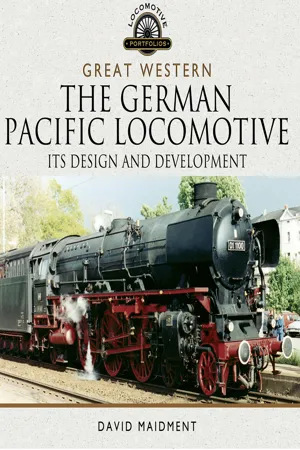
The German Pacific Locomotive (Its Design and Development) is David Maidments fourth book in the series of Locomotive Profiles published by Pen & Sword. It is the first in the series to tackle an important range of overseas steam locomotives, the German pacific locomotives, which, with the Paris-Orleans pacific in France, were the first of that wheel layout in Europe and came to be the dominant type for express passenger work throughout Western Europe for the following fifty years, until displaced by diesel and electric traction. The German railways in the first two decades of the twentieth century were run principally as regional State railways, and two distinct styles of design developed, which were influenced by the natural terrain. In the south, in the mountainous foothills of the European Alps, four cylinder compound locomotives with comparatively small coupled wheels, most produced by the famous firm of Maffei in Munich, held sway from 1907 until the late 1930s, and in parts of Bavaria that were not yet electrified, even until the early 1960s. In the flatter lands of the north, Prussian 4-6-0s sufficed until Paul Wagners standard two cylinder simple pacifics came onto the scene in 1925, and were followed by the three cylinder streamlined pacifics at the start of the Second World War. After addressing the devastating damage to the German railways in the conflict, the book follows the modernization of the locomotive fleet in the postwar period until the elimination of steam in both East and West Germany in the mid-late 1970s. The book describes the design, construction and operation of the full range of pacifics that ran in both parts of Germany, and the large numbers of these locomotives that have been preserved, and is illustrated with over 180 black and white and 80 colour photos.
Information
Subtopic
Deutsche GeschichteChapter 1
OVERVIEW
The first railway in Germany was the short line from Nuremberg to Fürth in Bavaria in 1835, followed by a rapid expansion into a vast network of railways throughout the independent States and Princedoms. These were run by a variety of companies over very different terrain and with different political allegiances, served by a number of engineering companies and works pursuing their own policies and practices. It was not until after the Franco-Prussian war in 1871, and the increasing dominance of the Prussian State, that the beginning of some order began to arise, although the independence of the State systems lasted well into the twentieth century.
At the turn of the century, express passenger trains of the various companies were in the hands of Atlantic 4-4-2 and 4-6-0 locomotives – of the State railways of Bavaria, Baden, Saxony and Württemberg in the south, and Prussia, Oldenburg and Mecklenburg in the north. With the pressure to increase train speeds and loads for the more affluent travellers during the first decade, the railways began to look for larger and more powerful locomotives and the Munich firm of Maffei produced Germany’s first Pacific 4-6-2 for the Baden system in 1907, one year before Britain’s first, the Great Western’s Great Bear, and just a few months after the French Pacific 4500 built by the Paris-Orleans (PO) Railway. The Baden IV f (DR 18.2), was followed in rapid succession by the Bavarian Royal State Railway’s famous four-cylinder compound S3/6 Pacific (DR 18.4) also built by Maffei, and the smaller Württemberg class ‘C’ (DR 18.1) built at the private Esslingen Works in 1909. The Baden Company produced an improved version of their Pacific, the IV h (DR 18.3) in 1918, and the Saxon Railway, their XVIII H (DR 18.0), built by the Hartmann Engineering Company a year earlier during the war in 1917.
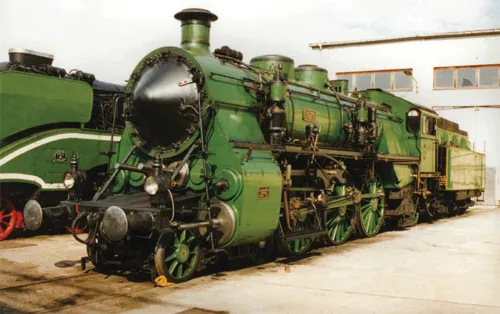
Preserved Bavarian four-cylinder compound 3673 (DB 18.478) restored in Bavarian Royal State Railway livery and in active operation at Meiningen Works, 1999. It is standing next to the unique Pacific, 18.201, used for rolling stock testing at Halle Research Centre and since preserved. (Richard Spoors)
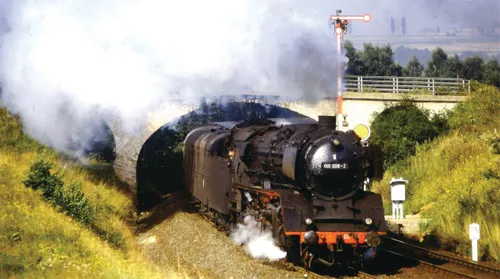
The January 1926-built 001.008-2 (since preserved) departs from Neuenmarkt-Wirsberg under the B303 road with a Nuremberg-Hof train, September 1972. (Richard Spoors)
Only after the First World War was there pressure to unify and standardise railway systems and locomotive policy – the financial state of the main State railways after so much railway equipment had been handed to the victors as war reparations made the nationalisation of the State railways inevitable, which happened on 1 April 1920, with all the State railways incorporated by April 1921. With a shortage of capital, the nationalised railway struggled and, within a short time, efforts to privatise the railway were being advocated. Initially there were continuing problems, as the French military still occupied the Ruhr industrial area and inflation was rising rapidly. However, under the American Dawes Plan, a loan of 800 million Goldmarks was provided to enable German industry to recover and improve exports, and, on 24 February 1924, the Deutsche Reichsbahn Gesellschaft (DRG) took responsibility for the national railway system outside state control.
When the amalgamation of the State railways into a national system took effect on 1 April 1920, the new Deutsche Reichsbahn inherited 275 different classes of steam locomotive. The Transport Minister, at a conference in Oldenburg in May 1921, asked three key questions re future locomotive policy:
1. Which existing locomotive classes should be further constructed?
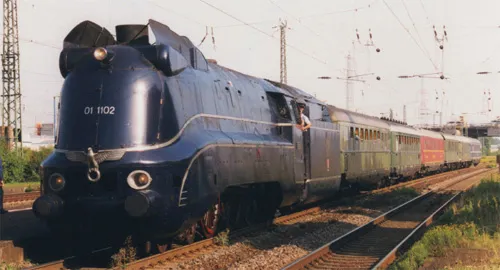
The preserved and re-streamlined three-cylinder Pacific, 01 1102, as built in 1940, on a Sunday special from Cologne to Kreuzberg in the Ahrtal. Here, she is awaiting a path at Huerth-Kalscheuren on the way to Remagen, October 1999. (Richard Spoors)
2. What new locomotive types should be created?
3. How should all the new locomotives to be created be allocated?
There followed a long series of debates between the former chief engineers over the merits of the Prussian S10.1 4-6-0s for lighter work, the Saxon XX HV compound 2-8-2s for heavier work, issues of axle-weight, length compared with turntables available. In the meantime, a number of German manufacturers put forward a host of 4-6-0, 4-6-2 and 2-8-2 simple and compound designs for consideration for new standard express engines.
The DRG was formed in 1924, and the new numbering and classification system of the State locomotives was then introduced, with all the Pacifics receiving the class 18 designation, the numbers 01-10 being reserved for possible future DRG standard locomotive developments. The construction of State railway designs continued for a few years, with the Bavarian S3/6 Pacific and the Saxon XX HV 2-8-2 in particular, as capital for new investment was in short supply until preparations for new standard locomotives were completed. Then, at the end of 1925, the two-cylinder DRG 01 designed by the new chief engineer, Head of Locomotive Construction, Richard Paul Wagner, appeared, built by Borsig and AEG. The locomotives continued to be built by a variety of firms until 1937, when the class numbered 231 examples.
The Bavarian S3/6s were the last State design to be built by the DRG, forty class 18.5s being constructed by Krauss-Maffei and Henschel between 1926 and 1930, some twenty or more years after the introduction of the prototype, while a version of the 01, the class 03, was developed with lighter axle-loads for secondary main lines. The DRG experimented with four-cylinder compound variations of the 01, but quickly opted for the simplicity and reliability of the two-cylinder simple 01 and 03s for all main line express passenger work. Then, in the 1930s, the worldwide interest in high-speed rail travel to compete with the burgeoning air and auto industries led to experimentation with high pressure and streamlining. The German Nazi regime, interested in demonstrating their power and supremacy, encouraged the development and high-speed exploits of a streamlined three-cylinder 4-6-4, the 05, in 1935, built by Borsig in Berlin, the second example of which, 05.002, set a world record of 200.4km/hr (125mph) on 11 May 1936, the record standing until just eclipsed by the British A4 Pacific Mallard in 1938.
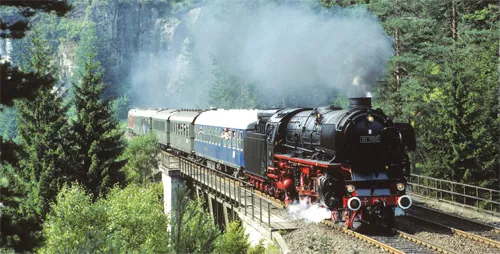
Preserved three-cylinder de-streamlined and reboilered oil-burner 01.1100 on a railtour special at Velden, 25 May 1985. (Roger Bastin)
With this experience behind them, the DRG developed the three-cylinder streamlined 01.10s for regular express passenger work, the first of which was built in 1939 in competition with the high-speed diesel train concept of the early 1930s – the Flying Hamburger. It was planned to build 400 of these locomotives, although only fifty-five had been completed before the impact of the Second World War caused construction to cease. Experiments had been conducted to assess the effects of streamlining on examples of the 03 class and the building of 140 03.10 three-cylinder streamlined lightweight Pacifics was planned, although only sixty had been built before their construction also ceased in 1941.
The German railways suffered enormous damage during the final years of the war and many of the old State Pacifics were either destroyed or were in such a bad condition at the end of the war that they were stored as unserviceable, pending decisions on possible repair, rebuilding or withdrawal. Many of the streamlined standard Pacifics were also in a very damaged condition and as post-war track allowed no possibility of the immediate restoration of high-speed working, the 01.10s and 03.10s were de-streamlined and reboilered.
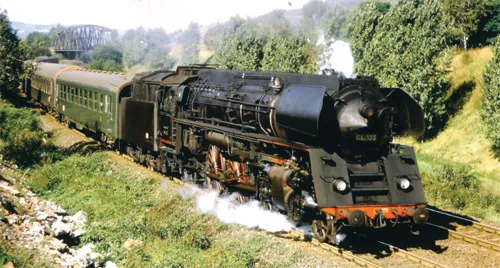
Oil-burning 01.523, rebuilt from standard 01.191 by the East German DR in 1964, climbs through Ronshausen to Hönebach Tunnel with a Frankfurt– Bebra–Erfurt express, 16 September 1968. (Richard Spoors)
As the German economy recovered and post-war reconstruction commenced, the West German Federal Railway (Deutsche Bundesbahn – DB) began to equip their locomotive fleet for post-war conditions, rebuilding many of the 01s, and all of the 01.10s and 03.10s, with all-welded boilers and combustion chambers. Also, thirty of the 1926-30-built S3/6 Bavarian compound Pacifics were rebuilt between 1953 and 1957, with higher performance welded boilers, and reclassified 18.6. In 1956, 01.1100 was equipped for oil-burning and thirty-four of the fifty-five-strong class were similarly modified and a dozen examples remained on the Rheine-Emden-Norddeich route until 1975 as the last DB steam main line passenger engines.
The West German examples of the 03.10s were reboilered between 1956 and 1958, but remained coal-burning and were all stationed at Hagen in the Ruhr, until their mass withdrawal in 1966. The post-war administration designed a new series of standard locomotives in the mid-1950s, but the only Pacific design, the semi-streamlined class 10, built as a three-cylinder simple locomotive by Krupp in 1956, consisted of only two prototypes before dieselisation and electrification of the main routes made the design redundant.
The Communist East German State inherited a similar number of 01, 03 and 03.10 Pacifics (although no 01.10s) and also proceeded to equip them for the post-war era. The 03s and 03.10s received new boilers with feedwater heaters, and thirty-five of the two-cylinder 01s also received new boilers with semi-streamlining, being reclassified as 01.5s. Locomotives of all four Pacific types – 01, 01.5, 03 and 03.10 – lasted until the early 1980s, with all bar two of the 03.10s and most of the 01.5s becoming oil-fired for their last decade of operation.
All the former State railway Pacifics had been withdrawn by the early 1960s in West Germany, apart from the reboilered 18.6s which lasted until 1965 and three Maffei Pacifics kept at Minden research headquarters for testing purposes (ex-Bavarian 18.505 and Baden 18.316 and 323). The Saxon State engines 18.001-010 (apart from 18.002, destroyed during the war) lasted on the Berlin–Dresden route until the early 1960s, and one other State Pacific, Baden’s 18.314, and two DR Pacifics, 03.1010 and the unique 18.201, rebuilt from a pre-war high-speed 4-6-4 tank, were housed at the Halle Research Centre.
However, both administrations allowed a series of Plandampf projects when diesel or electric services on secondary routes were replaced by steam engines on selected trains for two or three days for the benefit of enthusiasts. In West Germany this mainly occurred in the Rhine/Moselle area, with standard 01 Pacifics and smaller engines, but in East Germany in the 1990s there were more ambitious events on the Magdeburg–Berlin and the Bebra– Erfurt–Dresden–Görlitz corridor between the West German and Polish borders. Five former DR Pacifics were the stars for these events – 01.137, 01.531, 03.001, 03.204 and 03.1010 – and Plandampf events have continued into the twenty-first century although the appearance of the Pacifics has been less frequent, except on the occasional enthusiast railtour.
A large number of German steam locomotives have been preserved, most ‘plinthed’ in the cities where they were built or domiciled, but German enthusiast societies have been active in establishing some excellent museums and ensuring some of these large engines are fit to run on the main line. In fact, one locomotive, 18.201, is the only steam locomotive in the world still authorised to run at a maximum of 160km/hr (100mph) and 03.1010 is allowed 140km/hr (87½mph). A few of the State railway engines existed for some time capable of operating on the main lines, the main examples being the Baden 18.316 and the Bavarian 18.478 (as Bavarian Railways 3673), both in the former West Germany.
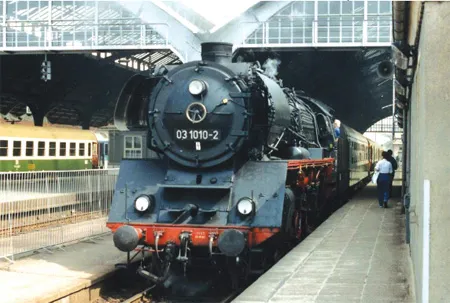
Preserved three-cylinder 03.1010-2, built in 1940 as a streamlined light axleweight pacific, was de-streamlined and reboilered after the war in East Germany at Halle, converted to oil-burning in 1967, and reconverted to coal fuel after preservation, at Görlitz with D1854 to Dresden during a Plandampf event, 30 April 1994. (David Maidment)
The following chapters will recount the history of the construction and operation of each class of German Pacific, their development and modification in East and West Germany after 1945, my personal experiences of seeing and travelling behind many of the Pacifics in both parts of Germany between 1958 and 1979 and experiencing the main line Plandampfs in 1993 and 1994, and finally a brief description of each Pacific that has been preserved in either museum or running condition.
Chapter 2
GERMAN EXPRESS PASSENGER LOCOMOTIVES AT THE START OF THE TWENTIETH CENTURY
Express locomotive power at the turn of the century in Britain, France and Germany consisted of a large assortment of different classes of 4-4-0s and 4-4-2 Atlantics, with some of the more progressive companies beginning to see the 4-6-0 wheel arrangement offering more power and adhesion to cope with the fast increasing market of leisure travel by the newly affluent middle classes. Some of the leading engineers, such as Churchward and De Bousquet, were sharing ideas an...
Table of contents
- Cover
- Title
- Copyright
- Acknowledgements
- Contents
- Chapter 1 Overview
- Chapter 2 German Express Passenger Locomotives at the start of the Twentieth Century
- Chapter 3 The Baden Pacifics – The IV f&h (18.2 & 18.3)
- Chapter 4 The Württemberg ‘C’ (18.1)
- Chapter 5 The Bavarian Maffei Pacifics – S 3/6 (18.4-5)
- Chapter 6 The Rebuilt Maffei Pacifics – 18.6
- Chapter 7 The Saxon Pacifics – XVIII H (18.0)
- Chapter 8 The Deutsche Reichsbahn 01
- Chapter 9 The Deutsche Reichsbahn 02
- Chapter 10 The DR (East German) 01.5
- Chapter 11 The Deutsche Reichsbahn 01.10
- Chapter 12 The Deutsche Reichsbahn 03
- Chapter 13 The Deutsche Reichsbahn 03.10
- Chapter 14 The Deutsche Reichsbahn 04
- Chapter 15 The Deutsche Bundesbahn 10
- Chapter 16 Further Developments of the German Express Passenger Steam Locomotive
- Chapter 17 Foreign Pacifics and other express Locomotives on German Railways
- Chapter 18 Personal Experiences of German Pacifics, 1958 – 1979
- Chapter 19 The ‘Plandampf’ Experience, 1993-1994
- Appendices – Dimensions, Weight Diagrams & Statistics
- Bibliography
- Map of the East & West German main-line railway routes during the period of steam Pacific-hauled expresses, 1907-1982
Trusted by 375,005 students
Access to over 1.5 million titles for a fair monthly price.
Study more efficiently using our study tools.
Frequently asked questions
Yes, you can cancel anytime from the Subscription tab in your account settings on the Perlego website. Your subscription will stay active until the end of your current billing period. Learn how to cancel your subscription
No, books cannot be downloaded as external files, such as PDFs, for use outside of Perlego. However, you can download books within the Perlego app for offline reading on mobile or tablet. Learn how to download books offline
Perlego offers two plans: Essential and Complete
- Essential is ideal for learners and professionals who enjoy exploring a wide range of subjects. Access the Essential Library with 800,000+ trusted titles and best-sellers across business, personal growth, and the humanities. Includes unlimited reading time and Standard Read Aloud voice.
- Complete: Perfect for advanced learners and researchers needing full, unrestricted access. Unlock 1.5M+ books across hundreds of subjects, including academic and specialized titles. The Complete Plan also includes advanced features like Premium Read Aloud and Research Assistant.
We are an online textbook subscription service, where you can get access to an entire online library for less than the price of a single book per month. With over 1.5 million books across 990+ topics, we’ve got you covered! Learn about our mission
Look out for the read-aloud symbol on your next book to see if you can listen to it. The read-aloud tool reads text aloud for you, highlighting the text as it is being read. You can pause it, speed it up and slow it down. Learn more about Read Aloud
Yes! You can use the Perlego app on both iOS and Android devices to read anytime, anywhere — even offline. Perfect for commutes or when you’re on the go.
Please note we cannot support devices running on iOS 13 and Android 7 or earlier. Learn more about using the app
Please note we cannot support devices running on iOS 13 and Android 7 or earlier. Learn more about using the app
Yes, you can access Great Western: The German Pacific Locomotive by David Maidment in PDF and/or ePUB format, as well as other popular books in Technik & Maschinenbau & Deutsche Geschichte. We have over 1.5 million books available in our catalogue for you to explore.