"Practically all new information on the greatest empire of all and how it controlled and policed its frontiers. Absolutely fascinating!"—
Books Monthly
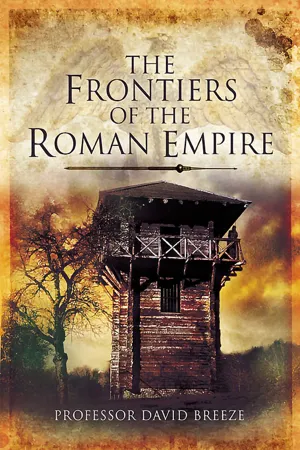
At its height, the Roman Empire was the greatest empire yet seen with borders stretching from the rain-swept highlands of Scotland in the north to the sun-scorched Nubian desert in the south. But how were the vast and varied stretches of frontier defined and defended?
Many of Rome's frontier defenses have been the subject of detailed and ongoing study and scholarship. Three frontier zones are now UNESCO World Heritage sites (the Antonine Wall having recently been granted this status—the author led the bid), and there is growing interest in their study. This wide-ranging survey will describe the varying frontier systems, describing the extant remains, methods and materials of construction and highlighting the differences between various frontiers. Professor Breeze considers how the frontiers worked, discussing this in relation to the organization and structure of the Roman army, and also their impact on civilian life along the empire's borders. He then reconsiders the question of whether the frontiers were the product of an overarching Empire-wide grand strategy, questioning Luttwak's seminal hypothesis.
This is a detailed and wide-ranging study of the frontier systems of the Roman Empire by a leading expert. Intended for the general reader, it is sure also to be of great value for academics and students in this field. The appendixes will include a brief guide to visiting the sites today.
"The result of this book-crafting care and Breeze's erudition is a near-perfect example of specialized military history done for a popular audience." —
Open Letters Monthly
- 224 pages
- English
- ePUB (mobile friendly)
- Available on iOS & Android
eBook - ePub
The Frontiers of the Roman Empire
About this book
Information
Part I
Sources
Chapter 1
The Frontiers
There is no such creature as a typical Roman frontier. Each section relates to the countryside through which it runs, the enemy, the builders, the materials of construction locally available, the date it was built, existing installations, and how it was surveyed and laid out.
A hundred years ago, Lord Curzon, former viceroy of India, discussed many of these issues – and more – in a series of lectures on frontiers.1 He acknowledged that this subject had not been much considered before, but at that time was growing in importance. He noted that most of the treaties of his day between sovereign states concerned the definition of frontiers. Curzon characterized frontiers as being natural or artificial. In the former he included the sea, deserts, mountains, rivers and features such as forests, marshes and swamps. His description of artificial frontiers encompassed linear barriers, but also a broad zone of separation, ‘a razed or depopulated or devastated tract of country’, and buffer states. He also noted the role of the protectorate or, as we would call them in the Roman world, the client or friendly kingdom, on frontiers, and spheres of influence. Finally, he appreciated the concept of ‘hinterland’, that a new conquest has its own hinterland which forms part of the new acquisition.
For Curzon, the landscape appears to have been the most significant criterion and so it was for the Romans. In many places, the boundary of their empire was defined by the sea. This is particularly noteworthy in North Africa and western Europe, where the Atlantic Ocean and the English Channel/La Manche provided a clear edge to the empire, but the Red Sea and the Black Sea were also significant in the East. Beyond the Channel lay two large islands, Britain and Ireland. Roman arms only extended to the former and here, again, Roman dominion was brought to the edges of the island, except in the north.
A major river was adopted as the de facto imperial boundary in several places. The most important rivers were the Rhine, Danube and Euphrates which formed the greater part of the frontier around the whole of the northern half of the empire for the greater part of its life. In the 70s, the frontier in Germany was moved beyond the headwaters of the Rhine and Danube, but, when this sector was abandoned in the 260s, the new line then adopted followed a route along the rivers Danube, Iller and Rhine (pl. 1).
In the Middle East and in North Africa, that is the southern half of the empire, deserts offered a defining boundary, except in Egypt as Nubia lay further up the Nile. No powerful state lay beyond the empire in the Sahara Desert, nor beyond modern Jordan, that is Roman Arabia. But east of the northern section of the eastern frontier lay Parthia, the greatest enemy faced by Rome. Here the Roman frontier ebbed and flowed as Roman emperors captured one or other of the oasis cities or were forced to relinquish them by the Parthians or their successors, the Persians. Holding such cities was also the key to the control of further conquests as each formed a stepping stone to the next.
Mountains could offer a strategic boundary, such as the Carpathians which enveloped the province of Dacia, modern Romania. But there are always passes through mountains and in Romania we have recently been discovering the ways in which the Roman army controlled these routes by the erection of barriers across the passes. Even in areas technically beyond the boundary of the empire, the army sought to control passes through mountains such as the Caucasus between the Black Sea and the Caspian Sea.
In some places, there was no obvious boundary. Thus, in north Britain, Germany and parts of North Africa, artificial barriers were constructed. That in Germany ran for 550km (330 miles) and included a stretch of 43km (25 miles) where the River Main and its tributary the Neckar formed the frontier. In Britain, Hadrian’s Wall was only 130km (74 miles) long and the Antonine Wall in modern Scotland half that length, though in each case installations continued along the river banks to west and east. Each such artificial frontier took the form of a linear barrier, of timber, earth, turf or stone, which, in effect, defined the limit of the empire.
The countryside, or at least its geology, dictated the materials used to build Roman frontiers. The German frontier was of timber and when that decayed it was replaced by either an earthen bank or a stone wall. The Fossatum Africae in modern Algeria was partly of mud brick and partly of stone, both being used in the construction of the forts. Hadrian’s Wall in Britain was built of both stone and turf, while the Antonine Wall was primarily of turf and timber but with some fort buildings of stone or at least on stone footings.
One of the interesting aspects of Roman frontiers is that they are all different. The available materials of construction play a part in these differences, but only a part. A stretch of the Upper German frontier built under Antoninus Pius was mathematically straight for over 80km (48 miles), totally ignoring the changes in the landscape through which it passed; the adjacent section of frontier acknowledged the landscape. Hadrian’s Wall was erected in the 120s in relation to an existing series of military installations and this affected its location. On the line of the Antonine Wall, however, there were no such forts and the line was more sinuous and more closely related to the topography through which it ran. Recent research has demonstrated that these two British frontiers were laid out in very different ways.2
The relationship of a frontier to the ‘enemy’ is more difficult to determine. The great nineteenth-century German ancient historian Theodor Mommsen suggested that the two British frontiers appeared to be more defensive than their German counterparts because the enemy pressed more strongly upon the borders in Britain.3 In this book I will offer an alternative reason for these differences. Along the Danube, the lightly held stretches of the frontier would appear to relate to the lack of enemy across the river, which itself related to the topography.
The definition of what constitutes a ‘frontier’ is of some interest. The word ‘frontier’ is often used as if it is defined as a single line on a map. In fact, while this may have been the case along certain borders of the empire, for example along the major rivers of the empire, it was certainly not the case elsewhere. In several provinces there was a broader military frontier area than a simple, single line and each case was unique. Further, outposts existed beyond many frontiers. Moreover, in the first century at least, some land across the Rhine was retained for the use of the army. In the desert regions, forts were located where there was water and thus were distributed over a wide area. In North Africa, forts might be pushed as far out into the desert as possible along traditional routes, though again respecting oases. A line drawn on a map joining the outermost forts looks seductively like a frontier, but this is a mirage for the links of these forts went back to the settled areas not along a ‘frontier’ line.
In these circumstances, it is difficult to know where the exact boundary of the empire lay. Did the military frontier coincide with the legal frontier? Even if we can assume that a river formed the border, Rome might seek to control activities immediately beyond. This can be seen in the treaties agreed in the 170s between Marcus Aurelius and the Marcomanni, Quadi and Iazyges to the north of the Danube whereby a cleared zone was established north of the river. Moreover, the Romans had a habit of seeing their allies beyond their formal border as being part of their empire, which is an additional complication.
It is also important to acknowledge that the relationship between Rome and her neighbours was not one between equals, except in the case of Parthia and her successor Persia. Rome was a world power, in our terminology a super power, and she acted as such, crossing her frontiers to retaliate against attacks on her territory and her people and in some areas maintaining outposts beyond her boundaries and even a military presence on the territory of adjacent states.
There is perhaps one further aspect to the definition of frontiers, the so-called ‘frontier zone’, an area in which the Romans and the indigenous population both within and without the empire were complicit in the maintenance of life in the frontier region. As Owen Lattimore noted, the degree of economic integration between conqueror/occupier and the native population is of paramount importance: upon that rests the ability of the occupying force to maintain its position.4 Yet, while accepting that view, my primary concern in this book lies with the military installations which lay on or close to the boundary of the Roman Empire, accepting both that these could form part of a wide military zone and also that the frontier works did not necessarily constitute the boundary of the empire.
Some words on terminology are essential. The Romans themselves had various words for frontiers and their components. Inscriptions from North Africa and Germany use the word fines to denote a boundary. In both literature and epigraphy limes is used to designate a land boundary – not a frontier – of the empire, with ripa designating the river boundary. Usage changed over the centuries. Limes, at first a road, by the beginning of the second century had come to be used to describe the boundary of the empire, and later a frontier district, such as the limes Tripolitanus, the Tripolitanian frontier. Both Hadrian’s Wall and the Antonine Wall were called vallum on inscriptions and murus in literature. In the early-third-century road book, the Antonine Itinerary, occurs the phrase, a limite, id est a vallo, ‘from the boundary, that is the Wall’, which does suggest that Hadrian’s Wall was the boundary of the province even though there were Roman forts beyond it. A river frontier was a ripa. The frontier area might be known as the praetentura, the forward area.5
The Romans obviously knew where the boundary of the empire lay, even if this is not clear to us. The Notitia Dignitatum, dating to about 400, recorded forts as being in barbarico, that is outside the empire. Descriptions of the contents of treaties or the actions of emperors and governors demonstrate that they knew the precise line between Rome and barbaricum, and when they crossed it.
The individual types of installations had their own names: Tacitus called a legionary base and an auxiliary fort castra. In the Antonine Itinerary, castra is a fort and praesidium something smaller, perhaps a fortlet. In the Eastern Desert of Egypt castra is used for the main base and praesidium for the outposts, though praetensio was used for an outpost in Arabia. The Diocletianic inscriptions use praesidium for both forts and a fortlet, a garrison in fact, as used by Tacitus. A fort could also be a castellum (which was also used in Africa to describe a non-military civil settlement) or, in the late empire, a munitio. On inscriptions, burgus is either a tower or a fortlet, sometimes a tower sitting within an enclosure, while turrem appears on some inscriptions to describe a tower. Today, a camp is the term used to describe a temporary fortification: a marching camp occupied for a few nights; a labour camp used by a building party; a siege camp; or a practice camp. A fort is a permanent structure. A legionary base is often referred to as a fortress. A small fort held a small unit or a detachment drawn from a larger unit, and a fortlet usually no more than about eighty men.6
‘Limes’ has also come into general use today, especially in Germany where it is the generic term for the Roman frontier. Elsewhere, it is used to describe sections of frontier such as the Limes Ponticus, the Black Sea coast, and the Limes Transalutanus, the barrier across, that is to the east of, the River Olt (Alutus in Latin) in modern Romania.
Chapter 2
An Overview of the Sources
The frontiers of Rome do not feature much in the literary sources for the Roman Empire. There is only one clear reference each to the construction of Hadrian’s Wall and the Antonine Wall, and one slightly less clear reference to the German limes, but all were written some 200 years after the events to which they relate. Some statements are so opaque to us today that historians still argue about their meaning. The reference to the creation of a palisade under Hadrian, for example, is not directly linked to the description of his visit to Germany. Roman historians rarely provide an account of the destruction of military installations, merely that the frontier was crossed, and certainly no description of the nature of the frontier crossed.
Significant accounts of frontiers do, however, survive. The governor of Cappadocia in the 130s, Arrian, has left a unique account of his tour of that part of his province fringing the eastern shore of the Black Sea in which he reported on his inspection of the forts as well as descri...
Table of contents
- Front Cover
- Dedication
- Title
- Copyright
- Contents
- List of Illustrations
- List of Plates
- Acknowledgements
- Technical Matters
- Abbreviations
- Select List of Roman Emperors by Dynasties
- Introduction
- Part I: Sources
- Chapter 1 The Frontiers
- Chapter 2 An Overview of the Sources
- Chapter 3 The Romans on Frontiers
- Chapter 4 The Romans on Frontier Installations
- Chapter 5 Regulations and Treaties
- Chapter 6 The Building Blocks of Frontiers
- Part II: The Frontiers
- Chapter 7 Linear Barriers
- Chapter 8 River Frontiers
- Chapter 9 Desert Frontiers
- Chapter 10 Mountain Frontiers
- Chapter 11 Sea Frontiers
- Chapter 12 Forests, Marshes and Swamps
- Chapter 13 The Deep Frontier: Defence-in-Depth?
- Part III: Interpretation
- Chapter 14 The Development of Frontiers
- Chapter 15 Military Deployment
- Chapter 16 A Comparison of Frontiers
- Chapter 17 Decision Making
- Chapter 18 How Did Frontiers Work?
- Chapter 19 The Purpose and Operation of Roman Frontiers
- Chapter 20 Were Roman Frontiers Successful?
- Conclusions
- Further Reading
- Sites to See
- Notes
Trusted by 375,005 students
Access to over 1.5 million titles for a fair monthly price.
Study more efficiently using our study tools.
Frequently asked questions
Yes, you can cancel anytime from the Subscription tab in your account settings on the Perlego website. Your subscription will stay active until the end of your current billing period. Learn how to cancel your subscription
No, books cannot be downloaded as external files, such as PDFs, for use outside of Perlego. However, you can download books within the Perlego app for offline reading on mobile or tablet. Learn how to download books offline
Perlego offers two plans: Essential and Complete
- Essential is ideal for learners and professionals who enjoy exploring a wide range of subjects. Access the Essential Library with 800,000+ trusted titles and best-sellers across business, personal growth, and the humanities. Includes unlimited reading time and Standard Read Aloud voice.
- Complete: Perfect for advanced learners and researchers needing full, unrestricted access. Unlock 1.5M+ books across hundreds of subjects, including academic and specialized titles. The Complete Plan also includes advanced features like Premium Read Aloud and Research Assistant.
We are an online textbook subscription service, where you can get access to an entire online library for less than the price of a single book per month. With over 1.5 million books across 990+ topics, we’ve got you covered! Learn about our mission
Look out for the read-aloud symbol on your next book to see if you can listen to it. The read-aloud tool reads text aloud for you, highlighting the text as it is being read. You can pause it, speed it up and slow it down. Learn more about Read Aloud
Yes! You can use the Perlego app on both iOS and Android devices to read anytime, anywhere — even offline. Perfect for commutes or when you’re on the go.
Please note we cannot support devices running on iOS 13 and Android 7 or earlier. Learn more about using the app
Please note we cannot support devices running on iOS 13 and Android 7 or earlier. Learn more about using the app
Yes, you can access The Frontiers of the Roman Empire by David Breeze in PDF and/or ePUB format, as well as other popular books in History & Military & Maritime History. We have over 1.5 million books available in our catalogue for you to explore.