- 240 pages
- English
- ePUB (mobile friendly)
- Available on iOS & Android
eBook - ePub
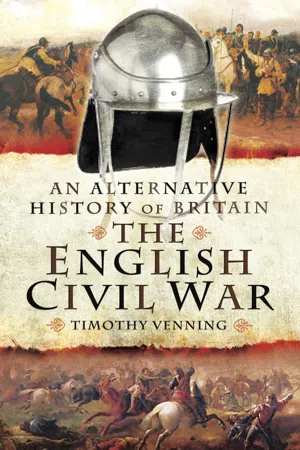
The English Civil War
About this book
With hindsight, the victory of Parliamentarian forces over the Royalists in the English Civil War may seem inevitable but this outcome was not a foregone conclusion. Timothy Venning explores many of the turning points and discusses how they might so easily have played out differently. What if, for example, Charles I had capitalized on his victory at Edgehill by attacking London without delay? Could this have ended the war in 1642? His actual advance on the capital in 1643 failed but came close to causing a Parliamentarian collapse how could it have succeeded and what then? Among the many other scenarios, full consideration is given to the role of Ireland (what if Papal meddling had not prevented Irish Catholics aiding Charles?) and Scotland (how might Montrose's Scottish loyalists have neutralized the Covenanters?). The author analyses the plausible possibilities in each thread, throwing light on the role of chance and underlying factors in the real outcome, as well as what might easily have been different.
Information
Chapter One
Countdown to War: December 1641 to Spring 1642
Forcing a confrontation in the New Year – who was most to blame? Did the ‘Junto’ deliberately try to panic Charles into over-reacting?
The main work of the early months of the ‘Long Parliament’ from November 1640 had been the demolition of Charles I’s prerogative powers and ability to raise money without resort to a Parliament, plus the prosecution of his most ‘dangerous’ ministers Thomas Wentworth, Earl of Strafford (Lord Lieutenant of Ireland) and Archbishop William Laud. These measures were generally non-controversial among the majority of ‘opposition’ MPs determined to enforce reform on the King, led by John Pym, plus the ‘opposition’ peers led by the Earl of Warwick and his allies the Earls of Essex (future Parliamentarian Army commander) and Bedford. Notably, the elections to the Parliament – the second one in a year, so the regime was not ‘rusty’ regarding getting the local office-holders (Lord and Deputy Lords Lieutenant) to organize candidates where possible – had seen very few backers of the King’s recent policies elected, and some who were evicted from the Commons ‘on appeal’ by the latter’s elections committee. The initiative thus passed to the ‘opposition’ as the Commons set to work – and one overlooked ‘what if’ question is the potential for Charles making more of an effort to rally support, possible if a determined organizer (e.g. Strafford, absent in Ireland) had been called upon. As opponents of the ‘Arminian’ forms of ceremonial and doctrine (seen as ‘popish’, semi-Catholic, by mainstream Calvinist Protestants) and rigid centralist discipline enforced on the Anglican Church by Laud’s faction, the ‘opposition’ also wanted reform of the Church. But the form that should take was less easy to agree – indicting Laud and returning the Church to ‘purer’ Elizabethan practices free of a supposedly Catholic taint was accompanied in the minds of hard-line Calvinist zealots by a need for ‘Root and Branch’ reform that might even involve abolishing the bishops and replacing them with control by the ‘grass roots’ boards of local ‘presbyters’ that existed in some Calvinist communities. Some of the MPs elected in autumn 1640 who had resented Laud’s ‘Arminian’ Church ceremonial and centralized interference in local Church appointments – or the King’s dubiously legal ways of raising non-Parliamentary finance – were to break from the radicals during 1641 over the attacks on the bishops. But the radicals were also resorting to an unusual degree of populist pressure via large ‘spontaneous’ demonstrations of Londoners for ‘Root and Branch’, huge petitions for reform to the House of Commons, and aggressive pamphleteering as the strict 1630s restrictions on the press lapsed. Rowdy and menacing scenes occurred during Strafford’s trial as Londoners fearing his anti-Parliamentary potential converged on Parliament demanding that he be executed, and the ‘politics of the street’ began to emerge as a political force (as seen also in France in 1789, Russia in 1917 and Iran in 1979). The King dithered over whether to accept the demands for execution, and apparently regretted giving in to the extent that it hardened his resolve not to compromise thereafter.
The non-episcopal form of ‘Presbyterian’ Church, plus hard-line Calvinist doctrine enforced by strict discipline, had been in existence in Scotland from the time of John Knox until pro-episcopal innovations under James VI and I, which Charles had sought to build on for an ‘Anglicanized’ Church. As seen by its defenders, it was the ‘original’ form of Christian Church in the Apostolic age, before bishops with their discipline and ‘Romish ceremonial’ had emerged; restoring this was a godly duty in England as in Scotland. The survival of most of the administrative forms (and some of the ceremonial practices) of the Catholic Church in the post-1559 Elizabethan Church in England thus had to be ended to install a ‘true’, ‘pure’ Church. The revival of episcopal authority and ‘Romish’ doctrine (exaggerated by its critics) by Charles, Laud, and the Scots bishops in the 1630s in Scotland had been forcibly rejected by outright defiance and armed rebellion in Scotland in 1637–9, to which the King had sought to reply with invasion to face defeat and bankruptcy. Local pro-Church Highland clansmen (many of them Catholic) had been defeated and an invasion from Ireland promised by Strafford had failed to materialize, and in summer 1640 the new, Calvinist Scots army (staffed by many veterans of the Continental ‘Thirty Years’ War’ led by their commander, Alexander Leslie) had invaded England and defeated the advance-force of Charles’ less-experienced, badly led army at Newburn on the Tyne. Lackadaisical Charles, slow to collect the main army to march north using an outdated medieval mechanism of feudal summons, had still been en route to York. Facing a virtual ‘strike’ by part of the English nobility instead of them loyally assembling troops for him as required, Charles had had to agree to a truce with the Scots. This disaster in 1640 had forced him to call Parliament and agree to listen to his subjects’ demands, and indeed the Calvinist faction of peers led by Warwick had seen the Presbyterian struggle in Scotland as their own and egged on the rebels – which arguably amounted to treason (and was seen as such by the King). While he was marching north to York, they had held a mutinous rally in London and been seen as threatening armed revolt; around a third of the nobility failed to join the King at York as required. Defeated and virtually bankrupt – though a potential loan of money and troops from Spain could have averted this had the Catalan and Portuguese rebellions not occurred in 1640 – Charles had had to summon the ‘Long Parliament’ and agree to the demolition of his administrative and financial powers, closure of his prerogative courts, reform of the Church, removal of his most disliked ministers, arrest of Laud, and impeachment of Strafford – who had urged him to use Irish troops to put down sedition in Scotland and possibly in England too. Strafford’s execution rather than banishment (the latter was more usual for an impeached minister) was, however, more controversial, and was forced in May 1641 on a reluctant King who was thereafter more alienated from his critics – among whom until this point he had been seen as willing to offer senior posts and partial control of policy to Warwick, Bedford, Essex, and even Pym. Arguably he committed a major mistake in appointing a key Warwick ally, radical lawyer Oliver St John (Oliver Cromwell’s cousin) who had led the ‘defence’ in the ‘Ship-Money’ case, as solicitor-general early in 1641. St John acted as an ‘opposition’ prosecutor, leading the indictment of Strafford and implicitly threatening similar vengeance on other centralizing royal ministers (e.g. Secretary of State Windebank) who fled the country. This heightened threat of judicial proceedings weakened Charles by unnerving his supporters – though the ‘opposition’ would have done their best to pursue it via Parliament’s judicial role anyway.
The possibilities of political compromise and the ‘opposition’ working for the King would have averted war, and it has been argued that the sudden death of the moderate reformist leader Bedford – less intent on abolishing the bishops and opposed to killing Strafford – in May prevented a settlement. This is unclear, as other senior peers such as Warwick (not to mention the rabidly anti-‘Arminian’ Pym) would still have been insisting on a Presbyterian form of Church reform, which the King was to resist as late as 1648, and the Scots commissioners in London also urged this on the English (partly to protect their newly freed Church from an English episcopal backlash later). The outbreak of Catholic rebellion in Ireland in October–November 1641 heightened anti-Catholic hysteria in England due to the accompanying atrocities, with the English crisis having removed Strafford (whose firmness would have discouraged moderate rebels risking all on a revolt) from power there in favour of weak governance. Control of the army sent to put down the rebels and the extent of the confiscations of lands from ‘disloyal’ Catholics thereafter would probably have split the putative reconciliation of ‘King and moderate opposition’ – indeed, many of the Catholic rebels saw themselves as loyal to the King and seeking to save their lands and faith from a vengeful and confiscatory Protestant Parliament in London. There were links between Irish Catholic rebel officers and ultra-royalist courtiers in London, both of whom hated Parliament, and the position and future of Charles’ Catholic Queen Henrietta Maria was also a potential source of tension. Her court loyalists, such as George Goring and Sir Henry Jermyn, and loud-mouthed, swashbuckling officers – the future ‘Cavaliers’ – were at the heart of (usually incompetent) plans to curtail Parliament. The issue of whether or not to abolish episcopacy in England – at the votes for which a majority of MPs could not be mustered in 1641– would have continued to divide radical and moderate critics of the King into 1642 even if a surviving Bedford and a reluctant Warwick and Pym had taken office under Charles in mid-1641. Also, Charles’ attitude to further ‘reform’ was unlikely to be conciliatory, and he was already showing that he was untrustworthy and could go back on his word. He had considered an ‘ultra’ royalist courtier/army plot to seize London by a military coup, free Strafford from the Tower, and close down Parliament in May 1641, though the (over-optimistic) arrangements had failed and it had been abandoned.
Charles had agreed to go to Scotland in summer 1641 to sign up to the abolition of episcopacy, the restoration of a full Presbyterian Church, and the loss of virtually all his executive powers as the triumphant rebels demanded. But once he arrived Charles was involved in a dubious plot to arrest their leaders and install the more moderate Calvinist leader Montrose as his ‘strongman’ by a coup. This plan backfired too, leaving him feebly denying all involvement. But his main intention in either winning over or overthrowing the ‘rebel’ regime in Edinburgh seems to have been to gain the use of the Scots army to use in England, and on his return to London in late 1641 the question of agreement with or coercion of Parliament resumed. The Warwick-Pym faction was now facing a rising ‘backlash’ of local provincial sentiment in favour of the King, with the most disliked elements of his ‘Personal Rule’ of 1629–40 abolished, a rebellion in Ireland needing crushing, and further reform of the Church unacceptable to many people. There were petitions in favour of as well as against the bishops as their local supporters mobilized. An embryo ‘royalist’ faction opposed to further reform was emerging in the Commons, led by former critics of the King such as Sir Edward Hyde, and the radicals’ demands for further reform and restraint of the untrustworthy King in the ‘Grand Remonstrance’ of November 1640 was barely passed. Arguably, now that the unpopular elements of prerogative rule had been abolished – and future Parliaments every three years guaranteed by statute, whether the King wanted them or not – patriots should rally around not criticize their sovereign. Pym and his group were undaunted, evidently regarding compromise on the crucial question of the Church as dangerous, and now sought to throw all the bishops out of the Lords (which would improve their chances of winning votes there) and to continue to use noisy and threatening demonstrations by anti-episcopal radicals in London (e.g. the apprentices) to intimidate Parliament. Now the question arose of whether the latter could be used by the King to argue that he had to act against disorder and to rally alarmed moderate opinion to his side. For the first time since May, ‘ultra’ royalist officers and troops from the regiments stationed at York (immobilized there since the end of the Scots war) were brought in to London ready to strike.
In the event, bolstered in December by a firm move to take control of the Tower of London arsenal and the first mustering of armed troops in the capital to prepare to overawe or take on the City crowds and urged to a determined course of action by the Queen and her allies,1 the King endeavoured to strike against the radical leaders. Technically, it was not an attempt to close down Parliament as in May 1641; he was staying within the constitution and not defying the Act which kept this Parliament in session as long as it so desired this. The Scots precedent should be remembered; he had attempted to have the ‘rebel’ leaders Argyll, Hamilton, and Lanark arrested (if not killed) by his loyalists in Edinburgh in mid-October in a similarly bold ‘strike’ at his critics. It should be noted that Charles issued a proclamation on 12 December requiring all MPs and peers absent from Parliament to return to Westminster as of 12 January; Venetian ambassador Giustinian reckoned that around 210 were currently absent.2 Most of these men could be assumed to be boycotting the sittings out of frustration at the ‘seditious’ actions of the Warwick-Pym group, so their return should give Charles a majority in each House; and already he had nearly won the vote on the ‘Grand Remonstrance’. On the 16th, the French ambassador (the Marquis de la Ferte-Imbault) reported that a court decision had been taken on the 12th to prepare for impeaching and beheading ‘several of the leading Parliament-men’3 – presumably by this means creating a majority in Parliament for it. Other spectators such as papal agent Rosetti believed a military coup to seize the Tower was being planned; possibly both were in Charles’ mind, the military option being backed by the Goring-Jermyn court ‘hotheads’. The often-overlooked order of 12 December raises a major issue – why did Charles not wait until 12 January before acting against his enemies? Had he initiated the planned arrests for impeachment only after enough ‘loyal’ MPs and peers returned, he could have expected to win the votes on these matters. Was he forced into premature aggression before 12 January by the pressure being put on him by the ‘Junto’ – who wanted to trap him in this way? Or was it a case of Goring’s group winning him over? In either case, the King’s inconstancy and wavering were disastrous for his reputation.
The return of an ‘opposition’ majority to the Common Council in the City despite the election of Gurney as lord mayor led to renewed mob intimidation of Parliament by anti-episcopal demonstrators, with a crowd led by militant Alderman Fowke delivering a huge petition against episcopacy to the Commons on 11 December.4 On the 15th the militants in the Commons secured the vote to print the ‘Grand Remonstrance’ – which Charles furiously opposed – by the simple expedient of waiting until most MPs opposing them had gone home and rushing a motion into action; the effect of this was to remind the London public of the full list of Charles’ misdemeanours and whip up opposition to him. Certainly some spectators such as the Earl of Hertford’s steward Edward Kirton believed that the current menacing anti-episcopal demonstrations were being co-ordinated by the future Earl of Manchester and other opposition ‘Junto’ agents.5 It is impossible to prove directly, but the ‘cui bono’ argument indicates the likelihood that ‘hard-liners’ were piling the pressure on Charles by manufacturing riots as at the time of the Strafford trial. Certainly Denzel Holles threatened the Lords with an appeal to the people if they continued to hold up the Commons’ proposals on who should control the Irish campaign, implying openly that the Pym faction would unleash a mob on them;6 this speech (21 December) went further than any threats back in May. The ‘opposition’ had just triumphed at the City’s Common Council elections, which would have given them confidence about assembling such a crowd; and in reply the King dismissed Deputy Lieutenant of the Tower William Balfour, still in ‘place’ since his involvement in the May plot to free Strafford but now taking orders from his ‘opposition’ superior Lord Newport. His replacement was to be the fiery officer Colonel Thomas Lunsford, a hot-headed ‘ultra’ among the ‘Reformadoes’ who had been in the Army at York until November and was now at court; he was known for his hatred of the ‘Junto’.7 The appointment of Lunsford threatened another royal coup to seize the Tower and turn its guns on the City; but such a provocative security measure was only a logical reaction to Holles’ threats. In a sign of the radicals’ ‘mindset’, their favourite preacher Stephen Marshall spoke in a sermon to the Commons of them as ‘Daniel’ facing ‘Nebuchadnezzar’, i.e. royal persecution.
The crisis now turned into a series of mutual escalations, increasingly turning to the use of blatant force – in which the ‘Junto’ had led the way by the City demonstrations. Charles surprisingly backed down over Parliamentary anger against Lunsford and replaced him with Sir John Byron, but sacked Newport as the Governor of the Tower; the Christmas recess (25–6 December) saw more rioting and on the 27th bishops arriving for the sitting of the Lords were jostled by an angry mob. Surprisingly, the anti-Laudian ‘hero’ John Williams was booed, presumably for accepting the Archbishopric of York and so ‘betraying’ his cause. The suspicion arises that the ‘Junto’ Calvinist peers and/or Pym were backing the riots to drive these staunch pro-King voters out of the Lords. Most bishops now declared that they dared not come to the Lords any longer so they did not recognize Parliament,8 and they were duly arrested for an alleged insult to the latter. The arrests could be couched in legalistic language as reacting to an insult to Parliament, but it was a blatant political act by the Warwick faction to remove them from their rights to vote in the Lords for whatever the King wanted.
The threat to impeach the bishops was a clear sign from the pro-Calvinist faction that they intended to force the issue of the episcopate on Charles, and the ‘opposition’ control of the City Common Council elections enabled easier mustering of a zealous City mob at a trial in Westminster Hall to secure conviction (as with Strafford). There was a rumour that the Catholic Queen would be impeached next – possibly played up by Pym in the hope of inflaming the King into a confrontation.9 But the threat of new prosecutions could also be used as evidence that the Commons radicals were going too far in infringing the King’s powers, provided that it was handled properly. Such radical proposals would not necessarily win enough Commons votes to succeed, unless the City apprentices besieged Parliament again to intimidate opposition. It was suspicious that Warwick now proposed that 600 of the troops being raised for the Irish war should be assembled immediately in London; they would be available until they sailed for use by the Lords-nominated Irish commanders (e.g. Essex) for use against the King. In fairness to Warwick, the King was undeniably concentrating troops at Whitehall (and building a temporary barracks) around the New Year.10
One of the main dangers to the royal cause lay in Parliament using its legal powers to arraign people for contempt of its authority, which could frighten off royal supporters from raising troops without Commons approval. (Pro-royalist MP George Digby was charged with this in January and had to flee abroad.) The King needed to be able to prove that it was Parliament abusing authority rather than him – which was not helped by evidence of wild talk at court about arresting MPs or by leaks about his attempts to hire troops from Irish Catholic peers. The dismantling of the royal prerogative, and the flight of the sternest royal ‘prerogative’ judges who had implemented Charles’ will in the 1630s but now feared Parliamentary vengeance, made it difficult for Charles to be able to put out legal opinions that Parliament was abusing its powers. The Attorney-General, Sir Edward Herbert, was more loyal than his deputy, Oliver St John, but seems to have been intimidated into inaction until the impeachment attempt of 3 January.
Before the impeachment went ahead, as soon as Parliament reassembled after Christmas the royalist Lord Digby put forward a motion on 28 December that it was not able to operate freely – due to intimidation by the crowds – and legislation was thus now invalid. This was probably an attempt to lay the legal basis for cancelling any forthcoming Commons or Lords votes that defied the King, as on impeaching or abolishing the bishops or on ‘Root and Branch’. Had it succeeded, the result would have been deadlock but no more embarrassing anti-Anglican votes however many MPs or peers were won over or pressurized into following Pym and Warwick. But the vote was lost by four, and the Lords voted to suspend and arrest those bishops who had voted for it – which indicates that the majority of peers still had faith in the right of this Parliament to decide on future governance, not that all who voted thus were totally won over to ‘Root and Branch’.11 Had the vote been won, the King would have been able to produce a legal basis for the closure of Parliament or – if ‘moderate’ MPs objected to that and he needed it to raise money – its removal to somewhere outside London. There were plenty of precedents for that, as lately as 1625, though then due to plague not disorder; and in 1644 Charles was to use this argument about intimidation invalidating a ‘free’ Parliament in summoning MPs to Oxford. Probably the hand of Hyde can be seen behind this idea.
Wh...
Table of contents
- Front Cover
- Title Page
- Copyright Page
- Contents
- Maps
- Acknowledgements
- Chapter 1 Countdown to War: December 1641 to Spring 1642
- Chapter 2 Could the War have been Won Quickly by the King? The Edgehill Campaign
- Chapter 3 Could the War have been Ended Quicker by Charles Making Better and More Decisive Plans?
- Chapter 4 Was the War Winnable in 1644 – by the King, or by Parliament without Resorting to the Creation of the New Model Army?
- Chapter 5 The New Model Army and the 1645 Campaign: Could Parliament Still have Failed to Win in 1645?
- Notes
- Bibliography
Trusted by 375,005 students
Access to over 1.5 million titles for a fair monthly price.
Study more efficiently using our study tools.
Frequently asked questions
Yes, you can cancel anytime from the Subscription tab in your account settings on the Perlego website. Your subscription will stay active until the end of your current billing period. Learn how to cancel your subscription
No, books cannot be downloaded as external files, such as PDFs, for use outside of Perlego. However, you can download books within the Perlego app for offline reading on mobile or tablet. Learn how to download books offline
Perlego offers two plans: Essential and Complete
- Essential is ideal for learners and professionals who enjoy exploring a wide range of subjects. Access the Essential Library with 800,000+ trusted titles and best-sellers across business, personal growth, and the humanities. Includes unlimited reading time and Standard Read Aloud voice.
- Complete: Perfect for advanced learners and researchers needing full, unrestricted access. Unlock 1.5M+ books across hundreds of subjects, including academic and specialized titles. The Complete Plan also includes advanced features like Premium Read Aloud and Research Assistant.
We are an online textbook subscription service, where you can get access to an entire online library for less than the price of a single book per month. With over 1.5 million books across 990+ topics, we’ve got you covered! Learn about our mission
Look out for the read-aloud symbol on your next book to see if you can listen to it. The read-aloud tool reads text aloud for you, highlighting the text as it is being read. You can pause it, speed it up and slow it down. Learn more about Read Aloud
Yes! You can use the Perlego app on both iOS and Android devices to read anytime, anywhere — even offline. Perfect for commutes or when you’re on the go.
Please note we cannot support devices running on iOS 13 and Android 7 or earlier. Learn more about using the app
Please note we cannot support devices running on iOS 13 and Android 7 or earlier. Learn more about using the app
Yes, you can access The English Civil War by Timothy Venning in PDF and/or ePUB format, as well as other popular books in History & Ancient History. We have over 1.5 million books available in our catalogue for you to explore.