- 192 pages
- English
- ePUB (mobile friendly)
- Available on iOS & Android
eBook - ePub
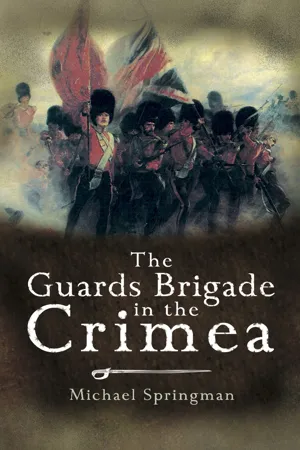
The Guards Brigade in the Crimea
About this book
The Guards Brigade consisted of three battalions, the 3rd Grenadier Guards, 1st Coldstream Guards and 1st Scottish Fusilier Guards (as the Scots Guards were then known).The book opens with a resum of the causes of the War and an analysis of the woeful disorganization of the Army, in contrast to the efficiency of the Royal Navy. The Brigades performance in the major battles (Alma, inkerman etc.) is examined. The author describes the Russians plans, the ground and conditions experienced by the long suffering troops. The roles and abilities of the various commanders, often found wanting, is fascinatingly treated. After the war was over, the return home and parades are described.
Information
CHAPTER 1
British Foreign Policy and the Origins and Reasons for the Crimean War
Trafalgar gave Great Britain control of the sea; Waterloo secured her against the domination of the continent of Europe by one nation. The maintenance of naval supremacy and of a European balance of power were the governing principles of British foreign policy, throughout the nineteenth century. The safeguarding of British naval supremacy was primarily a domestic affair, a matter of men and ships and money. The preservation of the balance of power implied diplomatic action, and, at times, the threat or the use of force. The balance of power was not a fact, but an ideal towards which all reasonable men worked.1
In nineteenth-century terms maintaining the balance of power was establishing an equilibrium between states or group of states, based upon an assessment of their material and moral strength. This equilibrium was always changing, as the powers of states waxed and waned, and these changes required continual adjustment. In fact, Europe never attained this equilibrium. Britain could not dictate to the powers of Europe the policy they should adopt, but she could use her wealth and influence to persuade any power or combination of powers, which wished to disturb the existing balance, to desist. No single continental power was capable of challenging the Royal Navy, and British naval supremacy was accepted as a fact by its allies. Britain’s principal aim was to maintain the peace and the stability of the European state system, so that its merchants could buy and sell in European markets.2
Britain was concerned about Russia’s aims to control the Bosphorus, including Constantinople, and its interest in taking over Mesopotamia, which would give Russia control over the overland route to India, where Britain had substantial commercial interests.3
In 1853 the Russian Empire stretched from Germany to the Pacific and its territory bordered the Black Sea, the Ottoman Empire, Persia and China. The Tsar, who ruled over this immense land, was an absolute despot, whose rule was imposed by his secret police. With limited access to the sea, Russia had little foreign trade and thus was not able to develop her considerable resources. Furthermore, her road and rail links were very primitive. She lacked a warm-weather port to enable her to develop foreign trade. To further her expansionist policies, her objective was to conquer Constantinople and the Dardanelles, and thus gain entry to the Mediterranean Sea. In addition, Russia had aims to expand its empire into Turkey, Mesopotamia, Persia and India. The influence of her agents with the rulers of Afghanistan had caused the British Government considerable problems in eliminating Russian influence in this country, which threatened India’s security.
In 1844 Tsar Nicholas I had made it clear to the British Government that Russia regarded the Ottoman Empire as the ‘sick man of Europe’ and offered Britain dominion over Egypt and Crete, provided Russia could have a free hand elsewhere. The British Government refused his offer as it had no wish for Russia to extend its borders further into Europe and Central Asia and thus to threaten the route to India.
Russia used as the occasion for their dispute with the Ottoman Empire the Tsar’s desire to obtain protection over the Christian subjects in these territories, for which there were some historical precedents. Russia asked for this right in the spring of 1853, but the Sultan refused, as this would give Russia sovereignty over these lands.
The hesitation of Lord Aberdeen’s divided cabinet, which faced opposition from Cobden, Bright and the radicals to any policy which risked war with Russia, encouraged Russia to take the decisive step of invading the Danubian Principalities, if Turkey did not accept their demands.4
In July 1853 Russia invaded Moldavia and Wallachia (modern-day Rumania). The British Government then ordered Admiral Dundas’s squadron of six warships to proceed to Besika Bay, at the entrance of the Dardanelles, to join the French Navy there and, if necessary, to protect Constantinople from attack. The Austrian Government meanwhile attempted to use its influence to settle the differences between both parties. The Tsar’s military might had enabled Austria to put down the recent revolt by Magyar nationalists in Hungary and he was therefore sure that Austria was his ally. The Austrian Government was disturbed by the Tsar’s expansionist aims in the Balkans, which could also upset its trade in Europe, as the Danube was a major trade route. They feared Russia, which controlled the German-speaking nations and had intervened in the dispute between the German Confederation and Denmark over the ownership of Schleswig Holstein. It had succeeded in obtaining the annexation of this territory by the German Confederation. With Turkey refusing to agree to Russia’s demands, Turkish resistance was stiffened by the belief that Britain and France would not allow Russia to take Constantinople.5
In France Louis Napoleon became President in December 1848. He was elected President for ten years in 1851 and in 1852, after a coup d’etat appointed himself Emperor Napoleon III. He was keen to demonstrate France’s power on the world stage and furthermore wanted to redeem France’s reputation after its defeat at Waterloo.
The Sultan was pleased that Britain and France were supporting him against Russia and put his defences in order. In October 1853 he issued an ultimatum to Russia to withdraw their troops from the Turkish territories in a fortnight, but in November 1853 the Russian Fleet surprised and sank a Turkish squadron at Sinope on the Black Sea.
The effect on British public opinion was dramatic. The action was called a massacre, as there was antipathy towards Nicholas, who the public felt was an enemy of liberty abroad and an upholder of serfdom at home. Furthermore it was felt that Russian designs on Turkey threatened Britain’s political and economic interests. Lord Aberdeen was accused of cowardice and of betraying his country to Russia. Lord Palmerston, the Home Secretary, resigned over the proposed Reform Bill, but it was generally interpreted as a result of disagreement on the policy of handling the disagreement with Russia.6
In January 1854 the British, French and Turkish fleets sailed into the Black Sea, as Russia needed to control this sea to be able to invade the Ottoman Empire. The British and French navies were sufficiently powerful and numerous to give the Allies undoubted command of the sea. The Russian Navy, whose warships were inferior to those of the Royal Navy, returned to Sevastopol, where Nicholas had constructed new forts and new docks. He had turned it into a strong naval base, from which he could dominate the Black Sea and plan an attack on Constantinople.7
In February 1854 Russia broke off diplomatic relations with Britain, but the two nations did not then declare war on one another. The Tsar was sent an ultimatum by the allies to evacuate his armies from Rumania. He failed to do so and the British Government declared war on Russia on 28 March 1854.
[Author’s Note: Woodward, E.L., The Age of Reform, pages 243 to 254 explains the background to the British Government’s disagreements with Russia. Royle, Trevor, The Great Crimean War 1854–1856 gives a full account of the development of Britain’s disagreements with Russia, which preceded the declaration of war by the British Government.]
CHAPTER 2
The Royal Navy and the Army in the 1850s – Their Development and Relative Efficiencies
From the earliest part of its existence as a nation, England, as an island, has faced the danger of invasion by its enemies. Although invasion of parts of the country by the Norsemen took place in the first millennium, the first invasion of the whole country was by the Normans in 1066. The next major invasion was by the Spanish Armada in 1588, repulsed by Sir Francis Drake.
The Navy has always been the most important service to the English Government, with the Army being of importance only when the sovereign wanted to invade a European country, to repulse an invasion or put down a rising in a part of the country.
What is of great interest to students of the Army is how far behind the Navy the Army was in the efficient direction of its operations, manning and administration, and especially in its strategic planning for the future. The Navy built its ships so that they were capable of achieving its strategic objectives and beating its enemies’ ships; it researched new materials and equipment for ships to improve their handling ability and to reduce their manning; it constantly improved its methods of preserving fleet supplies to avoid wastage and to maximize ships’ ability to stay at sea. On the medical side, it almost stamped out the outbreak of scurvy and was aware of what caused typhus. The Army seemed to struggle from one disaster to another without learning from its mistakes and certainly never planned for the future.
Professor N.A.M. Rodger in his book, The Command of the Ocean, discusses in great detail, the operations, staffing and administration of the Royal Navy during the seventeenth, eighteenth and the early part of the nineteenth centuries. He divides British eighteenth-century government into two parts: the Crown’s and Parliament’s. The Crown’s government, which included the Army and foreign affairs, was based on a balance of central and local forces, as the powers of the Crown were checked by those of the nobility and gentry. It was traditional, dispersed and inefficient. On the other hand, Parliament’s government was highly centralized and precociously professional. It included the Treasury and the revenue-collecting departments, especially Customs and Excise, and of course the Navy.
Parliament had taken control of the Navy during the Commonwealth and it was able to make British sea power the ideal expression of the nation in arms, which was founded on the folk-memory of the Elizabethan age. It made the Navy an expression of the liberty of the people, while the Army was an expression of the power of the crown.1
The Royal Navy
The Royal Navy was originally commanded by the Lord High Admiral, appointed by the Crown, but from 1673 onwards, the post was, more often than not, put into commission. From 1709 it was permanently in commission. Its powers were then exercised by a committee of Lord Commissioners, the Board of Admiralty, headed by the First Lord of the Admiralty, who was the political head of the Navy and a member of the Cabinet. The Navy had four separate organizations. The main strategic objectives of the Royal Navy were agreed in Cabinet. The First Lord made these objectives known to the Board of Admiralty, which was responsible for carrying out these tasks. It decided policy and controlled operations, it allocated ships to tasks, it appointed the captains and officers of naval vessels, and formulated naval strategy and tactics.
The second organization was the Navy Board, which was established by Henry VIII in 1546, to oversee the administrative affairs of the Navy. It operated as a separate entity to the Board of Admiralty, put into effect the ship building plans required, repaired and refurbished ships, purchased guns, through the Ordnance Board,2 and also warlike stores. Some ships were built in naval yards and others in private yards to the Board’s specifications.
The third organization was the Victualling Board, which bought all the foodstuffs required by the fleets, preserved them and shipped them out to the fleets. It was responsible for making it possible for fleets to remain on station much longer through developing higher standards for preserving food.
In 1693 the Allied fleet was barely able to remain at sea a fortnight and returned with its crews very sickly, leaving a convoy to its fate. Sixty-five years later Admiral Hawke was able to stay continually at sea for six months, keeping his men healthy and well fed far into the winter. No professional skill or strategic vision would have been of any avail, if means had not been developed to keep squadrons at sea for long periods in home waters, and on long overseas voyages. Moreover it was precisely in these matters of administration that the British opened a decisive superiority over their enemies, above all France.3
British naval victualling is a remarkable story of rising standards making ever more extended operations possible. It cost approximately the same to provide excellent victualling for 70–85,000 men during the Seven Years’ War, as it did to provide inadequate victualling for 40–50,000 men during the War of the Spanish Succession half a century before.
The Board was the largest single purchaser on the London market for agricultural products. It managed the markets to encourage the growth of large firms, while at the same time promoting competition. The suppliers were paid by bills, which they could discount locally in the City.4
During the American War the Victualling Office coped efficiently with the victualling of troops overseas, which was transferred to it from the Treasury. There was a marked improvement in efficiency and economy.5
The fourth organization was the Sick and Hurt Board, which was in charge of taking care of all sick and wounded sailors. It also initiated new...
Table of contents
- Front Cover
- Title Page
- Copyright Page
- Contents
- Maps
- Preface and Acknowledgements
- Chapter 1 British Foreign Policy and the Origins and Reasons for the Crimean War
- Chapter 2 The Royal Navy and the Army in the 1850s – Their Development and Relative Efficiences
- Chapter 3 The Journey to the Crimea, February–August 1854
- Chapter 4 The Landing at Old Fort and the Battle of the Alma, September–October 1854
- Chapter 5 The Battle of the Alma – Other Personal Accounts
- Chapter 6 The Flank March
- Chapter 7 The Inkerman Position, the Russian Forces and their Plan of Attack, and the Allied Forces
- Chapter 8 The Battle of Inkerman, up to the Intervention of the French Army, 5 November 1854
- Chapter 9 Inkerman – The French Army and Victory, November 1854
- Chapter 10 After Inkerman
- Chapter 11 The Winter of 1854/5 – November 1854 to June 1855
- Chapter 12 The Capture of Sevastopol, June 1855–January 1856
- Chapter 13 The Armistice, Peace and the Army’s Return Home, January to May 1856
- Chapter 14 The Government and the Army
- Appendix A Battalion Officers of the Brigade of Guards who served in the Crimean War
- Appendix B Officers of the Brigade of Guards on the Staff in the Crimean War
- Appendix C The Commanders of the 1st Division, the Guards Brigade and the three Battalions
- Appendix D Victoria Crosses and Distinguished Conduct Medals Awarded to All Ranks in Each Battalion
- Appendix E Guards Brigade Effective Strengths and Casualties, Crimean War, 1854–1856
- Bibliography
- Notes
Trusted by 375,005 students
Access to over 1.5 million titles for a fair monthly price.
Study more efficiently using our study tools.
Frequently asked questions
Yes, you can cancel anytime from the Subscription tab in your account settings on the Perlego website. Your subscription will stay active until the end of your current billing period. Learn how to cancel your subscription
No, books cannot be downloaded as external files, such as PDFs, for use outside of Perlego. However, you can download books within the Perlego app for offline reading on mobile or tablet. Learn how to download books offline
Perlego offers two plans: Essential and Complete
- Essential is ideal for learners and professionals who enjoy exploring a wide range of subjects. Access the Essential Library with 800,000+ trusted titles and best-sellers across business, personal growth, and the humanities. Includes unlimited reading time and Standard Read Aloud voice.
- Complete: Perfect for advanced learners and researchers needing full, unrestricted access. Unlock 1.5M+ books across hundreds of subjects, including academic and specialized titles. The Complete Plan also includes advanced features like Premium Read Aloud and Research Assistant.
We are an online textbook subscription service, where you can get access to an entire online library for less than the price of a single book per month. With over 1.5 million books across 990+ topics, we’ve got you covered! Learn about our mission
Look out for the read-aloud symbol on your next book to see if you can listen to it. The read-aloud tool reads text aloud for you, highlighting the text as it is being read. You can pause it, speed it up and slow it down. Learn more about Read Aloud
Yes! You can use the Perlego app on both iOS and Android devices to read anytime, anywhere — even offline. Perfect for commutes or when you’re on the go.
Please note we cannot support devices running on iOS 13 and Android 7 or earlier. Learn more about using the app
Please note we cannot support devices running on iOS 13 and Android 7 or earlier. Learn more about using the app
Yes, you can access The Guards Brigade in the Crimea by Michael Springman in PDF and/or ePUB format, as well as other popular books in History & 19th Century History. We have over 1.5 million books available in our catalogue for you to explore.