- 224 pages
- English
- ePUB (mobile friendly)
- Available on iOS & Android
eBook - ePub
About this book
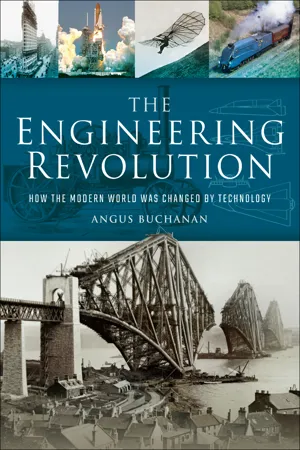
Over the past two million years that human species have inhabited the Planet Earth they have distinguished themselves by their ability to make and do things creatively to ensure their survival. From the beginning, therefore, they have been defined by their technology, and the history of technology is the history of the species. For most of this period, the development of human technical skills has been extremely slow and repetitive, limited to basic tools and weapons and the ability to control fire. The utilization of animal power and the invention of the means of harnessing the power of wind and falling water added gradually to their technical skills, but it was the discovery of ways of using power from heat engines a mere three hundred years ago that accelerated this process into a prodigious expansion of technical power that fundamentally transformed human societies . It is this development which deserves to be to be called The Engineering Revolution and provides the primary focus of this book.
Information
Subtopic
Ingegneria industrialeCHAPTER 1
Introduction – Technology in Context
Angus Buchanan
Technology is the study of the way human beings make artefacts and do things with them. The ability to acquire such techniques, other than by instinct such as that by which birds build nests, is virtually unique to human beings on Planet Earth. Indeed, the possession of such power is one of the chief qualities distinguishing the human species, which makes 'technology' at least two million years old. For most of this huge period of time, the development of technical skills has been extremely slow and repetitive. While the climate changed with a succession of prolonged Ice Ages, and while the level of the oceans rose and fell, 'hominids' – man-like species – struggled to survive in the sub-tropical region of central Africa where they first emerged from the jungle. Then, as the climate became warmer with the end of the last Ice Age about 20,000 years ago, our own species – Homo sapiens - emerged from a long period of competition with rival hominids and undertook the tremendous task of taking control of their environment, although they were not able to see it in such grandiose terms.

Fig 1.1: Stonehenge, 4,000 years old, marks the transition from Low to Median Technology. Its builders not only moved and raised the stones but worked them into shape and fitted them together. (Angus Buchanan)
They tamed animals to help them in their hunting, and improved the crude stone implements of their predecessors to create well-shaped tools and weapons. They devised intricate techniques of linguistic communication and discovered how to make and control fire. They expressed themselves in haunting cave paintings of animals that they hunted for food and for furs to provide their first clothes. We know very little about the lives of the many generations of these people, except what we can interpret from the archaeological fragments that they left behind. But we can be sure of their hardiness and their determination to survive and pass on their bloodline to their children, because without such qualities we would not be here to wonder at their achievements in a largely hostile environment.
Moreover, they spread as their population increased and they hived of communities of hunters and their families who moved away from the African heartlands in search of food. Some moved north towards milder climates and new environments, to which they adjusted themselves and journeyed on over many generations; some eastwards, to populate South East Asia; and others westwards, around the Mediterranean and, at length, into Europe. Some, such as the people who moved into Australasia about 40,000 years ago, became isolated by rising sea levels, and established a virtually static existence for many millennia. The Americas were populated some time later, as tribes crossed the Aleutian chain of islands to Alaska and then moved southwards. It is possible that others managed to cross the Atlantic Ocean from the east on primitive rafts, but that remains a matter of speculation. Others, in India and China, made relatively rapid technological progress. For all parts of the land surface of the world that they managed to inhabit, however, the struggle for survival remained arduous, absorbing the energy of individuals and limiting their aspirations.
Phase One: Low Technology
Gradually, human societies increased their power – their ability to make and do things – by improving their tools and weapons, and thus began a long process of technological development. Although new ideas must have come initially from individual people, we have no way of knowing anything about such individuals, but we can recognise their collective achievements through their surviving artefacts. Anything they made of wood or vegetable fibre or animal skins has usually perished, but the survival of stone implements provides ample evidence of advancing technical skills. In the earliest human settlements, natural stones were adapted for use in hammering and cutting. In later settlements, the evidence of stone chippings demonstrates that techniques of shaping stone to produce more efficient tools and weapons had been acquired, presumably by striking one stone with a harder stone, or by subjecting it to a laborious exercise of grinding one stone against another. By the end of the Old Stone Age, some 10,000 years ago, the remains of well-shaped axes and spear-heads demonstrate great skill in stone working, and frequently bear evidence of shafting on to handles or poles which have long-since disappeared. By this time, also, the more advanced groups of human beings had discovered the control of fire, which enabled them to prepare more varied and nutritious diets and to keep warm and safe at night. Thus equipped, they were able to survive in variable climates, and so to undertake more ambitious migrations than any they had attempted before.
All this can be confidently based upon the surviving archaeological evidence, although this tells us nothing about individuals and little about the social organisation of these early groups of human beings, or of what they believed or how they mastered sophisticated means of linguistic communication. There is not much to show for this long period of some two million years, except the vital fact that human beings mastered the basic techniques of survival in a variety of different conditions and climates. And if we pursue the notion that technology is about the power to make and do things, these achievements were all made with the power available from human hands and feet, making this the defining quality of the first phase of the history of technology, the period dominated by 'Low Technology'. Later phases achieved much more in a much shorter period of time, but they could not have done so without the two million years of trial and error, by which human beings who must for ever remain anonymous to us, established the basic techniques for survival in a challenging environment.
On this basis, we can distinguish two subsequent phases of technological evolution: that in which techniques were acquired for using the power of animals and of naturally replenishable sources of power such as the wind and falling water ('Median Technology'); and that in which the power of heat engines was harnessed to convert the energy of burning fuel into novel ways of making and doing things on a scale that could not previously have been imagined ('High Technology'). Median Technology dominated the period from about 2000BC to AD1700, and High Technology has flourished in the period since 1700. We will look briefly at the way in which technology transformed society in these two periods.
Phase Two: Median Technology
Stonehenge was built in stages over many years, but it was certainly in the course of construction and use around 2000BC. It is thus not unreasonable to take this outstanding monument as marking the transition from the Low Technology of the archaeological Old Stone Age to the Median Technology of the New Stone Age, and the use of metals in the large and well-organised societies that succeeded it. Earlier societies had moved large boulders, forming them into circles and long causeways, as at Avebury in Wiltshire, Callanish in Scotland, and Carnac in Brittany. But at Stonehenge the stones were not only placed in a circle: they were shaped and capped with similar stones which were fixed in place by mortise and tenon joints, representing a dramatic advance in stone working techniques and engineering skills. We can still only speculate about how it was achieved and to what purposes it was devoted, but while we can surmise that it was intended for some sort of religious or communal use, we can be certain that its construction involved a large number of highly skilled craftsmen and an army of labourers and supporters. Such a community implies an astonishingly high level of social organisation amongst people who were far more numerous than the small tribal societies that had previously been the norm in Western Europe, although large civilised societies had already been established in Egypt, Sumeria, India, and China. Even though Stonehenge preserves the anonymity of its builders, it can be seen as being on the cusp of the transition to a new phase of Median Technology in Western Europe. The dynamic force of this transition probably came from an increase in population that had stimulated a change from an existence based upon hunting and collecting food to one that managed its own food supply by adopting agricultural techniques of growing crops and keeping animals for food, both as meat and for their milk. This implied a transition from a nomadic society, for ever on the move in search of better hunting grounds, to a more settled society, in which people cleared the land of trees and undergrowth in order to cultivate crops for food to sustain themselves and their herds of animals. In such settled societies, new forms of specialisation arose: men who had previously been hunters undertook the heavy duties of tilling the soil, and women who had previously been food gatherers became cooks, processing food over fires and in ovens.
Further specialisation followed, with a few families emerging as millers to grind the corn and other grains, and some as potters to make culinary vessels of all sorts, acquiring in the process knowledge of how to spin the soft clay they were working on a wheel by operating a crank with their feet. Others, again, learnt skills in brewing beer and distilling spirits, and in making clothes and shoes. The net result of such activities over a substantial area was a significant rise in productivity, a further growth of population, the rise of towns for the exchange of agricultural produce and as a means of social control and defence, generating further specialisation in luxury goods and refined metal working. In a word, within a short space of time in comparison with previous technological developments, civilisation emerged.
Civilisation did not occur uniformly, but in favoured temperate latitudes where large rivers watered fertile land which could be readily adopted for agriculture and for the development of towns. Such towns were the characteristic feature of civilised communities, even though most of the population long remained committed to providing food by agricultural and pastoral pursuits, and satisfactory town life depended on techniques that had been virtually non-existent before. These included the possession of skills in measurement, essential for the precise definition of property ownership; a mode of recording commercial transactions between individuals and parties, so that trade could operate smoothly at a distance and over time; and the creation of a monetary system accessible to the whole population. All these requirements assumed the existence of skills in literacy and numeracy, which became the crucial attributes of the new social specialisation of a class of clerks who could undertake measurements and keep records. These clerks frequently became clergy, controlling the important religious functions of the community, such as maintaining and interpreting the scriptures and traditions, and determining the feasts and the public commemorations. In China, they became the powerful class of 'mandarins', a non-hereditary governing class which served the ruling monarchy and to which access was by special training and examination.
In other civilisations the role of the clerks was rather less conspicuous, but always it was essential to the smooth running and efficiency of the society. As well as clergy directing religious affairs, other important specialisations, in administration, science, and historiography, were generated. The administrative activities of the clerks in running the government, collecting the taxes, and maintaining law and order, were legion and need not concern us in detail. In science, however, the clerks made the systematic study of their environment possible by their accumulation of records concerning the movement of the stars and planets, the relative productivity of different provinces, the nature of their mineral resources, and many other subjects. The use to which they put this information was at first astrological rather than astronomical, but came to provide a basis for valuable scientific speculations which were properly astronomical. Similarly, the information about the nature and whereabouts of materials had at first an alchemical value rather than one representing chemical or biological science, but it gave a realistic starting point for such studies. It is not unreasonable, therefore, to see science beginning with the emergence of literacy and numeracy in these first civilisations.
The same line of thought leads to the realisation that history – the systematic study of the past – is also a product of the early civilisations, whose clerks kept accounts of previous kings and other rulers, frequently going back many generations. While granting that the earliest parts of such genealogies were almost inevitably legendary or even mythological, they remained a valuable source of information for clerical scholars to examine and analyse, thus comprising genuinely historical studies. The fact that archaeologists have very recently – in the last two hundred years – developed ways of tracing the record of human beings back many millennia through their physical remains and artefacts gives a new dimension to the study of history, but it does not alter the supposition that the realistic study of the past only began with the first civilisations.
The observation that the history of technology began two million years ago, while the study of science and history only began some 4,000 years ago with the first civilisations, makes it all the more remarkable that technology has received such poor attention from clerks and scholars. The trouble was probably that the considerable achievements of technology by the time of Median Technology in which science and history were born, were already being taken for granted as having been present from the beginning. The foreshortened view of the past shared by the early clerks thus meant their own tools, weapons and techniques were seen as part of the established order and so not worth serious study. These artefacts, moreover, were usually the product of artisans and slaves, who were already regarded as the bottom of the social scale, and as such not worth the attention of clerks. This certainly contributed to the strange lack of interest in technology shown by these early scholars, and their disinclination to deal with it persisted in subsequent generations. As far as science is concerned, it might have been expected that it would have received as little attention as technology, as the two disciplines share a great deal of common ground and have been mutually supportive in many respects, but as science involved so much speculative thought it was more attractive to the early clerks than the more practical concerns of technology. Nevertheless, the processes of speculation and invention fed into each other, as when improvements in tools and instruments such as telescopes and microscopes became of incalculable value in science, and science in return has stimulated many technological initiatives. But this inter-relationship only became apparent much later, in the period of High Technology, and until then the two fields of study tended to keep to their own special interests.
There were, however, significant technological advances in the early civilisations, which deserve to be taken into account and to justify a distinction between an earlier stage of Median Technology, during which reliance for power was on human and animal strength, directed primarily towards land clearance and drainage for systematic agriculture; and a later stage, during which experiments in harnessing 'natural' sources of power such as that of wind and falling water, gradually increased productivity and competence. The new human attention to agriculture, in the first place, underwent considerable development, as various grains and other crops were tried and improved by careful selection over the seasons. Animal stock was also improved by selective breeding, and tools were developed, such as the plough, which, when drawn by oxen, provided farmers with a tremendous help in breaking and turning the soil. This was made even more efficient when the use of horse shoes and collars made it possible to adapt the horse to drawing the plough, and new ways of maintaining soil fertility were explored by manuring and keeping one field (out of two, and subsequently out of three) fallow in rotation – all contributing to a gradual increase in productivity. Cooking techniques were advanced by building ovens adjacent to fires so that the heating could be partially controlled. Strong beverages were brewed, and stronger ones became attainable with the technique of distilling in order to concentrate the alcoholic content. Cooking and drinking vessels of many shapes and sizes were produced by the new skills of the potter at his wheel; and the whee...
Table of contents
- Cover
- Title
- Copyright
- Contents
- Preface
- Dedication
- Chapter 1 Introduction - Technology in Context
- Chapter 2 Feeding the People
- Chapter 3 Power for Industry and Society
- Chapter 4 Structures - Buildings and Civil Engineering
- Chapter 5 Transport I - A Brief History of Shipping
- Chapter 6 Transport II - The Steam Revolution on Land and Sea
- Chapter 7 Transport III - A Brief History of Aeronautics
- Chapter 8 Modern Communications
- Chapter 9 The History of Technology in Medicine
- Chapter 10 Technology and Society
- Chapter 11 Technological Prospects
- Chapter 12 The Heritage of Technology
- About the Authors
Trusted by 375,005 students
Access to over 1.5 million titles for a fair monthly price.
Study more efficiently using our study tools.
Frequently asked questions
Yes, you can cancel anytime from the Subscription tab in your account settings on the Perlego website. Your subscription will stay active until the end of your current billing period. Learn how to cancel your subscription
No, books cannot be downloaded as external files, such as PDFs, for use outside of Perlego. However, you can download books within the Perlego app for offline reading on mobile or tablet. Learn how to download books offline
Perlego offers two plans: Essential and Complete
- Essential is ideal for learners and professionals who enjoy exploring a wide range of subjects. Access the Essential Library with 800,000+ trusted titles and best-sellers across business, personal growth, and the humanities. Includes unlimited reading time and Standard Read Aloud voice.
- Complete: Perfect for advanced learners and researchers needing full, unrestricted access. Unlock 1.5M+ books across hundreds of subjects, including academic and specialized titles. The Complete Plan also includes advanced features like Premium Read Aloud and Research Assistant.
We are an online textbook subscription service, where you can get access to an entire online library for less than the price of a single book per month. With over 1.5 million books across 990+ topics, we’ve got you covered! Learn about our mission
Look out for the read-aloud symbol on your next book to see if you can listen to it. The read-aloud tool reads text aloud for you, highlighting the text as it is being read. You can pause it, speed it up and slow it down. Learn more about Read Aloud
Yes! You can use the Perlego app on both iOS and Android devices to read anytime, anywhere — even offline. Perfect for commutes or when you’re on the go.
Please note we cannot support devices running on iOS 13 and Android 7 or earlier. Learn more about using the app
Please note we cannot support devices running on iOS 13 and Android 7 or earlier. Learn more about using the app
Yes, you can access The Engineering Revolution by Angus Buchanan in PDF and/or ePUB format, as well as other popular books in Tecnologia e ingegneria & Ingegneria industriale. We have over 1.5 million books available in our catalogue for you to explore.