eBook - ePub
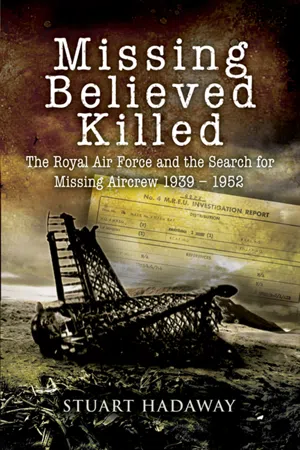
Missing Believed Killed
The Royal Air Force and the Search for Missing Aircrew 1939–1952
- 224 pages
- English
- ePUB (mobile friendly)
- Available on iOS & Android
eBook - ePub
Missing Believed Killed
The Royal Air Force and the Search for Missing Aircrew 1939–1952
About this book
During the early years of WW2 it soon became apparent that the system for tracing the remains of R.A.F. aircrew deemed Missing Believed Killed was totally inadequate. The Missing Research Section (M.R.S.) of the Air Ministry was set up in 1941 to deal with this problem. It collected and collated intelligence reports from a wide variety of official, unofficial and covert sources in an attempt to establish the fate of missing aircrew, using forensic or semi-forensic work to identify personal effects passed on through clandestine channels or bodies washed up on Britains shores. In 1944 the M.R.S. a small team of fourteen men was sent to France to seek the missing men on the ground. With 42,000 men missing, the amount they achieve was limited, although a lot of useful work was carried out through contacts in the French Resistance. The book explains why, men volunteered for the job, and why they worked for so long at such a gruesome task. Facing difficulties in terrain and climate, from the Arctic Circle to the jungles of Burma and Germany and not knowing if the local people would be friendly or hostile. The book also explains how to trace R.A.F. members through both personnel and operational records, where these records are kept and how to access them.
Information
CHAPTER ONE
A Corner of a Foreign Field
With proud thanksgiving, a mother for her children,
England mourns for her dead across the sea.
Flesh of her flesh they were, spirit of her spirit,
Fallen in the cause of the free.
England mourns for her dead across the sea.
Flesh of her flesh they were, spirit of her spirit,
Fallen in the cause of the free.
Lawrence Binyon ‘For the fallen’
Homer tells us that after Achilles killed Hector of Troy, he added insult to injury by dragging his body around the city walls from his chariot. This was not the way dead heroes were supposed to be treated, and caused as much despair in Troy as his death had done. Hector’s father, King Priam, felt so strongly that he even entered the enemy camp incognito twelve days later in a successful attempt to secure the return of his son’s body so that suitable honour could be shown to it.
What Homer does not tell us is what happened to the other hundreds of dead warriors, who were probably either flung into a pit, or left for the birds and animals. For millennia that was the accepted conclusion of the soldier’s ‘hard bargain’–an unmarked mass grave. By the eighteenth century technology, warfare and society had advanced enough to see the burial and memorialisation of soldiers, almost invariably officers, by those families who could afford it. Generally this would be in the place they had fallen, but occasionally bodies, or parts of them, were returned to their own countries. In the early nineteenth century, Britain would bring the body of Horatio Nelson home in a vat of brandy for a hero’s funeral, and France would bring Napoleon’s heart back from St Helena. For the majority, the enlisted men and non-commissioned officers, fate still held only the nameless corner of a foreign field. Soldiers were regarded, as the Duke of Wellington so succinctly put it, as ‘the scum of the earth’, and in his army as well as most others, an announcement on the Parish notice board at home was the best eulogy they could expect.
By the 1850s, in Britain at least, this began to change. A religious resurgence in the country led to widespread reformation of the way the dead were treated. Graveyards had until then been almost temporary resting places, with graves being reused again and again as space ran out. Now new cemeteries were being laid out on the edges of towns to accommodate permanent graves, but even these were still subject to grave robbers and body snatchers. Criminals would still often have their bodies used for instruction at medical schools, and have their bones displayed for future doctors to study. Plots and headstones were expensive, and as often as not the dead would receive little or nothing in the way of identifying marks on their graves. But, things were changing.
As early as the Sikh Wars (1845–46 and 1848–49) regimental monuments such as that in Christchurch Cathedral, Canterbury, for the 9th Lancers, began to list in stone the names of all the dead. By the Crimea, individual soldiers faced the possibility of a separate and named, albeit temporary, grave. In Britain the armed forces were slowly being afforded more respect and dignity within society, although this process would take another half a century to make much headway, and battlefield conditions also came into play. Unusually for a British campaign, in the Crimea the army remained essentially static for several years. Without the need to break camp and march on in pursuit or retreat, more care could be taken over burials. Still, though, there was no permanence. A cross may be placed over the grave, but no-one would be entrusted to care for the grave, or replace the marker when it rotted.
The South African War, 1899–1902, would be the first to see any systematic care for British Army dead. The government provided each casualty a metal grave marker, and with the colonial authorities on hand after the war more care of the graves was taken. The impetus for this can be seen clearly in changes in society. Across Europe and America the late Victorian period saw a growth in individualism. With greater literacy rates, wider suffrage and a growing middle class came a society where the individual wielded greater power and received greater recognition than ever before. The South African campaign saw the recruitment and deployment of a largely civilian army by Britain for the first time since the English Civil War, two and a half centuries before. Men joined the army on a wave of patriotism just to fight the Boers, and with the regular army hard stretched, thousands of men from what would become the Territorial Army–the Militia, Volunteers and Yeomanry–volunteered and were sent to fight. For the first time the British Army had both a large middle class contingent and roots in the wider society, with a huge number of enlisted men who were essentially civilians in uniform. They, and their families, still thought in civilian terms, and were reluctant to accept the traditional approaches of the regular army.
Similar movements had already happened abroad. During the American Civil War (1861–64) directives had been issued for the separate burial of all fallen soldiers, whether their identities were known or not. Most often this would occur on the field of battle, but there was also a booming business in travelling embalmers and coffin-makers with the field armies. For a fee, a soldier could arrange in advance for his body to receive proper treatment and a coffin, and be shipped back to his home-town and family. After the war permanent cemeteries were laid out and maintained for the dead from both sides. A similar arrangement occurred after the Franco-Prussian War (1870–71). The subsequent Treaty of Frankfurt included stipulations regarding the burial of the dead, and the proper care of those graves that were on enemy soil.
These were wars held in relatively settled and populated areas. Frontier wars were still understood to be subject to different standards and conditions. After the loss of 268 men of the 7th Cavalry at the Little Big Horn in 1876, it would take the United States Army almost exactly a year to send an expedition to clear up the battle site. This was despite the area having been cleared of ‘hostile’ tribes and forts established along the valley. Eventually it was pronounced pressure from the public and the families of the dead that stirred the authorities into sending a party to conduct a sweep of the field, collecting the remains of most of the officers for shipment home, and burying the remains of the other ranks. Even then, the job was hurriedly done and a year later most of the graves had washed away to leave the bones open to the elements again. A second expedition was mounted the next year to rebury the dead.
This pattern repeated itself almost every year until 1881 when the first mass grave was dug and properly lined against the elements. Even so, remains are still being discovered today. What perhaps makes this, and the treatment of the dead in so many other colonial campaigns, ironic is that the enemy was one who was often demonised and dehumanised based upon their behaviour towards their enemy’s dead. The Zulus, for example, were vilified for their practice, meant as a sign of respect, of cutting open their enemy’s stomachs. This let the warrior’s spirit leave the body and proceed to paradise. The British found this horrifying when they came to clear up the field of their defeat by the Zulu’s at Isandhlwana (1879). However, as they tipped their own dead into mass graves, unidentified and marked only by white-washed boulders, they paid little or no heed to the occasional officer who wandered through the unburied Zulu dead collecting skulls or other bones to send back to Britain for anthropological study.
This trend is an interesting one. Throughout the late Victorian period it was a widespread phenomenon. While the British were decrying the likes of the Maori or the Ashanti (another tribe for whom mutilation was a sign of respect) for their treatment of the dead, they simultaneously gave little regard to their own soldiers, and packed off large quantities of the enemy’s dead to Britain for evaluation and study. What this all proves, if nothing else, is that treatment of the dead in military circles had always been as subjective and erratic as that in the civilian world.
This all changed with the First World War. Social, religious and educational improvements by the beginning of the twentieth-century had changed people’s expectations, and a new realisation of political power helped to enforce them. In Britain’s mass, civilian field armies it became expected that relatives would be informed of a soldier’s death and the circumstances. The British Army, though, had not expected a campaign on this scale or of this complexity, and in the early days of the war, in the chaotic retreats and scrambles for tactical advantages of 1914, much of this work was done by the Red Cross Mobile Unit, under Fabian Ware. Although primarily concerned with the treatment and evacuation of wounded, the Mobile Unit also logged graves and, through their connections via Geneva with the German Red Cross, traced missing men and prisoners.
From 1915 careful records and lists began to be kept, cross-referenced and utilised to send telegrams on their way to homes to break the news of the death or wounding of a loved one. Frequently, a letter from the commanding officer or friend would follow with more details. Even as battles raged, every effort would be made by Graves Registration Units (GRU) to recover and identify bodies, bury them, and then mark and record their location. One officer, from 3 Graves Registration Unit, explained their task in a letter to his young son:
We go away to a place to look after the graves of the poor English soldiers who have been killed. We keep them ever so neat and presently we are going to sow some fresh seed around them. We have put up a cross at the head of each with the poor soldiers name on, so that when the Mummies come to see the graves they know which is their own soldier boy. There are lots of German soldiers buried near here too.3
In time these records would be handed over to Fabian Ware. His Red Cross Mobile Unit had, in 1915, been reconstituted as the Graves Registration Commission. In 1917 they became the Imperial War Graves Commission (IWGC). Under all of these guises, they oversaw the concentration and permanent marking and care of the graves of the fallen. Records of each casualty and the known details of their burial were kept, graves were marked where possible, and photographs of those graves sent to the families. It was decided, partly on symbolic grounds but also with a heavy consideration for practicality and cost, that fallen servicemen would be buried in the countries where they fell. For the most part the host nations donated the land needed, and suitable preparations were made.
This task took many years. Work on laying out proper cemeteries could not begin until after the war, and even then not until the battlefields had been at least superficially cleared up and made safe. The Treaty of Versailles helped clarify the process, with Articles 221, 225 and 226 all dealing with the international exchange of information on casualties, missing persons and graves, the repatriation of bodies, and future burial sites. Contrary to the popular belief, none of these clauses dictated that German graves should be black to denote guilt for starting the war. Germany had even less resources than Britain for marking their dead, and tarred wooden crosses, black in appearance, were all that could be afforded. Throughout the inter-war period the IWGC carried on replacing their temporary crosses with permanent headstones, landscaping their cemeteries with flowers and arcades, and compiling lists and memorials to the missing, all the while receiving more bodies recovered from the old battle lines. Ironically, the Commission finally declared their initial tasks, notwithstanding the steady stream of newly discovered remains, finished in 1939.
In Britain, the scale of the loss was unimaginable. Virtually every family had lost someone. Everyone knew someone who had been killed. Only around forty towns, the so-called ‘Thankful Villages’4 had not lost a single resident. In this environment of death and loss, a culture of mass mourning and symbolism grew up. The simple, even naïve, air of unity and patriotism that had held the country together as they faced an unparalleled struggle and unimaginable horror was still in force. There was little room for individual mourning, and with most of the 908,371 British and Imperial dead being buried overseas (at this time over one third of them with no known grave), there was little chance for relatives to indulge in personal grief. Instead, symbols such as the Cenotaph, the Unknown Warrior and local war memorials became the focus of mourning across the country.
The Second World War brought another round of killed and missing servicemen across the world. For the British, this meant much the same routine of Graves Registration Units and IWGC burials. The Americans too adopted this approach, although with the extra consideration of allowing the families to choose whether they wished their relatives to lie in the country they had fallen, or to be brought home for burial. In the Far East neither side paid much attention to the proper burial and marking of their enemies graves; much the same could be said of the war on the Eastern Front, with the added complication that each side actively sought to destroy enemy cemeteries during their advances. In most other areas, though, the dead were respected and recorded as far as was practical.
The Air Ministry decided that simply leaving the recovery of remains to chance was not enough. Casualties were dealt with by P.4 (Cas) Branch of the Ministry, and by 1941 they were coming under public pressure to do more about the hundreds, perhaps thousands of RAF aircrew who were officially listed as ‘missing’. Something was needed to bring them out of this limbo of uncertainty, and so the Missing Research Section (MRS) was set up to investigate just these cases. Despite their incredible work, by the end of the war in Europe nearly 42,000 aircrew were still missing without a trace and tens of thousands more had fates identified only by shaky evidence provided by the Germans, and an extended version of the MRS, the Missing Research and Enquiry Service (MRES) was established. A worldwide organisation, the MRES took the search to the battlefields, and systematically scoured millions of squares miles to account individually for and bury their list of missing men and women. Unlike anything that had gone before, they began with a list of every known missing person, and as they were found, they were ticked off.
But, why did the Air Ministry feel that these added measures were necessary? Public opinion was certainly an issue. The aftermath of the Great War had brought a social and political awakening to much of the country. The nation was more willing to question the powers that be, rather than just accept what they were told. P.4 (Cas) had an open door policy, and visitors could write or call, either on the telephone or in person, at any time. Questions could and were asked in Parliament, as well as to the Ministry in person, and increasingly relatives demanded answers.
There was also perhaps an added factor. Everyone in the senior echelons of the Air Ministry, be they politicians, civil servants, or serving officers, had been through the First World War. Most had held combat commands, and most had been decorated for bravery. Some had sons in the services. Air Marshal Sir Philip Babington MC AFC, Air Member for Personnel 1940–42, had commanded 49 Wing in 1918 as a 23 year old, and his son was killed in a Mosquito crash in 1942. Sir Arthur Street MC, Permanent Under Secretary of State for Air 1939–45, had been an infantry officer until wounded, and his son had been in Bomber Command until shot down. In 1944, he became one of the fifty British officers executed by the Gestapo after the Great Escape. Viscount Stansgate DSO, Secretary of State for Air in 1945, had been a combat pilot and now had two fighter pilot sons. The eldest was killed in a night fighter crash in 1944. Air Marshal Sir John Slessor DSO MC, Air Member for Personnel in 1945, had also been combat pilot and had been appointed straight from commanding Coastal Command. Air Chief Marshal Sir Arthur Tedder, Chief of the Air Staff 1946–49, had commanded squadrons on the Western Front and in Egypt during the Great War, and in 1921 had commanded No. 207 Squadron during the Chanak Incident, when war with Turkey appeared possible. His eldest son had been a Blenheim pilot, and was reported missing in August 1940. His body was only found and identified, by the MRES, in December 1945.
These men had seen the original war to end all wars from the sharp end, and many had all too close a personal experience of the second one. They had seen how their comrades had been treated during and after the First World War, and knew that nearly a thousand of them from the flying services on the Western Front alone were still missing, with no known graves, twenty years on. There is not enough documentary evidence to say for sure, but their experiences as soldiers and as parents must have had some effect on their actions.
The same enthusiasm permeated every level of the organisation. All officers in the MRES were theoretically volunteers. Their task involved long hours, often seven days a week, in arduous conditions. To close a case would involve the exhumation of bodies that had been extracted from wrecks and may have been buried, often several to a grave, anything up to ten years previously.
By December 1950, the Air Ministry was reporting that of the 41,881 personnel listed as missing in August 1945, 23,881 had been accounted for in known burials. Another 9,281 had been formally recorded as being lost at sea. This left just 8,719 personnel known as otherwise unaccounted for, and this total included around 800 who had been located in Burma, but on whom no clear information had arrived as yet.5
The operations of the MRS and MRES would, at least in the long term, set the trend for future generations. While the tail end of the MRES was still active, the Royal Australian Air Force was listing more of their personnel as missing in the air war over Korea. In the final days of December 1950, Squadron Leader E. W. New and Sergeant T. S. Henderson were sent from Australia to Pusan to trace two missing men from 77 Squadron RAAF6. Squadron Leader Graham Strout had been lost in his Mustang on 7 July 1950 near Mukho, and Pilot Officer William Harrop had been shot down on 3 September 1950 while escorting B-29 bombers on a raid over Taegu. New and Henderson headed in-country even as the Communist North Korean and Chinese troops swept south and retook Seoul. Despite the evident dangers, they visited the areas where the pilots had been lost to see the crash sites and interview the local population. On the 18 January 1951, both Strout and Harrop were buried with full military honours on the outskirts of Pusan in the presence of their fellow pilots.
Interestingly, another point is raised by New and Henderson’s report. While the armies of the United Nations, and particularly the United States, made little effort to account for missing men (although in fairness their governments’ fought for the rights of their prisoners of war despite the issue holding up peace negotiations for a full year), the bodies of the dead retained all of the symbolic importance they had gained in the last thirty years. Even as the Allies were being rolled seemingly inexorably back to the sea and it appeared that all was lost, both the British and American high commands were considering the future of the graves of their killed. New and Henderson record that the Americans were preparing to exhume their dead and take them back with them, so as to prevent them falling into enemy hands. The British were publicly stating that they would do no such thing; they intended to stay and protect them. The location and treatment of the dead had not lost any of its symbolism.
This could be a double-edged sword. Few acts in the round of counter-insurgency operations that accompanied Britain’s withdrawal from her Empire caused as much distress, anger and frustration as the murders of two sergeants in the Intelligence Corps in Palestine in 1947. Sergeants Paice and Martin had been captured by the Palestinian Irgun group in mid-July 1947. Three weeks later the bodies of the two sergeants were found hanging near Nathanya. The areas around the bodies were checked for booby traps and mines, but as the first body was cut down an explosive device strapped to it exploded, severely wounding an officer. Even the local mayor, O. Ben Ami, was shocked by this act, stating that ‘Of all the crimes which have been committed in Palestine, this is the most dastardly, and most abominable, and will sully our struggle for the liberation of our people.’7 No strangers to provocation and terrorism, the British Army found this desecration of the dead to be an outrage, and direct reprisals by British soldiers can be traced back to this act.
By the end of the Korean War, 8,000 American and 82 British service personnel were still officially missing in action. Thanks to New and Henderson, no Australian aircrew were unaccounted for. These figures were nothing compared to the Second World War (for example, 78,000 Americans were still missing from that conflict), but a factor ...
Table of contents
- Title Page
- Copyright Page
- Table of Contents
- Acknowledgements
- Introduction
- CHAPTER ONE - A Corner of a Foreign Field
- CHAPTER TWO - The Missing Problem and Wreck Recovery
- CHAPTER THREE - The Air Ministry Regrets: Casualty Procedure 1939-45
- CHAPTER FOUR - Missing Research Section, P.4 (Cas)
- CHAPTER FIVE - Missing Research and Enquiry Service
- CHAPTER SIX - Around the World I Search For Thee
- CHAPTER SEVEN - France, Belgium, Holland, Norway and Luxembourg
- CHAPTER EIGHT - No. 5 MREU Mediterranean and Middle East
- CHAPTER NINE - Germany and Poland
- CHAPTER TEN - The Far East
- CHAPTER ELEVEN - Missing Research and Graves Registration Service
- CHAPTER TWELVE - Last Resting Place
- APPENDIX A - Casualty Statistics
- APPENDIX B - Chronology and Organisation of Units
- APPENDIX C - History of P.4 (Cas)
- APPENDIX D - Tracing Royal Air Force Airmen
- APPENDIX E - War Crimes and the MRES
- APPENDIX F - MRES Unit Badge
- Select Bibliography
- Notes
- Index
Trusted by 375,005 students
Access to over 1.5 million titles for a fair monthly price.
Study more efficiently using our study tools.
Frequently asked questions
Yes, you can cancel anytime from the Subscription tab in your account settings on the Perlego website. Your subscription will stay active until the end of your current billing period. Learn how to cancel your subscription
No, books cannot be downloaded as external files, such as PDFs, for use outside of Perlego. However, you can download books within the Perlego app for offline reading on mobile or tablet. Learn how to download books offline
Perlego offers two plans: Essential and Complete
- Essential is ideal for learners and professionals who enjoy exploring a wide range of subjects. Access the Essential Library with 800,000+ trusted titles and best-sellers across business, personal growth, and the humanities. Includes unlimited reading time and Standard Read Aloud voice.
- Complete: Perfect for advanced learners and researchers needing full, unrestricted access. Unlock 1.5M+ books across hundreds of subjects, including academic and specialized titles. The Complete Plan also includes advanced features like Premium Read Aloud and Research Assistant.
We are an online textbook subscription service, where you can get access to an entire online library for less than the price of a single book per month. With over 1.5 million books across 990+ topics, we’ve got you covered! Learn about our mission
Look out for the read-aloud symbol on your next book to see if you can listen to it. The read-aloud tool reads text aloud for you, highlighting the text as it is being read. You can pause it, speed it up and slow it down. Learn more about Read Aloud
Yes! You can use the Perlego app on both iOS and Android devices to read anytime, anywhere — even offline. Perfect for commutes or when you’re on the go.
Please note we cannot support devices running on iOS 13 and Android 7 or earlier. Learn more about using the app
Please note we cannot support devices running on iOS 13 and Android 7 or earlier. Learn more about using the app
Yes, you can access Missing Believed Killed by Stuart Hadaway in PDF and/or ePUB format, as well as other popular books in History & Historical Biographies. We have over 1.5 million books available in our catalogue for you to explore.