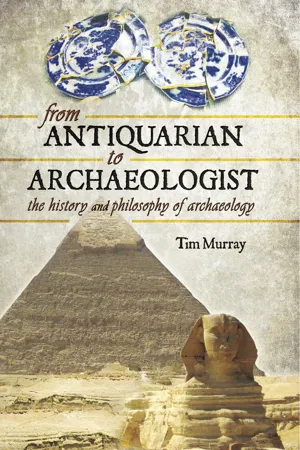
"Brings together fourteen of Tim Murray's papers on the history, philosophy, and sociology of archaeology published over two decades." —
Bulletin of the History of Archaeology
This volume forms a collection of papers tracking the emergence of the history of archaeology from a subject of marginal status in the 1980s to the mainstream subject which it is today. Professor Timothy Murray's essays have been widely cited and track over twenty years in the development of the subject.
The papers are accompanied by a new introduction which surveys the development of the subject over the last twenty-five years as well as a reflection of what this means for the philosophy of archaeology and theoretical archaeology.
This volume spans Tim's successful career as an academic at the forefront of the study of the history of archaeology, both in Australia and internationally. During his career he has held posts in Britain and Europe as well as Australia. He has edited the
Bulletin of the History of Archaeology since 2003.
- 261 pages
- English
- ePUB (mobile friendly)
- Available on iOS & Android
eBook - ePub
About this book
Information
Chapter 1
Explorations in the historiography of archaeology: a personal account
The papers and book chapters collected here were published between 1990 and 2012, but the themes they explore all grew out research and writing that took place between 1976 and 1987 for three dissertations, all submitted to the University of Sydney.
The first dissertation, Aspects of Polygenism in the Works of Robert Knox and James Hunt (1976), explored the space between historiography and the histories of anthropology and archaeology that had been recently charted by John Burrow (1966) and George Stocking (1968, 1971). My focus was on the history of race theory in Europe as it came to be expressed within the formal structures of disciplines as they were emerging from Natural Philosophy in the nineteenth century. Chapters 2, 3, 7 and 11 report developed versions of this research.
The second dissertation, Patterns in Prehistory: Gordon Childe Reconsidered (1978), traced the influence of race theory in nineteenth and twentieth century prehistoric archaeology through the work of Australian archaeologist Vere Gordon Childe. Of course I was hardly the only person interested in Childe, as witnessed by the flood of monographs and papers that have since appeared (see eg Gathercole et al. 1995; Green 1981; McNairn 1981; Trigger 1980), but my specific concern was to investigate the role of the concept of culture (particularly its ethnic connotations) in Childe’s treatment of the prehistory of what he called European Civilization. Chapter 5 presents a later application of this research to a broader question of the nature of archaeological theory in understanding the ‘identity’ of Europe.
Shortly after completing these undergraduate dissertations I began work on my doctoral dissertation Remembrances of Things Present: Appeals to Authority in the History and Philosophy of Archaeology (1987). Its thesis was straightforward and the approach (and areas of focus) I developed has been the foundation of Chapters 2, 4, 8, 9, 13 and 14, and has also played a significant role in my use of the history of archaeology to explore the broad question of the nature of time in archaeology.
In that dissertation I observed that over the past thirty years virtually every aspect of archaeology – from its nature as a discipline to its relationship with society – has been the subject of inquiry, debate and change. Not only has there been a vast increase in the amount of archaeology being done and the number of archaeologists doing it, but the development of new techniques of dating and analysis has also helped to broaden and deepen the scope of the discipline itself. New methodological links have been forged with the human, earth, and life sciences, with practitioners ranging far in search of approaches that could help them expand their understanding of the meaning and significance of the archaeological record.
It was also clear that not all of these changes have met with universal approval. Over the past three decades archaeology has become more disputatious than ever before, as practitioners have openly debated conceptual and epistemological issues lying at the core of the discipline itself. Indeed, much at the outset of the ‘new’ archaeology (particularly in the 1970s up to the mid 1980s) which was considered to be stable and unproblematic, such as the goals of archaeology, or even the nature of the archaeological record itself, are now openly questioned. Archaeology (particularly in its connections to contexts of practice such as heritage, especially indigenous heritage) continues to exhibit such internal dissension that we are entitled to question whether there are any disciplinary ‘cultural norms’ left, and whether there are bedrock goals and understandings among practitioners that can survive such disputation.
The core argument of Remembrances of Things Present was that such changes provide an opportunity to re-examine the nature, meaning, and value of archaeological knowledge, especially to question the relationship between past and present, and the nature of archaeology as a distinct discipline. I was also keen to point out that this investigation into disciplinary fundamentals could be both time consuming and potentially destabilizing, as what had been considered to be natural knowledge about the process of archaeology would come under severe scrutiny.
In that dissertation I adopted what was then a pretty standard history, philosophy and sociology of science approach to primarily prehistoric archaeology, so that I could get a clearer picture of the determinants of the production, dissemination and reception of archaeological knowledge within specific societies (primarily, but not exclusively, European) and at specific times. I have continued this approach ever since, but it has been adapted to incorporate developments within history, philosophy and sociology of science, and expanded to apply to the rapidly growing areas of historical archaeology and the archaeology of the contemporary past and, perhaps more controversially, the very diverse social contexts of archaeological practice (see eg Lucas 2007; Murray Chapter 15 of this book). The primary point of continuity has been to use the history of archaeology as a ‘possibility space’ within which to evaluate the performance of contemporary archaeological method and theory (to drill down into the methodological rhetoric of contemporary archaeology), and to canvas the existence of other ways of thinking about the project of archaeology as it has evolved.
Each of the works republished in this book follow an intertwined set of themes that continue to underwrite all aspects of my archaeology, whether it be the archaeology of cities, transnational archaeologies of the nineteenth and twentieth centuries, the archaeology of indigenous and settler conflicts, or inquiries into the constitution of archaeological epistemologies and ontologies (especially an understanding of archaeological time). The fundamental theme concerns arguments about the importance of a historical perspective on archaeological knowledge claims in order to establish that current theoretical and methodological orthodoxies have histories, and that archaeological knowledge is contingent. Establishing the historical and cultural contingencies of archaeological knowledge is not just about avoiding the consequences of Whig history, or as George Stocking would have it, of ‘presentism’. Exploring the reality of contingency also acts to undermine the assumption (either conscious or unconscious) that our current aspirations, questions, methods and theories are not natural or sui generis – they have histories and they also have within them the seeds of alternatives not currently explored.
A related theme concerns the interplay between practices and perspectives that archaeologists hold in common, and those which act to diversify and differentiate archaeology from other disciplines engaged in the business of researching and understanding human history. At root this is an inquiry into the existence of archaeology as a distinct discipline. At a time when researchers are beginning to break down disciplinary silos through the development of multidisciplinary programs tackling complex problems through a more effective articulation of past and present, we need to be very clear about the importance of distinctive types of data, method and theory so that these are not compromised within a multidisciplinary research context. I have noted many times previously the tendency, right across the history of our discipline, for that distinctiveness to be lost in an attempt to make data meaningful in conventional terms used by humanities and social sciences (see especially Chapter 8 of this book). This is a fundamental reason why building archaeological theory is of the first importance.
These have been some of the stimuli to my development as a historian of archaeology. Over that same period the history of archaeology has developed into a rich and rewarding field of inquiry for many other reasons than its potential contribution to the rehabilitation of archaeological theory. It should come as no surprise, as Christopher Evans and I observed in the introduction to our reader Histories of Archaeology (2008), that histories of archaeology are being written to serve many purposes, some complex and many others quite straightforward. This diversity of goals is matched by a diversity of approach and treatment. Over the past thirty years practitioners have explored perspectives that focus on the internal (through biographies and institutional histories) and external workings of archaeology (stressing the importance of social, political and cultural contexts of its practice). Historians of archaeology have also sometimes sought to significantly refashion our understandings of disciplinary history, most memorably in Alain Schnapp’s elegant and passionate defence of the importance of antiquarianism (1996). Indeed, my experience of editing the five volumes of the Encyclopedia of the History of Archaeology (ABC-Clio 1999-2001) drove home an understanding of both unity and diversity in archaeological practice, but its greatest message (for me at least) was what Glyn Daniel referred to as ‘backward looking curiosity’ (1976) that carries benefits both for an enhanced understanding of past times, but also of the means by which we reach that understanding.
The future of the historiography of archaeology?
I have focused on the role of the historiography of archaeology in the building and assessment of archaeological theory, as well as simply being an end in itself. The history of archaeology is littered with larger-than-life characters doing extraordinary things in even more extraordinary places and there is no sign of a slackening of public interest in the likes of Aurel Stein or Stevens and Catherwood. Its also true that archaeologists regularly turn to the history of their discipline to fight contemporary battles about disciplinary approach or purpose. The same applies to others who, willingly or unwillingly, have been directly affected by what archaeologists have done (and in some cases continue to do). This is especially the case for indigenous peoples who can turn to the history of archaeology in search of an understanding of how their present conditions came to pass – an understanding that frequently proves a very useful resource in creating much more culturally sustainable and viable futures. All of these are well and truly in the picture for the future for the history of archaeology, but I want to advocate for an additional reason for undertaking research and teaching in this field.
If there is one thing we have learnt from several decades of the philosophy of science it is that we need to pay close attention to the ways in which scientists persuade each other and members of the general public of the value of arguments or bodies of theories and perspectives that underpin everyday practice (called ‘normal science’ by Thomas Kuhn). It is this social and cultural context within which the plausibility of statements is negotiated that lies at the heart of each discipline, and it is crucial to remember that each discipline essentially goes about this process in quite different ways. In the early days of the philosophy of archaeology (really an application of logical positivism to the discipline) practitioners such as Lewis Binford genuinely believed that determinate rules of scientific method could be applied to archaeology and that this would ensure that archaeology became ‘scientific’. Several decades later we know that this is not the case, but we are still grappling with our responsibility as archaeologists to fashion a truer account of archaeological epistemology and archaeological ontology. The history of archaeology, specifically the detailed analysis of how arguments are made, justified and accepted in the discipline, has a truly vital role in this most important phase in the coming of age of archaeology.
References
BURROW, J.W. 1966. Evolution and Society. Cambridge: Cambridge University Press.
DANIEL, G. 1976. Cambridge and the Backward-looking Curiosity: an Inaugural Lecture. Cambridge: Cambridge University Press.
GATHERCOLE, P., IRVING, T. and G. MELLEUISH (eds) 1995. Childe and Australia. St Lucia, Qld: University of Queensland Press.
GREEN, S. 1981. Prehistorian. A Biography of V. Gordon Childe. Bradford-on-Avon: Moonraker Press.
LUCAS, G. 2007. Visions of archaeology: An Interview with Tim Murray. Archaeological Dialogues 14(2): 155-177.
McNAIRN, B. 1980. The Method and Theory of V. Gordon Childe. Edinburgh: Edinburgh University Press.
MURRAY, T. 1995. Gordon Childe, archaeological records, and rethinking the archaeologist’s project. In P. Gathercole, T. Irving and G. Melleuish (eds) Childe and Australia, pp. 199-211. St Lucia, Qld: University of Queensland Press.
MURRAY, T. (ed.) 1999-2001. Encyclopedia of Archaeology, 5 Vols. Santa Barbara: ABCCLIO Press.
MURRAY, T. and C. EVANS 2008b. The historiography of archaeology – an editorial introduction, pp. 1-12, in T. Murray and C. Evans (eds). Histories of Archaeology. Oxford: Oxford University Press.
SCHNAPP, A. 1996. The Discovery of the Past: the Origins of Archaeology. London: British Museum Press.
STOCKING, G.W. 1968. Race, Culture and Evolution: Essays in the History of Anthropology. New York: Free Press.
––1971. What’s in a name? The origins of the Royal Anthropological Institute (1837-71). Man (ns) 6: 369-390.
–– 1987. Victorian Anthropology. New York: Free Press.
–– 1989 Romantic Motives: Essays on Anthropological Sensibility. Madison, Wisc.: University of Wisconsin Press.
–– 1991. Colonial Situations: Essays on the Contextualization of Ethnographic Knowledge. Madison, Wisc.: University of Wisconsin Press.
TRIGGER, B. 1980. Gordon Childe. Revolutions in Archaeology. London: Thames and Hudson.
Chapter 2
The history, philosophy and sociology of archaeology: the case of the Ancient Monuments Protection Act (1882)
Introduction
At the conclusion of his last speech as President of the Royal Anthropological Institute (RAIGBI) in 1872, Sir John Lubbock announced his intention to try to introduce legislation that would protect the ancient monuments of Great Britain. He was optimistic about his chances for success:
As there seems to be a general wish throughout the country to take some adequate steps for the preservation of these ancient monuments and graves of our forefathers, I am not without hope that the Bill may meet with favorable reception (1872: 442).1
It transpired that the Ancient Monuments Protection Bill (AMPB) was to sorely try Lubbock’s patience and sap his optimism, because the Ancient Monuments Protection Act (AMPA) was not to receive Royal assent until 1882, ten years after Lubbock’s resignation from the presidency of the RAIGBI.
The long battle to get the first AMPA onto the statute books had entailed a great many compromises concerning the machinery of protection and the degree of state interferen...
Table of contents
- Cover
- Title Page
- Copyright
- Contents
- Details of first publication
- Acknowledgements
- Chapter 1: Explorations in the historiography of archaeology: a personal account
- Chapter 2: The history, philosophy and sociology of archaeology: the case of the Ancient Monuments Protection Act (1882)
- Chapter 3: The Tasmanians and the constitution of the ‘Dawn of Humanity’
- Chapter 4: Archaeology, ideology and the threat of the past: Sir Henry Rider Haggard and the acquisition of time
- Chapter 5: From Sydney to Sarajevo: a centenary reflection on archaeology and European identity
- Chapter 6: Epilogue: the art of archaeological biography
- Chapter 7: Excavating the cultural traditions of nineteenth century English archaeology: the case of Robert Knox
- Chapter 8: On ‘normalizing’ the Palaeolithic: an orthodoxy questioned
- Chapter 9: Epilogue: why the history of archaeology matters
- Chapter 10: Archbishop Ussher and archaeological time
- Chapter 11: The historiography of archaeology and Canon Greenwell
- Chapter 12: Rethinking antiquarianism
- Chapter 13: Prehistoric archaeology in the ‘Parliament of Science’ 1845-1884
- Chapter 14: Illustrating ‘savagery’: Sir John Lubbock and Ernest Griset
- Chapter 15: Writing histories of archaeology
- Suggestions for Further Reading
Trusted by 375,005 students
Access to over 1.5 million titles for a fair monthly price.
Study more efficiently using our study tools.
Frequently asked questions
Yes, you can cancel anytime from the Subscription tab in your account settings on the Perlego website. Your subscription will stay active until the end of your current billing period. Learn how to cancel your subscription
No, books cannot be downloaded as external files, such as PDFs, for use outside of Perlego. However, you can download books within the Perlego app for offline reading on mobile or tablet. Learn how to download books offline
We are an online textbook subscription service, where you can get access to an entire online library for less than the price of a single book per month. With over 1.5 million books across 990+ topics, we’ve got you covered! Learn about our mission
Look out for the read-aloud symbol on your next book to see if you can listen to it. The read-aloud tool reads text aloud for you, highlighting the text as it is being read. You can pause it, speed it up and slow it down. Learn more about Read Aloud
Yes! You can use the Perlego app on both iOS and Android devices to read anytime, anywhere — even offline. Perfect for commutes or when you’re on the go.
Please note we cannot support devices running on iOS 13 and Android 7 or earlier. Learn more about using the app
Please note we cannot support devices running on iOS 13 and Android 7 or earlier. Learn more about using the app
Yes, you can access From Antiquarian to Archaeologist by Tim Murray in PDF and/or ePUB format, as well as other popular books in Social Sciences & Historiography. We have over 1.5 million books available in our catalogue for you to explore.